Jesus is God

  • Christian Chat is a moderated online Christian community allowing Christians around the world to fellowship with each other in real time chat via webcam, voice, and text, with the Christian Chat app. You can also start or participate in a Bible-based discussion here in the Christian Chat Forums, where members can also share with each other their own videos, pictures, or favorite Christian music.

    If you are a Christian and need encouragement and fellowship, we're here for you! If you are not a Christian but interested in knowing more about Jesus our Lord, you're also welcome! Want to know what the Bible says, and how you can apply it to your life? Join us!

    To make new Christian friends now around the world, click here to join Christian Chat.
1. I knew Jesus was Lord, my Messiah, The Christ, the Son of God.
2.You must confess Jesus is Lord as a part of salvation and confessing Jesus is the Son of God is how we know we abide in God.
3."If you declare with your mouth, "Jesus is Lord," and believe in your heart that God raised him from the dead, you will be saved." (Rom 10:9) "Whoever confesses that Jesus is the Son of God, God abides in him, and he in God." (1 Jn 4:15)

Do you have to believe in a Trinity or Oneness etc., nope.

"But we know that there is only one God, the Father, who created everything, and we live for him. And there is only one Lord, Jesus Christ, through whom God made everything and through whom we have been given life." (1 Cor 8:16)

God and Jesus are one as we are one with them.

1 Corinthians 8 has very strong Trinitarian/Binitarian implications.

To Paul, the person who “loves God” (1 Cor 8.3) knows that “there is no God but one” (1 Cor 8.4). His statements here encapsulate the monotheistic essence of Judaism, the Shema (“Hear, O Israel: The LORD our God, the LORD is one. You shall love the LORD your God with all your heart and with all your soul and with all your might,” Deut 6.4-5). The allusions made to idolatry, to loving God, and believing that God is one removes any uncertainty that Paul is drawing here on Deut 6.4-5.

Paul writes in vv. 5-6,

‘Therefore, as to the eating of food offered to idols, we know that “an idol has no real existence,” and that “there is no God but one.” For although there may be so-called gods in heaven or on earth—as indeed there are many “gods” and many “lords”— yet for us there is one God, the Father, from whom are all things and for whom we exist, and one Lord, Jesus Christ, through whom are all things and through whom we exist.’​

Notice the contrast Paul makes between those heathen who have “many ‘gods’ and many ‘lords’—yet for us there is one God… one Lord.” In such a context where the Shema is central (idolatry, loving God, God is one), it would be self-defeating for Paul to do anything but embrace together the “one God” and “one Lord” in union, or as B.B Warfield puts it,

“Obviously, this ‘one God, the Father,’ and ‘one Lord, Jesus Christ,’ are embraced together in the one God who alone is. Paul’s conception of the one God, whom alone he worships, included, in other words, a recognition that within the unity of His being, there exists such a distinction of Persons as is given us in the ‘one God, the Father” and the ‘one Lord, Jesus Christ.’”

​

Had Paul wished to distinguish the "one God" from the "one Lord" so that there were in effect two sovereigns then his argument makes little sense. How then would Paul be any different than those heathen who have "many 'gods' and many 'lords'"?

Paul’s play on words in v. 6 makes this union of the “one God” and the “one Lord” even more apparent. Bauckham explains,

“that God is not only the agent or efficient cause of creation ('from him are all things') and the final cause or goal of all things ('to him are all things'), but also the instrumental cause ('through him are all things') well expresses the typical Jewish monotheistic concern that God used no one else to carry out his work of creation. By Paul's reformulation in 1 Corinthians 8:6, he includes Christ in this exclusively divine work of creation by giving to him the role of instrumental cause.” (God Crucified: Monotheism & Christology, 38-39)​

In drawing upon the monotheistic concept that God alone created the universe (Isaiah 44.24, 4 Ezra 3.4), Paul attributes to Christ a role in creation which Jews would commonly attribute to God (Heb 2.10, Rom 11.36). For Paul to include the “one Lord, Jesus Christ” in the divine work of creation places Him squarely in a unique union with the “one God, the Father.” Perhaps Bauckham puts it best, “the unique identity of the one God consists of the one God, the Father, and the one Lord, his Messiah…” (Jesus and the God of Israel, p. 101).

Adding further credence to this is the fact that Paul goes on to speak about the relationship between the Corinthians and the “one Lord” Jesus over against idolatry (10.19-22),

“You cannot drink the cup of the Lord and the cup of demons. You cannot partake of the table of the Lord and the table of demons. Shall we provoke the Lord to jealousy? Are we stronger than He?” (1 Cor 10.21-22 c.f. Deut 32.21, Malachi 1.7-12)​

The “Lord” that is spoken of here is most naturally taken to refer to Jesus for various reasons:

(i) Up to this point in Paul’s letter it is Jesus that is referred to as the “one Lord,” “the Lord of glory,” et al.

(ii) Paul uses this language of “the cup of the Lord” later in his letter to the Corinthians where it is Jesus who is the referent (1 Corinthians 11.27-28 c.f. 1 Corinthians 10.16-17, 2 Corinthians 6.15-16).


​
(iii) For Paul to refer to Jesus’ involvement in Israel’s redemptive history makes it clear who the “Lord” is in this passage. According to Paul, Christ is “the rock” (1 Cor 10.4) that accompanied the Israelites in the wilderness, and goes so far to even warn the Corinthians, “We should not test Christ, as some of them did—and were killed by snakes.” There seems to be a connection between testing Christ (1 Cor 10.9), and provoking the Lord (1 Cor 10.22).

(iv) Complimenting this is Paul’s utilization of κύριος (“Lord”) for Jesus repeatedly throughout 1 Corinthians which alludes to Old Testament texts involving the Divine Name (1 Corinthians 1.2 [c.f. Joel 2.32]; 1 Corinthians 2.16 [c.f. Isaiah 40.13]; 1 Corinthians 6.11 [c.f. Isaiah 45.23]).
​
 
One may get saved without knowing that Jesus is God, but if after being shown clear teaching from Scripture that He is God and a person continues to deny it, I would say that person's claim to being saved is in serious question.

Yep, would certainly go along with this...1John 4v1-6 (this is referring to not only that Christ came in flesh, but also refers to Him as the One Who fulfilled all the OT prophecies as regards His Personage)...
 
To take a scripture out of the bible and make a case based on the words I am He does not prove nothing. Read the context of the passage and you will see Jesus mention the Father as well as himself as the Son.
[SUP]17 [/SUP]It is also written in your law that the testimony of two men is true.
[SUP]18[/SUP]I am One that bear witness of Myself, and the Father that sent Me beareth witness of Me.”
[SUP]19 [/SUP]Then they said unto Him, “Where is thy father?” Jesus answered, “Ye neither know Me, nor My Father. If ye had known Me, ye should have known My Father also.”
[SUP]20 [/SUP]These words spoke Jesus in the treasury as He taught in the temple, and no man laid hands on Him, for His hour was not yet come.
[SUP]21 [/SUP]Then Jesus said again unto them, “I go My way, and ye shall seek Me, and shall die in your sins. Whither I go, ye cannot come.”
[SUP]22 [/SUP]Then said the Jews, “Will he kill himself, because he saith, ‘Whither I go ye cannot come’?”
[SUP]23 [/SUP]And He said unto them, “Ye are from beneath; I am from above. Ye are of this world; I am not of this world.
[SUP]24 [/SUP]I said therefore unto you that ye shall die in your sins; for if ye believe not that I am He, ye shall die in your sins.”
[SUP]25 [/SUP]Then they said unto Him, “Who art thou?” And Jesus said unto them, “Even the same that I said unto you from the beginning.

There are many scriptures that teach us Jesus is God no one is denying that fact. So whe nyou read the post read it as it is written not as you already have come to a conclusion that it is from a false doctrine.
Others would disagree ...

John 8:24 unless you believe. Jesus emphasized that the fatal, unforgivable, and eternal sin is failure to believe in him as Messiah and Son of God. In truth, all other sins can be forgiven if this one is repented of. See notes on 16:8–9. I am he. The word “he” is not part of the original statement. Jesus’ words were not constructed normally but were influenced by OT Hebrew usage. It is an absolute usage meaning “ I am” and has immense theological significance. The reference may be to both Ex. 3:14 where the Lord declared his name as “ I am” and to Isa. 40–55 where the phrase “I am” occurs repeatedly (especially Isa. 43:10 13 25 46:4 48:12). In this, Jesus referred to himself as the God (Yahweh—the Lord) of the OT, and directly claimed full deity for himself, prompting the Jews’ question of John 8:25. (MacArthur SB)
 
Last edited:
Others would disagree ...
John 8:24 unless you believe. Jesus emphasized that the fatal, unforgivable, and eternal sin is failure to believe in him as Messiah and Son of God. In truth, all other sins can be forgiven if this one is repented of. See notes on 16:8–9. I am he. The word “he” is not part of the original statement. Jesus’ words were not constructed normally but were influenced by OT Hebrew usage. It is an absolute usage meaning “ I am” and has immense theological significance. The reference may be to both Ex. 3:14 where the Lord declared his name as “ I am” and to Isa. 40–55 where the phrase “I am” occurs repeatedly (especially Isa. 43:10 13 25 46:4 48:12). In this, Jesus referred to himself as the God (Yahweh—the Lord) of the OT, and directly claimed full deity for himself, prompting the Jews’ question of John 8:25. (MacArthur SB)

Interestingly, we find the same form of verbs used in the Psalm 90.2 LXX where YHWH's timeless existence is contrasted with the creation of the mountains:

"Before (pro) the mountains were brought into existence (genethenai)... from age to age, you are (su ei).
​

Note the similarity in wording to John 8.58. Both, John 8.58 and Psalm 90.2 LXX use synonymous Greek terms to contrast the creation of one with the timeless existence of the other.

Rob Bowman notes:

"The word pro, like prin, means 'before,' and some manuscripts of the Septuagint actually have prin instead of pro. The verb introduced by these prepositions in both cases is ginomai: in Psalm 90.2 genethenai is the aorist passive infinitive of ginomai, while in John 8:58 genesthai is the aorist active infinitive. The use of the active voice instead of the passive voice, of course, does not affect the parallel between the two texts in terms of the created-eternal contrast. These aorist infinitive phrases are then set in contrast to a present indicative main clause in each case: in Psalm 90:2 LXX it is su ei, while in John 8:58 it is ego eimi. These two clauses are identical in terms and meaning except for the fact that the former is second person while the latter is first person; and again, this difference does not affect the parallel in question.

"Thus the tense mood forms are identical, the syntactical relations between the two verbs in each passage are identical, and the verbs themselves used in each passage are identical. In other words, it is as if John (quoting Jesus' words in Greek) had taken the relevant words from Psalm 90:2 LXX, perhaps substituted prin for pro, replaced 'the mountains' with 'Abraham' and changed su ei from second person to first person and genethenai from passive to active. One could hardly ask for a more exact parallel, unless the passage itself were actually quoted. Since the parallel in question is fundamentally one of tense (since the issue is the significance in relation to time of the present tense of eimi in John 8:58), and since none of the differences between the two texts affect that parallel, it would be safe to conclude that eimi has the same force in John 8:58 that ei has in Psalm 90:2 LXX. In Psalm 90:2, the Septuagint rendering su ei is clearly intended to assert the eternal preexistence of Yahweh in contrast to the created origin of the mountains... To be consistent... John 8:58 just as clearly affirms the eternality of Jesus." (Ibid., pp. 117-118)
 
There was a question asked to me saying, "Can you be saved and not know Jesus is God". My response was "Yes you can".
I will explain the answer. I have not found where the Bible saysI have to know Jesus is God or understand that he is God to get saved. Many people like myself did not know this when we came to Jesus for salvation. I only knew him (Jesus) as the Son of God, the Savior, the Christ and so on. Once I statred reading and understanding the Bible I saw that scripture revealed him as God as part of the Godhead which includes Father, Son and Holy Spirit and these three are one. Now I do believe that you cannot deny it and call yourself saved either ined it has bee shown to you in the Bible even though you don't understand how it could be.

So my questions are:
When you got saved did you have the knowledge that Jesus is God?
or
Did that knowledge come to you after asking Jesus to save you?
or
Do you believe you have to know this before you can be saved?


You are not Saved until you know and worship God as Triune.

Any 'feeling' of being Saved before this comprehension is a false trigger...
 
You are not Saved until you know and worship God as Triune.

Any 'feeling' of being Saved before this comprehension is a false trigger...

I think you limit what God can do.

God reaches out to men and brings them to Himself before their full enlightenment.
 
I think you limit what God can do.

God reaches out to men and brings them to Himself before their full enlightenment.


Narrow is the gate.

The OT is a clinic on how Yahweh only allowed the remnant of humanity to progress into the future...the ones that worshipped Him as Triune.

 
I wonder if the thief on the cross knew that Jesus was God in the flesh?

Luke 23:39-43 (KJV)
39 And one of the malefactors which were hanged railed on him, saying, If thou be Christ, save thyself and us.
40 But the other answering rebuked him, saying, Dost not thou fear God, seeing thou art in the same condemnation?
41 And we indeed justly; for we receive the due reward of our deeds: but this man hath done nothing amiss.
42 And he said unto Jesus, Lord, remember me when thou comest into thy kingdom.
43 And Jesus said unto him, Verily I say unto thee, To day shalt thou be with me in paradise.
 
41 And we indeed justly; for we receive the due reward of our deeds: but this man hath done nothing amiss.
42 And he said unto Jesus, Lord, remember me when thou comest into thy kingdom.
43 And Jesus said unto him, Verily I say unto thee today, thou shalt be with me in paradise.
 
Why does it not surprise me. That when u have a thread with...name, God, perfection,..or sin free...that Jeff shows up?
Tell me Jeff...why not get into macrame? Google it...you may find something worthy of all ur boasting time? :)
 
You are not Saved until you know and worship God as Triune.

Any 'feeling' of being Saved before this comprehension is a false trigger...
So knowledge saves you?

Let's see. We have Jesus saves. Knowledge saves. Worship saves. Any other pathways to salvation you got? I thought there was only one.

(I am so reformed it oozes. lol)
 
Narrow is the gate.

The OT is a clinic on how Yahweh only allowed the remnant of humanity to progress into the future...the ones that worshipped Him as Triune.


No one in the Old Testament worshiped God as triune.
 
I wonder if the thief on the cross knew that Jesus was God in the flesh?

Luke 23:39-43 (KJV)
39 And one of the malefactors which were hanged railed on him, saying, If thou be Christ, save thyself and us.
40 But the other answering rebuked him, saying, Dost not thou fear God, seeing thou art in the same condemnation?
41 And we indeed justly; for we receive the due reward of our deeds: but this man hath done nothing amiss.
42 And he said unto Jesus, Lord, remember me when thou comest into thy kingdom.
43 And Jesus said unto him, Verily I say unto thee, To day shalt thou be with me in paradise.

I agree with you. I think you are right. The dying thief realised that Jesus was God's Messiah, and recognised something other worldly about Him. But I doubt very much that he had come to a full realisation that He was God made man.
 
thankfully, graciously, my only boast is CHRIST CRUCIFIED - HE IS FAITHFUL AND TRUE.


perhaps you will have the honor of meeting him some day ......


Why does it not surprise me. That when u have a thread with...name, God, perfection,..or sin free...that Jeff shows up?
Tell me Jeff...why not get into macrame? Google it...you may find something worthy of all ur boasting time? :)
 
No one in the Old Testament worshiped God as triune.

The Saved ones most assuredly did.

Enoch was translated because he walked with 'haelohim' (literally...'all the Gods' in Hebrew).

Noah...the same...he walked with 'haelohim'.


Study up...

 
we are saved by grace through faith in jesus christ...but the question is...-which- jesus?

there are many versions of 'jesus' in the world...there is the secularized non miraculous jesus who never rose from the dead...or there is the muslim jesus who was merely a human prophet who preached the same thing as muhammad...or there is the view of sympathetic buddhists that jesus was a bodhisattva...or there is the theosophical jesus who was an 'ascended master'...or there was the marcionist jesus who was sent to redeem the fallen world that marcion blamed on an incompetent yahweh...

there is only one jesus who can save...and he happens to be a person of the triune God...
 
So my questions are:
When you got saved did you have the knowledge that Jesus is God?
or
Did that knowledge come to you after asking Jesus to save you?
or
Do you believe you have to know this before you can be saved?

actually i did realize that jesus is God when i was saved...because when i was saved i understood that jesus had to be who he said he was or else there would be no salvation through him...

i would not say that a person absolutely -must- know about the divinity of jesus in order to be saved...however i -would- say that once you are saved you had better figure out which jesus you are following pretty early on!
 
So knowledge saves you?

Let's see. We have Jesus saves. Knowledge saves. Worship saves. Any other pathways to salvation you got? I thought there was only one.

(I am so reformed it oozes. lol)

everyone here agrees that jesus saves...but again the question is -which jesus-?

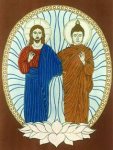
this jesus?
buddha-and-jesus1.jpg

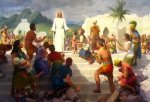
or maybe this jesus?
Mormon-Jesus-visits-Indians.jpg

there is only one way to salvation...and not everything that goes by the name of 'jesus' is it!
 
The Saved ones most assuredly did.

Enoch was translated because he walked with 'haelohim' (literally...'all the Gods' in Hebrew).

Noah...the same...he walked with 'haelohim'.


Study up...


all Israel worshipped haelohim. but it was used with a singular verb because it was a plural of majesty. They had no concept of triunity. Perhaps you should study up lol