Daniel's 1260 vs. 1290 vs. 1335 vs. 2300 Days

  • Christian Chat is a moderated online Christian community allowing Christians around the world to fellowship with each other in real time chat via webcam, voice, and text, with the Christian Chat app. You can also start or participate in a Bible-based discussion here in the Christian Chat Forums, where members can also share with each other their own videos, pictures, or favorite Christian music.

    If you are a Christian and need encouragement and fellowship, we're here for you! If you are not a Christian but interested in knowing more about Jesus our Lord, you're also welcome! Want to know what the Bible says, and how you can apply it to your life? Join us!

    To make new Christian friends now around the world, click here to join Christian Chat.
Both Matthew and Mark use similar phrases about 'reading and understanding':
  • whoso readeth, let him understand
  • let him that readeth understand
Reading what? Understanding what? Some suggest that the phrases are referring to Daniel. The reader should understand that book. Thus, we must rely on the verses in Daniel to decipher things.
...
Back to these phrases:
  • whoso readeth, let him understand
  • let him that readeth understand
A suggestion that most overlook is that the verse has a sort of 'built-in decoder' to let us know how to understand the word 'see'. In other words, if we interpret the word 'see' as literally seeing with the eyes, then the verse has issues. However, if we heed the advice of the decoder phrase, we find that the word 'see' should be interpreted as 'understand', hence the need to clarify using the "let him that readeth understand." phrase.
In the same ballpark (forced embedded link to another thread - looks like a new 'feature' - it might prove to be worthwhile):

 
Thank you @GaryA for the posts about days and years. I will need to study more to give a good response.

If the woman in Daniel 11:17 is not Cleopatra - who is it?

You ask really good questions! Let's look at the verse in the KJV:

Daniel 11:17 - He shall also set his face to enter with the strength of his whole kingdom, and upright ones with him; thus shall he do: and he shall give him the daughter of women, corrupting her: but she shall not stand on his side, neither be for him.

Indeed the phrase 'daughter of women' is often attributed to Cleopatra I Syra. However, keeping in line with what I wrote earlier, these events are all about what you referenced earlier in the thread:

Daniel 11:31 is describing the one-and-only real-and-true actual bona fide Abomination of Desolation ['event'] - which was instigated by Antiochus IV Epiphanes in 167 B.C.

Here is a quick breakdown of Daniel 11:17:

He shall also set his face to enter with the strength of his whole kingdom:
In 168 BC, relying on a false rumor that King Antiochus IV had died in Egypt, the deposed Jewish High Priest Jason launched a coup in Jerusalem. He led 1,000 men to oust his rival, High Priest Menelaus, forcing Menelaus to retreat to the city's citadel. Antiochus, returning humiliated from his Egyptian campaign, interpreted this internal strife as an outright rebellion against his rule. Enraged, he stormed Jerusalem, massacred thousands, reinstated Menelaus, and subsequently enacted decrees that outlawed traditional Jewish practices, triggering the Maccabean Revolt.

...and upright ones with him:
These would be pro Seleucid/Hellenizing factions. In other words, they were Jews on the side of Epiphanes during the Maccabean Revolt.

...thus shall he do: and he shall give him the daughter of women:
The phrase 'daughter of women' would symbolize the Jewish nation or the people of Israel, a common metaphor in the Bible.

...corrupting her:
Here we have the infamous 'swine event', plundering of the Temple as well as other heresies. Note that Menelaus, the High Priest at that time, gained his position through bribery with Antiochus IV Epiphanes and is rumored to have assisted Antiochus IV Epiphanes in plundering the temple. Thus, Antiochus IV Epiphanes is given the 'daughter of women', Judea, for a short time.

...but she shall not stand on his side, neither be for him:
Thankfully, Judea will not stand for all of this corruption. They will not be on the side of Antiochus IV Epiphanes, neither will they be for him.
 
For me Luke makes the Abomination simple Luke 21:20-21 - And when ye shall see Jerusalem compassed with armies, then know that the desolation thereof is nigh. Then let them which are in Judæa flee to the mountains; and let them which are in the midst of it depart out; and let not them that are in the countries enter thereinto.

Yes, I responded in post #6.
 
How is this possible?

I believe:

~ The "great tribulation" as spoken of in Matthew 24:21 started ~70 A.D.
~ We are currently in it.
~ It will end at some point in time in the future.
~ The worst is yet to come.
~ There will not be another brick-and-mortar temple. (At least, not that God will recognize - and, that would be valid for the Bible to call "temple of God"...)

That is literally what I beleive! I thought I was the only person on the planet that had those viewpoints.
 

Hi @Rob7 .

Part of the reason why I can't post all of my info is that it ties to the chapters you reference. Basically Daniel 11 has so many incredible parallels to chapters 2, 7 and 8 that it would take many posts to go through them all.

Just for the record, I do not connect the Papacy to Daniel. Rome in general, yes.
 
That being said, Daniel 11:19 is actually about Antiochus Epiphanes IV, *NOT* about Antiochus III as so many claim.

I have a bit of time tonight to add some more detail to the timeline of Daniel 11. Something that I have noticed is that most scholars are in agreement up to Daniel 11:14. The timeline is fairly straightforward with the various kings of the north and south duking it out.

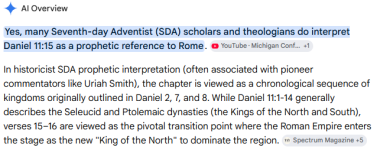
However, Daniel 11:15 is where a strange split occurs. There is no longer a consensus. Some Seventh Day Adventists for example, interpret Daniel 11:15 as a transition into the Roman Empire:

1783914264686.png

I found that and other commentaries to be very odd, which led me to formulate my own interpretations of events. That being said, the interpretations you will see from me from Daniel 11:13 onwards will most likely not be found in anything out there currently. However, it is my opinion that they line up *much* better than what the mainstream has to offer.

Let us now look at Daniel 11:13 from a fresh perspective. I believe this is the end of Antiochus III the Great. He was the King of the North at that time:

Daniel 11:13 - For the king of the north shall return, and shall set forth a multitude greater than the former, and shall certainly come after certain years with a great army and with much riches.

That was around 200 BC to 198 BC. Antiochus III the Great died around 187 BC. The very next verse then segues into Antiochus IV Epiphanes:

Daniel 11:14 - And in those times there shall many stand up against the king of the south: also the robbers of thy people shall exalt themselves to establish the vision; but they shall fall.

Note the phrase 'and in those times'. The timeline now jumps ahead to somewhere between 170 BC and 160 BC. Many have tried to stand up against the King of the South. The idea here is that much time has passed since the previous verse, which means Antiochus III the Great is now long dead.

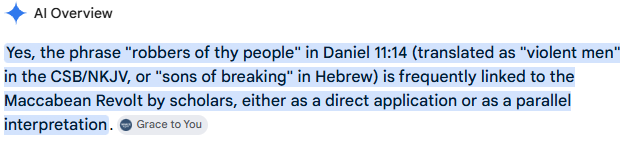
Look at the terminology being used. The phrase "robbers of thy people" is very strong. This is Maccabean Revolt language being used. A quick search shows that this is a valid interpretation:

1783915745967.png

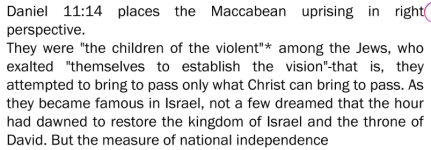
Here is a snippet from an SDA PowerPoint I found:

1783916584801.png


It appears that the Seventh Day Adventists are on the right track. There is a transition to Rome in these verses. However, my interpretation is a bit different. Also, I don't go hating on the Papacy.

Anyhow, I believe Daniel 11:14 is describing that there will be an attempt to 'establish the vision', i.e., force Daniel's prophecies to come to fruition. Again, This is Maccabean Revolt language being used.

It's as if the verse is warning against trying to force the Abomination of Desolation too early in the timeline.
 
This scene from the movie Cleopatra is Daniel 11:30:


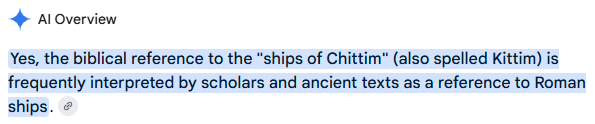
Daniel 11:30 - For the ships of Chittim shall come against him: therefore he shall be grieved, and return, and have indignation against the holy covenant: so shall he do; he shall even return, and have intelligence with them that forsake the holy covenant.

It describes the famous Battle of Actium:

Octavian (Augustus): King of the North
Mark Antony and Queen Cleopatra VII: King of the South

The 'ships of Chittim' is Rome 'coming against' Mark Antony:

1783919368177.png

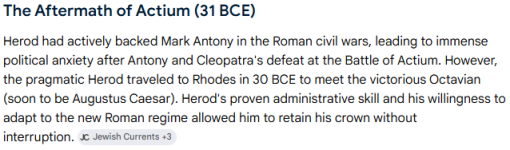
Mark Antony formed an alliance with King Herod the Great:

1783918625029.png

1783918644835.png

And now you can see how the next verse in Daniel ties in with Herod's dynasty and the Roman Empire and eventual the setting up of the abomination that maketh desolate, i.e., the Crucifixion.
 
Daniel 11:18 breakdown and commentary:

Daniel 11:18 - After this shall he turn his face unto the isles, and shall take many: but a prince for his own behalf shall cause the reproach offered by him to cease; without his own reproach he shall cause it to turn upon him.

After this…:
This is a continuation of verse 15, right after Antiochus Epiphanes IV (King of the North) led his first campaign into Egypt against Ptolemy VI (King of the South). It was around this time that Antiochus Epiphanes IV caused major upheaval in Judea.

…shall he turn his face unto the isles and shall take many…:
Antiochus IV Epiphanes begins his second campaign against Egypt, taking the island of Cyprus and various parts of the coastlands.

…but a prince for his own behalf shall cause the reproach offered by him to cease…:
This was viewed as a 'reproach' or insolence by the Roman Republic. As a result, the Roman ambassador Gaius Popillius Laenas famously forced Antiochus to withdraw his forces by drawing a circle in the sand around the king, demanding a withdrawal before he stepped out.

…without his own reproach he shall cause it to turn upon him.:
Antiochus IV Epiphanes reluctantly withdrew and was bitter. He then turned this bitterness against Judea, ultimately resulting in the Maccabean Revolt. The reproach of Antiochus IV Epiphanes was consequently turned back onto himself.

As mentioned earlier in the thread, the next verse is a prophecy of Antiochus IV Epiphanes falling off of his chariot and eventually passing away:

Daniel 11:19 - Then he shall turn his face toward the fort of his own land: but he shall stumble and fall, and not be found.

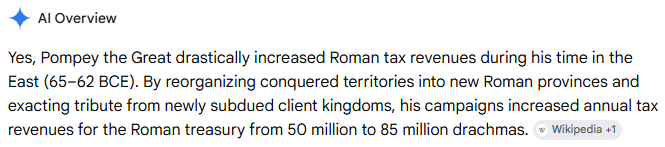
The narrative then shifts to the 'Legs of Iron' in the overall vision, i.e., the Roman Empire, beginning with Pompey, a 'raiser of taxes':

Daniel 11:20 - Then shall stand up in his estate a raiser of taxes in the glory of the kingdom: but within few days he shall be destroyed, neither in anger, nor in battle.

1783972719097.png

The Abomination of Desolation is still several verses ahead in the timeline and has nothing to do with Antiochus IV Epiphanes.
 
Just for the record, I do not connect the Papacy to Daniel. Rome in general, yes.

The Historicist vs. Futurist Interpretation of Prophecy


1. The Historic Protestant View

The historic Protestant interpretation of prophecy teaches that Bible prophecy unfolds continuously through history from the prophet's day to the end of time. This was the standard view held by the Protestant Reformers.
In this view:

  • Daniel 2 shows a sequence of world empires: Babylon → Medo-Persia → Greece → Rome → Divided Rome → God's Kingdom.
  • Daniel 7 shows the same sequence, with a "little horn" arising among the divided kingdoms of Rome.
  • Revelation 13 shows the same persecuting power under the symbol of the beast.
  • 2 Thessalonians 2 identifies the same power as the "man of sin" or "man of lawlessness."
  • The 1260 prophetic days are understood by the year-day principle as 1260 literal years.
  • The Papacy's prophetic supremacy is dated from AD 538 to AD 1798.
The Apostle Paul warned:
"That day shall not come, except there come a falling away first, and that man of sin be revealed, the son of perdition; Who opposeth and exalteth himself above all that is called God." — 2 Thessalonians 2:3-4 (KJV)
This "falling away" was understood as a gradual apostasy within professed Christianity, culminating in the establishment of the Papal system, which blended pagan and Christian elements:
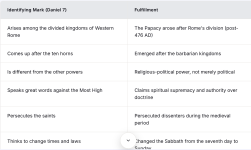
"And he shall speak great words against the most High, and shall wear out the saints of the most High, and think to change times and laws: and they shall be given into his hand until a time and times and the dividing of time." — Daniel 7:25 (KJV)

2. The 1260 Years: 538 AD to 1798 AD

The 1260 prophetic days are interpreted as 1260 literal years, based on the year-day principle found in Scripture:
"I have appointed thee each day for a year." — Ezekiel 4:6 (KJV)
"After the number of the days in which ye searched the land, even forty days, each day for a year, shall ye bear your iniquities." — Numbers 14:34 (KJV)
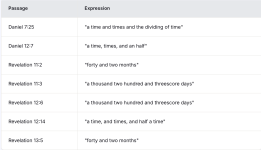
The relevant prophetic passages are:

[th]Passage[/th][th]Expression[/th] [td]Daniel 7:25[/td][td]"a time and times and the dividing of time"[/td] [td]Daniel 12:7[/td][td]"a time, times, and an half"[/td] [td]Revelation 11:2[/td][td]"forty and two months"[/td] [td]Revelation 11:3[/td][td]"a thousand two hundred and threescore days"[/td] [td]Revelation 12:6[/td][td]"a thousand two hundred and threescore days"[/td] [td]Revelation 12:14[/td][td]"a time, and times, and half a time"[/td] [td]Revelation 13:5[/td][td]"forty and two months"[/td]
All of these represent the same period: 1260 prophetic days = 1260 literal years.
Historic dating:

  • Start (AD 538): The Papacy gained decisive civil-religious authority after the removal of the Ostrogothic opposition from Rome.
  • End (AD 1798): General Berthier, under Napoleon, entered Rome and took the pope prisoner, delivering what historicists call the "deadly wound" of Revelation 13:3.

3. Francisco Ribera and the Futurist Counter-Interpretation

Francisco Ribera (1537–1591) was a Spanish Jesuit theologian. In 1585, he published a commentary on Revelation that placed most of the Antichrist prophecies into a short period at the very end of the world. This became known as futurism.
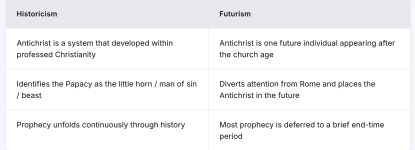
The purpose of futurism was to redirect the prophetic spotlight away from the Papacy. Instead of Antichrist being a long historical power already active in Christian history, Ribera's system made Antichrist a single future individual who would appear near the end of time.
The contrast:

[th]Historicism[/th][th]Futurism[/th] [td]Antichrist is a system that developed within professed Christianity[/td][td]Antichrist is one future individual appearing after the church age[/td] [td]Identifies the Papacy as the little horn / man of sin / beast[/td][td]Diverts attention from Rome and places the Antichrist in the future[/td] [td]Prophecy unfolds continuously through history[/td][td]Most prophecy is deferred to a brief end-time period[/td]
This directly opposed the Protestant Reformation view. Reformers such as Luther, Calvin, Knox, Cranmer, and Tyndale all identified the Papacy as the Antichrist power of prophecy. The Jesuit counter-interpretations were specifically designed to neutralize this Protestant charge.
A second Jesuit, Luis de Alcazar (1554–1613), developed an opposite counter-interpretation called Preterism, which placed all fulfillment of Revelation in the early centuries. Both Futurism and Preterism served the same purpose: removing the Papacy from prophetic focus.


4. Jesus' Own Historic Approach to Prophecy

When Jesus spoke of the destruction of Jerusalem and the end of the world in Matthew 24, He directed His followers to Daniel as the interpretive key:
"When ye therefore shall see the abomination of desolation, spoken of by Daniel the prophet, stand in the holy place, (whoso readeth, let him understand)." — Matthew 24:15 (KJV)
Jesus did not teach a disconnected prophetic system where the bulk of prophecy is detached from history. He treated prophecy as a continuous unfolding narrative grounded in real historical events.
The prophetic sequence through history:

  1. Babylon → 2. Medo-Persia → 3. Greece → 4. Pagan Rome → 5. Papal Rome (during the 1260 years) → 6. Time of the End (after 1798) → 7. Final conflict centered on worship, God's commandments, and the Sabbath.

††††††††††††††††††††††††††††††††††††† ~~ Blessed Sabbath Folks ~~ ††††††††††††††††††††††††††††††††††


Ooops ! Here are the tables presented correctly;

In point #2; relevant prophetic passages are:

2026-07-18_17-56.png

In Point #3

2026-07-18_17-57.png

5. John Nelson Darby and Dispensational Futurism

John Nelson Darby (1800–1882), a Plymouth Brethren teacher, developed a system now called dispensationalism. Darby's system included:

  • A sharp separation between Israel and the church.
  • A secret rapture before a future tribulation.
  • A future seven-year tribulation.
  • A future personal Antichrist.
  • The rebuilding of a Jewish temple.
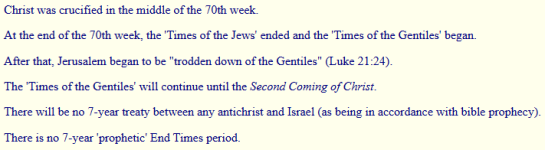
  • The postponement of Daniel's 70th week into the future.
Darby did not invent Ribera's futurism, but he systematized and popularized a Protestant version of it. His views later influenced the Scofield Reference Bible (1909), which spread dispensational futurism widely among evangelical Christians.

6. The Critical Issue: Daniel 9 and the 70 Weeks

The Prophecy

Daniel 9:24 states:
"Seventy weeks are determined upon thy people and upon thy holy city, to finish the transgression, and to make an end of sins, and to make reconciliation for iniquity, and to bring in everlasting righteousness, and to seal up the vision and prophecy, and to anoint the most Holy." — Daniel 9:24 (KJV)
The word "determined" literally means "cut off" — the 70 weeks are cut off as one continuous prophetic period of 490 years.

The Historicist Calculation

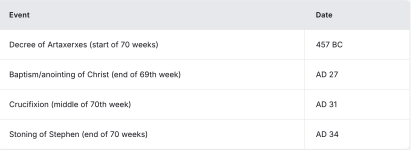
The 70 weeks begin with the decree to restore and rebuild Jerusalem. That decree was issued by Artaxerxes Longimanus in 457 BC (Ezra 7).
  • 69 weeks (483 years) from 457 BC reach to AD 27, the baptism and anointing of Christ.
"Know therefore and understand, that from the going forth of the commandment to restore and to build Jerusalem unto the Messiah the Prince shall be seven weeks, and threescore and two weeks." — Daniel 9:25 (KJV)
  • The middle of the 70th week (AD 31): The crucifixion of Christ.
"And he shall confirm the covenant with many for one week: and in the midst of the week he shall cause the sacrifice and the oblation to cease." — Daniel 9:27 (KJV)
The "he" is understood as Christ, not Antichrist. Christ confirmed the covenant. After three and a half years of ministry, He died on the cross, causing the sacrificial system to lose its significance — the veil of the temple was torn in two (Matthew 27:51).
  • End of the 70th week (AD 34): The stoning of Stephen marked the final rejection of the gospel by the Jewish nation, and the message went decisively to the Gentiles (Acts 7–8).

Summary Timeline


2026-07-18_17-57_1.png


7. Why the Futurist Gap Theory Was Rejected

Historicists rejected the futurist gap theory for several reasons:
1. The text says the 70 weeks are "determined" (cut off) as one unit. There is no biblical statement that the 70th week is separated from the first 69 weeks by thousands of years. The prophecy says "Seventy weeks are determined" — not "Sixty-nine weeks are determined, then a gap of unknown length, then one final week."
2. The "he" in Daniel 9:27 is Christ, not Antichrist. Futurism shifts Daniel 9:27 away from Christ and applies it to a future Antichrist. This distorts one of the strongest Messianic prophecies in Scripture, making the final week about a future deceiver rather than the Messiah.
3. The sacrifice ceasing in the "midst of the week" refers to Christ's death. When Jesus died, the veil of the temple was rent (Matthew 27:51), signifying that the earthly sacrificial system had ended. Futurism assigns this to a future Antichrist stopping sacrifices in a rebuilt temple.
4. It breaks the Christ-centered focus of Daniel 9. Daniel 9 is explicitly about the Messiah — "to make an end of sins," "to make reconciliation for iniquity," "to bring in everlasting righteousness" (verse 24). Reassigning the 70th week to a future Antichrist figure undermines the Messianic focus of the entire passage.


________________________________________________________________________________________________________


8. The Papacy as the Antichrist Power

The historic Protestant position identified the Papacy — not pagan Rome, Islam, atheism, or a future individual — as the primary fulfillment of the Antichrist prophecies. This was based on the identifying marks in Daniel 7:
2026-07-18_17-58.png


9. The Broader Problem: Diversion from the Real Antichrist System

From the historicist perspective, both Ribera's futurism and Darby's dispensationalism produce the same effect: they move the Antichrist away from the historic Papal system and place him in the future.
This trains Christians to look for:
  • A future world dictator
  • A rebuilt Jewish temple
  • A seven-year tribulation
  • A secret rapture
  • A future covenant with national Israel
Meanwhile, they overlook the prophetic reality that the Antichrist power has already been operating through history — fulfilling every identifying mark given in Daniel and Revelation.


10. Summary

The historic Protestant interpretation of prophecy, shared by the Reformers and grounded in Scripture, teaches:
  1. Prophecy unfolds continuously through history. Daniel 2 and 7 trace a succession of world empires from Babylon to the end.
  2. The 1260 years (AD 538–1798) represent the period of Papal supremacy, drawn from Daniel 7:25, Revelation 11:2-3, 12:6,14, and 13:5, using the year-day principle.
  3. Francisco Ribera, a Jesuit, developed futurism (c. 1585) as a counter-Reformation interpretation to remove the Papacy from Protestant identification as Antichrist.
  4. John Nelson Darby later popularized a Protestant version of futurism (dispensationalism), which separated Israel from the church, introduced a secret rapture, and pushed Daniel's 70th week into the future.
  5. Daniel's 70 weeks (Daniel 9) are one continuous prophetic period of 490 years (457 BC – AD 34), fulfilled in Christ's baptism, death, and the apostolic era. The 70th week belongs to Christ's ministry — not to a future Antichrist.
  6. Futurism obscures the prophetic identity of the Papacy as the "little horn," the "man of sin," and the beast power, causing believers to look for a future Antichrist while overlooking the system that has already fulfilled every prophetic criterion.

††††††††††††††††††††††††††††††††††††† ~~ Blessed Sabbath Folks ~~ ††††††††††††††††††††††††††††††††††
 
  • Like
Reactions: Melach
Two Witnesses 1260 days as being symbolic of years?

The Two Witnesses of Revelation 11: Are the Old and New Testaments


I. The Main Passage: Revelation 11:3–12 (AKJV)​

"And I will give power unto my two witnesses, and they shall prophesy a thousand two hundred and threescore days, clothed in sackcloth. These are the two olive trees, and the two candlesticks standing before the God of the earth."Revelation 11:3-4
"And if any man will hurt them, fire proceedeth out of their mouth, and devoureth their enemies... These have power to shut heaven, that it rain not in the days of their prophecy: and have power over waters to turn them to blood, and to smite the earth with all plagues, as often as they will."Revelation 11:5-6
"And when they shall have finished their testimony, the beast that ascendeth out of the bottomless pit shall make war against them, and shall overcome them, and kill them. And their dead bodies shall lie in the street of the great city..."Revelation 11:7-8
"And they of the people and kindreds and tongues and nations shall see their dead bodies three days and an half... And they that dwell upon the earth shall rejoice over them, and make merry, and shall send gifts one to another; because these two prophets tormented them that dwelt on the earth."Revelation 11:9-10
"And after three days and an half the Spirit of life from God entered into them, and they stood upon their feet... And they heard a great voice from heaven saying unto them, Come up hither. And they ascended up to heaven in a cloud; and their enemies beheld them."Revelation 11:11-12

II. The Biblical Source: Zechariah 4:2–3, 11–14 (AKJV)​

John explicitly connects the witnesses to Zechariah's vision: "These are the two olive trees, and the two candlesticks standing before the God of the earth" (Revelation 11:4).

"And he said unto me, What seest thou? And I said, I have looked, and behold a candlestick all of gold, with a bowl upon the top of it, and his seven lamps thereon... And two olive trees by it, one upon the right side of the bowl, and the other upon the left side thereof."Zechariah 4:2-3
"Then answered I, and said unto him, What are these two olive trees...? And he answered me and said, Knowest thou not what these be?... Then said he, These are the two anointed ones, that stand by the Lord of the whole earth."Zechariah 4:11-14
Both passages use identical imagery — two olive trees and lampstands standing before God, supplied with golden oil (the Holy Spirit), functioning as divine witnesses.


III. Why the Two Witnesses Represent the Old and New Testaments​

A. The Requirement of Two Witnesses​

Scripture establishes that valid testimony requires two witnesses:

"At the mouth of two witnesses, or at the mouth of three witnesses, shall the matter be established."Deuteronomy 19:15
"In the mouth of two or three witnesses shall every word be established."2 Corinthians 13:1
God's own legal standard requires two witnesses to establish truth. The Old and New Testaments together constitute God's complete two-fold witness to humanity.

B. The Law and the Prophets — Christ's Own Division​

"Think not that I am come to destroy the law, or the prophets: I am not come to destroy, but to fulfil."Matthew 5:17
"Search the scriptures; for in them ye think ye have eternal life: and they are they which testify of me."John 5:39

C. The Miraculous Powers Echo Moses and Elijah​

Turning water to blood (Moses — the Law):

"And Moses stretched forth his hand over the waters of Egypt; and the waters were turned to blood."Exodus 7:20
Shutting heaven (Elijah — the Prophets):

"And the heaven was shut up three years and six months, while Elijah prayed; and it rained not."Luke 4:25
Moses represents the Law; Elijah represents the Prophets. Together they embody the entire Old Testament testimony, which the New Testament fulfills and confirms.

D. The Complete Testimony of God​

"But now the righteousness of God without the law is manifested, being witnessed by the law and the prophets."Romans 3:21
"All scripture is given by inspiration of God, and is profitable for doctrine, for reproof, for correction, for instruction in righteousness."2 Timothy 3:16
"For the testimony of Jesus is the spirit of prophecy."Revelation 19:10

IV. The 1260 Days — Duration, Not Identity

The witnesses prophesy for "a thousand two hundred and threescore days" — the same period the church is nourished in the wilderness:

"And the woman fled into the wilderness, where she hath a place prepared of God, that they should feed her there a thousand two hundred and threescore days."Revelation 12:6
The 1260 days describe the duration of the witnesses' ministry — the period during which God's Word testifies in sackcloth (obscurity and persecution). This timeframe is not the identity of the witnesses but the context of their testimony. During this same period, the true church was sustained by the Scriptures.


V. The Death and Resurrection of the Witnesses​

The Beast's Attack​

"And when they shall have finished their testimony, the beast that ascendeth out of the bottomless pit shall make war against them, and shall overcome them, and kill them."Revelation 11:7
When earthly powers suppress Scripture, forbid its translation, burn Bibles, and persecute those who preach it, the witnesses are effectively "killed." The Word of God is silenced in the public square.

The World's Rejoicing​

"And they that dwell upon the earth shall rejoice over them, and make merry... because these two prophets tormented them that dwelt on the earth."Revelation 11:10
The world rejoices when God's Word is suppressed because Scripture "torments" the conscience — it condemns sin and demands obedience.

The Resurrection​

"And after three days and an half the Spirit of life from God entered into them, and they stood upon their feet... And they ascended up to heaven in a cloud; and their enemies beheld them."Revelation 11:11-12
The Word of God cannot remain dead. After a period of suppression, the Scriptures revive with power. When the Bible was rediscovered, translated, and preached boldly, it "stood upon its feet" again — ascending in glory and authority before its enemies.


VI. God's People Witness Through the Word​

"Ye are my witnesses, saith the LORD, and my servant whom I have chosen."Isaiah 43:10
"And the dragon was wroth with the woman, and went to make war with the remnant of her seed, which keep the commandments of God, and have the testimony of Jesus Christ."Revelation 12:17

VII. Conclusion: The Enduring Word​

The two witnesses are the Old and New Testaments — the complete written testimony of God to mankind. This interpretation is grounded in:

  1. The legal requirement of two witnesses — God's standard requires two to establish truth (Deuteronomy 19:15; 2 Corinthians 13:1).
  2. The two-fold division of Scripture — Jesus identified "the law and the prophets" (Matthew 5:17; Luke 24:44).
  3. Olive trees and lampstands — Zechariah's vision shows these as sources of light and spiritual power flowing from God through His Word (Zechariah 4:14).
  4. Moses and Elijah mirrored — The witnesses' miracles echo the Law-giver and the chief Prophet, representing the entire Old Testament, fulfilled by the New.
  5. Death and resurrection — The Word has been suppressed and attacked throughout history, yet it always revives and prevails.
"For ever, O LORD, thy word is settled in heaven."Psalm 119:89
"The grass withereth, the flower fadeth: but the word of our God shall stand for ever."Isaiah 40:8
"But the word of the Lord endureth for ever. And this is the word which by the gospel is preached unto you."1 Peter 1:25
The two witnesses — the Old and New Testaments — prophesy throughout the 1260 years in sackcloth, are attacked by the beast, appear dead for a season, then rise again in power. God's Word endures forever and triumphs over every attempt to silence it.

††††††††††††††††††††††††††††††††††††† ~~ Blessing Folks ~~ ††††††††††††††††††††††††††††††††††
 
  • Like
Reactions: Melach
The two witnesses — the Old and New Testaments — prophesy throughout the 1260 years in sackcloth, are attacked by the beast, appear dead for a season, then rise again in power. God's Word endures forever and triumphs over every attempt to silence it.

††††††††††††††††††††††††††††††††††††† ~~ Blessing Folks ~~ ††††††††††††††††††††††††††††††††††

That's a reasonable interpretation.

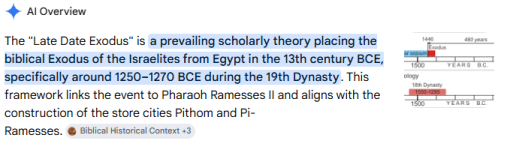
Does this mean you believe in the 'late date Exodus' of around 1260 BC?

1784683420217.png
 
This day-year principle is bogus. In Daniel's prophecies, a day is literally a day, not a year. 2300 days in Dan. 8 is the time of Greek occupation and desacration, namely by king Antiochus IV, until the restoration of the temple. 1260 days are the timespan of the great ftribulation; 1290 days are the same timespan plus a leap month; 1335 days are the same timespan plus extra 75 days, and those 75 days are the precise gap from the Day of Atonement (Yom Kippur) to the Feast of Dedication (Hanukkah), and the would be the restoration of the holy temple desacrated by the Antichrist.