Thanks for posting, but that is an issue for a different topic.
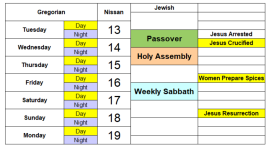
But I do wonder about your chart. Under Gregorian you have day first and then night. However, it should be night first, then day and then night. What am I missing?
Your instinct is correct. My chart is inadequate to paint the entire picture. During the lifetime of Jesus (early 1st century AD),
the Romans did indeed begin the civil day at midnight —
media nox — and counted the 24‑hour period from
midnight to midnight. Roman timekeeping sources explicitly confirm this. My chart would have been "more correct" if it showed two nighttime sections per calendar day: the first nighttime row beginning at midnight. Then the yellow daytime row. Then the second nighttime row ending at midnight.
In Jewish reckoning, the day begins at twilight, and it ends 24 hours later on the next twilight. Since I created the chart to be shown on a computer screen, I simplified it so the basic ideas could be easily grasped. The Bible is written for a Jewish audience so it uses the Jewish reckoning.
A few key elements in the Gospels give the reader a hint about the timeline.
- Jesus prediction: 3 days and 3 nights
- Passover - Feast of Unleavened Bread
- Weekly Sabbath
- High Sabbath
- Preparation days
- Jesus' arrest
- Jesus' trial
- The hour when Jesus was crucified
- The activities of the women
- The activities of those who buried Jesus
- His Resurrection
We begin with the facts we know: Jesus rose on Sunday morning and he was to spend three days and three nights in the tomb. Let's assume, for the time being Jesus was in the tomb on Thursday, Friday, and Saturday. This is just a supposition for now; we will look at other factors to arrive at our final conclusion.
Before we continue, we should note a few key concepts, which help us understand the timeline. As we know, the Jewish culture celebrates a weekly Sabbath every Saturday. No work can be done on that day. The women couldn't prepare spices, for instance, on the Sabbath because no work can be done on that Day. So traditionally, the day before the Sabbath is called "the preparation day," and John mentions this day in his Gospel.
Jesus ate Passover with his disciples. The Passover is the Day just before the Feast of Unleavened Bread. This Feast funs for seven days. The first day of Unleavened Bread is a High Holy Day.
יוֹם טוֹב (
Yom Tov) — “Good Day,” meaning a festival day with Sabbath-level restrictions. No work can be done on either of these days. This is significant because the Chief Priests requested that Pilate break the legs of those on the cross so that the bodies could be taken down before the Passover -- meaning "The High Holy Day." We know this because John's Gospel tells us this.
So, What do we know so far? Jesus ate the Passover meal with his disciples. The Passover began at twilight. During that time, Jesus ate with his disciples, talked with them outside in the evening, and was arrested, tortured, and interviewed during that night. When daylight came, he was taken to Pilate to be judged and sentenced. Jesus was crucified later that day. It was 3:00 pm.
He was already dead when the soldiers came to break his legs, so they didn't break his legs. According to every Gospel account,
Joseph of Arimathea took charge of the burial and placed Jesus in the tomb, while Nicodemus helped with spices and wrapping.
The women were going to deliver the spices to the tomb, but since Jesus was crucified the day before the High Holy Day, Nicodemus and the women were required to wait until the end of the High Holy Day. They prepared the spices on a Preparation Day. Luke 23:56 shows the women
prepared the spices before the Sabbath began, which means they did this work on
Friday — the Preparation Day (the day before the Sabbath).
In other words, between the time when Jesus was crucified and the day that the women showed up to the tomb to prepare the body of Jesus, there was a High Sabbath, a Preparation Day, and a Weekly Sabbath.
With this information, we can safely conclude that Jesus was crucified on Wednesday during the daylight hours. He was placed in the tomb just before Twilight that day because the Chief Priests wanted the bodies removed before the High Holy Day began. After the High Holy Day, during the daylight hours of Friday, the women prepared the spices. That day was a day of preparation, which preceded the Weekly Sabbath.
When the Sabbath was over, they went to the tomb and found it empty.
Hopefully this helped.