What is the Abomination of Desolation?

  • Christian Chat is a moderated online Christian community allowing Christians around the world to fellowship with each other in real time chat via webcam, voice, and text, with the Christian Chat app. You can also start or participate in a Bible-based discussion here in the Christian Chat Forums, where members can also share with each other their own videos, pictures, or favorite Christian music.

    If you are a Christian and need encouragement and fellowship, we're here for you! If you are not a Christian but interested in knowing more about Jesus our Lord, you're also welcome! Want to know what the Bible says, and how you can apply it to your life? Join us!

    To make new Christian friends now around the world, click here to join Christian Chat.
A lot of SDA proponents on this forum...

'Adventists' not being Advent i.e run up to Christmas celebrating Jesus birth

But another kind of advent.
Also Mormon's call themselves 'Latter-day' saints. Latter day meaning 'end of days' usually they are survivalists or extreme preppers.

You won't convince them anything, they all stocking their bomb shelters in event of a nuclear meltdown.
 
  • Like
Reactions: Researcher
JWs came about becasue of a failed prophecy interpretation. They were all waiting for a hill to die on. Didn't happen and they called it 'the great disappointment'
And Jonestown. Well that REALLY happened. I don't know how he convinced those 900 odd people to drink the Kool-Aid, but he did.
 
  • Like
Reactions: Researcher
Jim Jones -- originally a christian preacher. Possibly self-appointed huckster, but anyone in America can be a preacher. There is no governing Church of America to rein anyone in.
 
YOU is you.!

Here is one of many verses which make your presuppositions null and void.

For, "Yet a little while, and the coming one will come and will not delay;
Hebrews 10:37 ESV


"For yet a little while."
The Greek in the letter is very expressive and emphatic.
The author used a word which signifies "a little while," but then for further emphasis, the particle meaning "very" is also added!!

This indicates without any doubt the author is intensifying the information even more by repeating it, therefore rendering this clause as:
"For yet a very, very little while, and He that shall come will come."
Hebrews 10:37 is not a problem for my claim — it’s actually a proof of the very thing I’ve been arguing: the NT uses intensified imminence language without guaranteeing the hearers’ participation, and Hebrews is one of the clearest examples of that prophetic idiom.
The author piles up the Greek — mikron hoson hoson (“a very, very little while”) — precisely the way Isaiah, Joel, and Zephaniah do when they say the Day_of_the_Lord is “near” for people who lived centuries before the final Day.
Hebrews is quoting Habakkuk 2:3, which already frames the coming as “hastening” even though its fulfillment stretches far beyond the original audience.
The writer of Hebrews applies that same prophetic idiom to Christ’s return: he intensifies the nearness, but he never says “you will live to see it.” He uses the same eschatological posture found in prophetic_immediacy — the next act in God’s plan is treated as impending, not scheduled. So your verse doesn’t nullify my point; it reinforces it: even the strongest imminence language in Scripture never promises the hearers’ survival to the event. The system you’re using assumes imminence equals timetable; Hebrews shows imminence equals urgency, not chronology
 
Daniel 9:27 does use the same technical pairing — šiqqûṣîm (abominations) and šōmēm (desolation) — that Daniel uses in 11:31 and 12:11, and Hebrew grammar does not treat “abominations” in 9:27 as a random pile of sins but as the cultic desecration tied to the cessation of sacrifice; the participial phrase “on the wing of abominations shall come one who makes desolate” is syntactically bound to the covenant‑breaking act in the middle of the week, not floating off as a separate phenomenon.
Your claim that 9:27 speaks of “an overspreading of abominations” while 11:31 and 12:11 speak of “a singular abomination” is not a textual distinction — it’s an English gloss;
the Hebrew uses the same root and the same desolation formula, and Daniel’s pattern is consistent: a desecrator, a halted sacrifice, and a desolating act.
Antiochus is in Daniel’s prophecy (Dan 8, Dan 11:21–35) because the historical details match the Seleucid crisis precisely — the little horn’s rise, the trampling of the sanctuary, the removal of the daily sacrifice, the setting up of the abomination, and the persecution of the faithful — and Jesus Himself places the abomination future to His ministry (Matt 24:15), which means He treats Antiochus as a type, not the final fulfillment.
The “Jesuit invention” claim is internet mythology; the early church fathers — Hippolytus, Athanasius, Jerome — all identified Antiochus in Daniel centuries before the Jesuits existed. The text itself shows Daniel 9:27, 11:31, and 12:11 forming a single prophetic pattern, not three unrelated events.

Sorry, Dan 11:20 was Augustus Caesar, the raiser of taxes. This would put verse 21 as Tiberius.
Tiberius was ruler in Rome when Jesus came (the Prince of the covenant) in verse 22.

Antiochus CANNOT be the little horn in Dan 8.
Look at the details of the prophecy.
The ram with 2 horns grew great (Dan 8:4).
The he-goat (Grecia under the rule of Alexander) grew VERY great (verse 8). He overthrew the Medes and Persians and his kingdom was greater than theirs.
The little horn which came out of the 4 divisions of Grecia became "EXCEEDING" great. Greater than the Medes and Persians. Greater than the Grecian empire under Alexander.
Obviously cannot be Antiochus. The Seleucid Empire NEVER became greater than Alexander's entire Grecian Empire.
The only possibility is the next world-controlling empire spoken of in Dan 2 and 7. Ancient/Pagan Rome who stood against Jesus (Dan 8:11 & 25). Namely Pontius Pilate under the rule of Tiberius.
 
Hebrews 10:37 is not a problem for my claim — it’s actually a proof of the very thing I’ve been arguing: the NT uses intensified imminence language without guaranteeing the hearers’ participation, and Hebrews is one of the clearest examples of that prophetic idiom.
The author piles up the Greek — mikron hoson hoson (“a very, very little while”) — precisely the way Isaiah, Joel, and Zephaniah do when they say the Day_of_the_Lord is “near” for people who lived centuries before the final Day.
Hebrews is quoting Habakkuk 2:3, which already frames the coming as “hastening” even though its fulfillment stretches far beyond the original audience.
The writer of Hebrews applies that same prophetic idiom to Christ’s return: he intensifies the nearness, but he never says “you will live to see it.” He uses the same eschatological posture found in prophetic_immediacy — the next act in God’s plan is treated as impending, not scheduled. So your verse doesn’t nullify my point; it reinforces it: even the strongest imminence language in Scripture never promises the hearers’ survival to the event. The system you’re using assumes imminence equals timetable; Hebrews shows imminence equals urgency, not chronology

"You is you" ......and the audience receiving the information is the one who needs to hear it.

And the context always provides the meaning and the meaning is with time in mind!

It is really something when people have the twist the obvious, the narrative is always about the coming judgement and the ending of the Old Covenant Age.

So your word study fails because the big picture is also clear in the text.
 
"You is you" ......and the audience receiving the information is the one who needs to hear it.

And the context always provides the meaning and the meaning is with time in mind!

It is really something when people have the twist the obvious, the narrative is always about the coming judgement and the ending of the Old Covenant Age.

So your word study fails because the big picture is also clear in the text.
I could not find any mainstream journals but what does exist are historical analyses showing dispensationalism is a 19th‑century movement (Darby, 1830s; Scofield, 1909) rather than an apostolic or patristic doctrine, and academic critiques arguing its core claims (a strict Israel–Church separation, a future rebuilt temple with sacrifices, multiple resurrections, a millennial era with sin and death) are not found in the early church or the text itself.
I also found some religious journals describing how it shaped American evangelical culture — but none of these claim theological authority; they simply show the movement is historically recent, interpretively novel, and not rooted in the early church’s reading of Scripture. Can anyone over there care to explain this?
 
It was John Darby who took Scofield's speculative commentary to the extreme.

I guess history likes to repeat itself though. The downfall of various civilisations has happened on and off for...thousands of years.
 
Sorry, Dan 11:20 was Augustus Caesar, the raiser of taxes. This would put verse 21 as Tiberius.
Tiberius was ruler in Rome when Jesus came (the Prince of the covenant) in verse 22.

Antiochus CANNOT be the little horn in Dan 8.
Look at the details of the prophecy.
The ram with 2 horns grew great (Dan 8:4).
The he-goat (Grecia under the rule of Alexander) grew VERY great (verse 8). He overthrew the Medes and Persians and his kingdom was greater than theirs.
The little horn which came out of the 4 divisions of Grecia became "EXCEEDING" great. Greater than the Medes and Persians. Greater than the Grecian empire under Alexander.
Obviously cannot be Antiochus. The Seleucid Empire NEVER became greater than Alexander's entire Grecian Empire.
The only possibility is the next world-controlling empire spoken of in Dan 2 and 7. Ancient/Pagan Rome who stood against Jesus (Dan 8:11 & 25). Namely Pontius Pilate under the rule of Tiberius.
Your reading collapses because Daniel’s own structure forbids identifying Augustus and Tiberius as the kings of the north in Daniel 11:20–22, and it forbids identifying Rome as the little_horn_of_Daniel_8; Daniel 11 is explicitly about the Ptolemaic–Seleucid conflict (Dan 11:4–5), and the “raiser of taxes” in 11:20 is Seleucus IV, not Augustus, because the entire chapter is narrating the wars between the kings of the south and north, not jumping to Rome.
Likewise, Daniel 8’s “exceeding great” language does not refer to territorial size but directional expansion (east, south, toward the Beautiful Land), and the horn arises from one of the four Greek divisions, not from a fifth empire; Rome did not arise from the Diadochi, but Antiochus IV did, and he alone matches the sanctuary trampling, the removal of the daily sacrifice, the setting up of the abomination, and the persecution of the faithful — the exact pattern Daniel repeats in Daniel_11_31 and Daniel_12_11.
Your argument that the Seleucid Empire “never became greater than Alexander’s” misunderstands the Hebrew comparative: the horn is “exceeding great” relative to its targets, not relative to global empire size; Antiochus expanded farther east and south than any other post‑Alexander ruler and directly assaulted the covenant people, which is Daniel’s metric.
Rome is the fourth kingdom in Daniel 2 and 7, but Daniel 8 is explicitly Medo‑Persia → Greece → a horn from Greece; inserting Rome violates the angel’s own interpretation (Dan 8:20–22). And Daniel 11:22’s “prince of the covenant” is not Jesus under Tiberius but the high priest Onias III, killed during the Seleucid crisis — exactly where the narrative sits. Once you keep Daniel’s own historical sequence intact, Antiochus fits Daniel 8 and 11 precisely, Rome fits Daniel 2 and 7, and Jesus places the abomination future to His ministry (Matt 24:15), proving Antiochus is the type, not the final fulfillment.
 
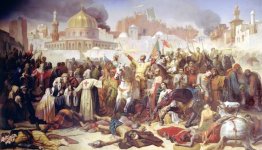
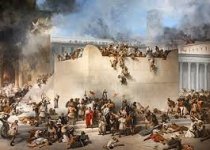
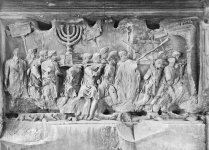
This one seems to be the earliest depiction...it wasn't about the 'future' it was recording the past.

images-36.jpg
 
Note the lampstand (or Menorah) being carried away. If you recall it was inside the temple.
 
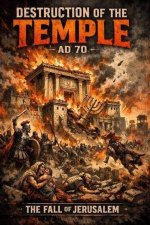
This one is more of a modern day rendering

images-37.jpg

But you get the gist..note the Roman soldiers.
 
I could not find any mainstream journals but what does exist are historical analyses showing dispensationalism is a 19th‑century movement (Darby, 1830s; Scofield, 1909) rather than an apostolic or patristic doctrine, and academic critiques arguing its core claims (a strict Israel–Church separation, a future rebuilt temple with sacrifices, multiple resurrections, a millennial era with sin and death) are not found in the early church or the text itself.
I also found some religious journals describing how it shaped American evangelical culture — but none of these claim theological authority; they simply show the movement is historically recent, interpretively novel, and not rooted in the early church’s reading of Scripture. Can anyone over there care to explain this?

Interesting response, but not sure how it connects to my post.:unsure:
 
OMC likes to put a lot of bold type in his AI corrected posts.

But he has a point (or several) to make.

Several people post on this thread, so he could be responding to someone else, not just you.
 
Maybe it's...'progressive' revelation

I once attended a church that had a dispy view (friend invited me, didn't stay for too long) and it was interesting, but then I noted that the friend kept saying 'this world is ending! Our only hope is Jesus comes back..maybe tomorrow!'

So it got kind of old to hear that ALL the time.
 
Interesting response, but not sure how it connects to my post.:unsure:
I think I am having one of those days- I cant make head nor tail of the argument here is - Care to simplify it for me ? I cant be bothered reading loads of text - sorry OMC but you are giving me information overload today, probably me not in the right mind :)