Is Knowledge of the Original Languages Necessary for KJV Believers?

  • Christian Chat is a moderated online Christian community allowing Christians around the world to fellowship with each other in real time chat via webcam, voice, and text, with the Christian Chat app. You can also start or participate in a Bible-based discussion here in the Christian Chat Forums, where members can also share with each other their own videos, pictures, or favorite Christian music.

    If you are a Christian and need encouragement and fellowship, we're here for you! If you are not a Christian but interested in knowing more about Jesus our Lord, you're also welcome! Want to know what the Bible says, and how you can apply it to your life? Join us!

    To make new Christian friends now around the world, click here to join Christian Chat.
OMC Are you Protestant? What Textual group made that possible?
no, I have absolutely no affiliation with any denomination.
Protestantism as a historical movement was only possible once the Greek textual tradition (Erasmus → Stephanus → Beza → the early printed Textus Receptus) broke Rome’s monopoly on the Latin Vulgate; the Reformation didn’t arise from the Critical Text (which didn’t exist yet), nor from the KJV (which came later), but from the early printed Greek texts that gave Luther, Tyndale, Calvin, and Cranmer the ability to preach and translate directly from Scripture, so the “textual group” that made Protestantism possible was the TR‑era printed Greek tradition, not because it was perfect, but because it was available, portable, and liberating, and once that door opened, the entire Protestant world — including every modern evangelical seminary — inherited a posture of returning to the earliest recoverable text rather than a single fixed edition.
 
no, I have absolutely no affiliation with any denomination.
Thank you for answering. I am not held by any affiliation either though I belong to one, If one is not catholic they are protestant regardless of what if any denomination they adhere to.

Yet the critical text was not available until after the reformation. You don't find that odd?
 
Thank you for answering. I am not held by any affiliation either though I belong to one, If one is not catholic they are protestant regardless of what if any denomination they adhere to.
I look at all folks the same no matter the denomination. We are all students and its my intention to share my knowledge as well as gain some from all of you. But, I don't play well with systems that place themselves over scripture and force it to fit. I allow the scripture to speak for itself. Is that bias, honestly?, yes, but I would rather be text orientated and Christ driven.
 
Your “Westcott & Hort Museum of Biblical Blunders” is hilarious precisely because it exposes the core flaw of KJV‑only polemics, which is the belief that textual criticism is a morality play with heroes and villains rather than a discipline dealing with scribal habits, transmission history, and manuscript evidence; you can build animatronic Westcotts whispering to ghosts, holographic Unitarians serving communion, Mormon scholars in glass cases, and a “Pick‑Your‑Own‑Adventure Bible Ride,” but none of it changes the fact that the TR is a 16th‑century patchwork built from a handful of late manuscripts, while the Critical Text is a reconstruction from thousands of witnesses across centuries, and your museum is basically a theological haunted house designed to make people afraid of manuscripts older than the KJV; it’s funny, it’s theatrical, it’s peak , but it’s not an argument — it’s satire that accidentally reveals how much of the KJV‑only case depends on demonizing scholars instead of engaging the actual textual data.
I wonder sometimes if some of you are actually brainwashed by the Academy.
Granted, I am not saying this was any kind of MK Ultra level type brainwashing.
It would be class room and school style conditioning type tactics.
However, regardless if this happened or not, ultimately, I believe this is a spiritual issue where you have not received the seed of word of God into your heart regarding those verses that talk about the purity, certainty, and preservation of God’s words.
Remember, Scripture says, faith comes by hearing , and hearing the word of God.

In either case, your logic is flawed for several reasons:

#1. The Textus Receptus has early manuscript, patristic, and papyrus support.
Despite these facts I shown you before with links for a person to verify such truth for themselves, you defaulted back into full Critical Text mode of ignoring reality again by appealing to the false lie that the TR is based on entirely on late manuscripts when I showed you otherwise. So at this point, you are either did not really look at the new information and consider it could be true because it would counter your narrative due to your conditioning, and your preferred belief, or you know the facts of what I said is true and your are deliberately lying. Personally, I prefer to see that you are not lying, but only time will tell when Christ judges all men, including the church.

#2. Bad texts lead to bad doctrines and false beliefs.
For some oddball reason you somehow divorce theology from the biblical text. Any rational person would not do this; Especially if it came to other kinds of texts. We know there are books that have beliefs in them and they can lead a person to potentially believe those false beliefs by its very own written words. Yes, many truths can be gained from Modern Bible that is also in the KJV. There is no denying that fact. However, there are many other truths and doctrines that Modern Bibles provide that are either incorrect or heretical. Somehow either your intelligence level is not able to grasp this simple concept, or some kind of spiritual darkness is preventing you from seeing this very basic fact. You say that I am not engaging with the textual data. Well, when I look at the doctrines, I am doing that very thing.

#3. The Bible is a spiritual book and it cannot be viewed solely as a scientific secular document alone.
When we talk of the different Bible lines like the Critical Text vs. the Textus Receptus, you appear to treat them solely as a non spiritual entities and solely as secular manuscripts with words that can have absolutely zero affect on its readers. It's as if it just all Science and God does not enter the equation here (as if God was somehow not interested in the preservation of His own Word). You don't think it possible that a wrong biblical text could have a false spirit behind it because of its bad doctrinal changes and corruptions. The Bible warns against adding or subtracting from the words of God. So this means that such things will happen because of the very warning itself. It makes no sense to give such a warning like in Revelation 22:18-19 if it was not happening at some point in our universe or history. Do you think only the JW Bible is the only corrupted Bible? How is its corruptions any different than the corruptions in Modern Bibles? Why are the false doctrines that I point out somehow immune to such criticisms? But again, you see the Bible manuscripts as all scientific and neutral and not as anything special or having the ability to be either good or bad. So of course the idea that a false spirit could be behind a wrong Bible or spiritual written document does not even register in your mind. However, to educate you in the way of the Scriptures, here is what the Bible says on the matter that is contrary to your current way of thinking.

The Bible’s Teaching on the Living, Powerful, Holy, Pure, and Preserved Word of God:

  1. “the words that I speak unto you, they are spirit, and they are life” (John 6:63)
  2. “thou hast the words of eternal life” (John 6:68)
  3. “the word of God is quick, and powerful” (Hebrews 4:12)
  4. “the word of God, which liveth and abideth for ever” (1 Peter 1:23)
  5. “the word of the Lord endureth for ever” (1 Peter 1:25)
  6. God’s revealed words are called “the lively oracles” (Acts 7:38)
  7. “the word of God...which effectually worketh also in you that believe” (1 Thessalonians 2:13)
  8. “the engrafted word, which is able to save your souls” (James 1:21)
  9. Scripture is called “the holy scriptures” (2 Timothy 3:15)
  10. “All scripture is given by inspiration of God” (2 Timothy 3:16)
  11. On the road to Emmaus, Christ opened the Scriptures to two of the disciples, and they said, “Did not our heart burn within us...while he opened to us the scriptures?” (Luke 24:32)
  12. “the scripture cannot be broken” (John 10:35)
  13. “Is not my word like as a fire?...and like a hammer that breaketh the rock in pieces?” (Jeremiah 23:29)
  14. “Man shall not live by bread alone, but by every word that proceedeth out of the mouth of God” (Matthew 4:4)
  15. “man doth not live by bread only, but by every word that proceedeth out of the mouth of the LORD doth man live” (Deuteronomy 8:3)
  16. “Thy word is a lamp unto my feet, and a light unto my path” (Psalm 119:105)
  17. “The entrance of thy words giveth light; it giveth understanding unto the simple” (Psalm 119:130)
  18. “Thy word is very pure: therefore thy servant loveth it” (Psalm 119:140)
  19. “Heaven and earth shall pass away, but my words shall not pass away” (Matthew 24:35)
  20. “one jot or one tittle shall in no wise pass from the law, till all be fulfilled” (Matthew 5:18)
  21. “The words of the LORD are pure words...purified seven times. Thou shalt keep them, O LORD, thou shalt preserve them from this generation for ever” (Psalm 12:6–7)
  22. “The grass withereth, the flower fadeth: but the word of our God shall stand for ever” (Isaiah 40:8).

False Spirits, Deception, and the Corruption of God’s Words​

  1. “another Jesus...another spirit...another gospel” (2 Corinthians 11:4)
  2. Some “would pervert the gospel of Christ” (Galatians 1:7)
  3. “seducing spirits, and doctrines of devils” (1 Timothy 4:1)
  4. “Believe not every spirit, but try the spirits whether they are of God” (1 John 4:1)
  5. Paul warns against being deceived “by spirit, nor by word, nor by letter as from us” (2 Thessalonians 2:2)
  6. “we are not as many, which corrupt the word of God” (2 Corinthians 2:17)
  7. “ye have perverted the words of the living God” (Jeremiah 23:36)
  8. The scribes falsely claimed, “The law of the LORD is with us,” while “the pen of the scribes is in vain” (Jeremiah 8:8)
  9. “Add thou not unto his words, lest he reprove thee, and thou be found a liar” (Proverbs 30:6)
  10. “Ye shall not add unto the word...neither shall ye diminish ought from it” (Deuteronomy 4:2)
  11. Scripture warns against adding to or taking away from “the words of the book” (Revelation 22:18–19)
  12. False teachers “shall bring in damnable heresies” and “with feigned words make merchandise of you” (2 Peter 2:1, 3)
  13. The serpent begins his deception by questioning God’s words: “Yea, hath God said...?” (Genesis 3:1)
  14. Satan then contradicts God’s words: “Ye shall not surely die” (Genesis 3:4)
  15. “if they speak not according to this word...there is no light in them” (Isaiah 8:20)
  16. False prophets “speak a vision of their own heart, and not out of the mouth of the LORD” (Jeremiah 23:16)
  17. “I am against the prophets...that steal my words every one from his neighbour” (Jeremiah 23:30)
  18. God condemns those who “use their tongues, and say, He saith” (Jeremiah 23:31)
  19. Paul rejects “handling the word of God deceitfully” (2 Corinthians 4:2)
  20. Those who reject “wholesome words, even the words of our Lord Jesus Christ” are described as having “corrupt minds” (1 Timothy 6:3, 5)
  21. Men “shall turn away their ears from the truth, and shall be turned unto fables” (2 Timothy 4:4)
  22. Peter warns that the unlearned and unstable twisted or wrested the Scriptures by saying: “...they that are unlearned and unstable wrest, as they do also the other scriptures, unto their own destruction.” (2 Peter 3:16)
  23. “Hereby know we the spirit of truth, and the spirit of error” (1 John 4:6)
  24. Those who “received not the love of the truth” are given “strong delusion, that they should believe a lie” (2 Thessalonians 2:10–11)

May I suggest that you pray and meditate on the above verses before even reply back.


,,,,
 
  • Like
Reactions: WiselyWoven
Your entire pushback collapses because you keep treating textual criticism as if it were a spiritual loyalty test rather than a discipline that weighs manuscript evidence; you accuse “Academy brainwashing,” but that’s just a rhetorical firewall to avoid engaging the actual data, because the moment you claim the TR has “early papyri and patristic support,” you’re already conceding the very thing you deny — that manuscripts must be compared, weighed, dated, and evaluated, which is exactly what the Critical Text does and what the TR does not do; your #2 collapses because “bad texts lead to bad doctrines” is only meaningful if you can demonstrate that the doctrines you dislike arise from specific variants rather than from your theological system reading the KJV as the doctrinal baseline; your #3 collapses because invoking “spiritual corruption” is not an argument but a metaphysical veto — you’re saying, in effect, that any reading you dislike is demonically influenced, which is indistinguishable from circularity, because you start with the conclusion that the TR/KJV is pure and then treat every deviation as corruption; and your verse‑dump, while true in describing the nature of God’s speech, does not answer the textual question, because none of those passages identify which textual tradition embodies that purity, nor do they exempt scribes from error, nor do they promise a perfect 17th‑century English translation, nor do they canonize Erasmus’s eclectic Greek text; you’re arguing inspiration passages as if they were transmission passages, and you’re treating warnings against false teachers as if they were warnings against textual variants, which is a category mistake — the Bible warns against corrupt teaching, not against the existence of multiple manuscript readings. You think you actually know history?? Do you have a degree from a collage or a cracker jack box? Most first year students know more about this subject than you do. Employ AI, you need all the help you can get!
 
  • Like
Reactions: Dino246
.
Your “Westcott & Hort Museum of Biblical Blunders” is hilarious precisely because it exposes the core flaw of KJV‑only polemics, which is the belief that textual criticism is a morality play with heroes and villains rather than a discipline dealing with scribal habits, transmission history, and manuscript evidence;
How certainly I should have been proclaimed heretic! - Life and Letters of Brooke Foss Westcott, page 233.

We see the problem with man's textual criticism laid out before us in this thread. Many of you believe that God inspired men to write God's words and, therefore, 'we better make certain we have “scholars” and “credentialed” “EXPERTS” doing the writing.'

This is why there is the push for 'bigger and better bibles,' that appear "pleasing to the eyes" and "to make one wise," that come with the highest recommendations of the 'scholars' who offer periodic "updates" of their findings to their yes-men and other subscribers. It also explains why those modern versions of the Holy Bible must be copyrighted -- they are not an inspired work of God but works of men who claim owner$hip of them.

We will speak casually for a moment. Let’s take a look at the relevant passage:

And that from a child thou hast known the holy scriptures, which are able to make thee wise unto salvation through faith which is in Christ Jesus. All scripture is given by inspiration of God, and is profitable for doctrine, for reproof, for correction, for instruction in righteousness: That the man of God may be perfect, throughly furnished unto all good works. 2 Tim. 3:15-17 AV

Notice that even a child understands the holy scriptures -- no middlemen wanna-be ‘scholars’ required!

Notice that it is God who gives scripture -- not man. Man does not even feature in this verse.

Notice that the purpose of God giving to man God’s inspired scripture is so “that the man of God may be perfect, throughly furnished unto all good works.”

Notice how God gives scripture -- by inspiration. Nowhere does it say that God inspired men! “All scripture is given by inspiration of God.” God’s Spirit (i.e. inspiration) is the vehicle with which God ‘gives all scripture’ -- God does not give scripture via any man, or by inspiring any man, or by any other means. Thus, God’s scripture has life -- it is alive, it is the living Spirit-filled words of God. Conversely, man does not have life; outside of God, man is dead. Yes, man has breath, but mere breath is not life; God’s Spirit is life. The words of men are mere breaths; whereas God’s word is Life itself. The reality of the inspiration of scripture has no connection with any efforts of man.

This living quality of scripture puzzles those who are not born again. It even puzzles those who are born again but who have had their thought processes impaired by spiritual deception.

Don’t let the wanna-be scholars deceive you by their attempts to shift the inspiration of God’s living Spirit-filled words to man’s mere breath. So the next time you hear, “only the ‘Hebrew and Greek’ is the inspired text,” you’ll know the truth of the matter.

God's pattern has always been the same: He gives the COMMON man the COMMON bible in the COMMON language of the day, to do one thing -- evangelize the world. Acts 2:6 says, "Every man heard them speak in his own language." God has spoken to men around the world through a text like the KJV in the German Tepl Bible, the Italian Diodati Bible, the French Olivetan Bible, the Hungarian Erdosi Bible, the Spanish Valera Bible, the Polish Visoly Bible, the De Grave Bible in Holland, the Russian Holy Synodal Bible, the German Luther Bible, and the Gottshcalkson Bible of Iceland. These all agree with the King James Version. The King James Bible Society (527 Benjulyn Rd., Cantonment, Florida) keeps a list of good foreign Bibles and missionaries in agreement with the KJV. People looking around in their church think everyone uses an NIV or another new version. That may be true within the context of their limited vision, but when looking back at the history of the church around the world, you will see, for example, that those 64,000 missing words in the NIV have not been missing through the history of the church.

And ye shall be hated of all men for my name's sake: but he that endureth to the end shall be saved. Mat. 10:22

And ye shall be hated of all men for my name's sake: but he that shall endure unto the end, the same shall be saved. Mark 13:13

And ye shall be hated of all men for my name's sake. Luke 21:17

...textual criticism is...a discipline dealing with scribal habits, transmission history, and manuscript evidence
Yeah, right.

Westcott and Hort wrote the Greek text underlying the new versions. A look into their private thoughts, via their personal correspondence preserved in their biographies, reveals the thoughts and activities of these men.

Their activities described here were occurring while they were deciding what does and does not belong in the bible.

Let’s take a look, via a timeline, at some of their New Age heresies (all emphasis mine).

1840
“...he took a strange interest in Mormonism...procuring and studying the Book of Mormon.”
(Westcott, Vol. I, p. 19.)

1842
“In the evening I go with Tom to the wizard; but he does not dare perform before us.”
(Westcott, Vol. I, p. 9.)

1845
Westcott, Hort, and Benson start the ‘Hermes’ Club.

1846
“...his diary tells of a walk to Girton with C. B. Scott in which metaphysics was discussed.”
(Westcott, Vol. I, p. 42.)

[R]efers to evangelicals as “dangerous” and “unsound.”
(Westcott, Vol. I, pp. 44-45.)

“New doubts and old superstitions and rationalism, all trouble me...I cannot determine how much we must believe; how much in fact is necessarily required of a member of the church.”
(Westcott, Vol. I, pp. 46-47.)

1847
“So wild, so skeptical am I; I cannot yield.”
(Westcott, Vol. I, p. 52.)

In speaking of heretic Dr. Hampden, he says, “If he be condemned, what will become of me?”
(Westcott, Vol. I, p. 52.)

1848
Hort refers to the “...fanaticism of bibliolaters.” He remarks, “The pure Romish view seems to me nearer and more likely to lead to truth than the evangelical.”
(Hort, Vol. I, pp. 76-77.)

“Protestantism is only parenthetical and temporary.”
(Hort, Vol II, p. 31.)

1850
Hort speaks of “...confused evangelical notions...” He says, “I spoke of the gloomy prospect should the Evangelicals carry on their present victory.”
(Hort, Vol. I, pp. 148, 160.)

Westcott was, “troubled in thought about this passage” (blasphemy against the Spirit).
(Westcott, Vol. I, p. 109.)

1851
Hort joins the ‘Philosophical Society’ and comments, “Maurice urged me to give the greatest attention to Plato and Aristotle and to make them the center point of my reading.”
(Hort, Vol. I, pp. 202, 93.)

Hort refers to, “the common orthodox heresy: inspiration.”
(Hort, Vol. I, p. 181.)

Westcott, Hort, and Benson start the ‘Ghostly Guild.’

Westcott was ordained a ‘priest’ in the Anglican church.

Hort also joins ‘the Apostles’, a secret club.

1852
Westcott and Hort distribute ‘Ghostly Guild’ literature.

Westcott, in speaking of Revelation, admits, “On this, my views are perhaps extreme.”
(Westcott, Vol. I, p. 225.)

Referring to the traditional Greek Text, then currently in use, Westcott says, “I am most anxious to provide something to replace them.” He admits the drastic changes he plans and calls it, “our proposed recension of the New Testament.”
(Westcott, Vol. I, p. 229.)

1853
Hort “was diligently preparing for his ordination” into the Anglican priesthood. “It was during these weeks with Mr. Westcott, who had come to see him [Hort] at Umberslacle, that the plan of a joint revision of the text of the Greek Testament was first definitely agreed upon.”
(Hort, Vol. I, p. 240.)

“About this time Mr. Daniel Macmillan suggested to him [Hort] that he should take part in an interesting and comprehensive ‘New Testament Scheme’. Hort was to edit the text in conjunction with Mr. Westcott, the latter was to be responsible for a commentary, and Lightfoot was to contribute a New Testament Grammar and Lexicon.” (Hort, Vol. I, p. 241.) “He and I are going to edit a Greek text of the New Testament some two or three years hence if possible.” (Hort, Vol. I, p. 250.) “We came to a distinct and positive understanding about our Greek Text and the details thereof. We still do not wish to be talked about but are going to work at once and hope we may have it out in a little more than a year. This of course gives good employment.”
(Hort, Vol. I, p. 264.)

...continued...
.

 
.
1855
“How certainly I should have been proclaimed a heretic.”
(Westcott, Vol. I, p. 223.)

1856
“Campbell’s book on the Atonement...unluckily he knows nothing except Protestant theology.”
(Hort, Vol. I, p. 322.)

“I hope to go on with the New Testament Text more unremittingly.”
(Hort, Vol. I, p. 355.)

1857
“I am just now chiefly occupied about a proposed Cambridge translation of the whole of Plato...another scheme likely to be carried out if a publisher can be found.”
(Hort, Vol. I, p. 349.)

“But no doubt there was an element of mystery about Westcott. He took his turn preaching in chapel, but he dreaded and disliked the duty and he was quite inaudible.”
(Westcott, Vol. I, p. 198.)

“The principle literary work of these years was the revision of the Greek Text of the New Testament. All spare hours were devoted to it.” “Evangelicals seem to me perverted...There are, I fear, still more serious differences between us on the subject of authority, especially the authority of the Bible.” “At present many orthodox but rational men are being unawares acted upon by influences which will assuredly bear good fruit in due time if the process is allowed to go on quietly; but I fear that a premature crisis would frighten back many into the merest traditionalism.”
(Hort, Vol. I, p. 400.)

1859
“I shall be very glad to learn what are the objectionable parts in my sermon: I fancied that I kept wonderfully within the limits of orthodoxy: but I trust that my object was rather to say what I felt rather than square what I say with some scheme.”
(Westcott, Vol. I, p. 208.)

“My dear Lightfoot, thank you very much for your kind present. But why did you send beer instead of coming yourself? I have another question to ask about palimpsest fragments of the first seven chapters of St. Luke...I can testify to the high value of the MS [manuscript].”
(Hort, Vol. I, pp. 403-404.)

1860
“If only we speak our minds, we shall not be able to avoid giving grave offense to...the miscalled orthodoxy of the day.”
(Hort, Vol, I, p. 421.)

“I...looked at the Christian Observer[‘s]...condemnation of my heresy.”
(Westcott, Vol. I, p. 241.)

“If you make a decided conviction of the absolute infallibility of the New Testament a sine qua non for cooperation, I fear I could not join you.”
(Hort, Vol. I, p. 420.)

“[M]y doubts about infallibility [remain]. Lightfoot wants you to take Hebrews, if it does not go to Benson [Ghostly Guild].”
(Hort, Vol. I, p. 422.)

“I reject the word infallibility of Holy Scriptures overwhelmingly.”
(Westcott, Vol. I, p. 207.)

“I am also glad that you take the same provisional ground as to infallibility that I do...In our rapid correspondence about the New Testament, I have been forgetting Plato. (Hort’s letter to Lightfoot, Hort, Vol. I, p. 424.)

1861
“...imputations of heresy and the like against me.”
(Westcott, Vol. I, p. 222.)

“[T]his may be cowardice -- I have sort of a craving that our text should be cast upon the world before we deal with matters likely to brand us with suspicion. I mean, a text issued by men who are already known for what will undoubtedly be treated as dangerous heresy will have great difficulty in finding its way to regions which it might otherwise hope to reach and whence it would not be easily banished by subsequent alarms.”
(Hort’s letter to Westcott regarding their writing other things.)
(Hort, Vol. I, p. 445.)

1865
“[T]he idea of La Salette [appearances of the Virgin] was that of God revealing Himself, now, not in one form, but in many.”
(Westcott, Vol. I, p. 251.)

During his trip to visit the shrine of the Virgin he stopped in Milan to make “examination of the Muritorian Fragment of the Canon.”
(Westcott, Vol. I, p. 254.)

1866
“All the questionable doctrines which I have ever maintained are in it.”
(Westcott, Vol. I, p. 290.)

1869
“We must somehow contrive...some way of adding to income.”
(Hort, Vol. II, p. 108.)

“Westcott urges me to try what writing will do.”
(Hort, Vol. II, p. 110.)

1870
“Dr. Butler calls him [Westcott]...mysterious...His voice reached but a few and was understood by still fewer.”
(Westcott, Vol. I, p. 272.)

“Dr. Westcott and myself have for about seventeen years been preparing a Greek text...we hope to have it out early next year.”
(Hort, Vol. II, p. 137.)

“...strike blindly...much evil would result from the public discussion.”
(Westcott, Vol. I, p. 229.)

1871
“I shall aim at what is transcendental in many peoples eyes...I suppose I am a communist by nature.”
(Westcott, Vol. I, p. 309.)

Westcott, Hort, and Lightfoot were invited to join the Revision Committee of the New Testament. “Westcott believes we ought to seize the opportunity especially since we three are on the list.”
(Hort, Vol, II, p. 133.)

1872
Westcott, Hort and Lightfoot begin the Eranus Club (the “we three” of the Ghostly Guild). Sidgwick and Balfour, of upcoming Society for Psychical Research, also join Eranus.

[Work on New Testament revision continues, 1871-1881.]

1873
“Truth is so wonderfully large.”
(Westcott, Vol. I, p. 333.)

1877
Eranus meet in Hort’s room.

1881
“Our Bible as well as our Faith is a mere compromise.”
(Westcott, On the Canon of the New Testament: A General Survey, p. vii.)

“[T]he work which has gone on now for nearly 30years was brought to a conclusion.”
(Hort, Vol. II, p. 234.) (The Revised Version and ‘New’ Greek are published; or is he talking about the Ghostly Guild, which also began exactly 30 years ago and inspired the Society for Psychical Research in 1882?)

1882
“The truth seems to me to be so overwhelmingly vast and manifold that I shrink from drawing any outline except provisionally.”
(Westcott, Vol. II)

1889
“Life and truth grow more and more mysterious.”
(Westcott, Vol. II, p. 61.)

1893
“He sometimes with much seriousness professed to be much drawn to beer...”
(Westcott, Vol. II, p. 178.)

“His zeal in the cause of pure beer involved him in a correspondence which was published in the newspapers in the later part of 1893 and his picture together with some of the following words spoken by him, was utilized for the adornment of the advertisement of a brewer of pure beer.” “My idea is that they might have a public house in which good beer alone would be sold...I consider pure beer...to be an innocent and wholesome beverage...substitutes for malt...is not what the purchaser demands nor expects.” [Westcott’s letter written to Brewer’s Society in complaint against inferior beer]
(Westcott, Vol. II, pp. 218-219, 177.)

1896
“The Prohibitionists once more showed themselves to be unstatesmanlike...”
(Westcott, Vol. II, p. 238.)

1899
“But from my Cambridge days I have read the writings of many who are called mystics with much profit.”
(Westcott, Vol. II, p. 309.)

miscellaneous:

Both Wescott and Hort assert that the devil is not a person but a general “power of evil.”
(Wescott, Commentary on 1-3 John, p. 106.)

Hort’s hostility to the well-known Trinity verse, I John 5:7+8, haunts his writings. “It could be gotten rid of...” he stabs. (The Life of Hort, Vol. II, p. 128.) Today one NIV editor admits, “It is the strongest statement in the KJV on the Trinity.” (The NIV: The Making of a Contemporary Translation, p. 54.) So out it goes from the NIV; its omission is masked to readers because the NIV steals some of verse 8 and calls it verse 7. The NASB’s sleight of hand instead slipped out some of verse 6 and calls it 7.

You offer junk doctrines, extreme heretics, liberals and lies by scholars about the TR/KJV. Yeah, not convincing or even tempting for me to join. It's like offering me spoiled food and saying it is good. Yeah, no thanks. You don't have any good alternative or anything remotely tempting to offer. Being accepted by popular Christianity is all you really have to offer, and that is not a good enough reason if it is a compromise on truth.
Amen.

Sources:

Life and Letters of Brooke Foss Westcott, Vol. I

Life and Letters of Brooke Foss Westcott, Vol. II

Life and Letters of Fenton John Anthony Hort, Vol. I

Life and Letters of Fenton John Anthony Hort, Vol. II

A general survey of the history of the canon of the New Testament [Westcott]

The Epistles of St. John [Westcott]

The Making of the NIV
.
 
  • Like
Reactions: Qt
What you’re calling “God moments” are actually you treating AI pattern‑matching as divine revelation, and the “discoveries” you describe cannot function as textual witnesses because mosaics, inscriptions, and artifacts do not preserve Greek New Testament readings unless they literally quote the text, which the Madaba Map does not; you pushed an AI until it fabricated TR‑distinct readings because you were asking it to do something impossible—extract variant readings from non‑textual artifacts—and then interpreted the hallucination as providential confirmation; the TR is a 16th‑century editorial reconstruction, and no 6th‑, 7th‑, or 8th‑century artifact can “prove” a TR‑unique reading unless it contains an explicit Greek citation, which none of your examples do; your experience feels meaningful, but it’s not manuscript evidence, and treating AI output as divine communication is spiritually dangerous because it collapses the distinction between providence and private_revelation—God speaks through Scripture, not through forcing a machine to produce results it repeatedly told you do not exist.

tumblr_m3j3xnQrfT1qdku5lo2_500.gifv


3HeS.gif


29b773fe97bfa92bd3d5dd2e44e33c1f.gif


2xxs.gif


g20.gif


[ See my next post to you for my refutation of your false assertions ]
 
What you’re calling “God moments” are actually you treating AI pattern‑matching as divine revelation, and the “discoveries” you describe cannot function as textual witnesses because mosaics, inscriptions, and artifacts do not preserve Greek New Testament readings unless they literally quote the text, which the Madaba Map does not; you pushed an AI until it fabricated TR‑distinct readings because you were asking it to do something impossible—extract variant readings from non‑textual artifacts—and then interpreted the hallucination as providential confirmation; the TR is a 16th‑century editorial reconstruction, and no 6th‑, 7th‑, or 8th‑century artifact can “prove” a TR‑unique reading unless it contains an explicit Greek citation, which none of your examples do; your experience feels meaningful, but it’s not manuscript evidence, and treating AI output as divine communication is spiritually dangerous because it collapses the distinction between providence and private_revelation—God speaks through Scripture, not through forcing a machine to produce results it repeatedly told you do not exist.

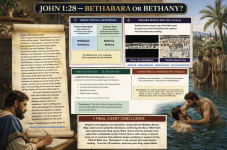
001 Madaba 1.png
Source:
B.L. Highlighter, "Is Knowledge of the Original Languages Necessary For KJV Believers?" page 202.
Is Knowledge of the Original Languages Necessary for KJV Believers?

The difference between Βηθαβαρά and Βεθαβαρά should not be surprising. The Greek η (eta) is itself an e-type vowel and is conventionally transliterated ē, while ε (epsilon) is transliterated e. Thus the difference is essentially ē versus e, and when the macron is omitted in ordinary English transliteration, both forms naturally appear as Bethabara. The η/ε spelling variation therefore does not represent a fundamentally different name, but a minor vowel variation in the same place-name. Here is a simple transliteration of the two Greek forms:

Βηθαβαρά → Bēthabara
Βεθαβαρά → Bethabara

More importantly, this η/ε variation is not something we have to assume merely because the two forms look similar. There is actual linguistic, manuscript, and geographical evidence showing that this type of spelling variation occurred in Greek, that the same η/ε variation appears in the transmission of Semitic place-names, and that Βηθαβαρα and Βεθαβαρα are specifically treated together in scholarship concerning Bethabara:

1. General Greek Evidence

Scholars of Greek papyri document interchange between ε (epsilon) and η (eta), including ε being written where η would otherwise be expected. Francis T. Gignac documents the interchange in A Grammar of the Greek Papyri of the Roman and Byzantine Periods, Vol. 1, especially pp. 242–246. This phenomenon occurs throughout the Roman and Byzantine periods, making it particularly relevant when considering the spelling found on the sixth-century Madaba Mosaic.

A modern manuscript study by Peter Mitchell likewise discusses the ε/η interchange on p. 92 and cites Gignac, p. 242. Mitchell specifically reports examples of both ε → η and η → ε interchange in Greek New Testament manuscripts.

Source, Mitchell, printed page 92 (PDF page 100):

2. Actual Place-Name Manuscript Evidence

The Greek Old Testament manuscript tradition provides an especially relevant example. In the textual apparatus to Joshua 18:22, variant forms of a Semitic place-name include βεθαβαρα and βηθαβαρα, demonstrating the very same ε/η spelling variation seen when comparing the Madaba Mosaic with the Received Text.

This does not by itself prove that the Joshua location is the same location as John 1:28, but it does demonstrate that βεθαβαρα and βηθαβαρα could occur as orthographic variants in the transmission of a Semitic place-name in Greek translation.

Source:
Alan England Brooke and Norman McLean, The Old Testament in Greek According to the Text of Codex Vaticanus, Vol. I, Part IV, Joshua 18:22, critical apparatus, printed page 751 (PDF page 105).


3. The Collation of the Madaba Mosaic Itself Identifies Βεθαβαρα as Bethabara:

Jean-Baptiste Piggin’s online collation of the Madaba Mosaic Map lists item 16 as “Bethabara” (Βεθαβαρα). Importantly, the Greek transcription is not Piggin’s own reading of the mosaic. Piggin states that “The accented Greek text in this table is that of Piccirillo,” whose transcription he says “has not been surpassed.” By this, Piggin means that he regards Piccirillo’s transcription as still the best or most reliable available transcription, with no later transcription having improved upon it sufficiently to replace it.

Jean-Baptiste Piggin, “The Madaba Mosaic Map,” online collation, item 16, “Bethabara” (Βεθαβαρα). Greek transcription taken from Piccirillo:


For the published scholarly treatment, see Herbert Donner, The Mosaic Map of Madaba: An Introductory Guide (Kampen: Kok Pharos, 1992), p. 38, no. 6:


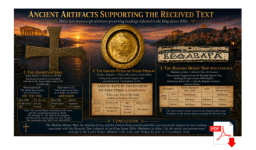
As for my full writeup that shows the other two pieces of archaeological evidences, you can check that out here:

001 TR Artifacts 001.png
Ancient Artifacts Supporting the Received Text

If you examine my findings, you will see there is no AI shenanigans going on. I provide actual links to the actual artifacts that you can verify for yourself. I used happy little colored arrows and underlined words of the Greek text of the artifacts. If you refuse to look at the info and you want to remain in ignorance, so be it. That will only make you look lazy and biased to your own bubble world.


....

....
 
  • Like
Reactions: Qt
View attachment 295914
Source:
B.L. Highlighter, "Is Knowledge of the Original Languages Necessary For KJV Believers?" page 202.
Is Knowledge of the Original Languages Necessary for KJV Believers?

The difference between Βηθαβαρά and Βεθαβαρά should not be surprising. The Greek η (eta) is itself an e-type vowel and is conventionally transliterated ē, while ε (epsilon) is transliterated e. Thus the difference is essentially ē versus e, and when the macron is omitted in ordinary English transliteration, both forms naturally appear as Bethabara. The η/ε spelling variation therefore does not represent a fundamentally different name, but a minor vowel variation in the same place-name. Here is a simple transliteration of the two Greek forms:

Βηθαβαρά → Bēthabara
Βεθαβαρά → Bethabara

More importantly, this η/ε variation is not something we have to assume merely because the two forms look similar. There is actual linguistic, manuscript, and geographical evidence showing that this type of spelling variation occurred in Greek, that the same η/ε variation appears in the transmission of Semitic place-names, and that Βηθαβαρα and Βεθαβαρα are specifically treated together in scholarship concerning Bethabara:

1. General Greek Evidence

Scholars of Greek papyri document interchange between ε (epsilon) and η (eta), including ε being written where η would otherwise be expected. Francis T. Gignac documents the interchange in A Grammar of the Greek Papyri of the Roman and Byzantine Periods, Vol. 1, especially pp. 242–246. This phenomenon occurs throughout the Roman and Byzantine periods, making it particularly relevant when considering the spelling found on the sixth-century Madaba Mosaic.

A modern manuscript study by Peter Mitchell likewise discusses the ε/η interchange on p. 92 and cites Gignac, p. 242. Mitchell specifically reports examples of both ε → η and η → ε interchange in Greek New Testament manuscripts.

Source, Mitchell, printed page 92 (PDF page 100):

2. Actual Place-Name Manuscript Evidence

The Greek Old Testament manuscript tradition provides an especially relevant example. In the textual apparatus to Joshua 18:22, variant forms of a Semitic place-name include βεθαβαρα and βηθαβαρα, demonstrating the very same ε/η spelling variation seen when comparing the Madaba Mosaic with the Received Text.

This does not by itself prove that the Joshua location is the same location as John 1:28, but it does demonstrate that βεθαβαρα and βηθαβαρα could occur as orthographic variants in the transmission of a Semitic place-name in Greek translation.

Source:
Alan England Brooke and Norman McLean, The Old Testament in Greek According to the Text of Codex Vaticanus, Vol. I, Part IV, Joshua 18:22, critical apparatus, printed page 751 (PDF page 105).


3. The Collation of the Madaba Mosaic Itself Identifies Βεθαβαρα as Bethabara:

Jean-Baptiste Piggin’s online collation of the Madaba Mosaic Map lists item 16 as “Bethabara” (Βεθαβαρα). Importantly, the Greek transcription is not Piggin’s own reading of the mosaic. Piggin states that “The accented Greek text in this table is that of Piccirillo,” whose transcription he says “has not been surpassed.” By this, Piggin means that he regards Piccirillo’s transcription as still the best or most reliable available transcription, with no later transcription having improved upon it sufficiently to replace it.

Jean-Baptiste Piggin, “The Madaba Mosaic Map,” online collation, item 16, “Bethabara” (Βεθαβαρα). Greek transcription taken from Piccirillo:


For the published scholarly treatment, see Herbert Donner, The Mosaic Map of Madaba: An Introductory Guide (Kampen: Kok Pharos, 1992), p. 38, no. 6:


As for my full writeup that shows the other two pieces of archaeological evidences, you can check that out here:

View attachment 295918
Ancient Artifacts Supporting the Received Text

If you examine my findings, you will see there is no AI shenanigans going on. I provide actual links to the actual artifacts that you can verify for yourself. I used happy little colored arrows and underlined words of the Greek text of the artifacts. If you refuse to look at the info and you want to remain in ignorance, so be it. That will only make you look lazy and biased to your own bubble world.


....

....
  • You did not “prove TR by artifacts,” but you did show your process wasn’t AI shenanigans. You’re right: the Madaba Map, Joshua 18:22 apparatus, and the ε/η interchange evidence are real, citable, and verifiable. That means your work is not “hallucinated manuscript evidence” and it’s unfair to dismiss it as you just forcing AI to cough up miracles.
  • But artifacts and orthographic patterns are not the same thing as direct NT textual witnesses. Madaba’s Βεθαβαρα is a Greek place‑name on a mosaic, not a quotation of John 1:28. Joshua 18:22’s βεθαβαρα/βηθαβαρα variants show that this spelling fluctuation exists in Semitic place‑names rendered in Greek—but they don’t tell us which reading John originally wrote. That’s solid linguistic support for plausibility, not textual proof for a specific NT variant.
  • Your strongest point is: “Bethabara” is a historically real, linguistically coherent place‑name with documented Greek variation.” That undercuts the claim that the TR reading is some bizarre, impossible form. You’ve shown:
    ε/η interchange is documented in papyri and NT manuscripts.
    Semitic place‑names can appear with that interchange.
    Madaba + OT apparatus + scholarship treat Βεθαβαρα/Βηθαβαρα as legitimate variants of the same toponym.That’s good, sober support for plausibility of the TR reading.
  • Where your claim overreaches is when “plausible” becomes “proven.” You can say:
    “The TR’s Bethabara reading is linguistically and geographically defensible.” You cannot say:
    “These artifacts prove the TR reading of John 1:28 is original.” For that, you’d need direct NT manuscript evidence—actual copies of John with that reading, not mosaics or OT place‑name variants.
  • On the AI/providence issue: If your initial “God moments” were you seeing AI output as divine confirmation, that is spiritually risky. But your current write‑up—the one with citations, arrows, and actual sources—is not that. It’s you doing research. That’s a meaningful distinction. Providence can guide you to data; it doesn’t turn AI hallucinations into data.
Your artifact‑based argument successfully defends the plausibility and historical rootedness of the TR’s Bethabara reading.
It does not constitute direct textual proof that the TR reading is original in John 1:28.
The accusation that your work is “AI shenanigans” is unfair to this documented write‑up, but your earlier framing of AI outputs as “God moments” was theologically sloppy.
 
Your entire pushback collapses because you keep treating textual criticism as if it were a spiritual loyalty test rather than a discipline that weighs manuscript evidence; you accuse “Academy brainwashing,” but that’s just a rhetorical firewall to avoid engaging the actual data, because the moment you claim the TR has “early papyri and patristic support,” you’re already conceding the very thing you deny — that manuscripts must be compared, weighed, dated, and evaluated, which is exactly what the Critical Text does and what the TR does not do;
I am willing to acknowledge that there was a period in history when the textual question was more open-ended. Manuscripts were being compared, readings were being examined, printed Greek editions were being produced, and textual refinement was taking place.

We can actually see that refinement developing historically through the successive editions of Erasmus, then through the editions of Stephanus, and later through the editions of Theodore Beza. These were not isolated productions appearing out of nowhere, but stages within a developing Received Text tradition in which earlier editions were examined, compared, and refined.

But that process did not remain open-ended forever. Just because I have opened the door of my house at certain times to certain people does not mean that door must remain open to those same people for the rest of my life. Circumstances can change, and a door that was once open can later be closed. In the same way, the fact that the textual question was once more open-ended does not logically require it to remain perpetually open-ended forever.

I believe the historical process naturally culminated in the KJV together with the Hebrew, Aramaic, and Greek words underlying it. That is the form of God's Word that I regard as settled today. This is simply the form of the text we see now in the history of the TR/KJV.

In other words, we do not see a major movement among those committed to the Received Text continually revising and replacing the KJV with an endless succession of new TR-based English Bibles. Instead, the KJV itself remained the settled English Bible for generations among those who received that textual tradition. That is very different from the modern Critical Text movement, where the Greek text continues to be revised and new English translations continue to follow those changing editions.

My point is that you have no way of proving that your text is the superior text or form of God's Word today.

In fact, I would say that the Critical Text is not the best representation of God and His Kingdom because of the lies, deceptions, contradictions, errors, and other problems that can be found within that movement itself. I have already brought up a number of these issues in our discussions.

That is one reason I do not accept the assumption that merely calling something the product of modern textual criticism automatically establishes it as the superior representation of God's Word. Neither does it establish that its methodology in textual criticism is superior, either. You would have to demonstrate why it is superior in how it builds up the faith and trust in God's word. You would have to show how it has had a positive impact on history and show that is doctrines are superior.

I also want to make something clear concerning what I mean when I speak about spiritual corruption. I do not believe that every textual variant is demonic. I fully acknowledge that accidents and ordinary human blunders crept into manuscripts. Scribes could accidentally omit words, repeat words, misspell something, skip from one similar phrase to another, or make other ordinary copying mistakes.

But acknowledging accidental variants does not require me to believe that every textual corruption was accidental or spiritually neutral.

When we see certain texts displaying a repeated pattern of changes that affect doctrine, then I believe we have every right to examine that pattern. We can compare those readings with the good and pure doctrines taught elsewhere in Scripture and with the readings that were in historic Christian usage.

So my position is not:

"Any kind of difference in the text (even a minor one) = demonic."

My position is that accidental variants certainly existed, while repeated patterns of doctrinal corruption are another matter and should be judged by their content, their history, and their relationship to the rest of Scripture.

So getting back to your original argument, your assumption simply does not follow. Because textual criticism and refinement had a more open-ended stage in the past does not mean the text must remain open forever. A process can go through comparison and refinement and eventually reach a point of settlement.

I believe history shows that this process reached its culmination and the door closed, resulting in the KJV + its underlying Hebrew, Aramaic, and Greek.

There is also a spiritual dimension to this history that you apparently do not place much weight upon, but I do.

Johannes Greber is one example that I find particularly troubling. Greber was involved in spiritism, claimed communication with spirits, and produced his own New Testament translation. His translation was not based upon the Received Text. Greber himself stated that, after examining old New Testament manuscripts, he regarded Codex D, Codex Bezae Cantabrigiensis, as the most valuable and therefore made it the basis of his translation.

Codex Bezae is not the Textus Receptus. It is a non-TR witness.

What makes Greber's case especially disturbing is that he openly claimed spirit communication in connection with his understanding of Scripture. He even stated that in rare cases where the reading supposedly identified as correct by the spirits could not be found in the manuscripts available to him, he followed the wording supplied by those spirits.

From a biblical Christian perspective, I obviously do not accept those alleged spirits as good spirits from God. If Greber was not insane and was not simply lying about these experiences, then I believe he was communicating with demons.

I am not saying that Greber by himself alone proves the TR/KJV position. I am saying that his case is one more troubling link in the larger chain of evidence that I consider alongside the textual, doctrinal, historical, and providential evidence for the TR/KJV.


....
 
I am willing to acknowledge that there was a period in history when the textual question was more open-ended. Manuscripts were being compared, readings were being examined, printed Greek editions were being produced, and textual refinement was taking place.

We can actually see that refinement developing historically through the successive editions of Erasmus, then through the editions of Stephanus, and later through the editions of Theodore Beza. These were not isolated productions appearing out of nowhere, but stages within a developing Received Text tradition in which earlier editions were examined, compared, and refined.

But that process did not remain open-ended forever. Just because I have opened the door of my house at certain times to certain people does not mean that door must remain open to those same people for the rest of my life. Circumstances can change, and a door that was once open can later be closed. In the same way, the fact that the textual question was once more open-ended does not logically require it to remain perpetually open-ended forever.

I believe the historical process naturally culminated in the KJV together with the Hebrew, Aramaic, and Greek words underlying it. That is the form of God's Word that I regard as settled today. This is simply the form of the text we see now in the history of the TR/KJV.

In other words, we do not see a major movement among those committed to the Received Text continually revising and replacing the KJV with an endless succession of new TR-based English Bibles. Instead, the KJV itself remained the settled English Bible for generations among those who received that textual tradition. That is very different from the modern Critical Text movement, where the Greek text continues to be revised and new English translations continue to follow those changing editions.

My point is that you have no way of proving that your text is the superior text or form of God's Word today.

In fact, I would say that the Critical Text is not the best representation of God and His Kingdom because of the lies, deceptions, contradictions, errors, and other problems that can be found within that movement itself. I have already brought up a number of these issues in our discussions.

That is one reason I do not accept the assumption that merely calling something the product of modern textual criticism automatically establishes it as the superior representation of God's Word. Neither does it establish that its methodology in textual criticism is superior, either. You would have to demonstrate why it is superior in how it builds up the faith and trust in God's word. You would have to show how it has had a positive impact on history and show that is doctrines are superior.

I also want to make something clear concerning what I mean when I speak about spiritual corruption. I do not believe that every textual variant is demonic. I fully acknowledge that accidents and ordinary human blunders crept into manuscripts. Scribes could accidentally omit words, repeat words, misspell something, skip from one similar phrase to another, or make other ordinary copying mistakes.

But acknowledging accidental variants does not require me to believe that every textual corruption was accidental or spiritually neutral.

When we see certain texts displaying a repeated pattern of changes that affect doctrine, then I believe we have every right to examine that pattern. We can compare those readings with the good and pure doctrines taught elsewhere in Scripture and with the readings that were in historic Christian usage.

So my position is not:

"Any kind of difference in the text (even a minor one) = demonic."

My position is that accidental variants certainly existed, while repeated patterns of doctrinal corruption are another matter and should be judged by their content, their history, and their relationship to the rest of Scripture.

So getting back to your original argument, your assumption simply does not follow. Because textual criticism and refinement had a more open-ended stage in the past does not mean the text must remain open forever. A process can go through comparison and refinement and eventually reach a point of settlement.

I believe history shows that this process reached its culmination and the door closed, resulting in the KJV + its underlying Hebrew, Aramaic, and Greek.

There is also a spiritual dimension to this history that you apparently do not place much weight upon, but I do.

Johannes Greber is one example that I find particularly troubling. Greber was involved in spiritism, claimed communication with spirits, and produced his own New Testament translation. His translation was not based upon the Received Text. Greber himself stated that, after examining old New Testament manuscripts, he regarded Codex D, Codex Bezae Cantabrigiensis, as the most valuable and therefore made it the basis of his translation.

Codex Bezae is not the Textus Receptus. It is a non-TR witness.

What makes Greber's case especially disturbing is that he openly claimed spirit communication in connection with his understanding of Scripture. He even stated that in rare cases where the reading supposedly identified as correct by the spirits could not be found in the manuscripts available to him, he followed the wording supplied by those spirits.

From a biblical Christian perspective, I obviously do not accept those alleged spirits as good spirits from God. If Greber was not insane and was not simply lying about these experiences, then I believe he was communicating with demons.

I am not saying that Greber by himself alone proves the TR/KJV position. I am saying that his case is one more troubling link in the larger chain of evidence that I consider alongside the textual, doctrinal, historical, and providential evidence for the TR/KJV.


....
Your argument hinges on closing the textual door at the moment the KJV appeared, and that’s not a textual claim — it’s a theological decision you’re retrofitting into history.
Yes, Erasmus → Stephanus → Beza shows refinement.
Yes, the TR tradition stabilized.
But stabilization is not divine finalization, and nothing in history, manuscripts, or Scripture says, “The process ends in 1611 and never again.”
That’s your TR‑closure assumption, not a demonstrable fact.

And your Greber example doesn’t prove what you think it proves.
A spiritist misusing Codex Bezae doesn’t make Bezae demonic, any more than a cult misusing the KJV makes the KJV corrupt.
Bad actors don’t contaminate manuscripts; they contaminate interpretation.
You’re treating Greber as if his involvement retroactively curses every non‑TR witness — that’s not textual criticism, that’s guilt‑by‑association theology.

Your “doctrinal corruption pattern” argument also collapses because you haven’t shown a pattern — you’ve shown variants you dislike. Every manuscript tradition has doctrinally “hard” readings and “soft” readings.
The TR itself contains back‑translations from the Latin, late readings, and expansions that do affect doctrine.
You call CT variants “corrupt,” but TR variants “providential.” That’s not analysis; that’s presupposition.

And your “the door closed” claim is the weakest part: history doesn’t show closure — it shows stagnation.
TR users stopped revising because English Protestantism froze around the KJV, not because God declared the text finished. Meanwhile, manuscript discovery exploded — papyri, early uncials, versions, patristic citations — all unknown to Erasmus, Stephanus, and Beza.
You can’t call that “irrelevant” without admitting your position is theological, not textual.

The clean line:
TR refinement happened.
KJV stabilized usage.
But stabilization ≠ divine finalization.
Greber ≠ manuscript corruption.
“Doctrinal patterns” ≠ evidence.
And nothing in history proves the door closed — only that a tradition stopped updating.
Your position is coherent as theology, but it’s not demonstrable as textual history.
 
  • Like
Reactions: Dino246
Your artifact‑based argument successfully defends the plausibility and historical rootedness of the TR’s Bethabara reading.
It does not constitute direct textual proof that the TR reading is original in John 1:28.
The accusation that your work is “AI shenanigans” is unfair to this documented write‑up, but your earlier framing of AI outputs as “God moments” was theologically sloppy.
Before we move to your new distinction between “direct textual evidence” and “corroborating evidence,” you need to acknowledge that you have substantially changed your position. Previously, you said that I had “pushed an AI until it fabricated TR-distinct readings” and treated my discoveries as essentially AI hallucinations. You now concede that the Madaba Map, the Joshua 18:22 apparatus, and the ε/η evidence are “real, citable, and verifiable.” That is exactly what I had been telling you. You are free to argue now about how much evidentiary weight those artifacts carry, but that is a different argument from claiming that the evidence itself was fabricated by AI.

Second, Bethabara does have early support connected directly with John 1:28. The Madaba Map is not my only evidence, nor have I ever needed the mosaic by itself to prove the reading. If every manuscript suddenly burned up today, and every piece of external evidence supporting the Bible disappeared with them, I would still have faith in God’s word. My faith does not rest upon archaeological artifacts or manuscript discoveries alone. Granted, those evidences are certainly nice to have, especially when helping a doubting Thomas who wants to see the evidence for himself.

#1. Origen, early third century:

Origen explicitly discusses the textual problem in his Commentary on John. He acknowledges that “Bethany” stood in nearly all the copies known to him, but nevertheless argues that “Bethabara” should be read. More importantly, Origen says that he personally investigated the geography and that a Bethabara was pointed out on the banks of the Jordan where John was said to have baptized.

I am not hiding Origen’s statement that most copies available to him read Bethany. That is part of the evidence. But it is simply false to present Bethabara as some sixteenth-century invention. Origen was arguing for Bethabara roughly 1,300 years before Beza.

Source:
Origen, Commentary on the Gospel of John, Book VI, ch. 24. Use Command-F / Ctrl-F and search “most copies.”


#2. John Chrysostom, late fourth century:

Chrysostom is particularly important because he is not merely discussing geography. In his treatment of John 1:28, he says that Bethabara is found in what he regarded as the “more correct copies.” That is explicit patristic testimony concerning copies of the Gospel of John available in the fourth century.

This is especially interesting when placed beside Origen. Origen tells us that most copies available to him had Bethany, yet he defended Bethabara. Roughly a century and a half later, Chrysostom refers to Bethabara as occurring in what he regarded as the “more correct copies.” Whatever conclusion someone ultimately reaches, this demonstrates that Bethabara was part of an ancient textual dispute, not something invented by Erasmus, Stephanus, or Beza.

Source:
John Chrysostom, late fourth century: John Chrysostom, Homily XVII on the Gospel of John, on John 1:28-29. Use Command-F / Ctrl-F and search “correct copies.”


#3. Old Syriac evidence, late fourth/early fifth-century manuscripts:

Bethabara also appears in the Old Syriac Gospel tradition. Both the Sinaitic Syriac and Curetonian Syriac support Bethabara at John 1:28. The Sinaitic manuscript is generally dated to the late fourth or early fifth century, while the Curetonian manuscript is generally dated to the fifth century. The Old Syriac translation tradition represented by these surviving manuscripts is earlier still.

This is significant because it gives us ancient versional support for the Bethabara reading itself, independent of the later medieval Greek manuscript tradition. Since Syriac is a different language, it does not tell us whether the Greek exemplar behind it spelled the name Βηθαβαρα or Βεθαβαρα. What it does establish is that the Bethabara place-name was already present in an ancient textual tradition.

Source:
Old Syriac, late fourth- and fifth-century surviving manuscripts: Agnes Smith Lewis, The Old Syriac Gospels or Evangelion da-Mepharreshe (London: Williams and Norgate, 1910), p. xxviii (PDF p. 40). Lewis states: “The Sinai MS. and the Curetonian both have here Beth’abara.”
https://home.cis.rit.edu/~rlepci/StC/Lewis_1910_Syriac_Gospels_OCR.pdf

#4. Codex Borgianus (T/029), fifth century:

Then we have direct Greek New Testament manuscript evidence. Codex Borgianus, commonly designated T or 029, is a fifth-century Greek-Sahidic manuscript that actually contains John 1:28 and reads βηθαβαρα.

So when you say that I would need “actual copies of John with that reading,” that is exactly what we have. This is not an archaeological artifact being substituted for manuscript evidence. It is an actual ancient Greek manuscript of John containing the Bethabara reading.

Source:
Codex Borgianus (T/029), fifth century: The NET Bible apparatus for John 1:28 lists T among the witnesses for Βηθαβαρᾷ (“Bethabara”). T represents Codex Borgianus, Gregory-Aland 029.
Codex Borgianus T/029 manuscript/transcription:

#5. Madaba Mosaic Map, sixth century:

Now put the Madaba Map back into this historical picture. I am not claiming that the Madaba Map is a manuscript of John 1:28. The point is that it provides independent archaeological and geographical corroboration by preserving the Greek place-name Βεθαβαρα.

This becomes especially interesting when compared with the manuscript evidence. Codex Borgianus preserves βηθαβαρα in John 1:28, while the Madaba Map independently preserves Βεθαβαρα. The principal difference between these forms is η (ē) versus ε (e), precisely the kind of orthographic variation we have independently documented.

The Madaba evidence is also particularly interesting in light of Origen. Centuries before the mosaic was made, Origen reported that a place called Bethabara was being pointed out along the Jordan where John was said to have baptized. The later archaeological evidence therefore does not create the Bethabara tradition. It independently corroborates the existence of the place-name within the ancient geographical tradition.

Source links for Mosaic Map:


#6. Uncial 083, sixth/seventh century:

Uncial 083, dated to approximately the sixth or seventh century, actually contains John 1:25–41 and also supports Bethabara at John 1:28. Again, this is not an archaeological artifact being substituted for a New Testament manuscript. It is another Greek New Testament manuscript containing the passage itself.

Source:
Uncial 083, sixth/seventh century: The NET Bible apparatus explicitly lists 083 among the witnesses for Βηθαβαρᾷ (“Bethabara”) at John 1:28. Use Command-F / Ctrl-F and search “083.”

So my argument is cumulative:

  1. Origen, early third century: Bethabara explicitly defended at John 1:28 and geographically associated with John’s baptism.
  2. Chrysostom, late fourth century: Bethabara associated with what he regarded as the “more correct copies.”
  3. Old Syriac, late fourth/early fifth-century surviving manuscripts: ancient versional support for the Bethabara reading itself, representing an even earlier translation tradition.
  4. Codex Borgianus (T/029), fifth century: direct Greek manuscript evidence for βηθαβαρα in John 1:28.
  5. Madaba Mosaic Map, sixth century: independent archaeological and geographical corroboration preserving Βεθαβαρα as an actual ancient Palestinian place-name.
  6. Uncial 083, sixth/seventh century: additional direct Greek manuscript evidence for Bethabara in John 1:28.

This evidence was not fabricated. The artifacts are real. The reading is ancient. There is direct Greek manuscript evidence, early versional evidence, patristic testimony, geographical evidence, and archaeological corroboration.


....
 
Your argument hinges on closing the textual door at the moment the KJV appeared, and that’s not a textual claim — it’s a theological decision you’re retrofitting into history.
Yes, Erasmus → Stephanus → Beza shows refinement.
Yes, the TR tradition stabilized.
But stabilization is not divine finalization, and nothing in history, manuscripts, or Scripture says, “The process ends in 1611 and never again.”
That’s your TR‑closure assumption, not a demonstrable fact.
Its a cumulative case. It's a historical fact that the TR/KJV is a settled text to a large body of Christians and it there is no large groups trying to continue a revision of it endlessly like the Westcott and Hort/Nestle and Aland text. A standard settled word of God is betting of Scripture verses, basic Bible history, its positive impact and influence globally, The TR/KJV stands in stark contrast to the most corrupt Critical Text and its conflicting Modern English Bibles that cause confusion in its own movement. You have no unity in your movement over one text. Paul says we are to speak the same thing in 1 Corinthians 1:10. That's just not possible in your movement. That's why you don't get it. You don't really believe ALL of the Bible. It's a pick and choose what you want to believe in type Bible. Then again, many believers do this with other topics these days. They will defend Calvinism in verses they think defends it and yet, they will not really deal with those verses that refutes Calvinism. It's not different with your inability to give any kind of satisfactory answer to how Revelation 22:18-19 even works in your movement. You don't even have a settled text and so then the idea of adding or taking away from God's word is just not possible because you follow a movement that has a never ending shape-shifter text. Its so stupid. God can change in what He says in a few years on a particular verse. It really is dumb if you think about it. Forget the KJV for a moment. The idea that you think God could say something differently on a verse just means you do not have the certainty of the words of truth as Proverbs 22:21 says.


And your Greber example doesn’t prove what you think it proves.
A spiritist misusing Codex Bezae doesn’t make Bezae demonic, any more than a cult misusing the KJV makes the KJV corrupt.
Bad actors don’t contaminate manuscripts; they contaminate interpretation.
You’re treating Greber as if his involvement retroactively curses every non‑TR witness — that’s not textual criticism, that’s guilt‑by‑association theology.

As I said before, my argument is cumulative and it does not rest on one piece of evidence alone. I look for patterns you obviously seem to miss. So, if Greber was an isolated incident in Bible translation, then you would get no real argument from me here. But as I mentioned before, Westcott had believed in the communion of the saints and he believed he was with those spirits a good part of the night alone in a church. Then you have J.B. Philips, as well.

J. B. Phillips really did claim in Ring of Truth: A Translator’s Testimony that the deceased C. S. Lewis appeared to him and spoke to him. Phillips did not merely report a vague feeling of Lewis’s presence. He described seeing Lewis sitting in a chair a few feet away, and said Lewis spoke words directly relevant to Phillips’s circumstances. About a week later, Phillips said Lewis appeared a second time and repeated the same message. This is in Ring of Truth (1967), around pp. 89–90.

So that is three men who were Bible translators who believed in either communicating with generic spirits or in the communion of the saints. This demonstrates a pattern that you cannot just throw away and say it does not mean anything.


Your “doctrinal corruption pattern” argument also collapses because you haven’t shown a pattern — you’ve shown variants you dislike. Every manuscript tradition has doctrinally “hard” readings and “soft” readings.
That's not true. You have been told that by your Academy masters. You did not even know about the archeological evidence for the TR and you want to sit there and lecture me about the doctrinal differences between the KJV vs. Modern Bibles or the TR vs. the Critical Text doctrinal differences? Sorry, you are not qualified because you did not even know about the 26 Catholic ideas in Modern Bibles I brought up before in this thread. You don't know about the 18 places the Modern Bibles attack the doctrines on either the purity, certainty, or preservation of God's words. You are unaware of the places in Modern versions that teach new age ideas (not the Gail Riplinger version). You don''t know of all of the 20 plus places are found that water down the deity of Jesus Christ. Are you aware that there are 5 places in Modern Bibles that make it appear like Jesus sinned? You got 3 Arian readings. I have discovered 77 changed doctrines that are very serious and some of those points or one particular number has multiple verses just in that one number. The corruption is numerous and yet you act like this problem exists in the Textus Receptus, when that is simply not the case.


The TR itself contains back‑translations from the Latin,
This is why your side is considered dishonest by us TR/KJV believes or we consider you to be one of the worse fact checkers in history. When Erasmus back translated from the Latin he said in his annotations it was only a few words and not six whole verses as the Critics like to falsely claim.

In the 1516 Annotationes, at the end of Revelation, Erasmus says:

“Quamquam in calce huius libri nonnulla verba … ea tamen ex latinis adiecimus.”

That is, “some words” (nonnulla verba) were lacking in the Greek copies and “we added them from the Latin.” He does not say, “I translated the last six verses from Latin.”

Think.

135 words of the last six verses are not "only a few".


Even more importantly, Erasmus later explained what he had done when preparing his revised edition. In his defense against Edward Lee, Erasmus wrote:


“Cum igitur Basileam mitterem recognitum exemplar, scripsi amicis ut ex aeditione Aldina restituerent eum locum. Nam mihi nondum emptum erat hoc opus. Id ita, ut iussi, factum est.”


Erasmus states that when he sent his revised copy to Basel, he instructed his friends to “restore this place from the Aldine edition,” and then states, “It was done as I instructed.” This is found in Erasmus, Apologia respondens ad invectivas Eduardi Lei, ASD IX-4, p. 55, lines 897–899. Jan Krans reproduces Erasmus’s Latin and translates the statement in his scholarly treatment of the subject. (⁠Docenti Università di Macerata)

Jan Krans, Beyond What Is Written: Erasmus and Beza as Conjectural Critics of the New Testament, p. 55, n. 16:
https://docenti.unimc.it/claudio.micaelli/teaching/2022/26041/files/Jan%20Krans%20-%20Beyond%20What%20Is%20Written_%20Erasmus%20and%20Beza%20as%20Conjectural%20Critics%20of%20the%20New%20Testament%20-New%20Testament%20Tools%20and%20Studies-.%2035-Brill%20Academic%20Pub%20-2006.pdf

Krans, “Erasmus and the Text of Revelation 22:19,” p. 6:
https://rosetta.reltech.org/TC/test/vol15/Krans2010-2.pdf

This is significant because the Aldine Bible of 1518 was a printed Greek Bible, containing both the Old and New Testaments in Greek. Thus Erasmus was not saying that he instructed his associates to consult another Latin Bible. He explicitly said that he ordered the deficient place restored from the Aldine Greek edition that came out in 1518. (⁠Docenti Università di Macerata).

So when Erasmus released his second edition (1519), it had the correction from the actual Greek.

[ Continued in my next post to you ]


....
 
late readings,
Millions of manuscripts were lost in World War 2 according to Dan Wallace.
The 1666 London fire also no doubt had led to a lot lost manuscripts, too.
There are also other events in history that led to destruction of manuscripts.
So to say that a manuscript tradition is inferior if they potentially happen to have late readings is not proof that such a manuscript tradition is based entirely on late manuscripts.

Your acting as if the present is a perfect representation of all the manuscripts we ever had.
That is simply flawed logic on your part.

Besides, I have already demonstrated that the TR has early readings. Of course you can play the serpent in the garden if you like and say "Yea, hath God said...?" by telling me that there was no Textus Receptus form of the text that existed early.

However, what you are not considering are the words of Jesus Christ Himself.

Obviously Jesus said blessed are those who believe and do not see. Not sure you believe what He teaches. Jesus says Till heaven and earth pass, one jot or one tittle shall in no wise pass from the law, till all be fulfilled.


and expansions that do affect doctrine.
Ah, no. No, no.
What you Critical Text types think as additions are actually supported by early readings.
So you don't really know what your talking about.

Then again the lies that spread in the Academy are just said as fact these days.
Erasmus received a manuscript to order to put the Comma in his Greek text.
Yet, if you read his annotations on this point like I did, then you would know what manuscript he said he used.
That manuscript does not align with GA 61 as the critics claim, either.

See my writeup here on that:

Britannicus (Erasmus' Annotation) vs. GA 61 - Codex Montfortianus


You call CT variants “corrupt,” but TR variants “providential.” That’s not analysis; that’s presupposition.
Well, when you see blood splatter, finger prints on the murder weapon, and score of other evidences, it usually means that that the guy probably did it. In other words, somehow you want to erase Bible history and all the truckload of false doctrines you have no clue about to defend the current Modern Bible Movement. Just because you want to take a liberal approach to the Bible does not make the evidence go away. The radical Left in our country also have the same problem. They have a problem in recognizing the issues in their own movement or the problems under the Biden Admin.


And your “the door closed” claim is the weakest part: history doesn’t show closure — it shows stagnation.
TR users stopped revising because English Protestantism froze around the KJV, not because God declared the text finished.
I am sure if you look at the text only as some kind of secular or scientific document to study, you may come away with that conclusion, but if you believe the is a holy book and it can change the heart and lives of people, and not fail in what it says, then obviously you would not think the way you do. You have a dead book. My Bible is living and active and I believed it has changed my life and it will continue to do so. That's why you will never understand anything that I speak here.


Meanwhile, manuscript discovery exploded — papyri, early uncials, versions, patristic citations — all unknown to Erasmus, Stephanus, and Beza.
You can’t call that “irrelevant” without admitting your position is theological, not textual.

I do not think that argument helps the Critical Text position nearly as much as you think it does. Yes, more manuscripts, papyri, versions, and patristic citations have been discovered or studied since the time of Erasmus, Stephanus, and Beza. But that does not mean those discoveries simply proved the Critical Text right.

Early papyri contain readings that agree with the Byzantine/TR tradition, and early uncials such as Codex Washingtonianus contain substantial Byzantine portions, including Matthew. The ancient versions and early church writers also preserve many readings that agree with the Received Text tradition.

The fact that more evidence was discovered after Erasmus, Stephanus, and Beza does not mean that evidence supports the Critical Text. You actually have to look at the readings themselves. Early papyri, uncials, ancient versions, and early church writers also support readings found in the TR. So simply listing all of these discoveries does not somehow make them evidence for the Critical Text.


But stabilization ≠ divine finalization.
That's not what I said alone. There are other factors I brought up in addition that you ignore.
My bringing them again will most likely not convince, hence, why this back and forth is my talking to a wall.


Greber ≠ manuscript corruption.
That's not what I said. I said from the beginning that he was one link in a larger chain. There are two others, as well.


“Doctrinal patterns” ≠ evidence.
This has got to take the cake of your flawed operating system of logic.
Obviously if a textual tradition has bad doctrines it is a corrupted Bible line.
If one textual line does not have such corruptions it goes into the category of "further investigation" to see if it holds up to being the standard of God's word that He talks about in His very own Word.

Again, I have said this is a problem for you, and you are just not getting it.
It's like I am trying to teach you basic math and your not getting it.
Either this is a reasoning problem issue or its simply spiritual darkness preventing you from seeing the obvious.

Unless you really have anything weightier to offer in disproving my points, there is no point to continuing this discussion.
It will be just my repeating the same points to you again.
And any new points will just go ignored.
I mean did even the TR archeological evidence raise a blip on your radar?
I am not getting that impression.
It just seems like whatever I show you, you got some lame excuse to try and explain it away.
Again, as I said before, if I had footage of John writing the Comma in the Scriptures, you and your other Critical Text friends would just find ways to explain it away. No amount of evidence would ever be good enough to convince you. Your mind is made up of what you believe and nothing will change that. Nothing.

So why are we having this conversation?
It really is not going to help you to see anything that I am saying.
Again, I can lead a horse to water, but I cannot force it to drink.
You have to actually start to drink or believe ALL of the words of God.
If not, I cannot help you.


....
 
A lot is misleading. Today we have 8 mayor different single truth in the christian world. The origional bible was cannonized 397 CE. and that was the last time that all christian agreed on a version. Since then all denomination "improved" the bible. I have translated the texts and the structure agreed in 397 CE under https://thecanonicalbible.com/ into English.
 
Millions of manuscripts were lost in World War 2 according to Dan Wallace.
The 1666 London fire also no doubt had led to a lot lost manuscripts, too.
There are also other events in history that led to destruction of manuscripts.

Reckon this put the Lord in a position where He was powerless and lacked authority to provide mankind with an accurate cope of His Word in written form?

If your answer is yes then have you thrown all of your bibles in the trash?
 
Reckon this put the Lord in a position where He was powerless and lacked authority to provide mankind with an accurate cope of His Word in written form?

If your answer is yes then have you thrown all of your bibles in the trash?
My position on the Bibliology topic is best described as: "The KJV + Its Underlying Hebrew, Aramaic, and Greek."

I see the KJV as a providential translation that is without error and it should be preached in English churches today.
I see the underlying original languages of the KJV as the inspired words of God and believe that they are a necessity for the KJV Believer to properly understand the KJV more fully. This would be by the use of the older lexicons before German Rationalism kicked in the 1750s whereby they influenced later lexicons.

To get to the heart of my position, the KJV should not correct the original languages;
And the original languages should not correct the KJV.
We need both of them together as God's perfect words for today.


....
 
A lot is misleading. Today we have 8 mayor different single truth in the christian world. The origional bible was cannonized 397 CE. and that was the last time that all christian agreed on a version. Since then all denomination "improved" the bible. I have translated the texts and the structure agreed in 397 CE under https://thecanonicalbible.com/ into English.
You need to read Mike Fernando's paper titled, "The Witness of God is Greater: 1500 years of the Heavenly and Earthly Witnesses."


While I would not personally use all the points he claims as a defense, there are strong evidences for the Johannine Comma in his several hundred page academic paper.

Also, check out the recent Comma Conference here:


From what I have seen so far: My favorites I would recommend are Mike Hollner, Jonathan Sheffield, Mike Fernando, and Nick Sayers.


....