Bible newcomer perplexed

  • Christian Chat is a moderated online Christian community allowing Christians around the world to fellowship with each other in real time chat via webcam, voice, and text, with the Christian Chat app. You can also start or participate in a Bible-based discussion here in the Christian Chat Forums, where members can also share with each other their own videos, pictures, or favorite Christian music.

    If you are a Christian and need encouragement and fellowship, we're here for you! If you are not a Christian but interested in knowing more about Jesus our Lord, you're also welcome! Want to know what the Bible says, and how you can apply it to your life? Join us!

    To make new Christian friends now around the world, click here to join Christian Chat.
I''m a newcomer to the bible, which I'm reading for the first time, aged 65. I started the New Testament and am now through to reading Romans. I'm not yet a believer, but think christianity may be the true counter to the terrible evil I see around me in the world.

Without wanting to offend anyone here, on several occasions I've felt that what I read does not seem kindly, generous or forgiving (my preconceived notion of christianity). I may be misinterpreting what I read; knowledgeable believers here may be able to help me better understand the text.

Firstly in Romans, from my understanding, it explains that God demanded that His own son Jesus die. Yes, it was for the sins of humanity in order that they could be born again, and yes, Jesus would be resurrected...but He still demanded that Jesus undergo an extremely painful death for what could be seen as a project of his father's (i.e. saving humanity). I find it troubling that the compassionate God would sacrifice his own son as a means of achieving his ends. How can this be explained?

Secondly, a couple of points related to the issue of eternal damnation. Take Luke 16:16. Those who believe and are baptized will be saved but "anyone who refuses to believe will be condemned". This condemnation of the non-believer to eternal damnation seems terribly harsh.

Wouldn't giving non-believers no afterlife at all be more appropriate than giving them eternal torture in hell? After all, if people hear the message but don't believe, isn't it partly what we'd call a "communication problem": the message was not convincing enough?

Isn't this especially true for all those who lived after Jesus' life - they never saw the miracles or heard the man Jesus speak? They only have second hand accounts passed down the generations (open to being rewritten, mistranslated etc.). Damnation is otherwise reserved for real evil-doers (murderers etc), whereas arguably unbelievers have strayed by omission rather than by a positive act.

This 'damnation-message of God' issue begs the question as to why God has not sent any other divine messenger to earth in the 2000 years since Jesus' ascendance. Surely that would convert millions to the true path?

Many thanks for any helpful guidance.
In our courts today, “eye witness” testimony is still the strongest and most powerful evidence you can give. That’s what we have in the New Testament: EYEWITNESS TESTIMONY! In 1 Cor. 15:3-8 Paul says that many of the eyewitnesses that saw the risen Christ are still alive to this day.
John 1:1 says that they Heard Him, they SAW Him with their eyes, and they TOUCHED him with their hands.
2 Peter 1:16 says, “We were EYEWITNESSES of His Majesty.”
Jesus Himself told His disciples, “ You will be my witnesses.” So every miracle recorded in the book of John is there, John says, so that you can “BELIEVE.”” John 20:30. Everything Jesus said and did recorded for us in the gospels is like us seeing it, just as they saw it. We can see the miracles of Jesus; we can hear his teaching; we are there at His cruifixtion and death. We hear Him say “Father forgive them for hey know not what they do.” We are there at the empty tomb on Sunday morning and we see the grave cloths folded and the angels who said “He is not here.” The testimony is powerful. No one has ever been able to explain the empty tomb—not for 2000 years! I thrill to the stories of the eyewitnesses just as if I was there ! I don’t have to be there in person; I don’t have to hear Him speak, in order to believe.

When Thomas felt the nail prints in Jesus’s hands and touched his side where the spear entered, he believed. But Jesus is more impressed with those of us who live 2000 years later. Jesus said, “ Thomas , you believe because you have seen me; BLESSED ARE THOSE WHO HAVE NOt SEEN ME AND YET HAVE BELIEVED.” That’s you and me. Jesus knows who we are; He loves us and
appreciates us for believing without being “eyewitnesses.” We are blessed!
 
  • Heart
Reactions: dkontner
I''m a newcomer to the bible, which I'm reading for the first time, aged 65. I started the New Testament and am now through to reading Romans. I'm not yet a believer, but think christianity may be the true counter to the terrible evil I see around me in the world.

Without wanting to offend anyone here, on several occasions I've felt that what I read does not seem kindly, generous or forgiving (my preconceived notion of christianity). I may be misinterpreting what I read; knowledgeable believers here may be able to help me better understand the text.

Firstly in Romans, from my understanding, it explains that God demanded that His own son Jesus die. Yes, it was for the sins of humanity in order that they could be born again, and yes, Jesus would be resurrected...but He still demanded that Jesus undergo an extremely painful death for what could be seen as a project of his father's (i.e. saving humanity). I find it troubling that the compassionate God would sacrifice his own son as a means of achieving his ends. How can this be explained?

Secondly, a couple of points related to the issue of eternal damnation. Take Luke 16:16. Those who believe and are baptized will be saved but "anyone who refuses to believe will be condemned". This condemnation of the non-believer to eternal damnation seems terribly harsh.

Wouldn't giving non-believers no afterlife at all be more appropriate than giving them eternal torture in hell? After all, if people hear the message but don't believe, isn't it partly what we'd call a "communication problem": the message was not convincing enough?

Isn't this especially true for all those who lived after Jesus' life - they never saw the miracles or heard the man Jesus speak? They only have second hand accounts passed down the generations (open to being rewritten, mistranslated etc.). Damnation is otherwise reserved for real evil-doers (murderers etc), whereas arguably unbelievers have strayed by omission rather than by a positive act.

This 'damnation-message of God' issue begs the question as to why God has not sent any other divine messenger to earth in the 2000 years since Jesus' ascendance. Surely that would convert millions to the true path?

Many thanks for any helpful guidance.
Unfortunately, you will find many different and contradicting “opinions” on any Bible discussion site.. it can be confusing and discouraging. I urge you to put your trust in the scriptures. Read and study for yourself. Do your own study before you accept the opinions of men. Psalms 119:160 says that the “sum” of God’s word is truth. You have to know all that God has said on a subject and put it all together to get the “truth”. God did not put the whole gospel in one verse. One rule to remember : the Bible does not contradict itself. One verse does NOT “cancel out” or contradict another verse in a different place. If someone tries to disprove one verse by quoting another verse, that is bad theology. All scripture must harmonize with every other scripture. Otherwise, If this is not true, then we cannot trust the Bible. Whether the subject is, “ baptism”, “hell”, the church, or how to be saved, get you a good concordance and look up and read every scripture that the Holy Spirit says about that subject before you decide what is “truth.”

In Revelation 22:18-19 God warned men not to “add” to or “take away” from His word; and that is exactly what men have done; so be careful. Peter warns about false teachers who have gone out into the world. They work for Satan and they “deceive” people.

2 Cor. 2:11 Paul says we are not ignorant of Satan’s devices or schemes— but I am afraid we are. See how Satan works: (1)
InGen. 3, Satan contradicts God’s command. God said. “if you eat from the tree YOU WILL DIE.” Satan comes along and tells Eve “You will NOT die.” Expect Satan ( through the teachings of men) to contradict what God plainly says in His word.
(2) Satan will “add” words to scripture that are not there and it will completely change the meaning of the verse.
(3) Satan will “pit” scripture against scripture; trying to “cancel out” some passages that teach the “truth.”
 
Unfortunately, you will find many different and contradicting “opinions” on any Bible discussion site.. it can be confusing and discouraging. I urge you to put your trust in the scriptures. Read and study for yourself. Do your own study before you accept the opinions of men. Psalms 119:160 says that the “sum” of God’s word is truth. You have to know all that God has said on a subject and put it all together to get the “truth”. God did not put the whole gospel in one verse. One rule to remember : the Bible does not contradict itself. One verse does NOT “cancel out” or contradict another verse in a different place. If someone tries to disprove one verse by quoting another verse, that is bad theology. All scripture must harmonize with every other scripture. Otherwise, If this is not true, then we cannot trust the Bible. Whether the subject is, “ baptism”, “hell”, the church, or how to be saved, get you a good concordance and look up and read every scripture that the Holy Spirit says about that subject before you decide what is “truth.”

In Revelation 22:18-19 God warned men not to “add” to or “take away” from His word; and that is exactly what men have done; so be careful. Peter warns about false teachers who have gone out into the world. They work for Satan and they “deceive” people.

2 Cor. 2:11 Paul says we are not ignorant of Satan’s devices or schemes— but I am afraid we are. See how Satan works: (1)
InGen. 3, Satan contradicts God’s command. God said. “if you eat from the tree YOU WILL DIE.” Satan comes along and tells Eve “You will NOT die.” Expect Satan ( through the teachings of men) to contradict what God plainly says in His word.
(2) Satan will “add” words to scripture that are not there and it will completely change the meaning of the verse.
(3) Satan will “pit” scripture against scripture; trying to “cancel out” some passages that teach the “truth.”
I agree.
Acts 17:11 is even an example of how some of the early Christians would search the scriptures DAILY to find out if what they were being taught was actually the truth or not.
Keep in mind the NT had not even been written yet or compiled into a cohesive whole.
The only possible scriptures (same as in John 5:39) they could be talking about is the OT.
 
  • Like
Reactions: Beckworth
I agree.
Acts 17:11 is even an example of how some of the early Christians would search the scriptures DAILY to find out if what they were being taught was actually the truth or not.
Keep in mind the NT had not even been written yet or compiled into a cohesive whole.
The only possible scriptures (same as in John 5:39) they could be talking about is the OT.
Yes. Paul always tried to teach that Jesus was the promised Messiah and he used the Old Testament scriptures to prove it. Thankfully, we have the New Law of Christ conveniently put together in a book—the Bible. It’s easy for us to “ prove all things” just as Paul says in 1 Thess. 5:21.
 
I''m a newcomer to the bible, which I'm reading for the first time, aged 65. I started the New Testament and am now through to reading Romans. I'm not yet a believer, but think christianity may be the true counter to the terrible evil I see around me in the world.

Without wanting to offend anyone here, on several occasions I've felt that what I read does not seem kindly, generous or forgiving (my preconceived notion of christianity). I may be misinterpreting what I read; knowledgeable believers here may be able to help me better understand the text.

Firstly in Romans, from my understanding, it explains that God demanded that His own son Jesus die. Yes, it was for the sins of humanity in order that they could be born again, and yes, Jesus would be resurrected...but He still demanded that Jesus undergo an extremely painful death for what could be seen as a project of his father's (i.e. saving humanity). I find it troubling that the compassionate God would sacrifice his own son as a means of achieving his ends. How can this be explained?

Secondly, a couple of points related to the issue of eternal damnation. Take Luke 16:16. Those who believe and are baptized will be saved but "anyone who refuses to believe will be condemned". This condemnation of the non-believer to eternal damnation seems terribly harsh.

Wouldn't giving non-believers no afterlife at all be more appropriate than giving them eternal torture in hell? After all, if people hear the message but don't believe, isn't it partly what we'd call a "communication problem": the message was not convincing enough?

Isn't this especially true for all those who lived after Jesus' life - they never saw the miracles or heard the man Jesus speak? They only have second hand accounts passed down the generations (open to being rewritten, mistranslated etc.). Damnation is otherwise reserved for real evil-doers (murderers etc), whereas arguably unbelievers have strayed by omission rather than by a positive act.

This 'damnation-message of God' issue begs the question as to why God has not sent any other divine messenger to earth in the 2000 years since Jesus' ascendance. Surely that would convert millions to the true path?

Many thanks for any helpful guidance.
 
it was the ultimate sacrifice for Jesus to die on the cross. always know that whatever God decides, it's always correct. trying to figure what God or Jesus does is not a sin, it's natural but we can never allow ourselves to be consumed by it. there's an old Christian saying: "if you don't understand something, trust it". as to your 2nd statement, if you think of what God has done for each individual & as for the human race altogether, you would not grasp it all. imagine all the chances we all have had to hear God's callings. it's in the trillions probably concerning all mankind. for those who choose to remain atheists it's there account of suffering. "they never saw the miracles of heard....." & 2nd hand accounts: read 2nd Timothy 3:16 & 17 & 1st Peter 1:20 & 21. God, Jesus & the Holy Spirit authored the Bible which means there are no 2nd hand accounts. around 40 men wrote God's word on paper with a writing utensil. it is God's Holy Spirit that reveals truths. the gospel of John & 1st John teach on discerning truth. "damnation message"..... no other messenger was needed. we have God's word in which we have free choice & free will to believe. "convert millions"? think of how many people didn't believe who were alive in Jesus day & the ones who saw him! people will always exercise free will & free choice no matter what. & remember, the devil is always working to steal, kill & destroy.
 
There are several other texts in scripture that show death to be a complete state of non existence. The bible calls it sleeping in the dust/ground.

What you have just said is completely contrary to them AND the texts I gave above.

I tend to believe what the bible says rather than someone else's interpretation of what the bible says.

Was Paul dead when he told the early Christians (twice actually) that he was with them in spirit while not being actually physically present in Col 2:5 and I Cor 5:3?
Rather he was saying not physically present with them at those times (in Colossi and Corinth) but in his spirit (AKA heart, desires, thoughts).

In those texts you gave above he IS NOT saying he wishes he was dead so he could go on to be with the Lord. That creates contradictions with the rest of scripture. He DESIRES to be with the Lord but right now he is physically still on earth.

Yes some people were raised from the grave when Jesus was. That was a physical resurrection. They were seen by many. Just as Jesus' resurrection was a physical resurrection.
I have to wonder whether you actually read my entire post. I did not present an interpretation. I pointed out specifics within actual scripture.

And as indicated at the onset: The destination and experience of the faithful after death appear to differ before and after Jesus’ resurrection, although Scripture does not fully explain the nature or extent of that difference.
 
Jesus told the thief on the cross, “This day you shall be with me in paradise.” He did not say “heaven”, He said “paradise.” This also proves that the soul does not stay in the grave after death. It goes somewhere. Scripture says that when Jesus died, God did not leave His body in Hades. The Greek word means “the place of the dead”. It’s where souls go after death to await judgement. Luke 16 describes this place. Paradise is “Abraham’s bosom” where Lazarus was after his death. There is also a place of torment and a great gulf separates the two places. Notice what happens immediately after death: the angels carry Lazarus’s soul to a place of comfort—Abraham’s bosom, paradise. When the rich man dies, he opens his eyes and he is in a place of torment. This is a picture of what happens immediately after death. They are awake, fully conscious. They are not sleeping and they are not in the grave.

The book of Revelation tells us that heaven will be seen coming down as a beautiful bride adorned for her husband AT THE JUDGEMENT. It seems we will all enter heaven and hell at the same time—after judgement. Rev. 20-21.
 
I did read your entire post.
But I see no evidence that the state of the dead (that of perpetual sleep) changes from before Jesus' resurrection to after.

King David still remains in the ground. He has not ascended. Acts 2:29 & 34
Paul knew he would have to wait in the grave. II Tim 4:6-8
So did Job. Job 19:26 (Of course Job could have been raised at Jesus' resurrection. We don't know yet.)
There is no hope of salvation if there is no resurrection. I Cor 15:12-19

What is the point of a resurrection at Jesus' 2nd coming if all His people are already alive and well in heaven?
 
I did read your entire post.
But I see no evidence that the state of the dead (that of perpetual sleep) changes from before Jesus' resurrection to after.

King David still remains in the ground. He has not ascended. Acts 2:29 & 34
Paul knew he would have to wait in the grave. II Tim 4:6-8
So did Job. Job 19:26 (Of course Job could have been raised at Jesus' resurrection. We don't know yet.)
There is no hope of salvation if there is no resurrection. I Cor 15:12-19

What is the point of a resurrection at Jesus' 2nd coming if all His people are already alive and well in heaven?
Ecclesiastes 12:7 tells us that our spirit returns to God upon our death and our bodies return to the dust of the earth. At the resurrection, our bodies are resurrected and transformed into an incorruptible state as shown in 1 Corinthians 15 and joined with our spirit. So, when the Bible refers to "sleep", it is referring to the state of the human body only, not the spirit.
 
  • Like
Reactions: 2ndTimeIsTheCharm
Ecclesiastes 12:7 tells us that our spirit returns to God upon our death and our bodies return to the dust of the earth. At the resurrection, our bodies are resurrected and transformed into an incorruptible state as shown in 1 Corinthians 15 and joined with our spirit. So, when the Bible refers to "sleep", it is referring to the state of the human body only, not the spirit.
In OT Hebrew the word "spirit" also means "breath". The word is "Ruah"
Gen 1:2 says the Ruah (Spirit) of God
Eze 37:39 calls it both wind and breath.
Job uses the same word (Ruah) twice in Job 27:3, 33:4 and 34:14 but the KJV translates it as both spirit AND breath.
When Jesus was crucified He said, "Father, into thy hands I commend my spirit" Luke 23:46. The Greek word is pneuma (wind, breath, air) and the phrase "gave up the ghost" means the same thing in both Greek AND Hebrew "to breathe one's last breath).

It is the breath of life that returns to God. Not some disembodied mindless cloud of vapor that lives forever.

Adam was not GIVEN a living soul in Gen 2:7. He BECAME a living soul when the breath of life entered the body of dust.
Look up the original Hebrew for "living creature" in Gen 1:21 & 24 and 2:19. Compare with the Hebrew for "living soul" in Gen 2:7

A soul is a living being, living creature. Made from the dust and has the breath of life.
Take away the breath, let the body return to dust and the living soul no longer exists. The living being/creature has died

So (unless you talking about the Spirit of God) nowhere does scripture denote the spirit as some conscious life force that survives after death.
 
Ecclesiastes 12:7 tells us that our spirit returns to God upon our death and our bodies return to the dust of the earth. At the resurrection, our bodies are resurrected and transformed into an incorruptible state as shown in 1 Corinthians 15 and joined with our spirit. So, when the Bible refers to "sleep", it is referring to the state of the human body only, not the spirit.
BTW where does it say in I Cor 15 that our bodies are rejoined with our spirits at the resurrection?

Did you just make that up?
 
I''m a newcomer to the bible, which I'm reading for the first time, aged 65. I started the New Testament and am now through to reading Romans. I'm not yet a believer, but think christianity may be the true counter to the terrible evil I see around me in the world.

Without wanting to offend anyone here, on several occasions I've felt that what I read does not seem kindly, generous or forgiving (my preconceived notion of christianity). I may be misinterpreting what I read; knowledgeable believers here may be able to help me better understand the text.

Firstly in Romans, from my understanding, it explains that God demanded that His own son Jesus die. Yes, it was for the sins of humanity in order that they could be born again, and yes, Jesus would be resurrected...but He still demanded that Jesus undergo an extremely painful death for what could be seen as a project of his father's (i.e. saving humanity). I find it troubling that the compassionate God would sacrifice his own son as a means of achieving his ends. How can this be explained?

Secondly, a couple of points related to the issue of eternal damnation. Take Luke 16:16. Those who believe and are baptized will be saved but "anyone who refuses to believe will be condemned". This condemnation of the non-believer to eternal damnation seems terribly harsh.

Wouldn't giving non-believers no afterlife at all be more appropriate than giving them eternal torture in hell? After all, if people hear the message but don't believe, isn't it partly what we'd call a "communication problem": the message was not convincing enough?

Isn't this especially true for all those who lived after Jesus' life - they never saw the miracles or heard the man Jesus speak? They only have second hand accounts passed down the generations (open to being rewritten, mistranslated etc.). Damnation is otherwise reserved for real evil-doers (murderers etc), whereas arguably unbelievers have strayed by omission rather than by a positive act.

This 'damnation-message of God' issue begs the question as to why God has not sent any other divine messenger to earth in the 2000 years since Jesus' ascendance. Surely that would convert millions to the true path?

Many thanks for any helpful guidance.

My friend, as your being bombarded by scripture which may or may not answer your questions due to your understanding now.
Let's visit the very first verse of the Bible Genesis 1:1.
In hopes that you believe this may I suggest that because the word of God has a beginning and end that all of the history of man has been his creation. For God created man. In his image. God and man had a relationship.
Satan came and by his cleverness of words destroyed that relationship.
Jesus came to restore that relationship. Offering up himself as the sacrifice for us all. Gods requirement.
Jesus is God's gift to us for God came to us, man could never go to God.
If you have read some of Paul's teachings I'm sure you have read......it is appointed for man once to die then the judgment
Jesus took the judgment of wrath on the cross for us. Willingly.
For while we were yet sinners Christ died for us. The good shepherd lay his life down for his sheep.
 
BTW where does it say in I Cor 15 that our bodies are rejoined with our spirits at the resurrection?

Did you just make that up?

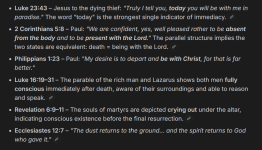
Sorry, "rejoin" was the wrong word to use, as flesh & blood do not enter heaven like 1 Corinthians 15:50 tells us. However, it's clear from the Bible that there is a place that we consciously go after death and before the "resurrection" of a new transformed body.

1788360558136.png1788360558136.png
 
I''m a newcomer to the bible, which I'm reading for the first time, aged 65. I started the New Testament and am now through to reading Romans. I'm not yet a believer, but think christianity may be the true counter to the terrible evil I see around me in the world.

Without wanting to offend anyone here, on several occasions I've felt that what I read does not seem kindly, generous or forgiving (my preconceived notion of christianity). I may be misinterpreting what I read; knowledgeable believers here may be able to help me better understand the text.

Firstly in Romans, from my understanding, it explains that God demanded that His own son Jesus die. Yes, it was for the sins of humanity in order that they could be born again, and yes, Jesus would be resurrected...but He still demanded that Jesus undergo an extremely painful death for what could be seen as a project of his father's (i.e. saving humanity). I find it troubling that the compassionate God would sacrifice his own son as a means of achieving his ends. How can this be explained?
God's righteousness (sense of right and wrong and ultimately His desire to want to save all of us from Hell) exceeds His need/want to provide Even His own son's comfort/unchallenged life.

Everything Jesus experiences in life was finite. He Himself is infinite, and the repercussions of what He did ensured that a great number of souls would be saved is an act that allows us to also live forever.

Christ when tempted was given an opportunity to take a short cut through satan worship to take possession of the world without having to do anything other than to bow down to satan.. He refused satan's offer. (Satan rules/owns this world.)

Meaning Jesus is/was on board with The Father's plan of salvation.

Secondly, a couple of points related to the issue of eternal damnation. Take Luke 16:16. Those who believe and are baptized will be saved but "anyone who refuses to believe will be condemned". This condemnation of the non-believer to eternal damnation seems terribly harsh.
Technically there are only two verses that can be used to support eternal damnation. One in the book of Matthew that describes Hell and It's torments lasting forever. and one in the book of revelation that says Satan and His end times buddies (The Beast, anti christ, those who take the mark of the beast) will burn in Hell forever.

The reason for this punishment is that those who take the mark, are responsible for the destruction of the church in rev 6. They slaughter/martyr the church.
Wouldn't giving non-believers no afterlife at all be more appropriate than giving them eternal torture in hell? After all, if people hear the message but don't believe, isn't it partly what we'd call a "communication problem": the message was not convincing enough?
And if 'no after life' was the purpose of Hell? Hell is described as the grave, the pit, the second death, the place where God destroyes both the new resurrected body and the Soul. These types ov verses appear/repeat over 30 times through out the bible, with only one verse that tells us a particular group is going to hell forever.
Isn't this especially true for all those who lived after Jesus' life - they never saw the miracles or heard the man Jesus speak? They only have second hand accounts passed down the generations (open to being rewritten, mistranslated etc.).
Actually, no. The bible is not a translation of a translation of a translation. We have manuscripts that date back to the 2nd century.
Damnation is otherwise reserved for real evil-doers (murderers etc), whereas arguably unbelievers have strayed by omission rather than by a positive act.

This 'damnation-message of God' issue begs the question as to why God has not sent any other divine messenger to earth in the 2000 years since Jesus' ascendance. Surely that would convert millions to the true path?
He has. This other 'messenger' is the Holy Spirit. We right now have direct access to God here now in real time. With the intervention of the Holy Spirit no other 3rd party messengers are needed.
Many thanks for any helpful guidance.
:)
 
Ecclesiastes 12:7 tells us that our spirit returns to God upon our death and our bodies return to the dust of the earth. At the resurrection, our bodies are resurrected and transformed into an incorruptible state as shown in 1 Corinthians 15 and joined with our spirit. So, when the Bible refers to "sleep", it is referring to the state of the human body only, not the spirit.
I Cor 15:50 says nothing about joining body and spirit back together again

You need to read the context verses 50-57.
For this corruptible must put on incorruption, and this mortal must put on immortality.
So when this corruptible shall have put on incorruption, and this mortal shall have put on immortality, then shall be brought to pass the saying that is written, Death is swallowed up in victory.
O death, where is thy sting? O grave, where is thy victory?

It is "corruption" (corruptible bodies, bodies that degrade and die, MORTAL SOULS) that cannot inherit the kingdom of God.
 
I did read your entire post.
But I see no evidence that the state of the dead (that of perpetual sleep) changes from before Jesus' resurrection to after.

King David still remains in the ground. He has not ascended. Acts 2:29 & 34
Paul knew he would have to wait in the grave. II Tim 4:6-8
So did Job. Job 19:26 (Of course Job could have been raised at Jesus' resurrection. We don't know yet.)
There is no hope of salvation if there is no resurrection. I Cor 15:12-19

What is the point of a resurrection at Jesus' 2nd coming if all His people are already alive and well in heaven?
The resurrection is of the body. Spiritually, we are already in heaven, if indeed we are born again. (Ephesians 2:6) Those who are born again are already alive and will never die. Yes, the body dies, but that is a temporary state until the new body is given to us.

At death, the soul departs to be with the Lord. Since Lord Jesus is in heaven, it seems pretty certain that we will with Him also. (2 Corinthians 5:8)

1 Corinthians 15 goes into great detail regarding the new body that awaits those who are born again. The church will be working in the Kingdom of God; the earthly reign of the Lord Jesus for 1,000 years. Since Lord Jesus has a material body, so will we. We will appear to be entirely normal, as Jesus did when He rose from the dead.​
 
  • Like
Reactions: 2ndTimeIsTheCharm
The resurrection is of the body. Spiritually, we are already in heaven, if indeed we are born again. (Ephesians 2:6) Those who are born again are already alive and will never die. Yes, the body dies, but that is a temporary state until the new body is given to us.

At death, the soul departs to be with the Lord. Since Lord Jesus is in heaven, it seems pretty certain that we will with Him also. (2 Corinthians 5:8)

1 Corinthians 15 goes into great detail regarding the new body that awaits those who are born again. The church will be working in the Kingdom of God; the earthly reign of the Lord Jesus for 1,000 years. Since Lord Jesus has a material body, so will we. We will appear to be entirely normal, as Jesus did when He rose from the dead.​
You are misunderstanding II Cor 5:8
I Cor 5:3 and Col 2:5 explain what he means. Though not physically present all his thoughts and desires are with them.
He is not saying that he has to die to be with them.
 
I Cor 15:50 says nothing about joining body and spirit back together again

You need to read the context verses 50-57.
For this corruptible must put on incorruption, and this mortal must put on immortality.
So when this corruptible shall have put on incorruption, and this mortal shall have put on immortality, then shall be brought to pass the saying that is written, Death is swallowed up in victory.
O death, where is thy sting? O grave, where is thy victory?

It is "corruption" (corruptible bodies, bodies that degrade and die, MORTAL SOULS) that cannot inherit the kingdom of God.

So, how do you explain the previous verses that I've already shared with you? Plus, who and how do you think that after Jesus' resurrection that so many others were resurrected to?

Matthew 27:52-53

52 And the graves were opened; and many bodies of the saints which slept arose,

53 And came out of the graves after his resurrection, and went into the holy city, and appeared unto many.