
Life beyond Earth has finally been found; or so it seems

  • Christian Chat is a moderated online Christian community allowing Christians around the world to fellowship with each other in real time chat via webcam, voice, and text, with the Christian Chat app. You can also start or participate in a Bible-based discussion here in the Christian Chat Forums, where members can also share with each other their own videos, pictures, or favorite Christian music.

    If you are a Christian and need encouragement and fellowship, we're here for you! If you are not a Christian but interested in knowing more about Jesus our Lord, you're also welcome! Want to know what the Bible says, and how you can apply it to your life? Join us!

    To make new Christian friends now around the world, click here to join Christian Chat.

tooldtocare

Banned
Mar 23, 2014
702
5
0
There is a moon circling Saturn that has a warm core, covered in ice and spewing geysers. With a green hew around the geyser points.


Explanation: This cylindrical projection global map is one of six new color maps of Saturn's midsized icy moons, constructed using 10 years of image data from the Cassini spacecraft. Discovered by Cassini (the astronomer) in 1684, Dione is about 1,120 kilometers across. Based on data extending from infrared to ultraviolet, the full resolution of this latest space-age map is 250 meters per pixel. The remarkable brightness difference between the tidally locked moon's lighter leading hemisphere (right) and darker trailing hemisphere clearly stands out. Like other Saturn moons orbiting within the broad E-ring, Dione's leading hemisphere is kept shiny as it picks up a coating of the faint ring's icy material. The E-ring material is constantly replenished by geysers on moon Enceladus' south pole. Lighter, younger surface fractures also appear to cross the dark, cratered trailing hemisphere.
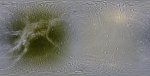

cassini.jpg
 
Life found?


I think what has been found is a green blotch on something very far away.

I have a rock with green blotches and it's never crossed my mind it might be alive.


I think that if we ever have actual proof of life beyond earth, then, at that point, we need to sit down and rationally consider any theological implications.
Personally, I don't see why God couldn't have put some mold or fungus on another planet... maybe he knows we need it for something... maybe the world is about to run out of penicillin, or shiitaki mushrooms, or french bread.

But regardless, we don't need to be overly concerned with the theological implications of a thing which, to date, still isn't a thing.
 
BTW I am not alarmed about this finding.
But I think its life cycle could be of interest.

Should this ever be proven to be life?

btw the geyser's spewing up is saltwater
(:-
 
Last edited:
BTW I am not alarmed about this finding.
But I think its life cycle could be of interest.

Should this ever be proven life?
(:-


So far there is no "life cycle" to be interested in.

It's still just a green blotch.

But I'm all for checking it out.... it is what it is.
 
Noon Titan
Building Block for 'Vinyl Life' Found on Saturn's Moon Titan
When winter comes to Titan’s poles, it brings seasonal downpours of toxic molecules that could, under the right conditions, assemble themselves into structures like the biological membranes that encase living cells on Earth.
Called vinyl cyanide, those molecules are created high in Titan’s atmosphere, and now, scientists know there’s a truckload of them tucked int
o the moon’s orange haze that probably rain down on its icy surface.
More than 10 billion tons of it could be floating in Ligeia Mare, the second-largest lake in the north, according to the paper
published today in Science Advances.

https://tinyurl.com/y8nysjkc

Noon Enceladus
Enceladus has attracted a lot of interest because it has an active pole that spews jets of material into outer space. During its last flyby over that pole, an instrument on board the Cassini spacecraft detected the presence of a biomarker—molecular hydrogen. This suggests that the ocean we know lies beneath the moon’s surface could indeed contain an ecosystem similar to the ones we find in deep-sea hydrothermal vents on Earth.

Hunter Waite, a researcher at the Southwestern Research Institute in San Antonio, Texas, is the lead author of a paper describing the findings in an upcoming issue of Science. In the piece, the team explains that the molecular hydrogen (H[SUB]2[/SUB]) content was measured using Cassini’s INMS instrument, a mass spectrometer capable of sniffing the molecular composition of gas that it captures.

A global ocean lies beneath the icy crust of Saturn's geologically active moon Enceladus, according to new research using data from NASA's Cassini mission.
Researchers found the magnitude of the moon's very slight wobble, as it orbits Saturn, can only be accounted for if its outer ice shell is not frozen solid to its interior, meaning a global ocean must be present.
The finding implies the fine spray of water vapor, icy particles and simple organic molecules Cassini has observed coming from fractures near the moon's south pole is being fed by this vast liquid water reservoir. The research is presented in a paper published online this week in the journal Icarus.

Astrophysicists working with NASA's Saturn sweeping Cassini spacecraft have just announced that Enceladus has a warm ocean at its southern pole with ongoing hydrothermal activity—the first ever discovered outside of Earth. This new research, published in the journal Nature, builds upon last year's discovery of the moon's 6-mile-deep ocean, which is also believed to contain many of the chemicals commonly associated with life.

https://www.nasa.gov/sites/default/files/thumbnails/image/pia19656_labeled.jpg

clip_image002.jpg

NASA Finds Hydrocarbons on Saturn's Moon Hyperion
07.04.07
PASADENA , Calif. - NASA's Cassini spacecraft has revealed for the first time surface details of Saturn's moon Hyperion, including cup-like craters filled with hydrocarbons that may indicate more widespread presence in our solar system of basic chemicals necessary for life.

Hyperion yielded some of its secrets to the battery of instruments aboard Cassini as the spacecraft flew close by in September 2005. Water and carbon dioxide ices were found, as well as dark material that fits the spectral profile of hydrocarbons.
"Of special interest is the presence on Hyperion of hydrocarbons--combinations of carbon and hydrogen atoms that are found in comets, meteorites, and the dust in our galaxy," said Dale Cruikshank, a planetary scientist at NASA's Ames Research Center, Moffett Field, Calif., and the paper's lead author. "These molecules, when embedded in ice and exposed to ultraviolet light, form new molecules of biological significance. This doesn't mean that we have found life, but it is a further indication that the basic chemistry needed for life is widespread in the universe."

NASA Finds Hydrocarbons on Saturn's Moon Hyperion
07.04.07
PASADENA , Calif. - NASA's Cassini spacecraft has revealed for the first time surface details of Saturn's moon Hyperion, including cup-like craters filled with hydrocarbons that may indicate more widespread presence in our solar system of basic chemicals necessary for life.

Hyperion yielded some of its secrets to the battery of instruments aboard Cassini as the spacecraft flew close by in September 2005. Water and carbon dioxide ices were found, as well as dark material that fits the spectral profile of hydrocarbons.

"Of special interest is the presence on Hyperion of hydrocarbons--combinations of carbon and hydrogen atoms that are found in comets, meteorites, and the dust in our galaxy," said Dale Cruikshank, a planetary scientist at NASA's Ames Research Center, Moffett Field, Calif., and the paper's lead author. "These molecules, when embedded in ice and exposed to ultraviolet light, form new molecules of biological significance. This doesn't mean that we have found life, but it is a further indication that the basic chemistry needed for life is widespread in the universe."
https://www.nasa.gov/mission_pages/cassini/media/cassini20070704.html

https://www.nasa.gov/sites/default/files/thumbnails/image/pia19656_labeled.jpg
 
Noon Enceladus

Enceladus has attracted a lot of interest because it has an active pole thatspews jets of material into outer space. During its last flyby over that pole,an instrument on board the
Cassini spacecraft detected the presence of a biomarker—molecular hydrogen.This suggests that the ocean we know liesbeneath the moon’s surface could indeed contain an ecosystem similar to theones we find in deep-sea hydrothermal vents on Earth.

Hunter Waite, a researcher at the Southwestern Research Institute in SanAntonio, Texas, is the lead author of a paper describing the findings in anupcoming issue of Science. In the piece, the team explains that the molecularhydrogen (H2) content was measured using Cassini’s INMS instrument, a massspectrometer capable of sniffing the molecular composition of gas that itcaptures.

A global ocean lies beneath the icy crust of Saturn's geologically active moonEnceladus, according to new research using data from NASA's Cassini mission.

Researchers found the magnitude of the moon's very slight wobble, as it orbitsSaturn, can only be accounted for if its outer ice shell is not frozen solid toits interior, meaning a global ocean must be present.

The finding implies the fine spray of water vapor, icy particles and simple organic molecules Cassini has observed coming from fractures near the moon'ssouth pole is being fed by this vast liquid water reservoir. The research ispresented in a paper published online this week in the journal Icarus.

Astrophysicists working with NASA's Saturn sweeping Cassini spacecraft havejust announced that
Enceladus has a warm ocean at its southernpole with ongoing hydrothermal activity—the first ever discovered outside ofEarth. This new research, published in the journal Nature, builds upon last year's discovery of the moon's 6-mile-deep ocean, which is alsobelieved to contain many of the chemicals commonly associated with life.

https://www.nasa.gov/sites/default/files/thumbnails/image/pia19656_labeled.jpg


Hyperion yielded some of its secrets to the battery of instruments aboard Cassini as the spacecraft flew close by in September 2005. Water and carbon dioxide ices were found, as well as dark material that fits the spectral profile of hydrocarbons.
"Of special interest is the presence on Hyperion of hydrocarbons--combinations of carbon and hydrogen atoms that are found in comets, meteorites, and the dust in our galaxy," said Dale Cruikshank, a planetary scientist at NASA's Ames Research Center, Moffett Field, Calif., and the paper's lead author. "These molecules, when embedded in ice and exposed to ultraviolet light, form new molecules of biological significance. This doesn't mean that we have found life, but it is a further indication that the basic chemistry needed for life is widespread in the universe."


IF they find some kind of life, we can talk about life.

So far, there still isn't any life to talk about... as is proven by these very articles.


I think science is wonderful... but there's no reason to get ahead of ourselves.


as we know it; if we find all the elements needed to sustain life & we find a green hew on its surface the chances of finding life is greater than not finding life.

In my view (:-
 
  1. Noon Enceladus

    Cassini spacecraft detected the presence of a biomarker—molecular hydrogen. This suggests that the ocean we know lies beneath the moon’s surface could indeed contain an ecosystem similar to the ones we find in deep-sea hydrothermal vents on Earth.

    The finding implies the fine spray of water vapor, icy particles and simple organic molecules Cassini has observed coming from fractures near the moon's south pole is being fed by this vast liquid water reservoir. The research is presented in a paper published online this week in the journal Icarus.

    Astrophysicists working with NASA's Saturn sweeping Cassini spacecraft have just announced that Enceladus has a warm ocean at its southern pole with ongoing hydrothermal activity—the first ever discovered outside of Earth. This new research, published in the journal Nature, builds upon last year's discovery of the moon's 6-mile-deep ocean, which is also believed to contain many of the chemicals commonly associated with life.

    [url]https://www.nasa.gov/sites/default/files/thumbnails/image/pia19656_labeled.jpg[/URL]​
 
Its all very interesting. It puts me in mind of the film 2012 the sequel to 2001. In that Europa one of Jupiter's moons was the place where the Alien civilization lived. This was a remarkable coincidence because it seems that Europa may have an Ocean that could support life. I believe this wasn't discovered when the film was produced.
 
Life found?


I think what has been found is a green blotch on something very far away.

I have a rock with green blotches and it's never crossed my mind it might be alive.


I think that if we ever have actual proof of life beyond earth, then, at that point, we need to sit down and rationally consider any theological implications.
Personally, I don't see why God couldn't have put some mold or fungus on another planet... maybe he knows we need it for something... maybe the world is about to run out of penicillin, or shiitaki mushrooms, or french bread.

But regardless, we don't need to be overly concerned with the theological implications of a thing which, to date, still isn't a thing.

The only problem I have with your theory is the matter of why God would stick stuff on places trillions of miles away when the Moon is a mere hop in comparison. Saturn is a long way to get a french Stick.