A
AgeofKnowledge
Guest
Many of your assertions are false. The United States actually paid off its debt including the interest in its entirely in January 1835, for example. And right after Andrew Jackson "killed the bank", a deep depression followed.
Now the federal reserve (e.g. central bank) isn't a private bank, so that's false. It's a quasi-government banking system run by an appointed Board of Governors that itself IS a federal agency. The President of the U.S. appoints the Chairman and Vice-Chairman of the board. The Board of Governors of the Federal Reserve System, the Federal Reserve banks, and the individual member banks undergo regular audits by the GAO and an outside auditor.
While banking reform is needed, the primary deficit/debt problem isn't the existence of a federal reserve or U.S. central bank but rather the legislature engaging in massive deficit spending every year.
That said, the underlying discussion is complicated and involves issues like treaties and trade as much as banking and fiscal policy.
Talk more later. I have to go see gravity 3D.
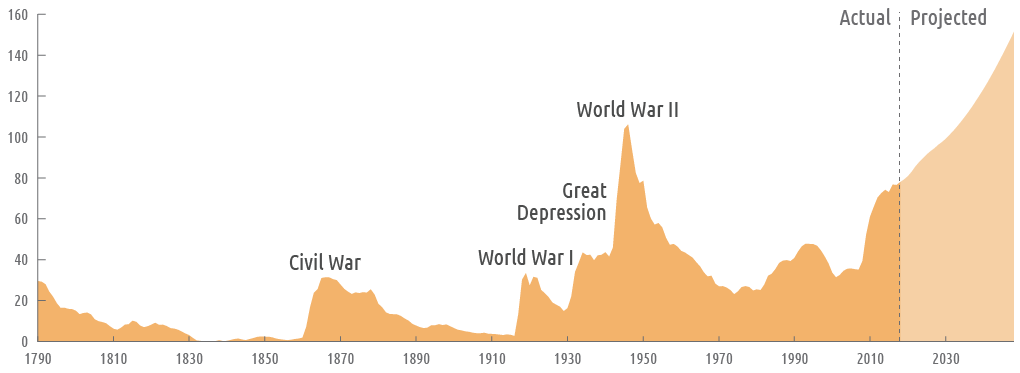
US federal debt held by the public as a percentage of GDP, from 1790 to 2013
Public debt as a percentage of GDP fell rapidly in the post-World War II period, and reached a low in 1973 under President Richard Nixon. The debt burden has consistently increased since then, except during the presidency of Bill Clinton. In recent years sharp increases in deficits and the resulting increases in debt have led to heightened concern about the long-term sustainability of the federal government's fiscal policies.
Now the federal reserve (e.g. central bank) isn't a private bank, so that's false. It's a quasi-government banking system run by an appointed Board of Governors that itself IS a federal agency. The President of the U.S. appoints the Chairman and Vice-Chairman of the board. The Board of Governors of the Federal Reserve System, the Federal Reserve banks, and the individual member banks undergo regular audits by the GAO and an outside auditor.
While banking reform is needed, the primary deficit/debt problem isn't the existence of a federal reserve or U.S. central bank but rather the legislature engaging in massive deficit spending every year.
That said, the underlying discussion is complicated and involves issues like treaties and trade as much as banking and fiscal policy.
Talk more later. I have to go see gravity 3D.
US federal debt held by the public as a percentage of GDP, from 1790 to 2013
Public debt as a percentage of GDP fell rapidly in the post-World War II period, and reached a low in 1973 under President Richard Nixon. The debt burden has consistently increased since then, except during the presidency of Bill Clinton. In recent years sharp increases in deficits and the resulting increases in debt have led to heightened concern about the long-term sustainability of the federal government's fiscal policies.


 . You left out though that our immature politicians also screwed up trade so badly there are very few jobs left outside of government jobs which rely on massive deficit spending to artificially maintain them.
 Global warming will be good ofr you guys, it will open up the whole Canadian Shield.