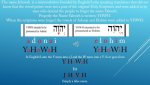
and the most prolific forgery:
The Masorites added vowel points to the manuscripts and sadi YHWH is not to be pronounced as written but to be pronounced with their added vowel points, as Adonai. English and Latin speakers did not understand this when translating and came up with a mixture of the 2: Jehovah.
New Revised Standard Version - Preface
"Careful readers will notice that here and there in the Old Testament the word Lord (or in certain cases God) is printed in capital letters. This represents the traditional manner in English versions of rendering the Divine Name, the "Tetragrammaton" (see the notes on Exodus 3.14, 15), following the precedent of the ancient Greek and Latin translators and the long established practice in the reading of the Hebrew Scriptures in the synagogue. While it is almost if not quite certain that the
Name was originally pronounced "Yahweh," this pronunciation was not indicated when the Masoretes added vowel sounds to the consonantal Hebrew text. To the four consonants YHWH of the Name, which had come to be regarded as too sacred to be pronounced, they attached vowel signs indicating that in its place should be read the Hebrew word Adonai meaning "Lord" (or Elohim meaning "God"). Ancient Greek translators employed the word Kyrios ("Lord") for the Name. The Vulgate likewise used the Latin word Dominus ("Lord").
The form "Jehovah" is of late medieval origin; it is a combination of the consonants of the Divine Name and the vowels attached to it by the Masoretes but belonging to an entirely different word. Although the American Standard Version (1901) had used "Jehovah" to render the Tetragrammaton (the sound of Y being represented by J and the sound of W by V, as in Latin), for two reasons the Committees that produced the RSV and the NRSV returned to the more familiar usage of the King James Version. (1) The word "Jehovah" does not accurately represent any form of the Name ever used in Hebrew. (2) The use of any proper name for the one and only God, as though there were other gods from whom the true God had to be distinguished, began to be discontinued in Judaism before the Christian era and is inappropriate for the universal faith of the Christian Church."
The Interpreters Dictionary of the Bible, Supplementary Volume, page 717
The earliest instance where a word in the biblical text was not read, but another was pronounced in its stead, is that of the TETRAGRAMMATON (YHWH). The
prohibition of pronouncing "The Name," and the obligation of substituting in perpetuity a term that expresses the divine majesty, are explicitly recognized in the
Babylonian Talmud (Pes. 50a): "Said the Holy One, blessed be He: not as I am written, am I read. I am written (yodh-he, i.e., the Tetragrammaton), but I am read (aleph-daleth, i.e., Adonai)." The antiquity of this
prohibition is evident from the fact that the Hebrew Tetragrammaton was not translated in the most ancient recensions of the lxx, where it appears only in Hebrew script. Later it was rendered into Greek by (Lord), which conveys the sense of the Hebrew Adonai. In the Greek text, at the beginning, the same procedure was followed as in the Hebrew, namely, the equivalent of the divine name was first abbreviated, through reverence, into the form , then, in later texts and under Christian influence, it came to be written out fully. In the same way, the Babylonian Targ. on the Pentateuch (Targ. Onkelos) systematically renders the Tetra-grammaton into Aramaic by the abbreviation (the arithmetic equivalent of which __26__ is the same as that of the Tetragrammaton fully written in its Hebrew form).
This ancient prohibition of pronouncing the divine name persisted orally until the introduction of the Hebrew vocalic system, where the vowels written under the Tetragrammaton are those of the substitute word Adonai. Its antiquity clearly shows that it originated in the oldest Jewish oral traditions that accompanied the transmission (masora) of the sacred text from the beginning.
In contrast to the qere perpetuum, substituted orally for the Tetragrammaton, the Masoretic tradition, as a precautionary measure, indicated in the margin of later mss, in the form of a statistical note (=134), the number of times in the text where God is explicitly designated by the title (cf. Gen. 18:3 and passim). In this way, they sought to forestall any change in the form of the sacred text that might be made by an overhasty scribe.