Oh, and by the way, please stop lecturing me on the reasons you don't like my GISS average temperature graph. You have wasted EVERY SINGLE word you've typed by doing this. What you are saying is that a graph that goes from 0 to 120 is not proper because it's too big to show the differences.
Thanks for all those paragraphs and paragraphs of explanation. But you could have just said something like this:
"The word your looking for is perspective"
I also said at the time that I could tell you, but I'd rather you find out on your own. Now do you realize that all that stuff you posted on that graph is just the stuff I was trying to get you to see on
my very first post on the topic?
Since I'm still pretty sure you've missed the point, here it is:
Yes, if you graph global temperatures on a graph that mostly represents real world temps (0-120), the change is not discernable.
THAT IS THE POINT. It is ONLY by making the tiny temperature anomalies appear massive on a graph with a very tiny scale, do you get to the alarmist position. In other words, when you made all those speeches decrying graph scale, you were talking to yourself, about YOUR graph.
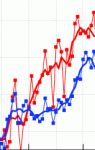
For example, you show a graph with what looks like huge temp anomalies. Since you start at 1880 (The end of the Little Ice Age, one of the coldest periods), you have a slope that goes upward for a set period of time. Of course, you then infer that this means that it will keep going up and increasing. The reason you believe this, is that you lack perspective. For example:
View attachment 97707
Now, if this were a graph of the last 35 years, you'd continue to post it as 'proof' that the planet is warming and that it's warming exponentially, and that it will continue to do so.
But actually it's chopped off your graph, a period from around 1910 - 1945. And even though by your logic the temps should have continued to go up (particularly with the exponential increases in CO2 that started around then), the temps actually decreased pretty substantially for the next 35 years, leading to Time Magazine doing exactly what you're doing now and calling for the next ice age on their cover.
"The word your looking for is perspective"
Again, these are SURFACE AIR TEMPERATURE graphs. The surface air temperature can decrease all it likes. Look at ocean temps and air temps and atmospheric temps together and you'll see a continuous increase in temperature going back 40 years:
Look at from the industrial revolution and you'll see a gradual increase with some dips (most likely due to high sulfur levels in older fuels, which while having a cooling effect, came with their own set of problems, hence their regulation). As for the reasons why the graph I showed for mean surface air temperature is zoomed in to within a degree or a couple of degrees -- the reason for that is because global mean temperature has not gone outside a certain degree frame in hundreds of thousands of years. It couldn't have.
The global mean temperature cannot be 100 degrees -- . if it were, we, humans, would most likely be dead, barring underground air conditioned cities or some other sci fi scenario. It cannot be, on average, 0 degrees on Earth either, because if it was, we'd most likely be dead. Most life on Earth survives within a very small average temperature range (although the actual temperature ranges vary from below freezing to superheated volcanic springs under the ocean). MOST LIFE ON EARTH REQUIRES A MEAN TEMPERATURE WITHIN A FEW DEGREES VARIANCE, IN ORDER TO LIVE.
The reason global warming is an issue is because the increase we see in MEAN GLOBAL TEMPERATURE ACROSS ALL FRONTS (not just mean surface air temperature) stands outside natural variance and as CO2 increases, global mean temperature increases. Look at that graph I just posted, showing the temperature across all fronts for the last 75 years. Look HOW MUCH HEAT CONTENT has increased in the last 15 years compared to the 60 years before it.
That is called exponential increase.
You're dodging that point and circling round it, but THAT GRAPH SHOWS THAT EARTH HAS GOTTEN CONTINUALLY WARMER FOR THE LAST 40 YEARS AND ALARMINGLY WARMER FOR THE LAST 15.
That is an issue. Do you actually know what global temperature rises of another degree can do? Now bear in mind that in the last 15 years Earth's temperature has shot up 0.4 of a degree. Even if the increase doesn't continue to be exponential and stays at current increase levels, that means that in another 15 years we'll be another .4 of a degree. In 30 years almost a full degree.
What will that do?
Surface sea temperatures in the subtropical Atlantic will exhibit at roughly 3 degrees above normal. That means more intense tornadoes and hurricanes and snowstorms along the Eastern Seaboard. The biggest on record, without a doubt. It means severely waterlogged winters for the northeastern US.
It means 20% less rainfall in the Mediterranean and Agaean. It means about 15% less stream flow in most American rivers. It means a 3-400% increase, per degree, in wildfire in hotstpots. It means the collapse of farming in subSaharan Africa, increased heat related health issues in hot areas, massive displacements in overly dry areas, mass flooding in Bangladesh, Northern India, Southern China and Indonesia, alos leading to discplacements. Note that these three areas hold the majority of the world's population. In fact, within the circle of southern India, Indonesia, the Phillipines and Southern Bangladesh, there are more people living within it than outside it.
Billions will be displaced. The results of global warming are also absolutely catastrophic in this regard for ecosystems and sub-ecosystems, particularly in tropical climates and in icy climates.
Now, I've shown there is a definite increase in global average temperature (not just mean surface air temperature), and it continues to increase. CO2 is a heat trap, and is undoubtedly the biggest contributing factor. There are only 53 years of oil left according to British Petroleum, and burning all of it will, by certain reliable estimations, see our temperature rising beyond that which I've laid out here.
Does anybody really want to take the risk, when we're going to have to invest in renewable energy when the oil runs out in 50 years time anyway? Why not just start now and avoid the risk altogether?