I have no problem with most of the above renderings, neither should any JW. But you are wrong. The above verses do not express the same meaning as "the word was God". If the word was God then it would display conclusively that Jesus was God (if we ignored the contradictory context), there would be no doubt about that.
However the renderings, "what God was, the Word was also", "the nature of the Word was the same as the nature of God", "the Word has the same nature as God" both instantly separate the persons God and the word/Jesus as distinct persons, in other words the word was not God but had the same nature as God. This is in complete harmony that Jesus is the charaktér/copy of God as Heb 1:3 demonstrates.
(Heb 1:3) "...He is the radiance of the glory of God and the exact imprint of his nature..."
Jesus is a copy, imprint, image of God, Jesus being a charaktér of God denotes that he is not the person that he is the charaktér of. Even in English the definition of copy, imprint, image, expression all denote the same thing just like the Greek, that the thing which images something else is not that source.
Thus translations which render that the Word had the same nature of God agree with Heb 1:3. It should not be forgotten though that having the same nature of God does not make you God as Jesus submissiveness clearly demonstrated.
The GNB rendering "the Word was the very same as God" still agrees with the context of Heb 1:3 as long as it is understood that isn't speaking about deity but nature/quality.
As I have pointed out, there is a link between Hebrews 1.3 and John 1.1 in that both express the
equality (and that being one of nature) between the Father, and the Son (also see Philippians 2.6),
In other words, θεὸς serves to describe the nature and essence of the Word, and this is precisely what we as Trinitarians believe. Not that the Word’s identity is being stressed, rather, it is the intrinsic nature of the Logos that is being portrayed here. All the qualities, attributes, and nature of God – everything that makes God, God – the Word also possesses. This text then, is teaching the equality of nature between the Father, and the Son (c.f. Hebrews 1.3).
Your objections could not possibly be from someone who read anything I wrote. If I were a betting man, you probably made it through the first paragraph and didn't even read the remainder, and the above is just a prime example of why I think that is the case.
In order to be "equal" to God then there obviously has to be a distinction of persons. The distinction in John 1.1 is not what is being debated (though you may think it is), because we as Trinitarians concede the point... it would counteract our theological perspective if the Word were not distinct from He who is mentioned in John 1.1b. Do you know the difference between Trinitarianism and Modalism (which is a form of Unitarianism)?
Murray J. Harris (whom you cite as favoring your position) compacts everything I have explained to you in just one paragraph,
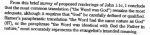
"From this brief summary of proposed renderings of John 1:1c, I conclude that the most common translation ("the Word was God") remains the most adequate, although it requires "God" to be carefully defined or qualified. Harner's paraphrastic translation "the Word had the same nature as God" (87), or the paraphrase "the Word was identical with God the Father in nature," most accurately represents the evangelist's intended meaning." (Jesus as God, p. 70)
Re-read what I wrote to you, and I explain why "the Word was God" (not, "the Word was the God") is to be taken as a qualitative expression and can be paraphrased as Harner does so above.
You clearly don't even have the slightest clue.