[SUP]16 [/SUP]For before the child shall know to refuse the evil, and choose the good, the land that thou abhorrest shall be forsaken of both her kings.
[SUP]17 [/SUP]The Lord shall bring upon thee, and upon thy people, and upon thy father's house, days that have not come, from the day that Ephraim departed from Judah; even the king of Assyria.
[SUP]18 [/SUP]And it shall come to pass in that day, that the Lord shall hiss for the fly that is in the uttermost part of the rivers of Egypt, and for the bee that is in the land of Assyria.
[SUP]19 [/SUP]And they shall come, and shall rest all of them in the desolate valleys, and in the holes of the rocks, and upon all thorns, and upon all bushes.
[SUP]20 [/SUP]In the same day shall the Lord shave with a razor that is hired, namely, by them beyond the river, by the king of Assyria, the head, and the hair of the feet: and it shall also consume the beard.
[SUP]16 [/SUP]For before the child shall know to refuse the evil, and choose the good, the land that thou abhorrest shall be forsaken of both her kings.
before the child shall know In support of my comments in verse 15 on: until he knows; ‘before the child shall know’ contrasts much better with ‘until he knows’ than with ‘that he may know’.
before the child shall know Since the prophesy to be fulfilled in Ahaz’s time involved unmarried young women, as a class; ‘the child’ must refer to any child born that month. The land would be forsaken of both her kings before the child shall know to refuse the evil. Children generally begin to understand right and wrong a few months into the second year.
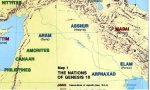
land that thou abhorrest Israel and Syria
forsaken of both her kings Tiglath-pileser had already carried his arms to the West and ravaged the northern border of Israel; and now he crossed the Euphrates and hastened to Damascus, slaying Rezin and carrying his people captive to Kir (2Ki 16:9).
Kir refers to Elam, aka Susiana. See: note at Is 7:1, and map at 7:1
[SUP]17 [/SUP]The Lord shall bring upon thee, and upon thy people, and upon thy father's house, days that have not come, from the day that Ephraim departed from Judah; even the king of Assyria.
[The Lord shall bring ...] The prophet having assured Ahaz that his kingdom should be free from the invasion that then threatened it, proceeds, however, to state to him that it would be endangered from another source.
[Thy father's house] the royal family-the princes and nobles
[Days that have not come] Times of calamity that have not been equalled.
[From the day that Ephraim departed from Judah] From the time of the separation of the ten tribes from the tribes of Judah and Benjamin.
[Even the king of Assyria] This was done in the following manner. Though the siege which Rezin and Pekah had undertaken was not at this time successful, yet they returned the year after with stronger forces, and with counsels better concerted, and again besieged the city. This was in consequence of the continued and increasing wickedness of Ahaz; 2Ch 28:1-5. In this expedition, a great multitude were taken captives, and carried to Damascus; 2Ch 28:5. Pekah at this time also killed 120,000 of the Jews in one day (2Ch 28:6); and Zichri, a valiant man of Ephraim, killed Maaseiah the son of Ahaz. At this time, also, Pekah took no less than 200,000 of the kingdom of Judah, proposing to take them to Samaria, but was prevented by the influence of the prophet Oded; 2Ch 28:8-15. In this calamity, Ahaz stripped the temple of its treasures and ornaments, and sent them to Tiglath-pileser, king of Assyria, to induce him to come and defend him from the united arms of Syria and Ephraim. The consequence was, as might have been foreseen, that the king of Assyria took occasion, from this, to bring increasing calamities upon the kingdom of Ahaz. He first, indeed, killed Rezin, and took Damascus; 2Ki 16:7.
Having subdued the kingdoms of Damascus and Ephraim, Tiglath-pileser became a more formidable enemy to Ahaz than both of them. His object was not to aid Ahaz, but to distress him (2Ch 28:20); and his coming professedly and at the request of Ahaz, to his help, was a more formidable calamity than the threatened invasion of both Rezin and Pekah. God has power to punish a wicked nation in his own way. When they seek human aid, he can make this a scourge. He has kings and nations under his control; and though a wicked prince may seek earthly alliance, yet it is easy for God to allow such allies to indulge their ambition and love of rapine, and make them the very instruments of punishing the nation which they were called to defend. It should be observed that this phrase, 'even the king of Assyria,' is by many critics thought to be spurious, or a marginal reading, or gloss, that has by some means crept into the text. The ground of this opinion is, that it does not harmonize entirely with the following verse, where "Egypt" is mentioned as well as Assyria, and that it does not agree with the poetical form of the passage.
(from Barnes' Notes, in Public Domain via E-Sword.)
[SUP]18 [/SUP]And it shall come to pass in that day, that the Lord shall hiss for the fly that is in the uttermost part of the rivers of Egypt, and for the bee that is in the land of Assyria.
[In that day the Lord shall hiss]; see the note at Isa 5:26.
[For the fly] That is, for the army, or the multitude of people. The comparison of a numerous army with "flies" is not uncommon; see Homer's "Iliad," B. ii. 469, etc.
Thick as insects play,
The wandering nation of a summer's day.
That, drawn by milky streams at evening hours
In gathered swarms surround the rural bowers;
From pail to pail with busy murmur run
The gilded legions, glittering in the sun.
(Pope.)
The comparison is drawn probably from the "number," but also is intended to indicate the troublesome character, of the invaders. Perhaps, also, there is an allusion here to the well-known fact that one of the ten plagues of Egypt was caused by numerous swarms of flies; Ex 8:21-24. An army would be brought up from that country as numerous, as troublesome, and as destructive as was that swarm of flies. The following description, by Bruce, of a species of flies in Abyssinia and the adjacent regions, will give an idea of the character of this calamity, and the force of the language used here:
'This insect is called Zimb; it has not been described by any naturalist. It is, in size, very little larger than a bee, of a thicker proportion, and has wings, which are broader than those of a bee, placed separate, like those of a fly: they are of pure gauze, without color or spot upon them; the head is large, the upper jaw or lip is sharp, and has at the end of it a strong pointed hair, of about a quarter of an inch long; the lower jaw has two of these pointed hairs; and this pencil of hairs, when joined together, makes a resistance to the finger, nearly equal to that of a strong hog's bristle; its legs are serrated in the inside, and the whole covered with brown hair or down. As soon as this plague appears, and their buzzing is heard, all the cattle forsake their food, and run wildly about the plain, until they die, worn out with fatigue, fright, and hunger. No remedy remains, but to leave the black earth, and hasten down to the sands of Atbara; and there they remain, while the rains last, this cruel enemy never daring to pursue them further.
Though his size be immense, as is his strength, and his body covered with a thick skin, defended with strong hair, yet even the camel is not capable to sustain the violent punctures the fly makes with his pointed proboscis. He must lose no time in removing to the sands of Atbara, for when once attacked by this fly, his body, head, and legs, break out into large bosses, which swell, break, and putrefy, to the certain destruction of the creature. Even the elephant and rhinoceros, who, by reason of their enormous bulk, and the vast quantity of food and water they daily need, cannot shift to desert and dry places as the season may require, are obliged to roll themselves in mud and mire, which, when dry, coats them over like armor, and enables them to stand their ground against this winged assassin; yet I have found some of these tubercles upon almost every elephant and rhinoceros that I have seen, and attribute them to this cause.
All the inhabitants of the seacoast of Melinda, down to Cape Gardefan, to Saba, and the south coast of the Red Sea, are obliged to put themselves in motion, and remove to the next sand, in the beginning of the rainy season, to prevent all their stock of cattle from being destroyed. This is not a partial emigration; the inhabitants of all the countries, from the mountains of Abyssinia northward, to the confluence of the Nile, and Astaboras, are once a year obliged to change their abode, and seek protection in the sand of Beja; nor is there any alternative, or means of avoiding this, though a hostile band were in their way, capable of spoiling them or half their substance. This fly has no sting, though he seemed to me to be rather of the bee kind; but his motion is more rapid and sudden than that of the bee, and resembles that of the gad-fly in England. There is something particular in the sound or buzzing of this insect; it is a jarring noise together with a humming, which induces me to believe it proceeds, at least in part, from a vibration made with the three hairs at his snout.'
[The uttermost part of the rivers of Egypt] The remotest part of the land-that is, from the whole country. Egypt was watered by a single river; the Nile. But this river emptied into the Mediterranean by several mouths; and from this river also were cut numerous canals to water the land. These are intended by the "rivers" of Egypt; see the notes at Isa 19:6-7. Those canals would be stagnant for no small part of the year; and around them would be produced, as is usual near stagnant waters, great quantities of flies. This prophecy was fulfilled by the invasion of the land in subsequent times by the Egyptians; 2Ki 23:33-34, 2Ch 35:20, 24, 36:1-2.
[And for the bee] That is, for the "army." An army is compared to "bees" on account of their number; perhaps also on account of the pungency and severity of the sting. The comparison is common; see Dt 1:44; 7:20, Ps 118:12. The Chaldee has rendered this verse, 'The Lord shall call to a people girded with the armies of the brave, who are numerous as flies, and shall bring them from the ends of the land of Egypt; and strong armies, strong as bees, and shall bring them from the land of Assyria.' No prophecy was ever more completely fulfilled than this by the successive invasions of Pharaoh-Necho, Esarhaddon and Nebuchadnezzar; see Isa 36:1-22; 37:1-38; 2Ch 36:7-21.
(from Barnes' Notes, in Public Domain via E-Sword.)
The seacoast of Melinda, down to Cape Gardefan, to Saba, and the south coast of the Red Sea, these place names are no longer in use. They were British names for Red Sea ports in Sudan and Ethiopia.
confluence of the Nile, and Astaboras, in southern Sudan
Beja a district of Sudan along the border of Ethiopia
The British have always been rather arrogant about place names. As countries gained independence; place names reverted to their native names.
[SUP]19 [/SUP]And they shall come, and shall rest all of them in the desolate valleys, and in the holes of the rocks, and upon all thorns, and upon all bushes.
[And they shall come] The idea in this verse is, that they would spread over the land, and lay it waste. The poetic image of flies and bees is kept up; meaning, that the armies would be so numerous as to occupy and infest all the land.
[And shall rest] As bees do. Thus the "locusts" are said to have "rested" in all the land of Egypt; Ex 10:14.
[In the desolate valleys] The word translated "valleys" usually means "a valley with a brook," or a brook itself. The Chaldee translates it, 'In the streets of cities.' But the idea is derived from the habits of flies and bees. The meaning is, that they should fill all the land, as innumerable swarms of flies and bees-would settle down everywhere, and would infest or consume everything. Bees, probably, chose situations near to running streams. Virgil, in his directions about selecting a place for an apiary, gives the following among others:
At liquidi fontes, et stagna virentia musco
Adsint, et tennis fugiens per gramina rivus.
(Georg. iv. 18,19.)
But there let pools invite with moss arrayed,
Clear fount and rill that purls along the glade.
(Sotheby.)
[In the holes of the rocks] Probably the same image is referred to here. It is well known that in Judea, as well as elsewhere, bees were accustomed to live in the holes or caverns of the rocks. They were very numerous; and the figure here is, that the Assyrians would be numerous as the swarms of bees were in that land, even in the high and inaccessible rocks; compare Is 2:19-21.
[Upon all thorns] The image here is kept up of flies and bees resting on everything. "Thorns" here refer to those trees and shrubs that were of little value; but even on these they would rest.
[All bushes] Hebrew 'All trees that are commendable, or that are to be praised;' see the margin. The word denotes those shrubs and trees that were objects of "praise;" that is, that were cultivated with great attention and care, in opposition to "thorns" that grew wild, and without cultivation, and that were of little value. The meaning of the passage is, that the land would be invaded in every part, and that everything, valuable or not, would be laid waste.
(from Barnes' Notes, in Public Domain via E-Sword in Public Domain via E-Sword.)
[SUP]20 [/SUP]In the same day shall the Lord shave with a razor that is hired, namely, by them beyond the river, by the king of Assyria, the head, and the hair of the feet: and it shall also consume the beard.
[In the same day ...] The idea in this verse is the same as in the preceding, though presented in a different form. The meaning is, that "God" would bring upon them this punishment, but that he would make use of the Assyrian as an "instrument" by which to do it.
[Shave] The act of shaving off the hair denotes punishment or disgrace; compare
2Sa 10:4: 'Hanun took David's servants, and shaved off one half of their beards;'
1Ch 19:4.
[With a razor] Using them as an instrument. God here claims the power of directing them, and regards them as employed by him; see Isa 10:5-7.
[That is hired] This is an allusion to the custom of hiring soldiers, or employing mercenary armies. Thus Great Britain employed mercenary troops, or hired of the Germans bodies of Hessians to carry on the war in America. The meaning here is, that God would employ the Assyrians as his instruments, to effect his purposes, as though they were hired and paid by the plunder and spoil of the nation.
[By them beyond the river] The river Euphrates. The Euphrates is usually meant in the Scriptures where 'the river' is mentioned without specifying the name; Ps 72:8, 80:2.This was the river which Abraham had passed; and this, perhaps, was, for a long time, the eastern boundary of their geographical knowledge; see the note at Isa 11:15.
[Barnes’ note at Isa 11:15 was not cited M.R.]
[The head] The hair of the head.
[The hair of the feet] Or the other parts of the body; of the lower parts of the body.
[Shall consume the beard] Shall cut off the beard. This was esteemed particularly disgraceful among the Jews. It is, at this day, among all Eastern nations. The beard is regarded as a distinguished ornament; among the Mahometans, it is sworn by, and no higher insult can be offered than to treat the beard with indignity; compare the note at Isa 50:6. The meaning is here, that God would employ the Assyrian as his instrument to lay waste the land. [Barnes’ note at Is 50:6 was not cited M.R.]
(from Barnes' Notes, in Public Domain via E-Sword.)