

The Vital Importance Of Forgiving Others
- Thread starter karen0123
- Start date
-
Christian Chat is a moderated online Christian community allowing Christians around the world to fellowship with each other in real time chat via webcam, voice, and text, with the Christian Chat app. You can also start or participate in a Bible-based discussion here in the Christian Chat Forums, where members can also share with each other their own videos, pictures, or favorite Christian music.
If you are a Christian and need encouragement and fellowship, we're here for you! If you are not a Christian but interested in knowing more about Jesus our Lord, you're also welcome! Want to know what the Bible says, and how you can apply it to your life? Join us!
To make new Christian friends now around the world, click here to join Christian Chat.
You are using an out of date browser. It may not display this or other websites correctly.
You should upgrade or use an alternative browser.
You should upgrade or use an alternative browser.

Matthew 18:21-22
21Then came Peter to him, and said, Lord, how oft shall my brother sin against me, and I forgive him? till seven times? 22Jesus saith unto him, I say not unto thee, Until seven times: but, Until seventy times seven.
21Then came Peter to him, and said, Lord, how oft shall my brother sin against me, and I forgive him? till seven times? 22Jesus saith unto him, I say not unto thee, Until seven times: but, Until seventy times seven.
J
JustWhoIAm
Guest
Very good. Forgiveness is important, but let me express another side of the equation as the bible reads.
Jesus did not back down from teaching against those who were desecrating the things of the Father, ever, to the point of getting physically involved (in one recorded instance). The bible also teaches about the Lord defending those who take advantage of the oppressed with serious vengeance.
Let's not forget about the hebrew armies under righteous command (gideon is a favorite of mine) that fought and killed many evil people. Or the armies of heaven wiping out evildoers in endtime prophecy (if you prefer a new testament example, not that i am saying that people should take such violence upon themselves if not directly commissioned by other people. Angels and such do THAT work).
Point is, God doesn't tolerate evil, he tells us to teach against it directly (which isn't necessarily unforgiveness IMHO, it's using one's voice to do what they can to keep people safe).
Jesus did not back down from teaching against those who were desecrating the things of the Father, ever, to the point of getting physically involved (in one recorded instance). The bible also teaches about the Lord defending those who take advantage of the oppressed with serious vengeance.
Let's not forget about the hebrew armies under righteous command (gideon is a favorite of mine) that fought and killed many evil people. Or the armies of heaven wiping out evildoers in endtime prophecy (if you prefer a new testament example, not that i am saying that people should take such violence upon themselves if not directly commissioned by other people. Angels and such do THAT work).
Point is, God doesn't tolerate evil, he tells us to teach against it directly (which isn't necessarily unforgiveness IMHO, it's using one's voice to do what they can to keep people safe).
J
JustWhoIAm
Guest

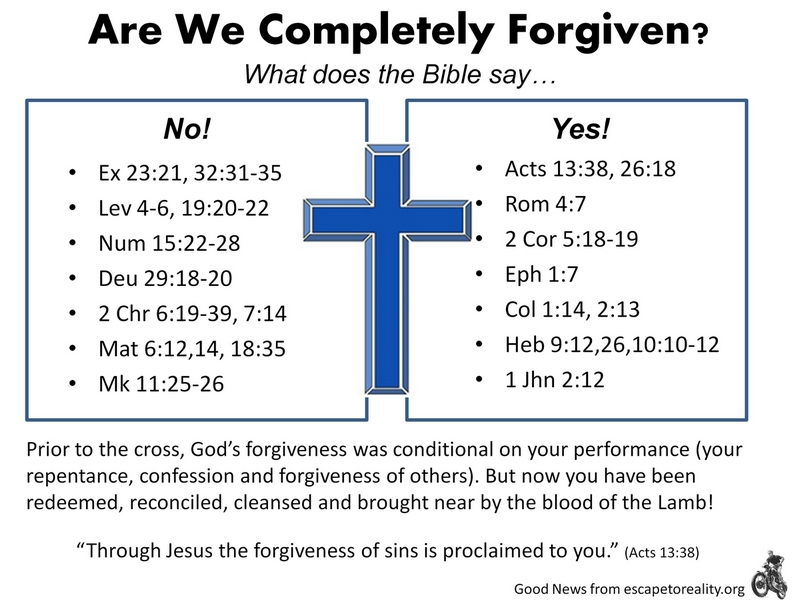
If you were living in the Old Covenant, before the Work of the Cross, only some of what Dan Corner (a rabid conditional security guy) writes in his article would hold true.
But we don't.
We live in the era of the New Covenant, AFTER the Work of the Cross.
We don't forgive to receive forgiveness, but we forgive because we are forgiven:
Before the Cross:
14 For if you forgive other people when they sin against you, your heavenly Father will also forgive you. 15 But if you do not forgive others their sins, your Father will not forgive your sins. (from Mt. 6)
After the Cross:
32 Be kind to one another, tenderhearted, forgiving one another, as God in Christ forgave you. (from Eph. 4)
13 bearing with one another and, if one has a complaint against another, forgiving each other; as the Lord has forgiven you, so you also must forgive. (from Col. 3)
Note that there are no verses after the Work of the Cross that require that we forgive to be forgiven - we are forgiven when we believe in Christ - that is what makes salvation possible, and is the first element of salvation. Next comes the gift of God's Righteousness given to us in Christ, then New Life, sealed with the Holy Spirit. These things all happen simultaneously when one puts their faith in Christ Jesus.
The forgiveness we receive when we believe in Christ is not conditional on our forgiving others. Forgiving others, however, often is a very real fruit that happens when we come into Christ.
As Ephesians and Colossians show us, forgive AS you have BEEN FORGIVEN, not forgive IN ORDER to be forgiven.
Even the Colossians passage, which says, "so you must also forgive" does not follow it up with an "or else", but talks of Fruit of the Spirit type stuff, not eternal damnation if you don't forgive someone. Please don't misunderstand - forgiving one another is a GOOD thing - it is the RIGHT and HEALTHY thing to do, but your salvation does not hang on whether or not you do it.
-JGIG


If you were living in the Old Covenant, before the Work of the Cross, only some of what Dan Corner (a rabid conditional security guy) writes in his article would hold true.
But we don't.
We live in the era of the New Covenant, AFTER the Work of the Cross.
We don't forgive to receive forgiveness, but we forgive because we are forgiven:
Before the Cross:
14 For if you forgive other people when they sin against you, your heavenly Father will also forgive you. 15 But if you do not forgive others their sins, your Father will not forgive your sins. (from Mt. 6)
After the Cross:
32 Be kind to one another, tenderhearted, forgiving one another, as God in Christ forgave you. (from Eph. 4)
13 bearing with one another and, if one has a complaint against another, forgiving each other; as the Lord has forgiven you, so you also must forgive. (from Col. 3)
Note that there are no verses after the Work of the Cross that require that we forgive to be forgiven - we are forgiven when we believe in Christ - that is what makes salvation possible, and is the first element of salvation. Next comes the gift of God's Righteousness given to us in Christ, then New Life, sealed with the Holy Spirit. These things all happen simultaneously when one puts their faith in Christ Jesus.
The forgiveness we receive when we believe in Christ is not conditional on our forgiving others. Forgiving others, however, often is a very real fruit that happens when we come into Christ.
As Ephesians and Colossians show us, forgive AS you have BEEN FORGIVEN, not forgive IN ORDER to be forgiven.
Even the Colossians passage, which says, "so you must also forgive" does not follow it up with an "or else", but talks of Fruit of the Spirit type stuff, not eternal damnation if you don't forgive someone. Please don't misunderstand - forgiving one another is a GOOD thing - it is the RIGHT and HEALTHY thing to do, but your salvation does not hang on whether or not you do it.
-JGIG
Thank you JGIG - this clearly shows the difference about forgiveness before and after the cross.
If this theory of "if you don't forgive then God will not forgive you" which is spoken before the cross is true. That would mean that everyone who received Christ would have to have forgiven others "first" before they would receive the forgiveness of sin. This is NOT the gospel message after the cross.
( all off them came to Christ without the "necessity" to have already forgiven others before they believed and received forgiveness of all sins from Christ's perfect work )
This theory of having to forgive in order to be forgiven is NOT the gospel. We do forgive now because we are already forgiven.
We forgive now from our hearts because we are forgiven now. Preach this and people will grow in who they are in Christ and eventually their minds will be renewed to who they are in Christ and their emotions will fall in line.
People are always trying to make some of Jesus' words that were spoken to those under the Law in order to expose their need for a Savior - and try to apply them after the cross and it is NOT the gospel message of the grace of Christ.
We forgive now because we are forgiven and the more we preach on the finished work of Jesus - the more our minds will be renewed to the truth and walk out the life, forgiveness and love that is already in us in our new creation that is in Christ.

This is for those who teach rebellion against Jesus' words.
And this is for those who are caught in satan's lie, that they may recover from their error.
I will raise up to them a prophet of their brethren, like thee; and I will put my words in his mouth, and he shall speak to them as I shall command him. And whatever man shall not hearken to whatsoever words that prophet shall speak in my name, I will take vengeance on him. Deuteronomy 18:18-19
And this is for those who are caught in satan's lie, that they may recover from their error.
Therefore the kingdom of heaven is likened unto a certain king, which would take account of his servants. And when he had begun to reckon, one was brought unto him, which owed him ten thousand talents. But forasmuch as he had not to pay, his lord commanded him to be sold, and his wife, and children, and all that he had, and payment to be made. The servant therefore fell down, and worshipped him, saying, Lord, have patience with me, and I will pay thee all.
Then the lord of that servant was moved with compassion, and loosed him, and forgave him the debt.
But the same servant went out, and found one of his fellowservants, which owed him an hundred pence: and he laid hands on him, and took [him] by the throat, saying, Pay me that thou owest. And his fellowservant fell down at his feet, and besought him, saying, Have patience with me, and I will pay thee all. And he would not: but went and cast him into prison, till he should pay the debt. So when his fellowservants saw what was done, they were very sorry, and came and told unto their lord all that was done.
Then his lord, after that he had called him, said unto him, O thou wicked servant, I forgave thee all that debt, because thou desiredst me: Shouldest not thou also have had compassion on thy fellowservant, even as I had pity on thee? And his lord was wroth, and delivered him to the tormentors, till he should pay all that was due unto him. So likewise shall my heavenly Father do also unto you, if ye from your hearts forgive not every one his brother their trespasses. Matthew 18:23-35
Then the lord of that servant was moved with compassion, and loosed him, and forgave him the debt.
But the same servant went out, and found one of his fellowservants, which owed him an hundred pence: and he laid hands on him, and took [him] by the throat, saying, Pay me that thou owest. And his fellowservant fell down at his feet, and besought him, saying, Have patience with me, and I will pay thee all. And he would not: but went and cast him into prison, till he should pay the debt. So when his fellowservants saw what was done, they were very sorry, and came and told unto their lord all that was done.
Then his lord, after that he had called him, said unto him, O thou wicked servant, I forgave thee all that debt, because thou desiredst me: Shouldest not thou also have had compassion on thy fellowservant, even as I had pity on thee? And his lord was wroth, and delivered him to the tormentors, till he should pay all that was due unto him. So likewise shall my heavenly Father do also unto you, if ye from your hearts forgive not every one his brother their trespasses. Matthew 18:23-35
We need to read all scripture in context of the finished work of Christ and what He did on the cross. To say that our sins are not forgiven in the believer after they cross is NOT the gospel.
We will forgive because we are in Christ now and have His nature in us - we need to have our minds renewed to this truth and we will walk in it.
Matt 18:35 says that God will not forgive unless you forgive from your heart.
This was Jesus giving them the law. Moses 2.0 as it shows their need for a Savior in order for Jesus to create in them a new heart that loves and forgives just like their Father does in Jesus. Love always forgives - it's in our nature now because we are in Christ - created in righteousness and holiness.
We have a new heart now - so we can't really have unforgiveness in our hearts anymore which is why Jesus said .."If you do not forgive from your heart" ....this is to expose their need for a new heart which always forgives.
Acts 15:8-9 (NASB)
[SUP]8 [/SUP] "And God, who knows the heart, testified to them giving them the Holy Spirit, just as He also did to us;
[SUP]9 [/SUP] and He made no distinction between us and them, cleansing their hearts by faith.
We love now from our new hearts in Christ and our hearts cannot sin. So Jesus's verse above in Matthew 18 would not apply to the person in Christ as it is impossible for them to have sin in their heart and to not forgive. We have the very nature of God inside us now - righteousness and holiness.
Romans 5:5 (NASB)
[SUP]5 [/SUP] and hope does not disappoint, because the love of God has been poured out within our hearts through the Holy Spirit who was given to us.
1 John 5:18 (NASB)
[SUP]18 [/SUP] We know that no one who is born of God sins; but He who was born of God keeps him, and the evil one does not touch him.
1 John 3:9 (KJV)
[SUP]9 [/SUP] Whosoever is born of God doth not commit sin; for his seed remaineth in him: and he cannot sin, because he is born of God.
We need to preach and teach the true gospel of the grace of Christ so that the believer in Christ can grow in the grace and knowledge of our Lord Jesus and walk out who they already are in their inner man - the new creation in Christ - created in righteousness and holiness.
When we see Christ as in a mirror - we see true selves being reflected back and the Holy Spirit transforms us outwardly to reflect Christ that is in us now. 2 Cor 3:17-18
We will forgive because we are in Christ now and have His nature in us - we need to have our minds renewed to this truth and we will walk in it.
Matt 18:35 says that God will not forgive unless you forgive from your heart.
This was Jesus giving them the law. Moses 2.0 as it shows their need for a Savior in order for Jesus to create in them a new heart that loves and forgives just like their Father does in Jesus. Love always forgives - it's in our nature now because we are in Christ - created in righteousness and holiness.
We have a new heart now - so we can't really have unforgiveness in our hearts anymore which is why Jesus said .."If you do not forgive from your heart" ....this is to expose their need for a new heart which always forgives.
Acts 15:8-9 (NASB)
[SUP]8 [/SUP] "And God, who knows the heart, testified to them giving them the Holy Spirit, just as He also did to us;
[SUP]9 [/SUP] and He made no distinction between us and them, cleansing their hearts by faith.
We love now from our new hearts in Christ and our hearts cannot sin. So Jesus's verse above in Matthew 18 would not apply to the person in Christ as it is impossible for them to have sin in their heart and to not forgive. We have the very nature of God inside us now - righteousness and holiness.
Romans 5:5 (NASB)
[SUP]5 [/SUP] and hope does not disappoint, because the love of God has been poured out within our hearts through the Holy Spirit who was given to us.
1 John 5:18 (NASB)
[SUP]18 [/SUP] We know that no one who is born of God sins; but He who was born of God keeps him, and the evil one does not touch him.
1 John 3:9 (KJV)
[SUP]9 [/SUP] Whosoever is born of God doth not commit sin; for his seed remaineth in him: and he cannot sin, because he is born of God.
We need to preach and teach the true gospel of the grace of Christ so that the believer in Christ can grow in the grace and knowledge of our Lord Jesus and walk out who they already are in their inner man - the new creation in Christ - created in righteousness and holiness.
When we see Christ as in a mirror - we see true selves being reflected back and the Holy Spirit transforms us outwardly to reflect Christ that is in us now. 2 Cor 3:17-18
Last edited:
F
FreeNChrist
Guest

B
BeyondET
Guest
Very good. Forgiveness is important, but let me express another side of the equation as the bible reads.
Jesus did not back down from teaching against those who were desecrating the things of the Father, ever, to the point of getting physically involved (in one recorded instance). The bible also teaches about the Lord defending those who take advantage of the oppressed with serious vengeance.
Let's not forget about the hebrew armies under righteous command (gideon is a favorite of mine) that fought and killed many evil people. Or the armies of heaven wiping out evildoers in endtime prophecy (if you prefer a new testament example, not that i am saying that people should take such violence upon themselves if not directly commissioned by other people. Angels and such do THAT work).
Point is, God doesn't tolerate evil, he tells us to teach against it directly (which isn't necessarily unforgiveness IMHO, it's using one's voice to do what they can to keep people safe).
The devil will do everything he can to lie to you.
Matthew 6:9-13King James Version (KJV)
[SUP]9 [/SUP]After this manner therefore pray ye: Our Father which art in heaven, Hallowed be thy name.
[SUP]10 [/SUP]Thy kingdom come, Thy will be done in earth, as it is in heaven.
[SUP]11 [/SUP]Give us this day our daily bread.
[SUP]12 [/SUP]And forgive us our debts, as we forgive our debtors.
[SUP]13 [/SUP]And lead us not into temptation, but deliver us from evil: For thine is the kingdom, and the power, and the glory, for ever. Amen.

Matthew 18:21-22
21Then came Peter to him, and said, Lord, how oft shall my brother sin against me, and I forgive him? till seven times? 22Jesus saith unto him, I say not unto thee, Until seven times: but, Until seventy times seven.
Isn't Peter the one who cut off Malchus's ear?
