Nice find! Might this be a genuine gem you're looking at? a treasure brought out?!1Thess5:19 Typically considered to be the Holy Spirit to which I'd agree. Christian are commanded not to extinguish the [Holy] Spirit
Your error is in assuming that a present condition, and what is possible for someone to do in their present condition, is a permanent condition unless God unilaterally recreates the person into being something different in the next present moment. You are ignoring the fact that changing circumstances change our perspective on what is desirable. We re-evaluate our priorities based on outcomes. Therefore someone who hates God can have experiences that cause them to reconsider their opinion of God. Someone who shuns certain knowledge can change their mind about their previous denial of their need for that kbowledge. Someone who loves money can realise what their lust for money has cost them in love and trust. You see humans as programmed robots meeding reprogramming rather than as intelligent beings learning through feedback loops and adjusting their priorities, opinions, choices and behavoiur because of the outcomes of past priorities, opinions, choices and actions.As stated in my opening post, I will give everyone time to come up with the biblical solution to these dilemmas. Perhaps someone will come up with a biblical explanation for how God-hating, Christ-hating, Knowledge-hating, Wisdom-hating, Truth-hating, Darkness-loving, Self-loving, Pleasure-loving, Money-loving, World-loving, Death-loving sinners (any of which is, paradoxically, the really bad news of the Gospel) can attain to true Knowledge of God, which itself is true Understanding, which in turn comes only through the narrow gate of the Fear of the Lord which no one has because sinners do not desire to have it, ultimately because of their pride (Ps 36:1-4) and love for the Darkness and Death
As stated in my opening post, I will give everyone time to come up with the biblical solution to these dilemmas. Perhaps someone will come up with a biblical explanation for how God-hating, Christ-hating, Knowledge-hating, Wisdom-hating, Truth-hating, Darkness-loving, Self-loving, Pleasure-loving, Money-loving, World-loving, Death-loving sinners (any of which is, paradoxically, the really bad news of the Gospel) can attain to true Knowledge of God, which itself is true Understanding, which in turn comes only through the narrow gate of the Fear of the Lord which no one has because sinners do not desire to have it, ultimately because of their pride (Ps 36:1-4) and love for the Darkness and Death.
In closing, Matthew Henry once said:
"Where no fear of God is, no good is to be expected." Fallen people might do civic goods that are praiseworthy from a human perspective, but they cannot do what is fully and truly good in the Lord's sight." (emphasis mine)
No. There is nothing that says fools must be unregenerate sinners. Regenerate sinners cam be fools too. Peter was blessed by the Father with spiritual insight one moment,, and satan the next.Fools = unregenerated sinners, who are themselves DARKNESS. Conversely, the Wise = saints who delight in the Fear of the Lord.
Mind = one aspect of Man. Heart = the whole Man and all his faculties, not just one.
P.S. Are fools ever spoken of in scripture in flattering terms?
cont'd
@Mem mentioned a "handshake" between us and God. I've spoken quite a bit about a commanded collaboration between us and our Father in our salvation. This concept can be seen above once again. God sanctifies men completely including their spirit, soul, and body - Christ teaches/commands sanctification - Christians obey God/Christ and live out sanctification (as God provides His capacities so Christians can both will and do what pleases God Phil2:12-13 and others). God is doing and Christians are doing [under grace].
- "through sanctification by the Spirit and belief in the truth"
- "through" is translating the preposition "en" that most basically (spatially) means "in".
- Again, like "eis" there are many other ways to translate "en"
- I think many English translations use "through" is because this English word can have the meaning of "by means of" (a process, an agent, etc.)
- "en" can mean "by means of" but I would typically translate it as "be means of " or "by" rather than "through" because there is another preposition that is more basically translated as "through."
- There are several other ways to translate this but for now I'll run with "by means of"
- This prepositional phrase is considered to be attached to "salvation" in this verse and I'm going to use the literal Greek for the prepositional phrases:
- So, it looks like Paul is saying:
- salvation by means of sanctification [of] S(s)pirit, and
- salvation by means of belief/faith [of] truth.
- So, sanctification [of] S(s)pirit, and belief/faith [of] truth are involved in salvation and "by means of" indicates instrumentality - so sanctification [of] S(s)pirit, and belief/faith [of] truth are instrumental in salvation
- sanctification of S(s)pirit
- S(s)pirit:
- At times it's difficult to determine if spirit is referring to the human spirit of the Holy Spirit and translation typically defer to Spirit
- In 1-2 Thess Paul writes "spirit" 8x. Three are in 2Thess:
- 2Thess2:2 Paul speaks of spirit in the sense of a deceiving spirit whether human or demonic or the combining of the two.
- 2Thess2:8 Paul speaks of spirit in the sense of the breath/spirit of/from His mouth
- 2Thess2:13 seems like the Holy Spirit because sanctification is mentioned but continuing the investigation because 2Thess is not as much of a help as I'd like to see.
- 1Thess1:5-6 the Holy Spirit is clearly spelled out (though I'd look just a bit further at 1:6)
- 1Thess4:8 God's Holy Spirit God has given to the Thess Christians.
- 1Thess5:19 Typically considered to be the Holy Spirit to which I'd agree. Christian are commanded not to extinguish the [Holy] Spirit
- 1Thess5:23 is an important one as Paul prays that the God of peace sanctify the Thess Christians [as] complete [men] and that their whole spirit, soul and body be kept blameless until the coming/presence of the Lord Jesus Christ.
- So this makes it seem like we should translate 2Thess2:13 as "Spirit" - sanctification of/by [the] Spirit.
- But more research...
- Sanctification:
- 1Thess5:23 uses the verb form of sanctify and God is the one doing the sanctifying. This veb is used only this once in 1-2Thess
- 2Thess2:13 is the only time the noun form is used in 2Thess.
- 1Thess4:3 says the Christians sanctification is God's will. 4:2 Paul says he has given them instructions/commands about this through/as agents of the Lord Jesus. Then Paul proceeds to explain this sanctification:
- You Thess Christians ("you"):
- to abstain from fornication
- 4:4-7 to know to possess his own vessel in sanctification and honor, etc...
- 4:8 Paul summarizes the reason: God did not call us upon/to uncleanness but in sanctification
- So, the interesting things to me is:
- God sanctifies 1Thess5:23
- God's will is the Christian's sanctification.
- God calls Christians to live in sanctification which is contrasted to living in uncleanness.
- Christ teaches through Paul, et.al. what living in sanctification entails.
- Christians actively live in sanctification as instructed/commanded
Maybe we can begin to see what salvation in/by means of sanctification of S(s)pirit and belief/faith of truth means. I can see a few things under S(s)pirit I should shore up, then "belief/faith of truth."
So, let me understand this: After being a professing Christian for many decades, you have never reached a solid conclusion in your mind who the fools or the ungodly are spiritually?
This probably won't satisfy you either, as I'm certain that now even though scripture contrasts the two groups you will still want me to "define" who or what the wise are, right?
you have never reached a solid conclusion in your mind who the fools or the ungodly are spiritually? I suppose, then, the same goes for the wise or godly?
Nice find! Might this be a genuine gem you're looking at? a treasure brought out?!It'd always gave me pause to wonder how the Holy Spirit could ever be extinguished. He's from everlasting to everlasting! The human spirit, on the other hand... "Do not be afraid of those who kill the body but cannot kill the soul. Instead, fear the One who can destroy both soul and body in hell (Matt 10:28)." I attend the school of thought that considers the second death as an extinguishment (which cause smoke to go up from) the soul. And so, apparently, it can be destroyed though not by any force outside of God. Yet, because there is a continuous struggle between one's own flesh and spirit, then it may well be very possible that the flesh strives to extinguish the spirit in order to obtain that which it most desires....
![]()
Your error is in assuming that a present condition, and what is possible for someone to do in their present condition, is a permanent condition unless God unilaterally recreates the person into being something different in the next present moment. You are ignoring the fact that changing circumstances change our perspective on what is desirable. We re-evaluate our priorities based on outcomes. Therefore someone who hates God can have experiences that cause them to reconsider their opinion of God. Someone who shuns certain knowledge can change their mind about their previous denial of their need for that kbowledge. Someone who loves money can realise what their lust for money has cost them in love and trust. You see humans as programmed robots meeding reprogramming rather than as intelligent beings learning through feedback loops and adjusting their priorities, opinions, choices and behavoiur because of the outcomes of past priorities, opinions, choices and actions.
To summarise the verses to their skeleton:
13. But we (Paul, Silvanus and Timothy, 1:1) are bound to give thanks to God always for you, (the Thessalonian Christians) brethren beloved by the Lord, because God from your stage 1 salvation, chose you then for stage three salvation, through undergoing stage two salvation. 14. He called you to stage two savation during your stage one salvation, for the obtaining of stage three salvation.
Considering the OT nuances, Matt 12:20 is cross referenced with BSB Isaiah 43:17, "who brings out the chariots and horses, the armies and warriors together, to lie down, never to rise again; to be extinguished, snuffed out like a wick:"NKJ 1 Thessalonians 5:19 Do not quench the Spirit.
σβέννυτε, verb imperative present active 2nd person plural from σβέννυμι
__________________________________
Bauer-Danker, Greek-English Lexicon of the NT (BDAG)
[BDAG] σβέννυμι
• σβέννυμι fut. σβέσω; 1 aor. ἔσβεσα, inf. σβέσαι. Pass.: 1 fut. σβεσθήσομαι; 1 aor. ἐσβέσθην LXX; pf. ptc pl. ἐσβεσμένοι 3 Macc. 6:34 (Hom. et al.; Sb 7033, 46; 67; LXX; TestJob 43:5; TestLevi 4:1; Ar. 5, 3; Just., D. 93, 1; Mel., P. 82, 614; Ath., R. 20 p. 73, 11) to cause an action, state, or faculty to cease to function or exist, quench, put out
a. lit. extinguish, put out τὶ someth., fire (Jos., Bell. 7, 405) Hb 11:34. In imagery, fiery arrows Eph 6:16; a smoldering wick Mt 12:20 (Is 42:3). Pass. be extinguished, be put out, go out (Artem. 2, 9; Pr 13:9; Philo, Leg. All. 1, 46; TestLevi 4:1) of lamps (s. TestJob 43:5 λύχνος … σβεσθείς; PGM 7, 364 σβέσας τὸν λύχνον; Musaeus, Hero and Leander 338) Mt 25:8. Cp. D 16:1. Of a pyre μετ᾽ ὀλίγον σβεννύμενον MPol 11:2. Of the fire of hell, that οὐ σβέννυται (Is 66:24) Mk 9:44, 46, 48; 2 Cl 7:6; 17:5; μηδέποτε σβεννύμενον πῦρ MPol 2:3.
b. fig. ext. of a, quench, stifle, suppress (Il. 9, 678 χόλον; epigram in praise of Apollonius of Tyana: New Docs 3, no. 15, 2 [III/IV AD] ἀμπλακίας ‘faults’; Pla., Leg. 8, 835d ὕβριν; 10, 888a τὸν θυμόν; Herm. Wr. 12, 6; SSol 8:7 τὴν ἀγάπην; 4 Macc 16:4 τὰ πάθη; Jos., Bell. 6, 31 τ. χαράν, Ant. 11, 40; Just., D. 93, 1 τὰς φυσικὰς ἐννοίας) τὸ πνεῦμα μὴ σβέννυτε 1 Th 5:19 (Plut., Mor. 402b τοῦ πνεύματος ἀπεσβεσμένου; Ps.-Plut., Hom. 127 τὸ πνεῦμα τὸ κατασβεννύμενον).—DELG. M-M. TW. Spicq.
__________________________________
Liddell-Scott, Greek Lexicon (Abridged)
[LS] σβέννυμι, ΣΒΕ´ΝΝΥ ΜΙ, σβέννυμι
ΣΒΕ´ΝΝΥ-ΜΙ or -ύω: f. σβέσω, Ep. σβέσσω: aor. i ἔσβεσα, Ep. inf. σβέσσαι:-Med., f. σβήσομαι: aor. i ἐσβεσάμηνass., aor. i ἐσβέσθην: pf. ἔσβεσμαι:-besides these, the aor. 2, pf. and plqpf. act. are used intr., ἔσβην, ἔσβηκα, ἐσβήκειν. To quench, put out, Lat. extinguere, Hdt., Pind. 2. generally, to quench, quell, check, σβ. χόλον, μένος Il.; ὕβριν Simon.; κύματα Ar., etc. II. Pass. σβέννυμαι (with intr. tenses of Act., v. supr.), to be quenched, go out, Lat. extingui, of fire, Il.: metaph. of men, to become extinct, die, Anth. 2. generally, to be quelled or lulled, of wind, Od. Hence σβεστήριος
__________________________________
Louw-Nida, Greek-English Lexicon of the NT
[LN] σβέννυμι (fut σβέσω aor ἔσβεσα inf σβέσαι) (a) extinguish a fire 14.70 (b) stop 68.52
We always have to remember that men with theological sensitivities are translating and even affecting our Lexical tools at times. I've found that considering the range of meanings of words and chasing how they are actually used in inspired Scripture can be very enlightening.
NC uses:
NKJ Matt. 12:20 A bruised reed He will not break, And smoking flax He will not quench, Till He sends forth justice to victory;
NKJ Matt. 25:8 "And the foolish said to the wise,`Give us some of your oil, for our lamps are going out.'
NKJ Mk. 9:48 "where`Their worm does not die, And the fire is not quenched.'
NKJ Eph. 6:16 above all, taking the shield of faith with which you will be able to quench all the fiery darts of the wicked one.
NKJ 1 Thess. 5:19 Do not quench the Spirit.
NKJ Heb. 11:34 quenched the violence of fire, escaped the edge of the sword, out of weakness were made strong, became valiant in battle, turned to flight the armies of the aliens.
How would you translate these?

Considering the OT nuances, Matt 12:20 is cross referenced with BSB Isaiah 43:17, "who brings out the chariots and horses, the armies and warriors together, to lie down, never to rise again; to be extinguished, snuffed out like a wick:"
And Ephesian 4:30 is explicit in designating the Holy Spirit as to whom one should not grieve. Is only that Paul isbeing a "lazy" writer in 1 Thess 5:19? And isn't it of interest that grieving is often used in a context of a mourning of another that is dying?
I don't think I got an answer there. Some like to keep equivocal vocabulary to dig escape tunnels with in a tight spot.I agree with your assessment here. The spiritual death concept is taken to an extreme and God is active in this world in many, many ways bringing men to and understanding of their condition.
Didn't you earlier question someone about spiritual death and what it actually means?
I don't think I got an answer there. Some like to keep equivocal vocabulary to dig escape tunnels with in a tight spot.
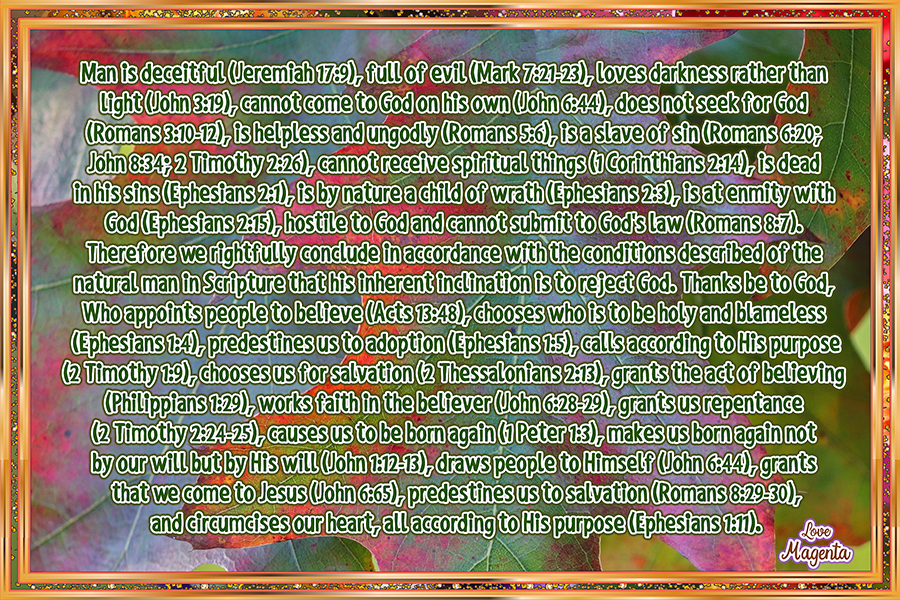
Thank you for the list, @Rufus! I was going to ask you for some more verses
to post on a panel about the natural man but now I don't have to!!! .
![]()
Man's depravity vs God's Grace
![]()
There's a lot of terminology used that we don't even know how to define but use it however we understand it whether it be right or wrong.
As you know, the phrase "spiritual death" is not in Scripture. Then we use it in everyday Christian discussions and it takes on whatever meaning we think it has. It's quite the challenge to actually think and speak Scripturally.
Nice find! Might this be a genuine gem you're looking at? a treasure brought out?!It'd always gave me pause to wonder how the Holy Spirit could ever be extinguished. He's from everlasting to everlasting! The human spirit, on the other hand... "Do not be afraid of those who kill the body but cannot kill the soul. Instead, fear the One who can destroy both soul and body in hell (Matt 10:28)." I attend the school of thought that considers the second death as an extinguishment (which cause smoke to go up from) the soul. And so, apparently, it can be destroyed though not by any force outside of God. Yet, because there is a continuous struggle between one's own flesh and spirit, then it may well be very possible that the flesh strives to extinguish the spirit in order to obtain that which it most desires....
![]()
Genesis 6:18 But I will establish my covenant with you, and you shall come into the ark, you, your sons, your wife, and your sons' wives with you.
Seems like the grace that was poured out on Noah was spilled out to his entire family through the covenant that God established!