
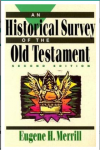
If you’re interested, I highly recommend this book. It’s no longer in print, but you can still find it available for purchase in digital format through the Olive Tree Bible Software library.
Grace and Peace
Grace and Peace


CONTENTS:Any way to see a basic table or summary of the content?
If you’re interested, I highly recommend this book. It’s no longer in print, but you can still find it available for purchase in digital format through the Olive Tree Bible Software library.
Grace and Peace
View attachment 281076
Any way to see a basic table or summary of the content?
Thanks. That's definitely more than I anticipated.CONTENTS:
A high point I enjoyed from Merrill’s Historical Survey of the Old Testament was his emphasis on God’s sovereign hand guiding Israel’s history despite human failure. It really brought out how the Old Testament isn’t just ancient history but a record of God’s covenant faithfulness unfolding through time.Thank you !
What is a high point that you enjoyed?
blessings


1. Foundations for Study of the Old Testament
The Book Itself
The Old Testament and History
The Old Testament and Science
The Old Testament and Prophecy
The People of the Old Testament
The History of the Old Testament Period
The Land of the Old Testament
2. In the Beginning
The Ancient Near Eastern World
Views of Creation
The Act of Creation (Genesis 1–2)
The Fall of Man (Genesis 3)
The Genealogy of Adam and Eve (Genesis 4–5)
The Flood (Genesis 6–9)
The Dispersion of the Nations (Genesis 10–11)
3. The Founding Fathers
The Historical Background
The Old Testament and the Patriarchal Period
Abraham (Genesis 11:26–25:8)
Isaac (Genesis 25:9–27:46)
Jacob (Genesis 28:1–38:30)
Joseph (Genesis 39:1–50:26)
Egyptian Culture and Life in the Patriarchal Period
4. Creation of a Nation
Old Testament Chronology
The Historical Background and Date of the Exodus
Israel in Egypt (Exodus 1–14)
Israel in the Sinai (Exodus 15–Numbers 21)
Israel in the Plains of Moab (Numbers 22–Deuteronomy 34)
5. The Theocratic Foundation
Ancient Near Eastern Law
Enlargement of the Covenant and Meaning of the Theocracy
The Mosaic Law
The Tabernacle
The Priesthood
6. Conquest and Conflict
The Historical Background of the Period
The Conquest (Joshua 1:1–Judges 3:7)
Canaanite Religion
The Judges (Judges 3:7–16:31)
The Condition of the Times (Judges 17:1–1 Samuel 7:17)
7. An Age of Greatness
Historical Background
Saul (1 Samuel 8–31)
The Reign of David (2 Samuel 1–1 Kings 2; 1 Chronicles 11–29)
The Reign of Solomon (1 Kings 3–11; 2 Chronicles 19)
Hebrew Poetry
Hebrew Wisdom
8. A House Divided
Ancient Near Eastern Historical Background
Israel and Judah to the Time of Jehu (1 Kings 12:1–2 Kings 9:6;
2 Chronicles 10:1–22:7)
The Prophets of the Period
9. Catharsis Before Calamity
Historical Background
Reign of Hezekiah (2 Kings 18–20; 2 Chronicles 29–32)
The Prophets of the Period (725–675)
The Last Years of Judah
The Prophets of the Period (650–585)
10. Return and Renewal
The Babylonia-Persia Contest
The Age of the Captivity
The Persian Empire
The First Return from Babylonia
Subsequent Returns from Babylonia
Intertestamental History
Bibliography
Index of Subjects
Index of Authors
Index of Scripture
Maps
Eugene H. Merrill, An Historical Survey of the Old Testament, 2nd ed. (Grand Rapids, MI: Baker Book House, 1991), 5–7.
Because Merrill’s book is under copyright, I cannot provide large excerpts from it. However, I can highlight and copy brief quotations (fair use) for educational or discussion purposes:What might be most edifying for folks on CC is seeing what is said about the correlation of the OT with secular history and science, including the beginning of the universe, the meaning of Adam and Eve, and the significance of the patriarchs, especially Moses, as well as the justification for the genocidal conquest of Canaan and the conflicting emphases of the Messianic prophecies and Ezra.
Can you C&P some of this?
Because Merrill’s book is under copyright, I cannot provide large excerpts from it. However, I can highlight and copy brief quotations (fair use) for educational or discussion purposes:
Eugene H. Merrill, An Historical Survey of the Old Testament, 2nd ed. (Grand Rapids, MI: Baker Book House, 1991), 52.
---Excerpt for EDUCATIONAL PURPOSES ONLY----
(Historical Survey of the Old Testament, An) Finally, on the sixth day, man himself was created (bārā’,; vv. 26-28). The nature of man is implied. He was in the image (ṣelem) and likeness (demût) of God and his function is clearly spelled out: he was to multiply, fill the earth, and dominate all things. All that is intended here is the mere mention of the fact and purpose of man’s creation. Chapter 2 enlarges on both a great deal.
(Historical Survey of the Old Testament, An) Because of the great emphasis on man’s having dominion over all nature, at least in the animal world, and its attestation in subsequent history until the flood, it appears that this was a most essential point. To what extent this domination was possible is uncertain, but it surely involved much more than is commonly thought. It is very likely that the remarkable conditions described by the prophets with regard to millennial life were the common, ordinary features of man’s life in his innocence (Isa. 11:6-9; 65:25; Hos. 2:18). “The lion and the lamb shall lie down together, and a little child shall lead them” may not be poetic after all, for the evidence clearly supports the possibility that man at one time could do this very thing. All this fortifies the earlier contention that natural law, after all, may be neither more nor less than restrictive measures placed on man as a result of sin. What might man do apart from this curse? The innocent Adam and the sinless Christ, with their domination of nature, answer that question eloquently (Matt. 17:20; Mark 4:39-41; 6:48-50; Luke 19:30-35).
Finally, God told man what he might eat, a diet consisting only of vegetables, both for him and for all animals (1:29-31). Only after the flood did men and animals become carnivorous, an indication of the deteriorating relationship between them, a deterioration that permeated the entire earth as a result of sin (Rom. 8:19-23).
(Historical Survey of the Old Testament, An) The seventh day was set apart as a day of rest, for within six days God had created all things, and now he rested (2:1-3). The thought is not that God was weary and needed respite, but merely that he ceased from creative work. His was now a task of maintenance, not creating. So the seventh day was set apart by God; from that time man was to commemorate the creation on the sabbath day as a monument to God’s power and glory.
God’s resting from creation flies in the face of evolution, which requires some form of eternal creationism. It is more scientific than scientism, which claims that creation is an ongoing process, for one of the cardinal principles of true science is that matter can be neither created nor destroyed; it can only be converted nonreversibly to heat energy.
(Historical Survey of the Old Testament, An) The Anthropological Approach (2:4-25)
The parallel account of creation in Genesis 2 deals almost exclusively with man. The passage begins by describing the purposelessness of a creation without a subregent acting on God’s behalf in nature (2:4-7). The stage is set, the scene is drawn, but there is no prime actor to give it all life and meaning. Then the creation of this actor is described in profoundly simple terms. The verbs employed here are of great interest, for they relate the steps involved in the creative act. Genesis 1:27 records that man was created (bārā’,), meaning that the concept of a man first came into existence. Now man is made (‘āśāh, 1:26) and formed (yāṣar). ‘&Amacrśāh refers to the assembling of anything, yāṣar to the perfecting of what is made. All together they suggest the tender and loving care that God lavished on his chief created object.
Eugene H. Merrill, An Historical Survey of the Old Testament, 2nd ed. (Grand Rapids, MI: Baker Book House, 1991), 52.
The book is available for electronic purchase for 27.99 on the olivetree website.
https://www.olivetree.com/store/product/17642
Thanks for the excerpt, and although I find it underwhelming, I would be interested to know if it gets better if you want to share another excerpt. This one did not go beyond what the Bible says and what has been written in every commentary since then, so I doubt there is anything that can be copyrighted.
For example, regarding "The nature of man is implied. He was in the image (ṣelem) and likeness (demût) of God and his function is clearly spelled out", notice that he skipped the nature and went right to the function, which as he says, is spelled out.
Another example is that I see no Scriptural warrant for speculating that "It is very likely that the remarkable conditions described by the prophets with regard to millennial life were the common, ordinary features of man’s life in his innocence (Isa. 11:6-9; 65:25; Hos. 2:18). “The lion and the lamb shall lie down together, and a little child shall lead them”.
Finally, I see nothing edifying by him merely noting that "God’s resting from creation flies in the face of evolution, which requires some form of eternal creationism. It is more scientific than scientism, which claims that creation is an ongoing process, for one of the cardinal principles of true science is that matter can be neither created nor destroyed; it can only be converted nonreversibly to heat energy."
In brief, explain something we do not already know!
Thanks for the recommendation.
If you would like a free survey of the history of beliefs, it is in lessons 7 & 8 on our
website <truthseekersfellowship.com>
Also, we are creating our own survey of key OT teachings in lesson 6 or on the thread of that name.
No worries — I understand if this section wasn’t what you were hoping for. Merrill’s strength isn’t necessarily in breaking new doctrinal ground but in tracing theological development through history and context.
I shared the excerpt mainly to illustrate his interpretive method and tone, not to claim it’s revolutionary. His later sections — especially those correlating the patriarchs and the Exodus with extrabiblical chronology — do get more analytical.
This book might not be a good fit for everyone, but personally, it’s one that fed me spiritually. Sometimes what stirs the heart isn’t something entirely new, but the way familiar truth is framed with reverence and depth.
Grace and Peace
I like that you like to share the word of God with people and to go in to depths about it which I think is overboard.
But me personally I do not go by what people say, and do not care to, but I will go over things myself.
Joh 16:13 Howbeit when he, the Spirit of truth, is come, he will guide you into all truth: for he shall not speak of himself; but whatsoever he shall hear, that shall he speak: and he will shew you things to come.
1Jn 2:27 But the anointin but I think you make g which ye have received of him abideth in you, and ye need not that any man teach you: but as the same anointing teacheth you of all things, and is truth, and is no lie, and even as it hath taught you, ye shall abide in him.
And I do not think I have to.
I hate to say it but I think you make things complicated by the way you put it forth.
Why can't people put it in simple terms and get to the point.
If I learn on my own I believe I will learn better.
But I appreciate what you are doing but it is not for me unless I want to wade through a bunch of words complicating things and not making it simple and to the point.
At least that is the way I see it.
