Do protestants have a reasonable non-Roman-Catholic explanation for John 20:22-23?

  • Christian Chat is a moderated online Christian community allowing Christians around the world to fellowship with each other in real time chat via webcam, voice, and text, with the Christian Chat app. You can also start or participate in a Bible-based discussion here in the Christian Chat Forums, where members can also share with each other their own videos, pictures, or favorite Christian music.

    If you are a Christian and need encouragement and fellowship, we're here for you! If you are not a Christian but interested in knowing more about Jesus our Lord, you're also welcome! Want to know what the Bible says, and how you can apply it to your life? Join us!

    To make new Christian friends now around the world, click here to join Christian Chat.
God does not require perfect understanding in His children. He does require us to love Jesus above all else and to demonstrate mercy and grace towards others.

Jesus does not want you to love HIM only. HE wants you to love others as if loving HIM.
Matthew 25:40, which says: "Truly I tell you, whatever you did for one of the least of these brothers and sisters of mine, you did for me".
 
  • Like
Reactions: OLDBUTNEW
I'm a Protestant, but I think it's a real pity that the Catholic church was broken away from, at all! Especially when we consider that the Catholic church was the first Christian church! Why break away from it, and cause all of this division? We should have left well enough alone!
 
I'm a Protestant, but I think it's a real pity that the Catholic church was broken away from, at all! Especially when we consider that the Catholic church was the first Christian church! Why break away from it, and cause all of this division? We should have left well enough alone!
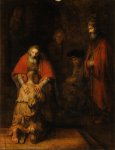
Could Luke 15 really a prophecy?
IMG_0482.jpeg
 
  • Like
Reactions: OLDBUTNEW
I'm a Protestant, but I think it's a real pity that the Catholic church was broken away from, at all! Especially when we consider that the Catholic church was the first Christian church! Why break away from it, and cause all of this division? We should have left well enough alone!
The Roman Catholic sect broke away from the Catholic Church by arrogating to itself a superior authority the rest of the Catholic Church did not recognise as legitimately belonging to Rome.
 
  • Like
Reactions: DeanM
But I have documents showing Bishop of Rome did act as boss.
#337
No. He acted as a fellow-presbyter and a fellow Christian should behave towards brothers w=ho one thinks are erring. or stumbling.

Gal 6:1
Brothers and sisters, if someone is caught in a sin, you who live by the Spirit should restore that person gently. But watch yourselves, or you also may be tempted.
Gal 6:2
Carry each other’s burdens, and in this way you will fulfill the law of Christ.
 
Why can't you put up one in fron of me?
"when the cat's away, the mice will play,"

While the Catholic Church presents a unified set of official doctrines, individual Catholics and even some clergy hold differing opinions or experience difficulty accepting certain teachings. Disagreements often center on matters of morality, church governance, and theological interpretations that are not considered primary, non-negotiable dogmas (such as the Trinity or the Resurrection).
Key areas of internal disagreement include:
  • Contraception and family planning: The Church has a clear stance against artificial contraception, but many Catholics privately dissent from this teaching and use contraceptives.
  • Ordination of women: Official doctrine states that only men can be priests. However, this remains a significant point of contention for some who believe women should be included in the clergy.
  • Celibacy of priests: The requirement for priests in the Latin Rite to be celibate is a disciplinary rule, not an unchangeable doctrine. Many Catholics believe the Church would benefit from allowing married men to be ordained, as is the practice in Eastern Catholic Churches and the Orthodox Church.
  • Remarriage of divorced persons: There are disagreements about the Church's processes for annulments and its stance on the possibility of remarriage for divorced Catholics within the Church.
  • Homosexuality and same-sex relationships: While the Church teaches that homosexual acts are sinful, but having homosexual tendencies is not, many Catholics hold differing personal views on the morality of same-sex relationships and the inclusion of LGBTQ+ individuals in the Church community.
  • Liturgical practices: There are differing views, particularly between traditionalist Catholics and others, regarding the post-Vatican II liturgical reforms, such as the use of the Tridentine Mass versus the Novus Ordo Mass.
  • Theological opinions not fully defined as dogma: Historically, there have been debates among theologians and laypeople on certain Marian doctrines (such as the precise implications of the Immaculate Conception or Assumption) and interpretations of doctrines like original sin or predestination, as long as they do not outright deny divinely revealed truth.
  • Capital punishment/Death Penalty: While the Church has a fundamental teaching on the sanctity of life, there has been some theological discussion regarding the application of the death penalty in modern society, with Pope John Paul II suggesting it should only be used if no other means are sufficient to protect society.
(from Google A!)

 
  • Like
Reactions: OLDBUTNEW
The Roman Catholic sect broke away from the Catholic Church by arrogating to itself a superior authority the rest of the Catholic Church did not recognise as legitimately belonging to Rome.
One thing I noticed that out of all the logos of various Christian denominations as shown below:
iq3dkrbf5bdq.jpg
Only one dares to say holding the keys to heaven:
Emblem_of_the_Holy_See_(no_background).svg.png
 
While the Catholic Church presents a unified set of official doctrines, individual Catholics and even some clergy hold differing opinions or experience difficulty accepting certain teachings. Disagreements often center on matters of morality, church governance, and theological interpretations that are not considered primary, non-negotiable dogmas (such as the Trinity or the Resurrection).
Key areas of internal disagreement include:
  • Contraception and family planning: The Church has a clear stance against artificial contraception, but many Catholics privately dissent from this teaching and use contraceptives.
  • Ordination of women: Official doctrine states that only men can be priests. However, this remains a significant point of contention for some who believe women should be included in the clergy.
  • Celibacy of priests: The requirement for priests in the Latin Rite to be celibate is a disciplinary rule, not an unchangeable doctrine. Many Catholics believe the Church would benefit from allowing married men to be ordained, as is the practice in Eastern Catholic Churches and the Orthodox Church.
  • Remarriage of divorced persons: There are disagreements about the Church's processes for annulments and its stance on the possibility of remarriage for divorced Catholics within the Church.
  • Homosexuality and same-sex relationships: While the Church teaches that homosexual acts are sinful, but having homosexual tendencies is not, many Catholics hold differing personal views on the morality of same-sex relationships and the inclusion of LGBTQ+ individuals in the Church community.
  • Liturgical practices: There are differing views, particularly between traditionalist Catholics and others, regarding the post-Vatican II liturgical reforms, such as the use of the Tridentine Mass versus the Novus Ordo Mass.
  • Theological opinions not fully defined as dogma: Historically, there have been debates among theologians and laypeople on certain Marian doctrines (such as the precise implications of the Immaculate Conception or Assumption) and interpretations of doctrines like original sin or predestination, as long as they do not outright deny divinely revealed truth.
  • Capital punishment/Death Penalty: While the Church has a fundamental teaching on the sanctity of life, there has been some theological discussion regarding the application of the death penalty in modern society, with Pope John Paul II suggesting it should only be used if no other means are sufficient to protect society.
(from Google A!)
Tell me which Catholic church or diocese allows woman priest,or divorce, or abortion,or not teaching perpetual virginity of Mary...etc
 
While the Catholic Church presents a unified set of official doctrines, individual Catholics and even some clergy hold differing opinions or experience difficulty accepting certain teachings. Disagreements often center on matters of morality, church governance, and theological interpretations that are not considered primary, non-negotiable dogmas (such as the Trinity or the Resurrection).
Key areas of internal disagreement include:
  • Contraception and family planning: The Church has a clear stance against artificial contraception, but many Catholics privately dissent from this teaching and use contraceptives.
  • Ordination of women: Official doctrine states that only men can be priests. However, this remains a significant point of contention for some who believe women should be included in the clergy.
  • Celibacy of priests: The requirement for priests in the Latin Rite to be celibate is a disciplinary rule, not an unchangeable doctrine. Many Catholics believe the Church would benefit from allowing married men to be ordained, as is the practice in Eastern Catholic Churches and the Orthodox Church.
  • Remarriage of divorced persons: There are disagreements about the Church's processes for annulments and its stance on the possibility of remarriage for divorced Catholics within the Church.
  • Homosexuality and same-sex relationships: While the Church teaches that homosexual acts are sinful, but having homosexual tendencies is not, many Catholics hold differing personal views on the morality of same-sex relationships and the inclusion of LGBTQ+ individuals in the Church community.
  • Liturgical practices: There are differing views, particularly between traditionalist Catholics and others, regarding the post-Vatican II liturgical reforms, such as the use of the Tridentine Mass versus the Novus Ordo Mass.
  • Theological opinions not fully defined as dogma: Historically, there have been debates among theologians and laypeople on certain Marian doctrines (such as the precise implications of the Immaculate Conception or Assumption) and interpretations of doctrines like original sin or predestination, as long as they do not outright deny divinely revealed truth.
  • Capital punishment/Death Penalty: While the Church has a fundamental teaching on the sanctity of life, there has been some theological discussion regarding the application of the death penalty in modern society, with Pope John Paul II suggesting it should only be used if no other means are sufficient to protect society.
(from Google A!)
I'll put up an analogy.
A McDonald's staff may dislike the taste of Big Mac,fries and cheese burgers and even regards these are all unhealthy junk foods. But he cannot deliver such opinions openly to the public. Doing so must get him being fired instantly.
 
While the Catholic Church presents a unified set of official doctrines, individual Catholics and even some clergy hold differing opinions or experience difficulty accepting certain teachings. Disagreements often center on matters of morality, church governance, and theological interpretations that are not considered primary, non-negotiable dogmas (such as the Trinity or the Resurrection).
Key areas of internal disagreement include:
  • Contraception and family planning: The Church has a clear stance against artificial contraception, but many Catholics privately dissent from this teaching and use contraceptives.
  • Ordination of women: Official doctrine states that only men can be priests. However, this remains a significant point of contention for some who believe women should be included in the clergy.
  • Celibacy of priests: The requirement for priests in the Latin Rite to be celibate is a disciplinary rule, not an unchangeable doctrine. Many Catholics believe the Church would benefit from allowing married men to be ordained, as is the practice in Eastern Catholic Churches and the Orthodox Church.
  • Remarriage of divorced persons: There are disagreements about the Church's processes for annulments and its stance on the possibility of remarriage for divorced Catholics within the Church.
  • Homosexuality and same-sex relationships: While the Church teaches that homosexual acts are sinful, but having homosexual tendencies is not, many Catholics hold differing personal views on the morality of same-sex relationships and the inclusion of LGBTQ+ individuals in the Church community.
  • Liturgical practices: There are differing views, particularly between traditionalist Catholics and others, regarding the post-Vatican II liturgical reforms, such as the use of the Tridentine Mass versus the Novus Ordo Mass.
  • Theological opinions not fully defined as dogma: Historically, there have been debates among theologians and laypeople on certain Marian doctrines (such as the precise implications of the Immaculate Conception or Assumption) and interpretations of doctrines like original sin or predestination, as long as they do not outright deny divinely revealed truth.
  • Capital punishment/Death Penalty: While the Church has a fundamental teaching on the sanctity of life, there has been some theological discussion regarding the application of the death penalty in modern society, with Pope John Paul II suggesting it should only be used if no other means are sufficient to protect society.
(from Google A!)
These official standing of the Catholic Church were there for centuries. If one is so disagree with them why one insisted to be a Catholic priest in the first place?
These dogmas and doctrines do not come out after one's ordination to his priesthood.

So I see AI has given you stupid guidance.
 
What is your test result of your spirit?
What kind of spirit is upon you, especially I have pointed out to you how you have misread and misinterpreted the scriptures.
"What kind of spirit is upon you?" You ask ! So ! Let me confess that; ...

What spirit I am of ?, ... whether to obedience, Believing & Loving Jesus OR disobedience, believing & following after Satan, is the matter to be determined, by God's SOON Judgement of my character, to see how well I conform to the Righteousness of Christ. ... Unto Salvation, eternal inheritance, and my "Hope of Glory" Gal 2:20

What I DO KNOW ... is that righteousness and unrighteousness, obedience and disobedience, are a "linear gradient" a line of progress, which scripture refers to as "Sanctification" I Pray CONTINUALLY and have Faith ... that I, like Paul "I have fought the good fight. I have finished the race. I have kept the faith. – 2 Timothy 4:7, ~~~ Yet knowing that, again like Paul, in Romans 7, I struggle daily, between obedience and disobedience, good vs evil..

I LOVE God's LAW .. the Righteousness of Christ, yet daily I fall short of that Love, and because of my carnal nature, I ... "know that in me (that is, in my flesh,) dwells no good thing: for to will is present with me; but how to perform that which is good I find not. For the good that I would I do not: but the evil which I would not, that I do. Now if I do that I would not, it is no more I that do it, but sin that dwells in me. I find then a law, that, when I would do good, evil is present with me. For I delight in the law of God after the inward man: But I see another law in my members, warring against the law of my mind, and bringing me into captivity to the law of sin which is in my members. O wretched man that I am! who shall deliver me from the body of this death? Romans 7: 18-24

It is ALL about Jesus .. Hallelujah & Amen !
 
Where is that is Scripture?
There are indeed two spirits in the world since the Fall of humanity in Eden: one that leads to obedience to God and righteousness, and the other that leads to disobedience and sin. These two spirits are fundamentally opposed to one another and reflect the ongoing spiritual battle between good and evil. The battle between Christ and His Angels and Satan and his angels, over the souls of men, commonly referred to as ...
The Great Controversy.

1. The Spirit of Obedience (The Holy Spirit)
The spirit of obedience is the work of the Holy Spirit, who guides believers toward righteousness, truth, and holiness. This spirit is associated with God’s commands and is in direct opposition to the spirit of disobedience, which seeks to lead people into sin.

  • Romans 8:14 (KJV): "For as many as are led by the Spirit of God, they are the sons of God."
    This verse shows that those who are obedient to God are led by the Holy Spirit, the spirit of obedience, which calls believers to live according to God’s will.
  • John 14:15-17 (KJV): "If ye love me, keep my commandments. And I will pray the Father, and he shall give you another Comforter, that he may abide with you forever; even the Spirit of truth; whom the world cannot receive, because it seeth him not, neither knoweth him: but ye know him; for he dwelleth with you, and shall be in you."
    Jesus promises the Holy Spirit, the Comforter, to those who obey His commandments. The Holy Spirit works within believers to guide them to obedience, aligning their hearts and lives with God's will.
  • Romans 6:16 (KJV): "Know ye not, that to whom ye yield yourselves servants to obey, his servants ye are to whom ye obey; whether of sin unto death, or of obedience unto righteousness?"
    This verse illustrates that obedience to God results in righteousness, and the Holy Spirit helps believers live according to God's commands, leading them to eternal life.
2. The Spirit of Disobedience (The Spirit of Antichrist)
In contrast, the spirit of disobedience is associated with the devil and the forces of evil. It leads humanity to rebel against God's commands, embrace sin, and follow the ways of the world.

  • Ephesians 2:2-3 (KJV): "Wherein in time past ye walked according to the course of this world, according to the prince of the power of the air, the spirit that now worketh in the children of disobedience: Among whom also we all had our conversation in times past in the lusts of our flesh, fulfilling the desires of the flesh and of the mind; and were by nature the children of wrath, even as others."
    This passage refers to the "spirit of disobedience," which is the influence of Satan (the "prince of the power of the air") that works in those who refuse to obey God. This spirit leads to sin, rebellion, and separation from God.
  • 1 John 4:3 (KJV): "And every spirit that confesseth not that Jesus Christ is come in the flesh is not of God: and this is that spirit of Antichrist, whereof ye have heard that it should come; and even now already is it in the world."
    The spirit of Antichrist, which is the spirit of disobedience, is in direct opposition to Christ and leads people away from the truth of God’s word. This spirit promotes lies, rebellion, and rejection of God’s commands.
  • Romans 8:7 (KJV): "Because the carnal mind is enmity against God: for it is not subject to the law of God, neither indeed can be."
    This verse highlights the nature of the "spirit of disobedience" — the carnal mind (human nature separated from God) is naturally rebellious and cannot submit to God's law without the work of the Holy Spirit.
3. Two Spiritual Realms: Obedience vs. Disobedience
After the Fall in Eden, humanity was divided between these two spiritual influences. The disobedience of Adam and Eve introduced the spirit of rebellion and sin into the world, and from that moment onward, humanity was torn between obedience to God (through the Holy Spirit) and disobedience (through the spirit of rebellion, which ultimately is the spirit of Antichrist).

  • Genesis 3:6-7 (KJV): "And when the woman saw that the tree was good for food, and that it was pleasant to the eyes, and a tree to be desired to make one wise, she took of the fruit thereof, and did eat, and gave also unto her husband with her; and he did eat. And the eyes of them both were opened, and they knew that they were naked; and they sewed fig leaves together, and made themselves aprons."
    This moment of disobedience in Eden marked the introduction of the spirit of disobedience into the world. The choice to listen to the serpent (Satan) rather than God led to sin, and the need for salvation and the Holy Spirit to restore obedience to God.
  • Romans 5:19 (KJV): "For as by one man’s disobedience many were made sinners, so by the obedience of one shall many be made righteous."
    Through Adam's disobedience, sin entered the world. But through Christ’s obedience, believers are made righteous. This shows that the spiritual divide is between the obedience to God's will (through Christ) and the disobedience to God (through sin and rebellion).
****************** ΙΧΘΥΣΙΧΘΥΣΙΧΘΥΣΙΧΘΥΣΙΧΘΥΣΙΧΘΥΣΙΧΘΥΣΙΧΘΥΣΙΧΘΥΣΙΧΘΥΣΙΧΘΥΣΙΧΘΥΣΙΧΘΥΣΙΧΘΥΣΙΧΘΥΣΙΧΘΥΣΙΧΘΥΣ ******************
 
  • Like
Reactions: OLDBUTNEW
The Roman Catholic sect broke away from the Catholic Church by arrogating to itself a superior authority the rest of the Catholic Church did not recognise as legitimately belonging to Rome.
I believe it was Waldensen's that said they didnt leave the catholic church it left them.
 
  • Like
Reactions: PaulThomson
These official standing of the Catholic Church were there for centuries. If one is so disagree with them why one insisted to be a Catholic priest in the first place?
These dogmas and doctrines do not come out after one's ordination to his priesthood.

So I see AI has given you stupid guidance.
Your arrogance almost matches your lack of knowledge. Different popes added and left out things along the way. Maybe do some reading?
 
Your arrogance almost matches your lack of knowledge. Different popes added and left out things along the way. Maybe do some reading?
Since you have read a lot, you show us how the official standing of the church had been added or left out in the issues stated in #470: woman priesthood, or divorce, or abortion, or not teaching perpetual virginity of Mary..
 
Where is that is Scripture?
There are indeed two spirits in the world since the Fall of humanity in Eden: one that leads to obedience to God and righteousness, and the other that leads to disobedience and sin.
An overly long response to a simple question. Two spiritual realms does not mean two spirits. Where in Scripture does it say there are two spirits? It doesn’t.