Iran missile attack Jerusalem

  • Christian Chat is a moderated online Christian community allowing Christians around the world to fellowship with each other in real time chat via webcam, voice, and text, with the Christian Chat app. You can also start or participate in a Bible-based discussion here in the Christian Chat Forums, where members can also share with each other their own videos, pictures, or favorite Christian music.

    If you are a Christian and need encouragement and fellowship, we're here for you! If you are not a Christian but interested in knowing more about Jesus our Lord, you're also welcome! Want to know what the Bible says, and how you can apply it to your life? Join us!

    To make new Christian friends now around the world, click here to join Christian Chat.
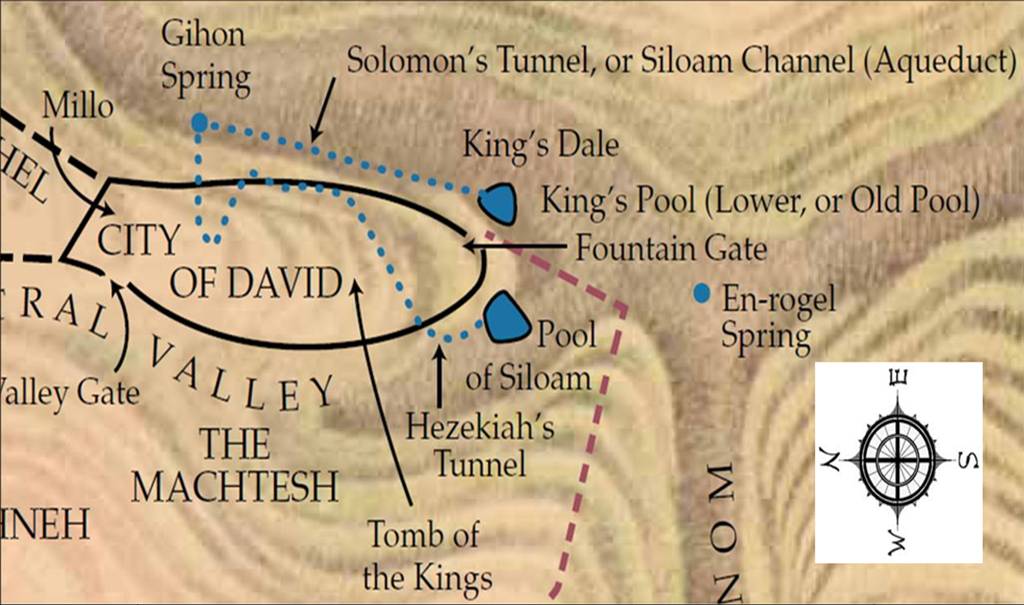
You will have to zoom in to see it. The Gihon spring is directly across from the neighborhood called Zahweilah at the northern extent of Silwan. It is most definitely is located at the northern part of old Jerusalem.
No. It is outside the old city walls. It had to be blocked up so that the invading armies couldn't make use of it when they besieged the city. It lies at the base of the hill from which Zion rose. Kenyon showed the line of the eastern flank of David's city to be west of the spring. That was why the tunnel had to be constructed through bedrock to provide a way for water to be retrieved for the inhabitants.

The western wall may well have been extended in later years to encompass the spring - but David's city did not have the spring inside the walls. In fact, Hezekiah's construction of the tunnel may have both buried the spring and provided an internal water source.
 
Descending the shaft that Kathleen Kenyon excavated to the shaft over the spring was also intriguing - but some archaeologists have questioned whether that was the first such construction when the spring was blocked up.

I'd bet money your tour guide didn't show you where Azal mentioned in Zechariah 14:5 is located
 
Yeah I know that. I didn't say it was inside the wall
Ah! You misled me! But it still wouldn't have been 'at the northern part of old Jerusalem' - it was on the east. Certainly, it was north of a line drawn from west to east through the centre of the city but your statement is similar to saying that Queens is north of Brooklyn - it is, but it's more east than north.

At least we agree.
 
Ah! You misled me! But it still wouldn't have been 'at the northern part of old Jerusalem' - it was on the east. Certainly, it was north of a line drawn from west to east through the centre of the city but your statement is similar to saying that Queens is north of Brooklyn - it is, but it's more east than north.

At least we agree.

I guess I should have said the City of David rather than old Jerusalem
 
Definitely at the northern extent of David's Jerusalem (on the eastern side)

Gihon+Map+A.jpg
 
Definitely at the northern extent of David's Jerusalem (on the eastern side)
You've got the map round the Jewish way - it's certainly not at the northern extent of David's City. I'll allow you that it's 'at the northern part of old Jerusalem' but not 'northern extent'. It would have to be in the City to be 'at the northern extent'. I've explained this above - your words are causing confusion in a very simple matter. Gihon, the spring of Siloam, never has been within the northern boundaries of the old city. You agree with that but your words confuse it.
 
You've got the map round the Jewish way - it's certainly not at the northern extent of David's City. I'll allow you that it's 'at the northern part of old Jerusalem' but not 'northern extent'. It would have to be in the City to be 'at the northern extent'. I've explained this above - your words are causing confusion in a very simple matter. Gihon, the spring of Siloam, never has been within the northern boundaries of the old city. You agree with that but your words confuse it.

You're being pedantic. I don't feel a need to be exact in every little detail about such a trivial matter.
 
You're being pedantic. I don't feel a need to be exact in every little detail about such a trivial matter.
It's about being able to adequately convey a matter without unnecessary misunderstanding.

I read a little way into the link you posted. Unfortunately, the etymology of the word relied on the Arabic tradition of place names as being faithful to the names that were in existence at the time of Zechariah - when they weren't continuously present there. It also seemed (and I couldn't find a statement to the contrary in the section I read) to say that the event wasn't 'fulfilled' but a pretended prophetic word about a historic event.

Certainly, the linguistic claims were dodgy (to say the least). There are locations that are taken to be where we have the modern day labels - and we don't realise that it isn't their location at all. For example, on the eastern side of the Kidron, the Arab settlement in the mid-eighties was called 'Siloam' (when it clearly isn't the location) and the Kidron is also called the 'Valley of Jehoshaphat' because of the Scripture - that is, after the prophetic passage was recorded, it got that name.
 
It's about being able to adequately convey a matter without unnecessary misunderstanding.

I read a little way into the link you posted. Unfortunately, the etymology of the word relied on the Arabic tradition of place names as being faithful to the names that were in existence at the time of Zechariah - when they weren't continuously present there. It also seemed (and I couldn't find a statement to the contrary in the section I read) to say that the event wasn't 'fulfilled' but a pretended prophetic word about a historic event.

Certainly, the linguistic claims were dodgy (to say the least). There are locations that are taken to be where we have the modern day labels - and we don't realise that it isn't their location at all. For example, on the eastern side of the Kidron, the Arab settlement in the mid-eighties was called 'Siloam' (when it clearly isn't the location) and the Kidron is also called the 'Valley of Jehoshaphat' because of the Scripture - that is, after the prophetic passage was recorded, it got that name.

Etymological analysis of Arabic geographic names in Israel has proven to be an effective tool in the discovery of forgotten biblical locations, a method pioneered in 1838 by Edward Robinson, “Father of Biblical Geography” and “founder of modern Palestinology”.

"While some of the main locales of Biblical history, such as Jerusalem, Hebron, Jaffa, Beth-shean, and Gaza, had never been forgotten, hundreds of additional places mentioned in the Bible were unknown. By using the geographical information contained in the Bible and carefully studying the modern Arabic place-names of the country, Robinson found it was possible to identify dozens of ancient mounds and ruins with previously forgotten biblical sites. … This process was particularly effective in regions that had been inhabited continuously throughout the centuries and where the site’s name had been preserved."​

The Bible Unearthed: Archaeology’s New Vision of Ancient Israel and the Origin of Its Sacred Texts, Israel Finkelstein and Neil Asher Silberman, pg. 15, 2002​
 
Certainly, the linguistic claims were dodgy (to say the least). There are locations that are taken to be where we have the modern day labels - and we don't realise that it isn't their location at all. For example, on the eastern side of the Kidron, the Arab settlement in the mid-eighties was called 'Siloam' (when it clearly isn't the location) and the Kidron is also called the 'Valley of Jehoshaphat' because of the Scripture - that is, after the prophetic passage was recorded, it got that name.

Israel archaeological authorities don't think so.

It is customary to identify the place referred to [i.e., Azal] as Mount Azal, following its [i.e., Azal’s] probable preservation in the [Arabic] name of Wadi Yasul [Yasul Valley], [where] the level of Talpiot [neighborhood] drops to the Kidron Valley.​
The Government Names Committee, therefore, decided on the name Azal River [for Wadi Yasul] (April 1955). Later (May 1990), Jabal Mukaber that looks upon Azal River from the south and Armon Hanatsiv sits atop, received the name Mount Azal.​
 
Etymological analysis of Arabic geographic names in Israel has proven to be an effective tool in the discovery of forgotten biblical locations...
It may have provided some assistance but it's not reliable or effective. They simply weren't there and the tradition began later than when the events took place. We have the same problem in the UK - and the tradition here is continuous.

Lots of lines of Roman Roads are plainly wrong - traditional names can suggest a location but the spade is the only reliable tool. Etymology proves nothing, unfortunately - but it does help the archaeologist in suggesting sites to dig.

The article's seeming insistence that Zechariah 14:1-5 was backwardly prophetic (again, if I read it right) undermines the entire supposition unfortunately. I can see the need for the location to be fixed where it says it is, to make the Scripture fit known history - but that isn't sound exegesis (to say nothing of the unbelief in Scripture).

Anyway, at least we've cleared up that we both agree where Gihon is.
 
Israel archaeological authorities don't think so.
See my previous post. Etymological identification is a suggestion but never proof. The spade must be used in conjunction - many sites have been located that way but etymology proves nothing on its own.