
All will hearThe last Trumpet/Judgment as the eternal gospel.
John 5:28-29

All will hearThe last Trumpet/Judgment as the eternal gospel.
The parable is about hearing Jesus' words and doing them vs. hearing Jesus' words and not doing them.Think of it this way. The house is fully built before the storm. His parable says nothing about:
He gives only two completed houses. He doesn't give a half-built house scenario. Instead, He uses
- a man who abandons the project
- a man who partially builds
- a man who builds well and then tears it down
- a man who switches foundations halfway
The entire force of the parable is: You cannot tell the difference between the saved and the unsaved by looking at the house. Only the foundation matters, and the storm reveals it.
- two completed houses
- two hidden foundations
- one final test
So what does this say about loss of salvation? It implies the opposite.
The parable assumes:
The wise man’s house never collapses. The foolish man’s house was never secure.
- A true foundation endures the storm
- A false foundation collapses
- No switching foundations mid‑construction
- No losing what was truly built on rock
This aligns with the broader biblical pattern:
The parable is about final vindication, not mid‑life apostasy.
- True faith endures
- False faith is exposed
- The final judgment reveals what was always true
In the context of Matthew, the storm is divine judgment—the ultimate testing of a life. Jesus is closing His sermon with an eschatological warning.
The rock is obedience to the way of life Jesus just laid out in the Sermon on the Mount—a life shaped from the inside out by the kingdom.

ToKnot slithered this in there. Smooth move.
I shudder to think of that given that someone had actually granted her authority over their child's guidance in concern to their salvation.Old habits don't die.
I shudder to think of that given that someone had actually granted her authority over their child's guidance in concern to their salvation.

Wow! Profaning His blood?!! Hmm, then, it's no wonder...I remember when she stated, many years back, that Christ had wasted His blood on some people......... or something to that effect.
Wow, what a metaphor. LolI said:
You aren't mining for the hearts of men and are just mining for the sediment if your focus is 'creating' gold, silver, and precious stone.
Anyone trying to "make" people good is just really looking for the sediment and then working it to try and 'convert' it to gold, silver, and precious stones. But if you're mining for gold, you have to wash away the sediment to find it. Approaching the hearts of men similarly, the former group only ends up hardens the sediment around the heart the more they keep 'working' with it while the latter reveals the gems encased within it.
That was my point. Hopefully, I was able to sharpen it up for you.

The parable illustrates acting on what Jesus taught, not doing what he commanded. The distinction is critical.The parable is about hearing Jesus' words and doing them vs. hearing Jesus' words and not doing them.
It's a teaching about obedience to Jesus Christ vs. disobedience to Jesus Christ.
There is only one storm illustrated in the parable and it comes after the house is built.If obeying Jesus is our foundation we build upon, then He compares us to wise men and the storms can't cause us to fall.
We must be careful to avoid giving the wrong impression. There is more to Jesus' teaching than rules to obey. The parables, for instance, don't compel us to obey a command, but they compel us to think rationally about truth, goodness, and righteousness.If we build upon disobeying Jesus, then He compares us to moros men - foolish men, stupid men - and we will fall a great fall.
Sure, but that is beside the point. The parable posits a situation in which a believer who builds his life on the foundation of Jesus' teaching will not fail to be saved.Hear and obey Jesus = the foundation of the wise who won't fall.
Unless we want to remove faith from the teaching, then this is another Faith-Obedience lesson.
Since men have volition, we can change our obedience to disobedience - our wisdom to stupidity - our foundation from rock - Jesus Christ - to sand.
I posed this question in the 10 commandments thread #6296.NKJ Matt7:21-23 "Not everyone who says to Me, 'Lord, Lord,' shall enter the kingdom of heaven, but he who does the will of My Father in heaven. 22 "Many will say to Me in that day, 'Lord, Lord, have we not prophesied in Your name, cast out demons in Your name, and done many wonders in Your name?' 23 "And then I will declare to them, 'I never knew you; depart from Me (leave Me, go away from Me), you whopracticeare working lawlessness!'

What was jesus teaching?Do I need to know why I'm doing it?
Yes, we need to know why we do what we do. Having pure motives is a common theme in the New Testament.
Do I need to know why you are giving me food? No. I don't really care. But I should. Remember when Jesus fed the 5,000? He was critical of the crowd because they sought him for his ability to feed them rather than for what he was teaching.
Jesus said this:ToKnot slithered this in there. Smooth move.
Let's look at the verses again.....Loving God
Loving our neighbor
requires a long list of rules.
You quoted Romans 2:6-8, and this passage illustrates my point. Paul asserts that we will be judged according to our deeds, and then he establishes the qualification for eternal life based on what a person seeks.
A. Eternal life
B. Wrath and indignation
- What he seeks
- glory
- honor
- immortality
Here we see the importance of knowing why we do what we do. What are we seeking?
- what he seeks
- selfishly ambitious
- what is false
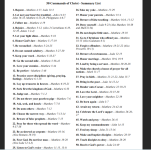
Jesus issues approximately 50 commands in Matt5-7.The parable illustrates acting on what Jesus taught, not doing what he commanded. The distinction is critical.
NKJ Matt7:21-25 "Not everyone who says to Me, 'Lord, Lord,' shall enter the kingdom of heaven, but he who does the will of My Father in heaven. 22 "Many will say to Me in that day, 'Lord, Lord, have we not prophesied in Your name, cast out demons in Your name, and done many wonders in Your name?' 23 "And then I will declare to them, 'I never knew you; depart from Me, you who practice lawlessness!'There is only one storm illustrated in the parable and it comes after the house is built.
Asked and answered. Do what He says - obey what He commands - keep his commandments - keep His word - keep His words - they're all basically the same thing.We must be careful to avoid giving the wrong impression. There is more to Jesus' teaching than rules to obey. The parables, for instance, don't compel us to obey a command, but they compel us to think rationally about truth, goodness, and righteousness.
The antithesis of acting on what Jesus taught is not acting on it. Defining "acting" as "obeying a command" flattens down the meaning of the parable too much.
Why do you delete things and soften them?Sure, but that is beside the point. The parable posits a situation in which a believer who builds his life on the foundation of Jesus' teaching will not fail to be saved.
Didn’t Jesus mostly teach in parables?What was jesus teaching?
You do sound very legalistic, I must say.
Matthew 7:23 describes people who use Jesus’ name but refuse to hear and do His words — a life of disobedience (thus unbelief) that Jesus calls lawlessness, which is sin.I posed this question in the 10 commandments thread #6296.
Re: Gal 2:18's stipulation in proving himself to be a transgressor if he tears down what he has built. This 'working lawlessness' seems to be conveying a similar message. That is, the law is fully fulfilled in Christ, so that if anyone should 'tear down' any part of that foundation, which is Christ crucified, and rebuild on it prophesies, and casting out demons, and many wonders 'in His name,' as if "His Name" was less than sufficient, I can see why He'd be offended in any claims of knowing Him.
Mainly I'd begin seeing it through the lens of Paul in Acts13:39 which is part of his real evangelistic teaching to Jews and Gentiles (Acts13:16-41) (and side note see in Acts13:42 who it was who was mainly interested).
YLT Acts 13:38 'Let it therefore be known to you, men, brethren, that through this one to you is the forgiveness of sins declared, 39 and from all things from which ye were not able in the law of Moses to be declared righteous, in this one every one who is believing is declared righteous;I'm using YLT because it is the most literal.There are nearly always translation issues to be discussed, but this is saying IN this man (Jesus Christ) every [man] (probably music to the ears of the interested Gentiles/God-fearers Acts13:16) who is believing (present tense taken as continuous or currently continuous) is (present tense) deemed righteous/release from institutional claims.The word order in Greek is important. The phrase "in this [man]" is just like the YLT translates it. So it's pushing forward a concept of being in union with - IN Christ, every man who is believing, is free from legal claims.There are several ways to look at these present tenses.Bottom line is there is legitimate discussion here that makes our justification relational - believing in Jesus Christ / being in union - in relationship with Jesus Christ / we are free from legal claims (He became our righteousness 1Cor1:30).So, yes, there is discussion to be had about withdrawing from being in relationship with Him and not having what the relationship provides.
What is John 15:5-6 teaching?
It is NOT teaching about justification.
So what is it teaching about?
John 15:2, 5, 6
Berean Standard Bible Par ▾
Jesus the True Vine
(Isaiah 27:1–13)
1“I am the true vine, and My Father is the keeper of the vineyard.
2He cuts off every branch in Me that bears no fruit, and every branch that does bear fruit, He prunes to make it even more fruitful.
5I am the vine and you are the branches. The one who remains in Me, and I in him, will bear much fruit. For apart from Me you can do nothing.
6If anyone does not remain in Me, he is like a branch that is thrown away and withers. Such branches are gathered up, thrown into the fire, and burned.
Jesus taught in parables.Didn’t Jesus mostly teach in parables?
Jesus does not say what you say: justified is justified.If you do not see/accept the big picture, no point in trying to understand scripture really, it becomes one big contradictory mess.
Justified is justified.


