Wishing you all a blessed Good Friday

  • Christian Chat is a moderated online Christian community allowing Christians around the world to fellowship with each other in real time chat via webcam, voice, and text, with the Christian Chat app. You can also start or participate in a Bible-based discussion here in the Christian Chat Forums, where members can also share with each other their own videos, pictures, or favorite Christian music.

    If you are a Christian and need encouragement and fellowship, we're here for you! If you are not a Christian but interested in knowing more about Jesus our Lord, you're also welcome! Want to know what the Bible says, and how you can apply it to your life? Join us!

    To make new Christian friends now around the world, click here to join Christian Chat.

Amargosa

Active member
Sep 28, 2025
152
206
43
This is a day of rememberance. A day memorialized by the sacrifice of The Lamb of God who takes away the sins of the world.

Adam's wife was made from a rib taken from his side. Jesus Christ's bride was made by the blood that flowed from His side.

B.C.-Good Friday.jpg
 
This is a day of rememberance. A day memorialized by the sacrifice of The Lamb of God who takes away the sins of the world.

Adam's wife was made from a rib taken from his side. Jesus Christ's bride was made by the blood that flowed from His side.

View attachment 287346
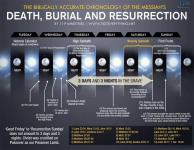
By Friday, Jesus had been dead for over a day seeing that his death took place on Wednesday.😉
 
  • Like
Reactions: Magenta
The Good News is:

"He lives, He lives, Christ Jesus lives today. He walks with me, He talks with me along life's narrow way. He lives, He lives, salvation to impart. You ask me how I know He lives, He lives within my heart."

Praying all have a great Resurrection Sunday!
 
By Friday, Jesus had been dead for over a day seeing that his death took place on Wednesday.😉
You propose an interesting timeline. Jesus entered Jerusalem on Sunday, the next day he cursed a fig tree, that would be Monday. The next morning the disciples noticed that the fig tree was withered, that would be Tuesday. Then the next day, that is Wednesday, He told two disciples to meet a man carrying a jug of water and arrange for the place where He would hold the last supper. And he died that day also?
 
You propose an interesting timeline. Jesus entered Jerusalem on Sunday, the next day he cursed a fig tree, that would be Monday. The next morning the disciples noticed that the fig tree was withered, that would be Tuesday. Then the next day, that is Wednesday, He told two disciples to meet a man carrying a jug of water and arrange for the place where He would hold the last supper. And he died that day also?
Lord Jesus was in the grave 3 days and 3 nights. That's all that we know for certain. Tradition is wrong.

It's not that important. My wife and I went to our local beach and watched dozens of believers baptised in the sea. There was a large crowd of onlookers, but there was great peace. It was nothing like the usual rowdy crowd. A Muslim family came, which is not unusual, but did not stay long. I can't imagine why...... The gospel was preached as well. We still have that freedom in Australia.
 
Lord Jesus was in the grave 3 days and 3 nights. That's all that we know for certain. Tradition is wrong.

It's not that important. My wife and I went to our local beach and watched dozens of believers baptised in the sea. There was a large crowd of onlookers, but there was great peace. It was nothing like the usual rowdy crowd. A Muslim family came, which is not unusual, but did not stay long. I can't imagine why...... The gospel was preached as well. We still have that freedom in Australia.
I merely cited the timeline presented in scripture. Scripture claims that Jesus was crucified on the day before a Sabbath Passover, which means on a Friday. It likewise claims that Jesus rose on the first day of the week, which for the Jews would have been a Sunday.

I trust that you have found a way to reconcile those points with your statement about Him dying on Wednesday.

Note, I am not stating who is wrong, merely that there is an inconsistency that you need to explain. Personally, I maintain that the Last Supper was on a Wednesday night, the beginning of the unofficial Passover which was popular in Galilee in the 1st century, Jesus was arrested that night, exactly what happened on Thursday is unclear, possibly back and forth between Jews and Pilate as to what was to be done, but then flogged and crucified on Friday and buries then found having risen on Sunday.

Under my logic He was in the tomb on three different days, Friday before sundown (6 pm) when the Sabbath/Passover started, all day Saturday, the Sabbath/Passover, and an indeterminate period of time on Sunday.
 
I merely cited the timeline presented in scripture. Scripture claims that Jesus was crucified on the day before a Sabbath Passover, which means on a Friday. It likewise claims that Jesus rose on the first day of the week, which for the Jews would have been a Sunday.

I trust that you have found a way to reconcile those points with your statement about Him dying on Wednesday.

Note, I am not stating who is wrong, merely that there is an inconsistency that you need to explain. Personally, I maintain that the Last Supper was on a Wednesday night, the beginning of the unofficial Passover which was popular in Galilee in the 1st century, Jesus was arrested that night, exactly what happened on Thursday is unclear, possibly back and forth between Jews and Pilate as to what was to be done, but then flogged and crucified on Friday and buries then found having risen on Sunday.

Under my logic He was in the tomb on three different days, Friday before sundown (6 pm) when the Sabbath/Passover started, all day Saturday, the Sabbath/Passover, and an indeterminate period of time on Sunday.
One thing people overlook is that there was not only one sabbath that week. If you look at the original Greek where "sabbath" appears in Matthew 28, it is plural. I don't know what day Lord Jesus was crucified for sure. All I can go on is "the sign of Jonah". Friday night and Saturday night is two nights, not three. This assumes night was sunset to sunrise, which I understand is the way the culture of the day believed it to be.

I've examined a number of theories. They all have their points. I am inclined to accept Thursday as the day Jesus was crucified.
 
  • Like
Reactions: rewriter
One thing people overlook is that there was not only one sabbath that week. If you look at the original Greek where "sabbath" appears in Matthew 28, it is plural. I don't know what day Lord Jesus was crucified for sure. All I can go on is "the sign of Jonah". Friday night and Saturday night is two nights, not three. This assumes night was sunset to sunrise, which I understand is the way the culture of the day believed it to be.

I've examined a number of theories. They all have their points. I am inclined to accept Thursday as the day Jesus was crucified.
You appear to be accepting the "sign of Jonah" as being perfect. If you examine more details, some of which are not obvious, the only year that fits for the crucifixion is 33. In that specific year, the Passover, according to the Galilean calendar, would fall on a Wednesday night into Thursday, while the official Passover it began on Friday night into Saturday. But also in 33, Pilate was politically isolated. His anti-Jewish patron back in Rome had been moved from office and executed in late 32 for scheming against Tiberius. Pilate was in need of political cover, so actively going against perceived enemies of Rome and able to be pressured by more politically stable individuals fits perfectly And, that is not all that you might have already uncovered. You might even have uncovered that in the spring of 37, Pilate and Caiaphas were both removed from office by Vitellius, the father of the future short-term emperor, and that Antipas escorted Vitellius to the Euphrates where they met with the Parthian emperor and where Antipas was exceedingly gracious to both men, before returning to Jerusalem by himself, only to be exiled two years later when Gaius revoked political pardons he had issued after the death of Tiberius in the spring of 37. But what I would be surprised to learn that you were aware of would be the numismatic evidence from 33-4 that Antipas appears to have supported the early Jesus movement, or that Moses of Chorene claimed to have had access to a letter from Tiberius in which he acknowledged the crucifixion and resurrection of Jesus and the involvement of Pilate, Caiaphas and Antipas in questionable activity, and that the letter also appears to reference specific, relatively obscure, activity from the period 35-6 CE.

If one is truly going to investigate the NT, one must make every possible effort to know what the people of the day knew, and not assume that our common 21sst century knowledge, which is largely ignorant of 1st century commonly known realities, is sufficient. I might add, that to date, I have yet to find another NT scholar who was aware of the numismatic evidence I uncovered before I appraised them of it, but their reaction has consistently been that if I am interpreting it correctly, it changes everything,

 
We had a lovely Good Friday service last night, concluding the service by taking communion together.

Worship songs were;

Jesus Messiah
How Deep The Father’s Love For Us
Beneath The Cross of Jesus

We played “The Old Rigged Cross” instrumentally for communion on two acoustic guitars.
 
  • Like
Reactions: rewriter
We had a lovely Good Friday service last night, concluding the service by taking communion together.

Worship songs were;

Jesus Messiah
How Deep The Father’s Love For Us
Beneath The Cross of Jesus

We played “The Old Rigged Cross” instrumentally for communion on two acoustic guitars.
I am not certain that communion is appropriate on Good Friday, but the songs certainly were.
 
You appear to be accepting the "sign of Jonah" as being perfect. If you examine more details, some of which are not obvious, the only year that fits for the crucifixion is 33. In that specific year, the Passover, according to the Galilean calendar, would fall on a Wednesday night into Thursday, while the official Passover it began on Friday night into Saturday. But also in 33, Pilate was politically isolated. His anti-Jewish patron back in Rome had been moved from office and executed in late 32 for scheming against Tiberius. Pilate was in need of political cover, so actively going against perceived enemies of Rome and able to be pressured by more politically stable individuals fits perfectly And, that is not all that you might have already uncovered. You might even have uncovered that in the spring of 37, Pilate and Caiaphas were both removed from office by Vitellius, the father of the future short-term emperor, and that Antipas escorted Vitellius to the Euphrates where they met with the Parthian emperor and where Antipas was exceedingly gracious to both men, before returning to Jerusalem by himself, only to be exiled two years later when Gaius revoked political pardons he had issued after the death of Tiberius in the spring of 37. But what I would be surprised to learn that you were aware of would be the numismatic evidence from 33-4 that Antipas appears to have supported the early Jesus movement, or that Moses of Chorene claimed to have had access to a letter from Tiberius in which he acknowledged the crucifixion and resurrection of Jesus and the involvement of Pilate, Caiaphas and Antipas in questionable activity, and that the letter also appears to reference specific, relatively obscure, activity from the period 35-6 CE.

If one is truly going to investigate the NT, one must make every possible effort to know what the people of the day knew, and not assume that our common 21sst century knowledge, which is largely ignorant of 1st century commonly known realities, is sufficient. I might add, that to date, I have yet to find another NT scholar who was aware of the numismatic evidence I uncovered before I appraised them of it, but their reaction has consistently been that if I am interpreting it correctly, it changes everything,
Seriously, it is no big deal. I take Lord Jesus at his word.
"...........some of the scribes and Pharisees said to Him, “Teacher, we want to see a sign from You.” Jesus replied, “A wicked and adulterous generation demands a sign, but none will be given it except the sign of the prophet Jonah. For as Jonah was three days and three nights in the belly of the great fish, so the Son of Man will be three days and three nights in the heart of the earth. ..."

What part of "3 days and 3 nights" do you want to argue about? And what is imperfect about the sign of Jonah?
 
  • Like
Reactions: TruthDefender
You appear to be accepting the "sign of Jonah" as being perfect. If you examine more details, some of which are not obvious, the only year that fits for the crucifixion is 33. In that specific year, the Passover, according to the Galilean calendar, would fall on a Wednesday night into Thursday, while the official Passover it began on Friday night into Saturday. But also in 33, Pilate was politically isolated. His anti-Jewish patron back in Rome had been moved from office and executed in late 32 for scheming against Tiberius. Pilate was in need of political cover, so actively going against perceived enemies of Rome and able to be pressured by more politically stable individuals fits perfectly And, that is not all that you might have already uncovered. You might even have uncovered that in the spring of 37, Pilate and Caiaphas were both removed from office by Vitellius, the father of the future short-term emperor, and that Antipas escorted Vitellius to the Euphrates where they met with the Parthian emperor and where Antipas was exceedingly gracious to both men, before returning to Jerusalem by himself, only to be exiled two years later when Gaius revoked political pardons he had issued after the death of Tiberius in the spring of 37. But what I would be surprised to learn that you were aware of would be the numismatic evidence from 33-4 that Antipas appears to have supported the early Jesus movement, or that Moses of Chorene claimed to have had access to a letter from Tiberius in which he acknowledged the crucifixion and resurrection of Jesus and the involvement of Pilate, Caiaphas and Antipas in questionable activity, and that the letter also appears to reference specific, relatively obscure, activity from the period 35-6 CE.

If one is truly going to investigate the NT, one must make every possible effort to know what the people of the day knew, and not assume that our common 21sst century knowledge, which is largely ignorant of 1st century commonly known realities, is sufficient. I might add, that to date, I have yet to find another NT scholar who was aware of the numismatic evidence I uncovered before I appraised them of it, but their reaction has consistently been that if I am interpreting it correctly, it changes everything,

What does all this matter? Only bits of minutia.
 
Low in the grave He lay
Jesus my Savior!
Waiting the coming day
Jesus my Lord!

(refrain):
Up from the grave He arose
With a mighty triumph o'er His foes
He arose a Victor from the dark domain
And He lives forever with His saints to reign
He arose! (He arose), He arose! (He arose)
Hallelujah! Christ arose!

Vainly they watch His bed
Jesus, my Savior!
Vainly they seal the dead
Jesus my Lord!

(refrain)

Death cannot keep his prey
Jesus, my Savior!
He tore the bars away
Jesus my Lord!

Up from the grave He arose
With a mighty triumph o'er His foes
He arose a Victor from the dark domain
And He lives forever with His saints to reign
He arose! (He arose), He arose! (He arose)
Hallelujah! Christ arose!
 
What does all this matter? Only bits of minutia.
Bits of minutia, suppose that you are on trial for your life, an eyewitness decides to ignore a bit of minutia and neglects to mention that when they saw you standing over the dead body holding a bloody knife in your hand that they also saw someone else drop the knife and run away.

If the entire Bible is true, then there should not be contradictions. If one place says it was two nights and another says it was three, ir would seem to me that one of them is wrong. A wrong comment in the Bible means the entire Bible is not true. If the entire Bible is not true, then we need to seriously study to determine what is most likely true and what is not instead of proclaiming tht we believe the Bible is true and paper over inconsistencies.

Papering over inconsistencies is not loving God and seeking to know Him, it is claiming to love God while actually loving a mirage.