The Ten Commandments are the Covenant, did you know?

  • Christian Chat is a moderated online Christian community allowing Christians around the world to fellowship with each other in real time chat via webcam, voice, and text, with the Christian Chat app. You can also start or participate in a Bible-based discussion here in the Christian Chat Forums, where members can also share with each other their own videos, pictures, or favorite Christian music.

    If you are a Christian and need encouragement and fellowship, we're here for you! If you are not a Christian but interested in knowing more about Jesus our Lord, you're also welcome! Want to know what the Bible says, and how you can apply it to your life? Join us!

    To make new Christian friends now around the world, click here to join Christian Chat.
Knowing Christ and do what He says are 2 different things Gideon, faith is belief and to believe is to listen and do also. just ask yourself what was Christ teaching? Hint: _ _ N _ _ m m _ _ _ _ _ _ _ S do you know why he spent so much time teaching this and gave is the perfect example to be followed?
Sure, Jesus is the perfect example to follow. When was the last time you walked on water and raised the dead? Never? So you are not following the example of Jesus. So your obedience is incomplete and you will not make it into heaven.

Of course, if you are saved by grace, that is a different matter. God puts you into Christ and He becomes everything that pleases God on our behalf. The rest of the believer's life is the outworking of that wonderful gift. By the way, no one earns a gift.

You should read Matthew 19:17 again. The man obeyed all the commandments. Lord Jesus said that it was not enough.

The one seeking to justify himself always asks , "What must I do?" True believers depend on what Jesus has already done.
 
Can you see how mercy and justice come together in Christ.

The law is not against us or evil
The law reveals sin and sin is what kills.

Rom 7:7-8
7 What shall we say then? Is the law sin? God forbid. Nay, I had not known sin, but by the law: for I had not known lust, except the law had said, Thou shalt not covet. 8 But sin, taking occasion by the commandment, wrought in me all manner of concupiscence. For without the law sin was dead.

Rom 7:11-14
11 For sin, taking occasion by the commandment, deceived me, and by it slew me. 12 Wherefore the law is holy, and the commandment holy, and just, and good. 13 Was then that which is good made death unto me? God forbid. But sin, that it might appear sin, working death in me by that which is good; that sin by the commandment might become exceeding sinful. 14 For we know that the law is spiritual: but I am carnal, sold under sin.

As a carnal person we all need salvation from sin. We are all doomed to death because we have all sinned.

We have salvation from.....
a. The law, or
b. Sin and death.

It is not the law... we are saved from the penalty of transgressing the law but the law still reveals sin.

Did Jesus die to save us from the law or Did Jesus die to save us from sin.

The law is not the enemy
It is Holy, just and Good.

Being saved from sin is not done by removing the law that reveals sin. It is achieved by a born again transformed heart. Motivated by love.

It is done by imputed righteousness and by imparted righteousness.

Both are a gift from Jesus.

We need faith
I am not the one promoting the "gospel" of law and commandments. Tell the SDA legalists. Maybe they will listen to you.
 
Does Jesus have to obey God's law?
Jesus was not a sinner and kept the commandments, just as He asked us to if we love Him

John 15:10 If you keep My commandments, you will abide in My love, just as I have kept My Father’s commandments and abide in His love

That’s why Jesus is our example 1John2:6 - He overcame and can give that gift to us if we allow Him to change our heart and be subject to His commandments- not everyone does Rom8:7-8
Does He observe the sabbath in heaven?

The Sabbath will be kept in heaven with all of His saints- if we are so opposed to it now would one really be happy in heaven for eternity coming before the Lord to worship Him on the Sabbath? God would never force anyone to worship Him, its why His judgment is one of love, not everyone would be happy where there will be no more sin,

Isa 66:22 “For as the new heavens and the new earth Which I will make shall remain before Me,” says the LORD, “So shall your descendants and your name remain. And it shall come to pass That from one New Moon to another, And from one Sabbath to another, All flesh shall come to worship before Me,” says the LORD
 
  • Like
Reactions: TMS
Jesus was not a sinner and kept the commandments, just as He asked us to if we love Him

John 15:10 If you keep My commandments, you will abide in My love, just as I have kept My Father’s commandments and abide in His love


The Sabbath will be kept in heaven with all of His saints- if we are so opposed to it now would one really be happy in heaven for eternity coming before the Lord to worship Him on the Sabbath? God would never force anyone to worship Him, its why His judgment is one of love, not everyone would be happy where there will be no more sin,

Isa 66:22 “For as the new heavens and the new earth Which I will make shall remain before Me,” says the LORD, “So shall your descendants and your name remain. And it shall come to pass That from one New Moon to another, And from one Sabbath to another, All flesh shall come to worship before Me,” says the LORD
I am not descended from Abraham. Isaiah was talking about the millennium, not heaven. Now I'll ask the question again, since you saw fit not to answer: Does Jesus obey the Sabbath?
 
I am not descended from Abraham. Isaiah was talking about the millennium, not heaven. Now I'll ask the question again, since you saw fit not to answer: Does Jesus obey the Sabbath?
God said it’s the New Heaven and New Earth, it doesn't say millennium. I am sticking with what God said.
 
So are you not included in 'whoever"
That's right. Jesus was talking to Israel and his contemporaries. He was not talking about you and I.
Can you please use Scripture, I find it not fruitful to try to reason with ones opinions as if its the same as the word of God. It never turns out to be fruitful. If you can support your argument with Scripture I would be happy to address.

Thanks.
We are both looking at the same scriptures.
 
Why would you not think incest is under adultery? Would that not start with lust of flesh which Jesus related to adultery. Why would not praying to God not be part of worshipping only Him as shown in the first 4 commandments.

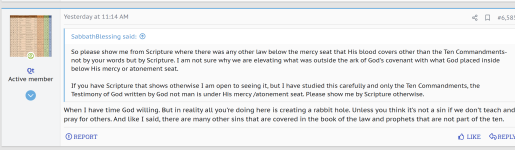
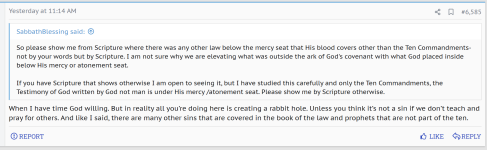
You are making connections that are not there. Adding what is not written. It being a sin praying for others is not in the Ten. IF IT WAS THEN THERE WOULD BE NO POINT IN REPEATING IT in the Book of the Law.

Incidently I would go as far to say most on this forum did not know it was a sin not to pray for others. And that it was sin not to teach the word of God.

As matter of fact I would say YOU did not know it was sin not to pray for others.

But I could be wrong.
Jesus related sexual immortality to adultery
Not in the broad all encompassing sense you are trying to ADD. The context is in relation to a married couple. PERIOD. Not good to add what is not. Verse 31 sets the context.

Matt 5:27 Ye have heard that it was said by them of old time, Thou shalt not commit adultery:
Matt 5:28 But I say unto you, That whosoever looketh on a woman to lust after her hath committed adultery with her already in his heart.
Matt 5:29 And if thy right eye offend thee, pluck it out, and cast it from thee: for it is profitable for thee that one of thy members should perish, and not that thy whole body should be cast into hell.
Matt 5:30 And if thy right hand offend thee, cut it off, and cast it from thee: for it is profitable for thee that one of thy members should perish, and not that thy whole body should be cast into hell.
Matt 5:31 It hath been said, Whosoever shall put away his wife, let him give her a writing of divorcement:
Matt 5:32 But I say unto you, That whosoever shall put away his wife, saving for the cause of fornication, causeth her to commit adultery: and whosoever shall marry her that is divorced committeth adultery.


Obviously they mean and cover much more than stated why they are so broad Psa119:89 why only the Ten is under God's mercy seat

No mentioned the mercy but you. You said Christ's blood only covers the Ten Commandments. That is untrue.

That is all that is being said here.


You claimed the law of Moses is under God's mercy seat, please show it through Scripture. If its there it should be easy to find.
Not sure where you got that from.

Where did I say the law of Moses was under the mercy seat?

Stayed focused please. This is extremely important to me.

I am an SDA but @Vassel you said you are not an Adventist. With being understood I am a bit perplexed as to why you are dogmatic about this false doctine that some Adventist share.

 
You are making connections that are not there. Adding what is not written. It being a sin praying for others is not in the Ten. IF IT WAS THEN THERE WOULD BE NO POINT IN REPEATING IT in the Book of the Law.

Incidently I would go as far to say most on this forum did not know it was a sin not to pray for others. And that it was sin not to teach the word of God.

As matter of fact I would say YOU did not know it was sin not to pray for others.

But I could be wrong.

Not in the broad all encompassing sense you are trying to ADD. The context is in relation to a married couple. PERIOD. Not good to add what is not. Verse 31 sets the context.

Matt 5:27 Ye have heard that it was said by them of old time, Thou shalt not commit adultery:
Matt 5:28 But I say unto you, That whosoever looketh on a woman to lust after her hath committed adultery with her already in his heart.
Matt 5:29 And if thy right eye offend thee, pluck it out, and cast it from thee: for it is profitable for thee that one of thy members should perish, and not that thy whole body should be cast into hell.
Matt 5:30 And if thy right hand offend thee, cut it off, and cast it from thee: for it is profitable for thee that one of thy members should perish, and not that thy whole body should be cast into hell.
Matt 5:31 It hath been said, Whosoever shall put away his wife, let him give her a writing of divorcement:
Matt 5:32 But I say unto you, That whosoever shall put away his wife, saving for the cause of fornication, causeth her to commit adultery: and whosoever shall marry her that is divorced committeth adultery.


No mentioned the mercy but you. You said Christ's blood only covers the Ten Commandments. That is untrue.

That is all that is being said here.


Not sure where you got that from.

Where did I say the law of Moses was under the mercy seat?

Stayed focused please. This is extremely important to me.

I am an SDA but @Vassel you said you are not an Adventist. With being understood I am a bit perplexed as to why you are dogmatic about this false doctine that some Adventist share.
In the verses you quoted Jesus related fornication with adultery so obviously they mean much more than stated. Like He related anger with thou shalt not commit murder.

Psa 119:96 I have seen the consummation of all perfection,
But Your commandment is exceedingly broad.

Were you able to find the verse that says another law was under God's mercy seat aside from the Ten Commandments? I didn't see it here. I believe that's what we were discussing that you said you would find.
 
I am an SDA but @Vassel you said you are not an Adventist. With being understood I am a bit perplexed as to why you are dogmatic about this false doctine that some Adventist share.
Sad. This really says more about you since you have not proved what you stated and insults seems to be the popular path and answer around here.I do not know of one SDA pastor who teaches what you are teaching,

Why do you think there would not be one sin that is not covered on what is under God's mercy seat, which is only the Ten Commandments? Which is what His blood covers. That each commandment means much more than stated just as Jesus taught. Mat5:19-30
 
Sure, Jesus is the perfect example to follow. When was the last time you walked on water and raised the dead? Never? So you are not following the example of Jesus. So your obedience is incomplete and you will not make it into heaven.

Of course, if you are saved by grace, that is a different matter. God puts you into Christ and He becomes everything that pleases God on our behalf. The rest of the believer's life is the outworking of that wonderful gift. By the way, no one earns a gift.

You should read Matthew 19:17 again. The man obeyed all the commandments. Lord Jesus said that it was not enough.

The one seeking to justify himself always asks , "What must I do?" True believers depend on what Jesus has already done.
the man said he obeyed them all but he did not, his riches were more important than GOD, and he broke the first and important commandment "Thou shalt have no other gods before me" Exo 20:3 , He chose Money over GOD in this case Jesus himself. Jesus Knew this it is why he said;
Mat 19:23 Then said Jesus unto his disciples, Verily I say unto you, That a rich man shall hardly enter into the kingdom of heaven.
Mat 19:24 And again I say unto you, It is easier for a camel to go through the eye of a needle, than for a rich man to enter into the kingdom of God.

But Note here the message about Matthew 19 that people ignore and use to deflect from the main message Jesus meant and instead focus like you did and said something totally false! and I quote you """You should read Matthew 19:17 again. The man obeyed all the commandments. Lord Jesus said that it was not enough.""" that man did not follow all the Commandment he broke assuredly the first one and Jesus never said it was not enough, he instead pointed the man placing his wealth as more important then God.

The main point of Matthew 19:16-26 is THIS;

Mat 19:17 And he said unto him, Why callest thou me good?there is none good but one, that is, God: but if thou wilt enter into life, keep the commandments.

by the way you did not answer the question and deflected again here it is again;

Knowing Christ and do what He says are 2 different things Gideon, faith is belief and to believe is to listen and do also. just ask yourself what was Christ teaching? Hint: TEN Commandments, do you know why he spent so much time teaching this and gave is the perfect example to be followed?
 
  • Love
Reactions: SabbathBlessing
Don't bother debating with those who trying to add to grace by works or add to it with the law (commandments, etc). The early Churches had this problem and it is something we still have today. Titus says not to give them an ear.
 
the man said he obeyed them all but he did not, his riches were more important than GOD, and he broke the first and important commandment "Thou shalt have no other gods before me" Exo 20:3 , He chose Money over GOD in this case Jesus himself. Jesus Knew this it is why he said;
Mat 19:23 Then said Jesus unto his disciples, Verily I say unto you, That a rich man shall hardly enter into the kingdom of heaven.
Mat 19:24 And again I say unto you, It is easier for a camel to go through the eye of a needle, than for a rich man to enter into the kingdom of God.

But Note here the message about Matthew 19 that people ignore and use to deflect from the main message Jesus meant and instead focus like you did and said something totally false! and I quote you """You should read Matthew 19:17 again. The man obeyed all the commandments. Lord Jesus said that it was not enough.""" that man did not follow all the Commandment he broke assuredly the first one and Jesus never said it was not enough, he instead pointed the man placing his wealth as more important then God.

The main point of Matthew 19:16-26 is THIS;

Mat 19:17 And he said unto him, Why callest thou me good?there is none good but one, that is, God: but if thou wilt enter into life, keep the commandments.

by the way you did not answer the question and deflected again here it is again;

Knowing Christ and do what He says are 2 different things Gideon, faith is belief and to believe is to listen and do also. just ask yourself what was Christ teaching? Hint: TEN Commandments, do you know why he spent so much time teaching this and gave is the perfect example to be followed?
Galatians 5:4
Romans 3:20

do not mix in OT laws in with the grace and salvation that is through Jesus Christ alone.
 
You are making connections that are not there. Adding what is not written. It being a sin praying for others is not in the Ten. IF IT WAS THEN THERE WOULD BE NO POINT IN REPEATING IT in the Book of the Law.

Incidently I would go as far to say most on this forum did not know it was a sin not to pray for others. And that it was sin not to teach the word of God.

As matter of fact I would say YOU did not know it was sin not to pray for others.

But I could be wrong.

Not in the broad all encompassing sense you are trying to ADD. The context is in relation to a married couple. PERIOD. Not good to add what is not. Verse 31 sets the context.

Matt 5:27 Ye have heard that it was said by them of old time, Thou shalt not commit adultery:
Matt 5:28 But I say unto you, That whosoever looketh on a woman to lust after her hath committed adultery with her already in his heart.
Matt 5:29 And if thy right eye offend thee, pluck it out, and cast it from thee: for it is profitable for thee that one of thy members should perish, and not that thy whole body should be cast into hell.
Matt 5:30 And if thy right hand offend thee, cut it off, and cast it from thee: for it is profitable for thee that one of thy members should perish, and not that thy whole body should be cast into hell.
Matt 5:31 It hath been said, Whosoever shall put away his wife, let him give her a writing of divorcement:
Matt 5:32 But I say unto you, That whosoever shall put away his wife, saving for the cause of fornication, causeth her to commit adultery: and whosoever shall marry her that is divorced committeth adultery.


No mentioned the mercy but you. You said Christ's blood only covers the Ten Commandments. That is untrue.

That is all that is being said here.


Not sure where you got that from.

Where did I say the law of Moses was under the mercy seat?

Stayed focused please. This is extremely important to me.

I am an SDA but @Vassel you said you are not an Adventist. With being understood I am a bit perplexed as to why you are dogmatic about this false doctine that some Adventist share.
The Following text is from an article I am writing and about the law of Moses that flows from the ten commandments, here i explain the one about adultery but just before explain why. I intend to post;

The Principle: The Ten Commandments Are the Root

Before examining specific examples it is essential to establish the foundational principle. The Ten Commandments are not simply the first ten laws in a long list of equal laws. They are the root from which the entire moral and legal structure of the Law of Moses grows. God spoke the Ten Commandments directly to all Israel and all of God's people with His own voice from the fire. He then gave Moses the detailed legal elaborations that unpacked, applied and protected those ten foundational principles in the specific context of Israel as a covenant nation.

Moses himself confirmed this relationship explicitly in his farewell address. Immediately after God gave the Ten Commandments in Deuteronomy 5 and Moses explained that God added no more after speaking them directly, Moses then said:

And the Lord commanded me at that time to teach you statutes and judgments that you might observe them in the land which you cross over to possess. (Deuteronomy 4:14 NKJV)

At that time. Immediately after the Ten Commandments. God commanded Moses to teach statutes and judgments that would apply those ten foundational principles to the daily life of a covenant people in a specific land at a specific time. The statutes and judgments are the application. The Ten Commandments are the source or the root..

Think of it this way. The Ten Commandments are the constitution. The Law of Moses is the body of legislation derived from and consistent with that constitution. A constitution establishes the supreme and foundational principles. The legislation derived from it applies those principles to specific situations, specific relationships and specific circumstances. When the specific circumstances change the specific legislation may no longer apply. But the constitutional principles from which it was derived remain permanently in force.

The Adultery Commandment

The seventh commandment is seven Hebrew words. Do not commit adultery. That is all. Seven words. But from those seven words the Law of Moses generates an entire body of legislation covering every aspect of sexual morality, relational faithfulness and the sanctity of covenant marriage. Let us trace them one by one.

The prohibition on adultery flows outward immediately into the prohibition on incest:

None of you shall approach anyone who is near of kin to him to uncover his nakedness I am the Lord. (Leviticus 18:6 NKJV)

The chapter then lists every specific incestuous relationship by name. Why? Because incest is a specific category of sexual violation of the covenant faithfulness that the seventh commandment protects. The root principle is the sanctity of sexual fidelity and the boundaries of lawful sexual relationship. The specific list is the application of that root to every possible relational boundary.

The prohibition on bestiality flows from the same root. (Leviticus 18:23). The prohibition on homosexual practice flows from it. (Leviticus 18:22). The prohibition on a man marrying both a woman and her sister flows from it. (Leviticus 18:18). All of these are specific applications of the foundational principle that sexual faithfulness and the sanctity of covenant marriage must be absolutely protected.

The laws governing rape and the distinction between consensual and forced sexual violation flow from the seventh commandment. (Deuteronomy 22:25-27). The penalties for adultery flow from it. (Deuteronomy 22:22). The laws governing the seduction of a virgin and the obligation of marriage or financial restitution flow from it. (Exodus 22:16-17). The laws of jealousy and the protection of a man's covenant marriage rights flow from it. (Numbers 5:11-31).

The laws governing divorce and remarriage that Jesus addressed directly in Matthew 19 flow from it. When the Pharisees asked Jesus about divorce and He referred them back to the creation order and the original intention of God for marriage He was tracing the specific Mosaic elaboration back to its root and showing that the root was deeper and older and more fundamental than the specific Mosaic provision:

From the beginning it was not so. (Matthew 19:8 NKJV)

Moses permitted divorce because of the hardness of your hearts Jesus said. It was a concession. An accommodation to human sinfulness. Not the original intention of God for marriage expressed in the creation order. And in saying this Jesus was doing something theologically profound. He was demonstrating that the specific Mosaic elaboration was contextual and concessive while the root principle from which it grew was eternal.

And then Jesus went deeper still into the seventh commandment than any Mosaic elaboration had gone. In the Sermon on the Mount He said:

You have heard that it was said to those of old you shall not commit adultery. But I say to you that whoever looks at a woman to lust for her has already committed adultery with her in his heart. (Matthew 5:27-28 NKJV)

The Mosaic elaborations of the seventh commandment addressed outward actions. Jesus drove the commandment into the heart and addressed the inward disposition from which the outward action flows. He did not abolish the seventh commandment. He deepened it. He showed that the root was always about the condition of the heart and not merely the regulation of outward behaviour.

This pattern, Jesus deepening the commandments rather than abolishing them, is one of the most powerful demonstrations that the Ten Commandments are the eternal root and the Law of Moses is the contextual application. Jesus consistently went back to the root and showed its full depth rather than pointing to a new standard that replaced the old one.
 
  • Heart
Reactions: SabbathBlessing
Galatians 5:4
Romans 3:20

do not mix in OT laws in with the grace and salvation that is through Jesus Christ alone.
did you miss that part:

Mat 19:17 And he said unto him, Why callest thou me good?there is none good but one, that is, God: but if thou wilt enter into life, keep the commandments.

J
esus did mix them did he not? the reason being the contents of the O.T. covenant and the contents of the N.T Covenant are the same. the difference is that Now and when Jesus atoned for our sins God by His Grace promised to send us the Holy Spirit it is By this Holy Spirit that all is possible, these commandments are placed in our hearts and flesh like Jeremiah ( Jer 31-31-34) prophecies and Paul quoted as well. please read the Opening post.
 
  • Heart
Reactions: SabbathBlessing
The Following text is from an article I am writing and about the law of Moses that flows from the ten commandments, here i explain the one about adultery but just before explain why. I intend to post;

The Principle: The Ten Commandments Are the Root

Before examining specific examples it is essential to establish the foundational principle. The Ten Commandments are not simply the first ten laws in a long list of equal laws. They are the root from which the entire moral and legal structure of the Law of Moses grows. God spoke the Ten Commandments directly to all Israel and all of God's people with His own voice from the fire. He then gave Moses the detailed legal elaborations that unpacked, applied and protected those ten foundational principles in the specific context of Israel as a covenant nation.

Moses himself confirmed this relationship explicitly in his farewell address. Immediately after God gave the Ten Commandments in Deuteronomy 5 and Moses explained that God added no more after speaking them directly, Moses then said:

And the Lord commanded me at that time to teach you statutes and judgments that you might observe them in the land which you cross over to possess. (Deuteronomy 4:14 NKJV)

At that time. Immediately after the Ten Commandments. God commanded Moses to teach statutes and judgments that would apply those ten foundational principles to the daily life of a covenant people in a specific land at a specific time. The statutes and judgments are the application. The Ten Commandments are the source or the root..

Think of it this way. The Ten Commandments are the constitution. The Law of Moses is the body of legislation derived from and consistent with that constitution. A constitution establishes the supreme and foundational principles. The legislation derived from it applies those principles to specific situations, specific relationships and specific circumstances. When the specific circumstances change the specific legislation may no longer apply. But the constitutional principles from which it was derived remain permanently in force.

The Adultery Commandment

The seventh commandment is seven Hebrew words. Do not commit adultery. That is all. Seven words. But from those seven words the Law of Moses generates an entire body of legislation covering every aspect of sexual morality, relational faithfulness and the sanctity of covenant marriage. Let us trace them one by one.

The prohibition on adultery flows outward immediately into the prohibition on incest:

None of you shall approach anyone who is near of kin to him to uncover his nakedness I am the Lord. (Leviticus 18:6 NKJV)

The chapter then lists every specific incestuous relationship by name. Why? Because incest is a specific category of sexual violation of the covenant faithfulness that the seventh commandment protects. The root principle is the sanctity of sexual fidelity and the boundaries of lawful sexual relationship. The specific list is the application of that root to every possible relational boundary.

The prohibition on bestiality flows from the same root. (Leviticus 18:23). The prohibition on homosexual practice flows from it. (Leviticus 18:22). The prohibition on a man marrying both a woman and her sister flows from it. (Leviticus 18:18). All of these are specific applications of the foundational principle that sexual faithfulness and the sanctity of covenant marriage must be absolutely protected.

The laws governing rape and the distinction between consensual and forced sexual violation flow from the seventh commandment. (Deuteronomy 22:25-27). The penalties for adultery flow from it. (Deuteronomy 22:22). The laws governing the seduction of a virgin and the obligation of marriage or financial restitution flow from it. (Exodus 22:16-17). The laws of jealousy and the protection of a man's covenant marriage rights flow from it. (Numbers 5:11-31).

The laws governing divorce and remarriage that Jesus addressed directly in Matthew 19 flow from it. When the Pharisees asked Jesus about divorce and He referred them back to the creation order and the original intention of God for marriage He was tracing the specific Mosaic elaboration back to its root and showing that the root was deeper and older and more fundamental than the specific Mosaic provision:

From the beginning it was not so. (Matthew 19:8 NKJV)

Moses permitted divorce because of the hardness of your hearts Jesus said. It was a concession. An accommodation to human sinfulness. Not the original intention of God for marriage expressed in the creation order. And in saying this Jesus was doing something theologically profound. He was demonstrating that the specific Mosaic elaboration was contextual and concessive while the root principle from which it grew was eternal.

And then Jesus went deeper still into the seventh commandment than any Mosaic elaboration had gone. In the Sermon on the Mount He said:

You have heard that it was said to those of old you shall not commit adultery. But I say to you that whoever looks at a woman to lust for her has already committed adultery with her in his heart. (Matthew 5:27-28 NKJV)

The Mosaic elaborations of the seventh commandment addressed outward actions. Jesus drove the commandment into the heart and addressed the inward disposition from which the outward action flows. He did not abolish the seventh commandment. He deepened it. He showed that the root was always about the condition of the heart and not merely the regulation of outward behaviour.

This pattern, Jesus deepening the commandments rather than abolishing them, is one of the most powerful demonstrations that the Ten Commandments are the eternal root and the Law of Moses is the contextual application. Jesus consistently went back to the root and showed its full depth rather than pointing to a new standard that replaced the old one.
The law of Moses was added because of sin Gal3:19 had there been no sin in the world and the holy law of God was kept from the very beginning, there would be no need for the law of Moses. The law of Moses taught how to keep the law of God. if the law of God was kept in the heart with its full intention, no law would be violated why it was written by the Holy Spirit and God's Testimony, the only Law we see in Heaven for Judgement Rev11:18-19 James 2:11-12 Gods perfect law converting the soulPsa19:7 how could it not be it was written divinely by God Himself, under His mercy seat where justice and mercy will come together soon Exo20:6KJV
 
The law of Moses was added because of sin Gal3:19 had there been no sin in the world and the holy law of God was kept from the very beginning, there would be no need for the law of Moses. The law of Moses taught how to keep the law of God. if the law of God was kept in the heart with its full intention, no law would be violated why it was written by the Holy Spirit and God's Testimony, the only Law we see in Heaven for Judgement Rev11:18-19 James 2:11-12 Gods perfect law converting the soulPsa19:7 how could it not be it was written divinely by God Himself, under His mercy seat where justice and mercy will come together soon Exo20:6KJV
The difference I see from then and Now is the sending of the Holy Spirit after the Cross, that enables us to keep the commandments and all Laws that flow from tham that are still applicable today. the contents of the covenant is the same and always will be As we know God does not change. God's plan is over time and restorative. Yes Jesus will come soon.
 
  • Love
Reactions: SabbathBlessing
did you miss that part:

Mat 19:17 And he said unto him, Why callest thou me good?there is none good but one, that is, God: but if thou wilt enter into life, keep the commandments.

J
esus did mix them did he not? the reason being the contents of the O.T. covenant and the contents of the N.T Covenant are the same. the difference is that Now and when Jesus atoned for our sins God by His Grace promised to send us the Holy Spirit it is By this Holy Spirit that all is possible, these commandments are placed in our hearts and flesh like Jeremiah ( Jer 31-31-34) prophecies and Paul quoted as well. please read the Opening post.
What Christ said is important, but what he did is what gave us salvation. That is first and foremost.
 
Don't bother debating with those who trying to add to grace by works or add to it with the law (commandments, etc). The early Churches had this problem and it is something we still have today. Titus says not to give them an ear.
Grace alone? I ask did Jesus teach this? Is what Jesus say of any importance to you?

No, Jesus did not teach “grace alone” as people often say it today.

He showed that God is full of mercy, ready to forgive, and kind to sinners. This is grace. But He never said that grace removes the need to obey, to repent, or to change our life.

Listen to His own words.

In John 8:11 (ASV), after forgiving the woman, He said,
“Neither do I condemn thee: go, and sin no more.”
He gives mercy first, but then calls her to stop sinning.

In Matthew 7:21 (ASV), He said,
“Not every one that saith unto me, Lord, Lord, shall enter into the kingdom of heaven; but he that doeth the will of my Father who is in heaven.”
So it is not words or belief alone, but doing the Father’s will.

In Luke 6:46 (ASV), He said,
And why call ye me, Lord, Lord, and do not the things which I say?”
Calling Him Lord is not enough. We must follow what He says.

In Matthew 19:17 (ASV), when asked about eternal life, He answered,
“If thou wouldest enter into life, keep the commandments.”
He did not point to grace alone, but to a life that obeys God.


In John 14:15 (ASV), He said,
“If ye love me, ye will keep my commandments.”
Love and obedience go together.

And He also warned in Matthew 7:24–27 that the wise man is the one who hears His words and does them. The one who hears but does not act falls.

So what do we see?

Grace is real. God reaches out first. He forgives, He calls, He gives us a chance to live. But Jesus never taught that grace stands alone. Grace is the beginning, not the end.

The path He showed is this:
repent, believe, obey, and remain faithful to the end..

Grace opens the door, but we must walk in the way.
 
  • Love
Reactions: SabbathBlessing