what is Speaking in tongues

  • Christian Chat is a moderated online Christian community allowing Christians around the world to fellowship with each other in real time chat via webcam, voice, and text, with the Christian Chat app. You can also start or participate in a Bible-based discussion here in the Christian Chat Forums, where members can also share with each other their own videos, pictures, or favorite Christian music.

    If you are a Christian and need encouragement and fellowship, we're here for you! If you are not a Christian but interested in knowing more about Jesus our Lord, you're also welcome! Want to know what the Bible says, and how you can apply it to your life? Join us!

    To make new Christian friends now around the world, click here to join Christian Chat.
Be careful. Paul writes that if a person doesn't know what they are saying, they are not speaking in tongues.
Give us scripture. Because it's also written in the NT, "That though I speak in tongues of angels." and yet another one, some are given the gifts of tongues, while others are given the gift of interpretation, but there are different gifts. And that not everyone will have both. But show me the scriptures so I can see it.
 
  • Like
Reactions: Roger316
I just looked it up. When you said it, it was such a broad and vague thing you spoke. I thought you where attacking me. But yes that is correct. 1 Corinthians 14
 
  • Wow
Reactions: Wansvic
Why doeth we still speaketh in ye old English?

Tongues is just a sixteenth century word for languages. Why the modern translation still used it when updating the English is beyond me. Tongues just means languages. Look it up, you'll see.

And the significance of languages in the OT is obvious. It meant judgment. It always meant judgment. Ever since God confused the languages all the way back to the tower of Babel (as judgment), foreign languages meant invading armies attacking Israel, and that meant God's judgment, just as He warned them through the Prophets every time just before they were invaded. That's what Paul said in 1 Corinthians 14 also.

In my opinion, from both Scripture and having dealt with this stuff first hand, because I went to a Pentecostal church for a few years, is that Paul was carefully and gently rebuking the immature church of Corinth who had allowed most of the pagan practices of that time into their church. Paul carefully laid out guidelines that should have eliminated the false gibberish to the true languages, since at Pentecost God removed those true language barriers. Yet again, as a warning of a coming judgment to Israel as a nation, (A.D. 70), plus the Gentiles being officially grafted in with the Jews at the birth of the Church (as judgment to Israel, Romans 11).

In 1 Corinthians chapters 12-14, Paul even gave examples, this is 'what to do', this is 'what not to do', and held them to those guidelines.

What todays Charismatic and Pentecostals have done, is taken the 'what not to do's, and taught those as positive commands, thus recreating the mystery religions that infiltrated the church of Corinth 2000 years ago.

2 cents

Dave
 
Give us scripture. Because it's also written in the NT, "That though I speak in tongues of angels." and yet another one, some are given the gifts of tongues, while others are given the gift of interpretation, but there are different gifts. And that not everyone will have both. But show me the scriptures so I can see it.
You asked me to provide scripture so I will. But please don't take anything I say as if I am speaking to you directly. I do not wish to doubt anyone's faith or their experience.

Let's begin with the doctrine of a prayer language.

Does the Bible teach us that the Holy Spirit gives us a prayer language? No, not exactly, but it does teach that the Holy Spirit helps us with our prayers. For my text, I would like to turn to Romans 8:26-27

26 In the same way the Spirit also helps our weakness; for we do not know how to pray as we should, but the Spirit Himself intercedes for us with groanings too deep for words; 27 and He who searches the hearts knows what the mind of the Spirit is, because He intercedes for the saints according to the will of God.

There are moments in the Christian life when suffering presses so heavily on us that we simply cannot form a prayer. Our thoughts are scattered, our emotions are raw, and all we can manage is a groan that rises out of our pain. Paul acknowledges this reality in Romans 8:26–27. He is not describing a special prayer language but the Spirit’s compassionate ministry in our weakness. When we do not know *what* to ask for—when our agony is louder than our words—the Spirit Himself takes our inarticulate cries and renders them into a true petition before the Father. Our groans are not wasted or lost in the chaos of our distress; they are gathered up, interpreted, and carried into the presence of God by the One who searches hearts and knows the mind of the Spirit. In this way, even when we cannot pray well, we are still prayed for.

Paul is not describing speaking in tongues or an angelic language in Romans 8:26–27. His focus is not on a gift we exercise but on the intercession the Spirit performs. It is the same Holy Spirit who empowers spiritual gifts elsewhere, but here the process is entirely different: instead of giving us words to speak, He speaks for us. Paul is addressing those moments when our weakness leaves us unable to form a prayer, when all we can manage are groans born of suffering. In those moments, the Spirit Himself takes our wordless cries and brings them before the Father in a way that perfectly aligns with God’s will. The passage is about the Spirit’s compassionate advocacy, not a prayer language we produce.

Interpretation of Tongues.

When Paul speaks of the interpretation of tongues in 1 Corinthians 12:10 and 14:13, he is not describing a second person translating the ecstatic syllables of a first person. In Paul’s framework, the gift of tongues is not the ability to speak an unknown heavenly language, but the miraculous ability for listeners to hear God’s works in their own language when someone speaks a foreign one (as in Acts 2). If that is the case, then the speaker himself is not confused about what he is saying—he is speaking his own language. Paul’s instruction in 1 Corinthians 14:13 makes this clear: “the one who speaks in a tongue should pray that he may interpret.” In other words, if a man is truly speaking in tongues, he should be able to tell the congregation what he intended to say because he knows exactly what he said. Interpretation is not decoding gibberish; it is explaining the meaning of a message that was spoken plainly but heard miraculously.

Paul also insists that tongues serve as a sign—an act of divine authentication (1 Corinthians 14:21–22). Their purpose is to demonstrate that God is at work, not to create a private spiritual experience. But if one supernatural gift (tongues) must be validated by another supernatural gift (interpretation), the sign loses its force and becomes circular. A sign that requires another sign to prove it is no longer a sign. Paul’s concern in 1 Corinthians 14 is intelligibility: the church must be edified by what is spoken. That is why he repeatedly says that speech must be understandable (14:9, 14:19). A message that is unintelligible to the speaker and requires a second person to “interpret” ecstatic sounds does not fit Paul’s logic, his pastoral concern, or his stated purpose for the gift. Tongues authenticate the message; they are not authenticated *by* another gift.

Hopefully this helps.
 
Yes so important to make this distinction!

Glossolalia has been thoroughly investigated by linguists and it have no recognizable patterns that every Earthly language has been shown to have.
There have been attempts to gets tongues "interpreters" to agree on one interpretation of a recorded tongues session. Surprise surprise surprise none of them could do it.

1781905464260.png
 
  • Like
Reactions: HeIsHere
...
Now as to the historicity of the accounts in Acts, I personally see many reasons to question, not the least of which are Paul's comments about the experience which predate the recorded accounts in Acts as well as specific details from the Acts accounts themselves and a knowledge of k1st century politics.
I'm curious. Would you please explain what you mean?
 
I'm curious. Would you please explain what you mean?
For one thing, in Acts two the table of the nations lists, with only the exception of adding Rome, the exact list of the earliest supporters of Vespasian, while ignoring other countries/regions that would have logically been included as they were actually closer than some of the cited ones. One key example is Libya, which was actually divided in its support for Bespasian, but only the portion that supported him was referenced. Doesn't that sound strange? And then there was Vespasian's known attempt to unify the empire, interestingly enough echoed, contrary to what Paul implied, in everyone being able to understand what was being said even though it was said in a reported multitude of languages.

Now one could claim coincidence and uniqueness, but when the whole of Acts is considered, and especially if Luke and Acts are treated as one account in two works, the coincidences start to pile up to extraordinary levels while remaining consistent with expected literary guidelines for Greco-Roman literature of the time, yet another coincidence if one claims historicity.
 
Be careful. Paul writes that if a person doesn't know what they are saying, they are not speaking in tongues.
You are mistaken. I'm not sure where you got that idea.

The manifestation of tongues serve different purposes:
Tongues serve as the initial sign of receiving the Holy Spirit.
Tongues function as a form of prayer directed toward God.
Speaking in tongues operates for the edification of the body of Christ as a spiritual gift in church.


1 Cor 14:2
For he that speaketh in an unknown tongue speaketh not unto men, but unto God: for no man understandeth him; howbeit in the spirit he speaketh mysteries.


Paul stated that he doesn't understand what he's saying when praying and singing in the spirit. Also, take note of verses 16-17. They reveal the hearer doesn't understand the words spoken by the spirit, but in fact thanks have been given:

1 Cor 14:14-17
For if I pray in an unknown tongue, my spirit prayeth, but my understanding is unfruitful.
What is it then? I will pray with the spirit, and I will pray with the understanding also: I will sing with the spirit, and I will sing with the understanding also.

16 Else when thou shalt bless with the spirit, how shall he that occupieth the room of the unlearned say Amen at thy giving of thanks, seeing he understandeth not what thou sayest?
17 For thou verily givest thanks well, but the other is not edified.


Paul also explained that a message given through the spiritual gift of tongues is not understood. The Holy Spirit provides the message through tongues and reveals its meaning through the gift of interpretation. Both are supernatural manifestations of the Spirit working together to edify the church (1 Corinthians 12:10; 14:2, 5, 27-28).

An important distinction Paul makes is that the spiritual gift of tongues used for a message to the church requires interpretation, whereas personal prayer in tongues is directed to God and does not require interpretation. (1 Corinthians 14:2, 14-15).
 
You asked me to provide scripture so I will. But please don't take anything I say as if I am speaking to you directly. I do not wish to doubt anyone's faith or their experience.

Let's begin with the doctrine of a prayer language.

Does the Bible teach us that the Holy Spirit gives us a prayer language? No, not exactly, but it does teach that the Holy Spirit helps us with our prayers. For my text, I would like to turn to Romans 8:26-27

26 In the same way the Spirit also helps our weakness; for we do not know how to pray as we should, but the Spirit Himself intercedes for us with groanings too deep for words; 27 and He who searches the hearts knows what the mind of the Spirit is, because He intercedes for the saints according to the will of God.

There are moments in the Christian life when suffering presses so heavily on us that we simply cannot form a prayer. Our thoughts are scattered, our emotions are raw, and all we can manage is a groan that rises out of our pain. Paul acknowledges this reality in Romans 8:26–27. He is not describing a special prayer language but the Spirit’s compassionate ministry in our weakness. When we do not know *what* to ask for—when our agony is louder than our words—the Spirit Himself takes our inarticulate cries and renders them into a true petition before the Father. Our groans are not wasted or lost in the chaos of our distress; they are gathered up, interpreted, and carried into the presence of God by the One who searches hearts and knows the mind of the Spirit. In this way, even when we cannot pray well, we are still prayed for.

Paul is not describing speaking in tongues or an angelic language in Romans 8:26–27. His focus is not on a gift we exercise but on the intercession the Spirit performs. It is the same Holy Spirit who empowers spiritual gifts elsewhere, but here the process is entirely different: instead of giving us words to speak, He speaks for us. Paul is addressing those moments when our weakness leaves us unable to form a prayer, when all we can manage are groans born of suffering. In those moments, the Spirit Himself takes our wordless cries and brings them before the Father in a way that perfectly aligns with God’s will. The passage is about the Spirit’s compassionate advocacy, not a prayer language we produce.

Interpretation of Tongues.

When Paul speaks of the interpretation of tongues in 1 Corinthians 12:10 and 14:13, he is not describing a second person translating the ecstatic syllables of a first person. In Paul’s framework, the gift of tongues is not the ability to speak an unknown heavenly language, but the miraculous ability for listeners to hear God’s works in their own language when someone speaks a foreign one (as in Acts 2). If that is the case, then the speaker himself is not confused about what he is saying—he is speaking his own language. Paul’s instruction in 1 Corinthians 14:13 makes this clear: “the one who speaks in a tongue should pray that he may interpret.” In other words, if a man is truly speaking in tongues, he should be able to tell the congregation what he intended to say because he knows exactly what he said. Interpretation is not decoding gibberish; it is explaining the meaning of a message that was spoken plainly but heard miraculously.

Paul also insists that tongues serve as a sign—an act of divine authentication (1 Corinthians 14:21–22). Their purpose is to demonstrate that God is at work, not to create a private spiritual experience. But if one supernatural gift (tongues) must be validated by another supernatural gift (interpretation), the sign loses its force and becomes circular. A sign that requires another sign to prove it is no longer a sign. Paul’s concern in 1 Corinthians 14 is intelligibility: the church must be edified by what is spoken. That is why he repeatedly says that speech must be understandable (14:9, 14:19). A message that is unintelligible to the speaker and requires a second person to “interpret” ecstatic sounds does not fit Paul’s logic, his pastoral concern, or his stated purpose for the gift. Tongues authenticate the message; they are not authenticated *by* another gift.

Hopefully this helps.
You stated: "Does the Bible teach us that the Holy Spirit gives us a prayer language? No, not exactly, but it does teach that the Holy Spirit helps us with our prayers."

Paul reveals different purposes for the manifestation of unknown tongues and one IS prayer:

1 Cor 14:2
For he that speaketh in an unknown tongue speaketh not unto men, but unto God:
AND no man understandeth him; howbeit in the spirit he speaketh mysteries.

1 Cor 14:4
"He that speaketh in an unknown tongue edifieth himself; ..."


Paul further explains that believers may pray and sing both with their understanding and with the Spirit. When praying or singing in the Spirit, the words are not understood by the speaker, yet genuine communication with God is taking place. Those who pray in tongues know that prayer, praise, thanksgiving, and worship are being offered unto God through the operation of the Holy Spirit.

Paul wrote, "For if I pray in an unknown tongue, my spirit prayeth, but my understanding is unfruitful" (1 Corinthians 14:14). He went on to say, "I will pray with the spirit, and I will pray with the understanding also: I will sing with the spirit, and I will sing with the understanding also" (1 Corinthians 14:15). Furthermore, Paul said that the one praying in the Spirit may "give thanks well" (1 Corinthians 14:17), even though others present do not understand what is being said.

Thus, Paul presents praying and singing in the Spirit as legitimate expressions of worship in which the Holy Spirit enables communication with God beyond the limits of human understanding, while praying and singing with understanding are also important for personally and for the edification of others.

"For if I pray in an unknown tongue, my spirit prayeth, but my understanding is unfruitful.
What is it then? I will pray with the spirit, and I will pray with the understanding also: I will sing with the spirit, and I will sing with the understanding also.

Else when thou shalt bless with the spirit, how shall he that occupieth the room of the unlearned say Amen at thy giving of thanks, seeing he understandeth not what thou sayest?
For thou verily givest thanks well, but the other is not edified.

I thank my God, I speak with tongues
more than ye all: (1 Cor. 14:14-18)


Lastly, Scripture reveals the spiritual gift of tongues and interpretation are manifestations of the Spirit, not man's natural abilities: (1 Cor. 12:6-11)

Scripture plainly reveals that the gifts of tongues and interpretation are manifestations of the Holy Spirit, not products of human ability. In 1 Corinthians 12:7-11, Paul places divers kinds of tongues and the interpretation of tongues among the supernatural manifestations of the Spirit. Just as wisdom, knowledge, faith, healing, miracles, prophecy, and discerning of spirits are given and empowered by the Spirit, so are tongues and interpretation.

Paul wrote, "But the manifestation of the Spirit is given to every man to profit withal" and included "divers kinds of tongues" and "the interpretation of tongues" among those manifestations. He concluded, "But all these worketh that one and the selfsame Spirit, dividing to every man severally as he will" (1 Corinthians 12:7-11).

Furthermore, in 1 Corinthians 14:13-18, Paul instructed, "Wherefore let him that speaketh in an unknown tongue pray that he may interpret." This instruction itself demonstrates that interpretation is not a natural understanding of a language already known to the speaker. If interpretation were merely a natural linguistic ability, there would be no need to pray for it. Rather, the interpretation must be given by the same Spirit who inspired the utterance.

Another point is that if tongues were always understood human languages known by someone present, the separate gift of interpretation would be unnecessary. Yet Paul consistently treats "divers kinds of tongues" and "interpretation of tongues" as distinct manifestations of the Spirit, working together to bring edification to the church (1 Corinthians 12:10; 14:5, 27-28). This is why he instructs that a message in tongues should be accompanied by interpretation so that the congregation may understand what the Spirit is communicating.

1 Cor 12:6-11
And there are diversities of operations, but it is the same God which worketh all in all.
But the manifestation of the Spirit is given to every man to profit withal.
For to one is given by the Spirit the word of wisdom; to another the word of knowledge by the same Spirit;
To another faith by the same Spirit; to another the gifts of healing by the same Spirit;
To another the working of miracles; to another prophecy; to another discerning of spirits; to another divers kinds of tongues; to another the interpretation of tongues:

But all these worketh that one and the selfsame Spirit, dividing to every man severally as he will."

 
I just looked it up. When you said it, it was such a broad and vague thing you spoke. I thought you where attacking me. But yes that is correct. 1 Corinthians 14
I don't see anything in 1 Corinthians 14 that suggests those who speak in tongues know what they are saying. Consider Paul's words:

1 Cor 14:2
For he that speaketh in an unknown tongue speaketh not unto men, but unto God: for no man understandeth him; howbeit in the spirit he speaketh mysteries.
KJV

1 Cor 14:14-15
For if I pray in an unknown tongue, my spirit prayeth, but my understanding is unfruitful.
What is it then? I will pray with the spirit, and I will pray with the understanding also: I will sing with the spirit, and I will sing with the understanding also.
 
There have been attempts to gets tongues "interpreters" to agree on one interpretation of a recorded tongues session. Surprise surprise surprise none of them could do it.

View attachment 290732
God's Word does reveal miraculous gifts such as speaking in tongues and interpretation are manifestations of the Spirit.

1 Cor 12:8
For to one is given by the Spirit... divers kinds of tongues; to another the interpretation of tongues:
But all these worketh that one and the selfsame Spirit, (1 Cor 12:8, 10-11)

1 Cor 14:26-27
How is it then, brethren? when ye come together, every one of you hath a psalm, hath a doctrine, hath a tongue, hath a revelation, hath an interpretation. Let all things be done unto edifying.
If any man speak in an unknown tongue, let it be by two, or at the most by three, and that by course; and let one interpret.
 
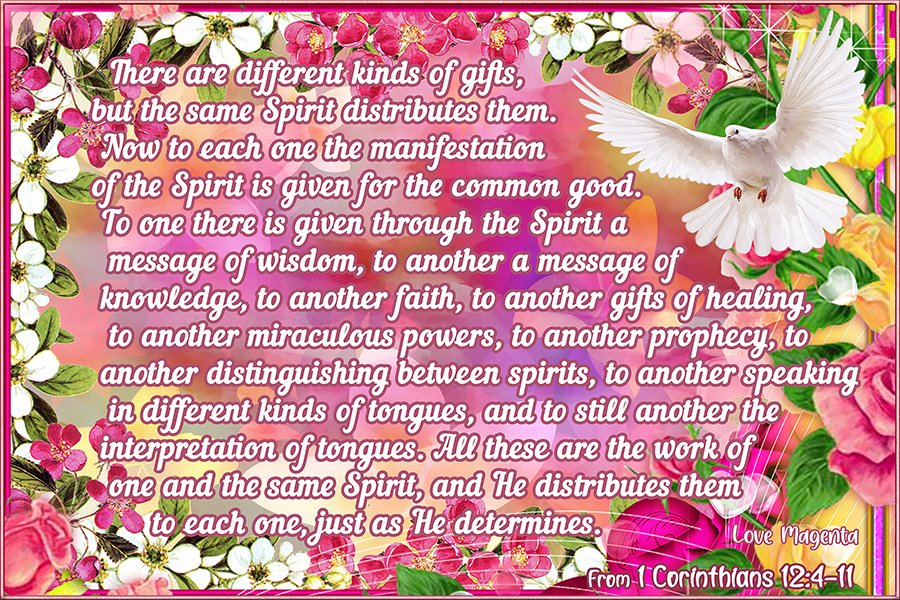
From1-Corinthians12-4-11s.png


From 1 Corinthians 12 verses 4-11 ~ There are different gifts, but the same Spirit. There are different ministries, but the same Lord. 6There are different ways of working, but the same God works all things in all people. Now to each one the manifestation of the Spirit is given for the common good. To one there is given through the Spirit the message of wisdom, to another the message of knowledge by the same Spirit, to another faith by the same Spirit, to another gifts of healing by that one Spirit, to another the working of miracles, to another prophecy, to another distinguishing between spirits, to another speaking in various tongues, and to still another the interpretation of tongues. All these are the work of one and the same Spirit, who apportions them to each one as He determines.
 
  • Heart
Reactions: Brasspen
Yes so important to make this distinction!

Glossolalia has been thoroughly investigated by linguists and it have no recognizable patterns that every Earthly language has been shown to have.
It's not an earthly language. That's the point.

1 Cor 14:2
For he that speaketh in an unknown tongue speaketh not unto men, but unto God: for no man understandeth him; howbeit in the spirit he speaketh mysteries.
 
Romans12-6-8s.png

Romans 12 v 6-8 We have different gifts according to the grace given us. If one’s gift is prophecy, let him use it in proportion to his faith; if it is serving, let him serve; if it is teaching, let him teach; 8if it is encouraging, let him encourage; if it is giving, let him give generously; if it is leading, let him lead with diligence; if it is showing mercy, let him do it cheerfully.
 
  • Heart
Reactions: Brasspen
Speaking in tongues translates Greek term that refers to speaking another languages. But in the context of scripture it refers to speaking in other languages supernaturally by the power of the Holy Spirit.

In Acts 2 there is a list of languages ( Or regions associated with these languages and Dialects) that people present for the feast of pentecost in Jerusalem heard the disciples speaking in. They were amazed to see these Galileans speaking in these languages.

I Corinthians 13 starts off with if I speak in the tongues of men or of angels...' Since many things in the arguments that follow are possible we should allow room for the idea that it is possible that someone speaking in tongue is good speak in the languages of men or of angels.

The situation in I corinthians 14 is different from that in acts 2. I corinthians 14 is about the use of spiritual gifts in the church meeting.

Biblical church meetings are a lot different from Roman Catholic or protestant tradition. This is really the only long, detailed passage we have regarding commandments from the Lord on what to do in church meetings other than chapter 11 which tells how not to have the Lord supper.

There is no passage of scripture that tells us to have a pulpit and pews or seats lined up as in an auditorium to listen to one clergy member give a long extended speech.

Rather the passage indicates that believers in the congregation speak... notice he says 'every one of you' in verse 26.

This passage deals with speaking in tongues and order and prophecy and mentions other types of utterances such as prayer teaching and singing psalms. Call encourages believers to use spiritual gifts but emphasizes that they must be done in a way that edifies the church.

In this passage we see that in the church speaking in tongues was not understood by the people in the congregation and required someone to interpret it. From chapter 12 we see that the interpretation, like speaking in tongues, also is a manifestation of the Spirit.

In the midst of polls writing on speaking in tones we can see that speaking in tongues edifices the speaker and that it can also be used in prayer outside of the assembly. But in the assembly in order to edify others it must be followed by an interpretation. A speaker in tongues can pray for the ability to interpret. Another member of the assembly may also be able to interpret. And if it is found that there is no interpreter than a speaker in tung's is to be quiet.

The passage implies that an individual in the church might pray in the known language of the assembly in a way that edifies others. But speaking in tongues in this way does not edify others without an interpretation.

The passage also specifically allows profits to speak in the assembly. It does not specify that a pastor or elder must give an address in the assembly. But since pastors are lumped together with teachers in ephesians for and elders are required to be able to teach we can assume that they would have taught in the assembly alongside others with the gift to teach.

Enrollments Paul commands believers to use spiritual gifts like prophecy teaching and exhortation. Here in first corinthians we can conclude that the assembly is a place where these gifts may be used to edify others.

First Peter 4 also exhorts believers to use spiritual gifts to benefit others including speaking as the oracles of God and makes it a matter of stewardship of God's grace.

I have not interpreted tongues in the assembly but from talking with those who have it seems like it comes to them in a similar way that a prophecy comes to someone who prophesies in the assembly. Some people that I have spoken with have had the experience that someone gives a tongue and before this individual can give the interpretation someone else gives the same message.

In some Pentecostal churches you may see tongues followed by interpretation usually occurring during the singing part of the meeting between songs. Some pentecostal churches do not really have this as a regular practice and some have moved away from it and just have lost the culture of it altogether.

There are Pentecostal churches where you will not hear speaking in tongues unless it is followed by an interpretation. There are also pentacles for churches where everyone is encouraged to speak in tongues at the same time or it is the practice to do so. Some of these churches will also have messages in tongues with interpretation and some of them will never have any interpretation of tongues and it's not a part of their church culture. The assemblies of God has churches where tongues are followed by interpretation and churches where everyone press in tongues at the same time within the same denomination. Though I have been in a church that actively taught on not speaking in tongues all at the same time at least at their Bible college or some type of meeting and it was reflected in their teaching it seems like in a lot of churches it's just a matter of church culture about how things operate and not really something that's addressed out loud and in detail in a lot of cases.

The Pentostal movement grew out of a revival that occurred between 1906 and 1908 and some other revivals before that. The charismatic movement was a movement in the 1960s may be going back to the 50s where groups in mainline churches began to embrace spiritual gifts and empowerment by the Holy Spirit. Independent churches and networks of churches formed out of this who also are called Charismatic. There are groups with doctrinal differences within the charismatic movement also. It is a more varied movement doctrinally and probably culturally than the pentecostal movement I think. Some of what I wrote about pentecostals is probably true of Charismatic as well. And there is interaction and overlap between Pentecostal Sam and Charismatics.


I am using speech to text so if there are odd errors please forgive me. I tried to catch them.
 
Speaking in tongues was the supernatural ability to speak in another language. This was particularly important in the early church in places like Corinth that had two ports and a lot of people with different languages.

Today there is a branch of Christianity that feels the supernatural gifts such as healing the sick and speaking in other languages continue as they had. This is called charismatic, full gospel, or pentacostal Christianity.

Often what is called speaking in tongues sounds like gibberish and is called a "prayer language" since they are usually utterances in no known language. Those who are not charismatic often call this ecstatic speech in that it is not of God but of one's own creation.

Each person has to decide if it is of God or people that are mistaken. Two verses that bear upon this subject are that the spiritual gifts would cease and that they were only a taste of the age to come.

1Co 13:10 But when that which is perfect is come, then that which is in part shall be done away.

Heb 6:5 And have tasted the good word of God, and the powers of the world to come,

The Spiritual manifestations of prophecy, tongues, and knowledge will no longer be necessary when we see Jesus face to face.

Noteworthy, as well, is what Jesus said in John 16:7-14. Jesus said the Holy Spirit will speak. And interestingly speaking in tongues is the initial sign that the Holy Ghost has come to dwell inside a believer. (Acts 2:4, 10:43-48, 19:1-7)

1 Cor 13:8-10
Charity never faileth: but whether there be prophecies, they shall fail; whether there be tongues, they shall cease; whether there be knowledge, it shall vanish away.
For we know in part, and we prophesy in part.
But when that which is perfect is come, then that which is in part shall be done away.


John 16:7-14
Nevertheless I tell you the truth; It is expedient for you that I go away: for if I go not away, the Comforter (Holy Spirit) will not come unto you; but if I depart, I will send him unto you.

And when he is come, he will reprove the world of sin, and of righteousness, and of judgment:
Of sin, because they believe not on me;
Of righteousness, because I go to my Father, and ye see me no more;
Of judgment, because the prince of this world is judged.

I have yet many things to say unto you, but ye cannot bear them now.

Howbeit when he, the Spirit of truth, is come, he will guide you into all truth: for he shall not speak of himself; but whatsoever he shall hear, that shall he speak: and he will shew you things to come.

He shall glorify me: for he shall receive of mine, and shall shew it unto you
."
 
Peter promises the gift of the Holy Spirit—not tongues as such. The Spirit is given to all who repent and believe. In Cornelius’s house, the Spirit chose to manifest Himself through tongues as a sign to Peter and the Jewish believers that God was truly saving Gentiles. The tongues were the evidence for Peter; the Spirit Himself was the gift for them.
Yes, the Spirit was the gift, and tongues was the sign that individuals had, indeed been filled with the Holy Ghost.

The Book of Acts records a progressive expansion of the gospel to all peoples. The Jews first received the Holy Ghost on the Day of Pentecost and spoke with other tongues (Acts 2:1-4). The Samaritans, half Jew-half Gentile, received the Holy Ghost in Acts 8:14-19. Although tongues are not specifically mentioned in that account, something observable occurred that convinced Simon the sorcerer that the Holy Ghost had been received when the apostles laid hands upon them.

Later, the Gentiles received the Holy Ghost in the house of Cornelius. Peter and the Jewish believers knew that the Gentiles had received the Holy Ghost because "they heard them speak with tongues, and magnify God" (Acts 10:44-48). Peter then commanded them to be baptized in water in the name of the Lord.

Finally, in Acts 19:1-7, approximately twelve disciples at Ephesus received the Holy Ghost and "spake with tongues, and prophesied." Thus, the same supernatural evidence that appeared among Jews at Pentecost and Gentiles at Cornelius' house also appeared among the Ephesian believers over 20+ years later.

These accounts span decades and include Jews (Acts 2), Samaritans (Acts 8), Gentiles (Acts 10), and disciples at Ephesus (Acts 19). The repeated pattern confirms that speaking in tongues was not merely a temporary sign to announce that salvation had become available to the nations. The truth concerning Gentiles had already been established through the conversion of Cornelius and his household. Yet, the same sign still appeared years later at Ephesus proving the experience was essential for all individually. This continued manifestation indicates that speaking in tongues remained associated with the reception of the Holy Ghost throughout the apostolic era.
 
  • Like
Reactions: Roger316
...The Spirit is given to all who repent and believe. ...
Paul's question, "Have you received the Holy Ghost SINCE you believed?" (Acts 19:1-2) makes it clear a person can believe but still not have experienced receiving the Holy Ghost.
 
  • Like
Reactions: Lamar
@NiNA2613 I have the gift of tongues.

When I got baptized by the holy spirit, when I received the holy spirit, Mrs Pat prayed that I would have the gift of tongues, for the evidence of the holy ghost. The way it works for me, is I let the holy spirit speak, giving him utterance. And he does, so well so fluently thru me. I don't know anything he says, but sometimes I can have an idea about it. And he speaks in more than one language sometimes. He sings sometimes. And, he has recently spoke judgments.

Using the gift tongues, you never know who the holy ghost is prayer for, you, yourself, or other people. It's possible who could be praying for someone who is in great danger. This is what Doctor Pat Holliday told me, she was my pastor.

The holy spirit will also, I read you can get other gifts when praying with tongues, but right now I wonder if that is true, because they talked about a dependency on hours.
I just wanted to encourage you since someone told you to be careful because you should understand what you're speaking.

You can be confident in your own experience, since it lines up with the Word. It says, "No man understandeth..." what is being said. And no man/woman includes the speaker. And in a church setting, If the one speaking in tongues understood what they were saying there would be no need for the gift of interpretation.

"For he that speaketh in an unknown tongue speaketh not unto men, but unto God: for no man understandeth him; howbeit in the spirit he speaketh mysteries. (1 Cor. 14:2)