
Calvinism is Gospel !
- Thread starter brightfame52
- Start date
-
Christian Chat is a moderated online Christian community allowing Christians around the world to fellowship with each other in real time chat via webcam, voice, and text, with the Christian Chat app. You can also start or participate in a Bible-based discussion here in the Christian Chat Forums, where members can also share with each other their own videos, pictures, or favorite Christian music.
If you are a Christian and need encouragement and fellowship, we're here for you! If you are not a Christian but interested in knowing more about Jesus our Lord, you're also welcome! Want to know what the Bible says, and how you can apply it to your life? Join us!
To make new Christian friends now around the world, click here to join Christian Chat.
You are using an out of date browser. It may not display this or other websites correctly.
You should upgrade or use an alternative browser.
You should upgrade or use an alternative browser.
- Status
- Not open for further replies.
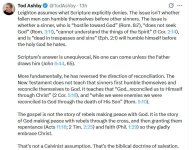
I do tend to avoid lengthy explanations, although there are times when
they are necessary. Some people seem to do or be the opposite way LOL
Well we are all different and see things differently and I do not subscribe to
the cookie cutter Christianity I notice in FWers with their cardboard God.
Such as those saying God would not command something if it cannot be obeyed. The law was
given specifically to show man his sinful nature... added to act as a mirror that reveals our
inability to achieve God’s perfect righteousness. Its purpose is to make us conscious of sin and
drive us toward divine grace. Through the law comes the knowledge of sin, entering "so that the
offense might abound." FWers even deny this. The law was brought in so that the trespass might
increase. But where sin increased, grace increased all the more. Romans 5 v 20. I hope they learn this.
I do not consider you to be a FWer. I may not agree with everything you say but I do
recognize that your understanding is well above and beyond the FWers here on that
topic. Eh I thought we were in the other thread... so I have moved my response to here.
Re "Such as those saying God would not command something if it cannot be obeyed.":
MFWers say a loving and just God would not do that, and the astute notice that Mag omitted key words,
because she realizes that doing so would burst the tulip bubble.

God hates those who demean His love and justness.
To say that tulip magnifies divine love and mercy is lunacy!
(I respected Rufus for admitting tulip does not do that.)
Tulipists who claim that need to pray for the gifts of sanity and truthfulness/honesty.
Actually, I got in a hurry and misspoke.
What I should have said is that God loves tulipists but hates their sin of demeaning His love and justness.
This shows
I am not Arminian, so that point is moot.
Yes, the modern/current debate is between tulipists and MFWers.

God hates those who demean His love and justness.
To say that tulip magnifies divine love and mercy is lunacy!
(I respected Rufus for admitting tulip does not do that.)
Tulipists who claim that need to pray for the gifts of sanity and truthfulness/honesty.
Interesting he admitted that, I agree, I do have some minimal respect for those who are willing to be honest about the implications, logical conclusion of their doctrine.
The "we don't believe that" is very disingenuous.
If God has made it so the fallen nature of mankind means they are born unable to respond positively to the Good New of Christ Jesus,
unless uniquely and divinely selected for divine intervention then there are consequences that must also be acknowledged that follow that premise.
And they "fit themselves for destruction" is an epic fail on trying to assign blame back onto non saved- mankind for not having been selected.
Yes, the modern/current debate is between tulipists and MFWers.
Yeah, they love to avoid the moral part.
Their system is such a mess.
Interesting he admitted that, I agree, I do have some minimal respect for those who are willing to be honest about the implications, logical conclusion of their doctrine.
The "we don't believe that" is very disingenuous.
If God has made it so the fallen nature of mankind means they are born unable to respond positively to the Good New of Christ Jesus,
unless uniquely and divinely selected for divine intervention then there are consequences that must also be acknowledged that follow that premise.
And they "fit themselves for destruction" is an epic fail on trying to assign blame back onto non saved- mankind for not having been selected.
Yes, and 2Christ prompted me to have this insight: It is the natural man who ascribes/projects hatred and injustice onto God.

I'm not sure what your objection might be, but I can take a few guesses. First, some people object to the phrase "eternal punishment" because they don't believe the Bible teaches eternal torment or everlasting torture. I agree, the Bible doesn't teach that sinners will suffer everlasting torture. What I mean by "eternal punishment" is that it is permanent and cannot be undone. Jesus describes it as eternal destruction, which is a condition that will be eternally permanent.Absolutely agree.
They cannot understand this though.
My concern was your addition of the concept of eternal punishment to the phrase.
It is not there in Ephesians.
You might object on the basis that the term "dead" doesn't include the concept of "eternal punishment." I agree. The term "dead" does not mean anything like eternal punishment. Interestingly, according to Jesus, not even death was permanent, not even death could be undone. He taught his disciples that death was only temporary and that a person's final state would be determined by how a person was situated to Jesus. A person who is a follower of Jesus will be brought back from the dead and given new life.
Paul’s use of “dead” in Ephesians 2 doesn’t, by itself, carry the idea of eternal punishment—but the *context* does. Paul immediately pairs “dead” with being made “alive” together with Christ, and that contrast only makes full sense when viewed through the lens of eternity. Jesus teaches that heaven is a realm where moth and rust cannot touch anything—where life is everlasting and untouched by decay. So when Paul speaks of being “dead” or “alive,” he is not merely describing moral condition or present experience; he is locating the human condition within an eternal framework. “Dead” describes a state that cannot inherit the everlasting kingdom, while “alive” describes the Spirit‑given life that endures forever. In other words, even though the word “dead” doesn’t *contain* the idea of eternal punishment, Paul’s argument is unmistakably oriented toward eternal destiny—life with Christ or life apart from Him.
Re "Such as those saying God would not command something if it cannot be obeyed.":
MFWers say a loving and just God would not do that, and the astute notice that Mag omitted key words,
because she realizes that doing so would burst the tulip bubble.
Along with the fact that yes, they did try to obey the law it was just they could not do it perfectly.
So this whole idea of trying to take the commandments in the OT and then say the Gospel call is also a command no one can respond to unless divinely and uniquely enabled.. I really have no words for that line of reasoning.
I'm not sure what your objection might be, but I can take a few guesses. First, some people object to the phrase "eternal punishment" because they don't believe the Bible teaches eternal torment or everlasting torture. I agree, the Bible doesn't teach that sinners will suffer everlasting torture. What I mean by "eternal punishment" is that it is permanent and cannot be undone. Jesus describes it as eternal destruction, which is a condition that will be eternally permanent.
You might object on the basis that the term "dead" doesn't include the concept of "eternal punishment." I agree. The term "dead" does not mean anything like eternal punishment. Interestingly, according to Jesus, not even death was permanent, not even death could be undone. He taught his disciples that death was only temporary and that a person's final state would be determined by how a person was situated to Jesus. A person who is a follower of Jesus will be brought back from the dead and given new life.
Paul’s use of “dead” in Ephesians 2 doesn’t, by itself, carry the idea of eternal punishment—but the *context* does. Paul immediately pairs “dead” with being made “alive” together with Christ, and that contrast only makes full sense when viewed through the lens of eternity. Jesus teaches that heaven is a realm where moth and rust cannot touch anything—where life is everlasting and untouched by decay. So when Paul speaks of being “dead” or “alive,” he is not merely describing moral condition or present experience; he is locating the human condition within an eternal framework. “Dead” describes a state that cannot inherit the everlasting kingdom, while “alive” describes the Spirit‑given life that endures forever. In other words, even though the word “dead” doesn’t *contain* the idea of eternal punishment, Paul’s argument is unmistakably oriented toward eternal destiny—life with Christ or life apart from Him.
It is not in that verse, you are making a connection... and no I do not see in context either.
Maybe "dead in transgressions" is about how that "position" (opposite to being alive inChrist) affected life here on earth.
All men by nature hate God and are at enmity against Him. Paul describes the gentile world here Rom 1:29-31God hates those who demean His love and justness.
29 Being filled with all unrighteousness, fornication, wickedness, covetousness, maliciousness; full of envy, murder, debate, deceit, malignity; whisperers,
30 Backbiters, haters of God, despiteful, proud, boasters, inventors of evil things, disobedient to parents,
31 Without understanding, covenantbreakers, without natural affection, implacable, unmerciful:
So dont think you are by nature any better than anybody else, if you do, its pride and self righteousness. We all like that before saved. Yet inspite of all this, God chose to love only some who are like this.
You call folk calvinist dont you ?This shows
I am not Arminian, so that point is moot.

"FORCES" - chuckle!!! It's called "Conviction of SIN by the Holy Spirit"!!!!! Repentance, and calling out in FAITH (which come by God's WORD) is up to us.Wrong. Calvinism proclaims salvation is by God regenerating a person first, then the person exercises faith.
Calvinism has salvation backwards. It claims that even though Jesus preached “Repent and believe the gospel”, no one can obey that command. It teaches that God forces repentance upon a person.
"Calvinism" is a "Theological systematic" - nothing more!!!!!What if im one of the "elect" but dont believe calvinism? Am I good or lost?
A born‑again person becomes spiritually awakened—given a new capacity to see the kingdom of God the way Jesus describes in John 3. In that moment, God’s Spirit brings life where there was only spiritual deadness. The individual receives a new heart that desires God, a new mind that understands spiritual truth, and a new identity as a child of God. Their relationship to sin changes: instead of being comfortable in darkness, they now hunger for righteousness. Their relationship to God changes: instead of fear or distance, they experience forgiveness, adoption, and the inner witness of the Spirit. And their relationship to the world changes: they begin to recognize God’s reign, God’s purposes, and God’s presence in ways they simply could not perceive before. Being born again is not just a moral improvement—it is a Spirit‑created transformation that enables a person to live in God’s reality.
Paul’s opening movement in Romans 8 makes the same essential claim Jesus makes in John 3: when the Spirit dwells in a person, their condition before God fundamentally changes. Paul ties the Spirit’s indwelling directly to being “in Christ”—a new realm of existence where condemnation is gone, the mind is set on life and peace, and the believer is empowered to walk in righteousness. This Spirit‑created union with Christ is not merely a moral shift but a new identity and new spiritual reality. And because the Spirit who indwells believers is the very Spirit who raised Jesus from the dead, Paul says that those who are **in Christ** can confidently look forward to being raised to life themselves. In other words, the same Spirit who awakens a person to see the kingdom also guarantees their future resurrection, making the born‑again experience both a present transformation and a promise of coming glory.
We could go into detail and examine these passages if you like
You do realize we were speaking about spiritual death really meaning being dead spiritually, don't you? Your description perfectly proves my point. You stated that prior to rebirth, there is 'only spiritual deadness' and the person 'simply could not perceive' spiritual reality. If there is only deadness - a total inability to perceive or desire God because of that death - then the person is fully and completely dead. They cannot operate a faith they do not possess nor are unaware of, nor can they assist in a rebirth they cannot even perceive is necessary, and which demands they be given spiritual life to comprehend. You have described total and complete spiritual inability, the cause of which inability, is spiritual death, which you, yourself, described.

You call folk calvinist dont you ?
Arminian would be alright, better than Calvinist that is 100% for sure.. but Arminius was definitely wrong on conditional salvation.
FW's is not a system so that does not apply.
Pelagius heretic is dumb because no one here is a scholar on him and new evidence examining the words of his contemporaries is showing that what Augustine attributed to him was false.
Since Calvinism has a highly distinct and unique soteriology (outside scripture) whoever ascribes to some type of un-conditional election is a Calvinist.
Tulipists who claim that need to pray for the gifts of sanity and truthfulness/honesty.
If they don't repent of the sin of misrepresenting God's Word then they will remain reprobate.
These people are like the Pharisees Jesus was talking to when He told them they were of their Father the devil.
The reason Jesus did not cast the devil out of these folks is because they are committed to serving the devil thinking they are in the right, so they love their devils and refuse to turn away from them.
Jesus cannot cast devils out of people who love their devils because He is the One Who gave them free will in the first place so they have the legal right before God to reject the Lord and choose to serve the devil instead.
And so Jesus let them have the devil because that's what they wanted.
This is why it's rare to hear of a calvinist being delivered from calvinism since they love doctrines of devils and the author of doctrines of devils which is satan. They think the devil they are following is the Lord

wrong on conditional salvation
Even though the New Testament teaches salvation is in fact conditional.
Even though the New Testament teaches salvation is in fact conditional.
Yes I know what you believe, you have not changed from the last few iterations of yourself.
Yes I know what you believe, you have not changed from the last few iterations of yourself.
I see so you believe in universalism.
You also don't believe what man sows is what he reaps making mockery of the Lord (Gal 6:7,8).
Acts 26:18
To open their eyes, and to turn them from darkness to light, and from the power of satan unto God,
that they may receive forgiveness of sins, and inheritance among them which are sanctified by faith
that is in me.
God's Word is very clear, if they don't turn from darkness unto the Lord and RECEIVE what Jesus did for them, then they will be lost. That's is conditional.
Here's a few more showing salvation is conditional that cherry pickin people ignore and play like is not in God's Word because they can't explain them away
Matthew 16:24
Then said Jesus unto his disciples, If any man will come after me, let him deny himself, and take up his cross, and follow me.
John 7:37
If any man thirst, let him come unto me, and drink.
John 5:40
And ye will not come to me, that ye might have life.
Romans 6:16
Know ye not, that to whom ye yield yourselves servants to obey, his servants ye are to whom ye obey; whether of sin unto death, or of obedience unto righteousness?

- Status
- Not open for further replies.