I'm sorry, I did not get you.All that II know do. I do myself.

Calvinism is Gospel !
- Thread starter brightfame52
- Start date
-
Christian Chat is a moderated online Christian community allowing Christians around the world to fellowship with each other in real time chat via webcam, voice, and text, with the Christian Chat app. You can also start or participate in a Bible-based discussion here in the Christian Chat Forums, where members can also share with each other their own videos, pictures, or favorite Christian music.
If you are a Christian and need encouragement and fellowship, we're here for you! If you are not a Christian but interested in knowing more about Jesus our Lord, you're also welcome! Want to know what the Bible says, and how you can apply it to your life? Join us!
To make new Christian friends now around the world, click here to join Christian Chat.
You are using an out of date browser. It may not display this or other websites correctly.
You should upgrade or use an alternative browser.
You should upgrade or use an alternative browser.
- Status
- Not open for further replies.
"To protect your synergistic theology, you have now resorted to an open assault on the absolute immutability of God. You claim that saying 'God never changes is scriptural ignorance,' but in doing so, you are directly calling God a liar. God explicitly states in Malachi 3:6: 'For I am the LORD, I change not.' [1, 2, 3, 4]God's character never changes. But to say God never changes is scriptural ignorance. One easy example is found in Matthew 5. God once stated under his law, eye for an eye...Christ comes along and changes the law he himself put in place. He changes it to turn the other cheek. God's direction for man has changed many times throughout the course of human history. What he requires of man has changed and once again will change in the future.
Matthew 5:
38 Ye have heard that it hath been said, An eye for an eye, and a tooth for a tooth:
39 But I say unto you, That ye resist not evil: but whosoever shall smite thee on thy right cheek, turn to him the other also.
Let’s look at the severe category error you are making in Matthew 5:38-39
1. You Confuse Civic Law with Divine Mutation
You claim that switching from 'an eye for an eye' to 'turn the other cheek' proves that God changes. You have completely misunderstood the text.
'An eye for an eye' (Exodus 21:24) was a forensic, legal statute given strictly to civil magistrates and courts in national Israel to ensure that legal punishments fit the crime and to prevent private, blood-feud vengeance. [1, 2, 3, 4, 5]
In Matthew 5, Jesus is confronting the corrupt Pharisees who were weaponizing a courtroom law to justify personal malice and private retaliation in their everyday lives. Jesus did not change His eternal mind or alter His moral essence; He stripped away their self-righteous hypocrisy and showed that God’s standard has always been righteousness and love. Fulfilling a temporary civil code for national Israel and bringing in the New Covenant is a change in the historical administration of His plan, not a mutation in the eternal mind of the Creator. [1, 2, 3, 4, 5]
2. You Are Trapped in a Philosophical Absurdity
Think through the blasphemous implications of your argument. If God genuinely changes His mind, His desires, and His requirements over time, then God is an imperfect, fluctuating being.
Change requires movement. If God changes, He is either changing from a lesser state to a better state (meaning He wasn't perfectly wise before), or from a better state to a worse state (meaning He is degrading). The God of the Bible is infinitely perfect, completely omniscient, and eternally unchangeable. He does not learn new information, He does not have 'ah-ha' moments in human history, and He does not adapt His eternal plans to the timeline of creatures. [1, 2, 3, 4, 5]
3. The Ironclad Verdict of Scripture
You call immutability 'scriptural ignorance,' yet the Holy Spirit directly shuts down your theory across the entire Bible:
- James 1:17: 'Every good gift and every perfect gift is from above, and cometh down from the Father of lights, with whom is no variableness, neither shadow of turning.' [1, 2, 3, 4, 5]
- Psalm 102:27: 'But thou art the same, and thy years shall have no end.' [1, 2]
- Isaiah 46:10: 'Declaring the end from the beginning, and from ancient times the things that are not yet done, saying, My counsel shall stand, and I will do all my pleasure.'
By arguing that God is a reactive, mutating deity whose mind shifts throughout human history, you don't just lose the debate on Calvinism—you completely surrender the classical Christian definition of God. You are fighting against the very unchangeableness that guarantees your own breath." [1, 2, 3, 4]

Notice the text does not say, "According as he has chosen us to be in him before the foundation of the world." This is how Calvinists read it.
Read Eph 1:4 -5 again and 1Co 1:30 too. They completely refute your conclusion. You are either blind to or didn't understand the pronoun "us" in Eph 1:4 -5.
Do you see the "chosen us in him", in vs4? The "us" designates specific individuals whom He chose to be in Him. In vs 1:5, again, Paul clearly states that only those individuals specifically chosen by Jesus Christ will He adopt to Himself. They will not become adopted because, they, of themselves, choose to be placed in Christ. To be placed "in Him" is not open to everyone. Read those verses carefully - you missed a lot of words.
[Eph 1:4-5 KJV]
4 According as he hath chosen us in him before the foundation of the world, that we should be holy and without blame before him in love:
5 Having predestinated us unto the adoption of children by Jesus Christ to himself, according to the good pleasure of his will,
In 1Co 1:30, only those whom God chose will He place in Christ. To be placed in Christ does not occur through someone's volition to be placed in Him - it is only by God's choice of them alone that they are they placed in Christ.
[1Co 1:30 KJV] 30 But of him are ye in Christ Jesus, who of God is made unto us wisdom, and righteousness, and sanctification, and redemption:
When a person hears the gospel preached to him, faith is built up within him. Faith is a gift of God and not something that man produces within himself. So, the credit goes to God. According to Heb. 11:1, faith is tangible in the spirit. Faith has a substance and an evidence. I would say that this faith opens up the spiritual understanding of the person who hears the gospel. Now, his response is to believe and call upon the name of the Lord to be saved.1. Your Circular Logic Trap: The Blind and Deaf Dilemma
Look closely at what you just wrote. You claim that God does not open blind eyes or unstop deaf ears until faith is exercised. At the same time, you claim that the preaching of the Gospel is what produces faith.
Think through the logical absurdity of your own timeline:
If a sinner’s ears are spiritually deaf to the truth of God, and God refuses to unstop those ears until the sinner believes, how can the deaf sinner hear the preaching of the Gospel to get the faith in the first place? If a sinner's eyes are completely blind to the glory of Christ, and God refuses to open them until they believe, how can the blind sinner see Christ to place their faith in Him?
Your system demands that a spiritually blind and deaf man must see and hear the Gospel via free will while still blind and deaf, so that God will reward him by opening his eyes and ears. This is a theological trainwreck.
Scripture turns your timeline upside down. God doesn't open eyes because we believe; we believe because God sovereignly opened our eyes. Jesus tells Paul in Acts 26:18 that He is sending him to the Gentiles 'To open their eyes, and to turn them from darkness to light... that they may receive forgiveness of sins.' The opening of the eyes is the first sovereign act that allows the sinner to see the kingdom and believe.
The answer to this is same as above.2. You Empty the New Birth of Its Divine Power
You claim that regeneration and the New Birth only happen after a person exercises faith. You have just flatly contradicted John 1:12-13:
John explicitly states that those who receive Him and believe on His name are those who were born of God. Furthermore, he explicitly rules out human initiative, stating that this birth is not of the 'will of the flesh' and not of the 'will of man.' If the sinner must choose to exercise faith while still unregenerate to trigger the New Birth, then the New Birth is directly dependent on the 'will of man.' You are stripping God of His sovereign role as the sole Author of life.
The conclusion of Rom. 9 is in verses 30-32 which says, "What shall we say then? That the Gentiles, which followed not after righteousness, have attained to righteousness, even the righteousness which is of faith. But Israel, which followed after the law of righteousness, hath not attained to the law of righteousness. Wherefore? Because they sought it not by faith, but as it were by the works of the law. For they stumbled at that stumblingstone;" It says very clearly that the gentiles attained righteousness by faith, but Israel failed to obtain it because their mindset was still upon obeying the law.3. You Are Repeating the Blasphemous Objection of Romans 9
You attempt an emotional deflection, claiming my view implies God is 'unfair' because many have not heard the gospel. You are using the exact same carnal objection that the wicked opponent brings against Paul in Romans 9:19: “Why doth he yet find fault? For who hath resisted his will?”
Look at how the Holy Spirit answers your 'unfairness' complaint in Romans 9:20: “Nay but, O man, who art thou that repliest against God? Shall the thing formed say to him that formed it, Why hast thou made me thus?”
You complain that sovereign grace turns man into a 'helpless prisoner of nature.' The Bible doesn't call us prisoners of nature; it calls us dead in trespasses and sins (Eph 2:1) and slaves of sin (Rom 6:20). A dead slave doesn't have 'free will' to consent to a resurrection.
Paul's definition of elect is not the same as yours. Your elect are those who are predestined to be saved. Paul's elect are those who faithfully follow Christ despite the hardships. Jesus is speaking of his sheep and not being his sheep is based on fore-knowledge and not based on predestination. God's knows beforehand who would believe him and who would not.3. Why the Gospel is Preached
You claim the Gospel is not preached to the elect, but to the general public. High Calvinism agrees that the external call goes out to the public. But Paul tells us the exact target of that preaching in 2 Timothy 2:10: 'Therefore I endure all things for the elect's sakes, that they may also obtain the salvation which is in Christ Jesus with eternal glory.'
The net is cast into the general public, but it is explicitly sent for the elect's sake. The reprobate public hears the external words and rejects them as foolishness because their 'alive soul' cannot receive them (1 Cor 2:14). But the elect sheep hear the internal, effectual voice of the Holy Spirit.
As Jesus told the free-will Pharisees of His day in John 10:26-27: 'But ye believe not, because ye are not of my sheep, as I said unto you. My sheep hear my voice, and I know them, and they follow me.'
Jesus did not say, 'You become my sheep if you choose to believe.' He said, 'You cannot believe because you are not of my sheep.' Identity precedes action. Election precedes faith. God must first make you a sheep, open your blind eyes, and unstop your deaf ears through sovereign regeneration, or you will never move an inch toward Christ."
Non-Calvinists need not necessarily be Pelagian, or Arminian. We exegete the Bible and not Eisegete.Do Pelagian heretics have eternal security? They deny an awful lot of Scriptures.
"Your three responses have driven you into a complete structural collapse. In your frantic effort to keep man in the driver’s seat of salvation, you have invented an impossible psychological timeline for faith, stripped the climax of Romans 9 of its sovereign foundation, and openly embraced a text-denying heresy that turns God into a helpless bystander who elects people based on human merit.When a person hears the gospel preached to him, faith is built up within him. Faith is a gift of God and not something that man produces within himself. So, the credit goes to God. According to Heb. 11:1, faith is tangible in the spirit. Faith has a substance and an evidence. I would say that this faith opens up the spiritual understanding of the person who hears the gospel. Now, his response is to believe and call upon the name of the Lord to be saved.
The answer to this is same as above.
The conclusion of Rom. 9 is in verses 30-32 which says, "What shall we say then? That the Gentiles, which followed not after righteousness, have attained to righteousness, even the righteousness which is of faith. But Israel, which followed after the law of righteousness, hath not attained to the law of righteousness. Wherefore? Because they sought it not by faith, but as it were by the works of the law. For they stumbled at that stumblingstone;" It says very clearly that the gentiles attained righteousness by faith, but Israel failed to obtain it because their mindset was still upon obeying the law.
Let’s look at exactly where your arguments completely shatter:
1. Your Impossible Timeline: Blind Eyes Receiving Sight
In your first point, you claim that the gift of faith is what 'opens up the spiritual understanding' of a sinner so they can then choose to believe. Think through the spiritual mechanics of what you are proposing.
You have a sinner who is still unregenerate, spiritually dead, and blind to the things of God. You claim that God drops the gift of faith into this blind, dead soul, and then that gift acts as a tool to open their eyes. How can a spiritually dead soul receive, process, or hold a holy, spiritual gift while they are still rotting in their sins? [1, 2, 3]
You have completely reversed the words of Jesus to Nicodemus in John 3:3: “Except a man be born again, he cannot see the kingdom of God.” [1, 2]
A sinner cannot see, perceive, or receive the spiritual gift of faith while they are blind. God does not give faith to open our eyes; God sovereignly opens our eyes through the New Birth so that we are enabled to possess and exercise saving faith. Regeneration must precede faith, or else you have a dead corpse performing spiritual actions to cure its own death. [1, 2, 3, 4, 5]
2. You Separate the Fruit of Romans 9 from its Sovereign Root
In your second point, you cite Romans 9:30-32 to claim that the conclusion of the chapter proves salvation is just about a human mindset of faith versus works. You are trying to use the end of the chapter to erase everything Paul just stated in the previous twenty verses. [1]
Why did the Gentiles attain to the righteousness of faith while national Israel stumbled? Was it because the Gentiles were naturally humbler, wiser, or better at exercising their free-will than the Jews? [1, 2]
No! Paul already gave the absolute sovereign answer in Romans 9:23-24: The Gentiles attained it because they were the 'vessels of mercy, which he had afore prepared unto glory, Even us, whom he hath called, not of the Jews only, but also of the Gentiles.' [1, 2]
The faith of verses 30-32 is the inevitable fruit of the sovereign, unconditional election detailed in verses 11-23. The elect Gentiles believe because they were vessels of mercy prepared for glory before time began. You are trying to turn the description of the elect into the cause of their election. [1, 2]
3. You Have Embraced a Heresy that Turns God into a Passive Spectator
In your third point, you completely abandon classical Christian theology and embrace the error of conditional election based on foreseen faith. You claim that Paul’s elect are just people who 'faithfully follow Christ,' and that being a sheep is based on God looking ahead in time to see who would choose Him. [1, 2, 3]
Think through the blasphemous implications of your system: If God looks down the tunnels of history, sees that a man will choose Him via free will, and then elects that man based on that foresight, then man has elected himself, and God is merely a passive observer copying man's choices. [1]
Furthermore, if God elects people because He foreknows they will 'faithfully follow Christ despite hardships,' you have just explicitly made election dependent upon human works, human stamina, and human faithfulness. You have flatly contradicted the Holy Spirit's absolute rule in Romans 9:11: 'For the children being not yet born, neither having done any good or evil, that the purpose of God according to election might stand, not of works, but of him that calleth.' [1, 2]
Scripture never defines God's foreknowledge (proginōskō) as passive, downstream information gathering. God doesn't look into a crystal ball to learn what creatures will do; He declares the end from the beginning (Isaiah 46:10). In the New Testament, to 'foreknow' means to fore-love—to enter into a definitive, sovereign covenant relationship with specific individuals before time began. Look at Romans 8:29: 'For whom he did foreknow, he also did predestinate...' Paul does not say God foreknew what they would do; He says God foreknew the people themselves. [1, 2, 3, 4, 5]
And as Jesus explicitly told the free-will advocates of His day in John 10:26: “But ye believe not, because ye are not of my sheep, as I said unto you.” Jesus did not say you become a sheep by faithfully following Him. He stated that you cannot even believe because you lack the identity of a sheep. Identity precedes action. Election precedes faith. God's sovereign grace creates the sheep, keeps the sheep, and guarantees they will follow Him to the end '+ nothing' (John 10:28)." [1, 2, 3, 4, 5]

Free willers are Pelagian heretics and deny a multitude of Scripture verses.Non-Calvinists need not necessarily be Pelagian, or Arminian. We exegete the Bible and not Eisegete.
Ignore, contradict, outright deny, and even rewrite the very words of Jesus Christ Himself.
As a non-Calvinist myself I know I exegete Scripture, and then am told I am a degenerate for believing what it says.
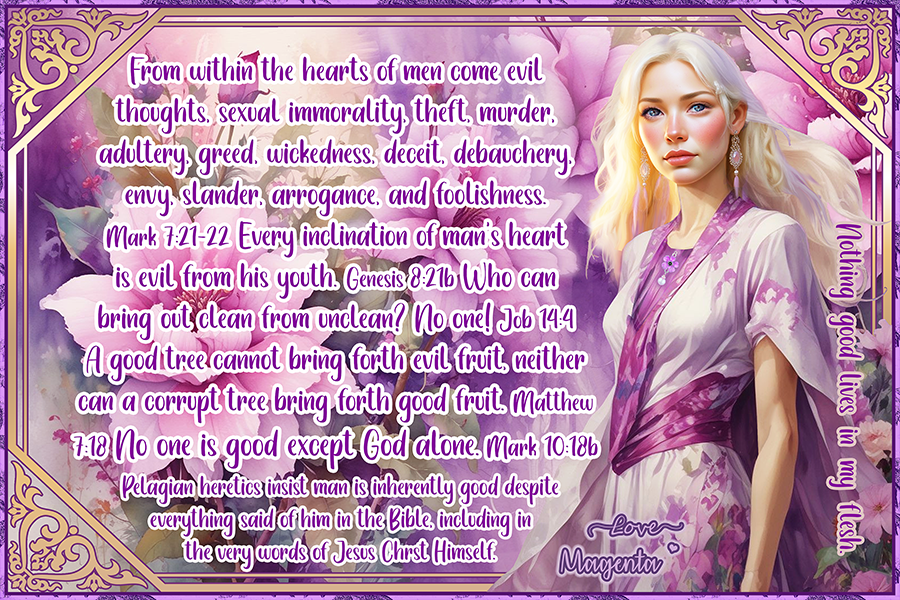
Pelagian heretics insist man is inherently good. From within the hearts of men come evil thoughts, sexual immorality, theft, murder, adultery, greed, wickedness, deceit, debauchery, envy, slander, arrogance, and foolishness. Mark 7 verses 21-22 Every inclination of man's heart is evil from his youth. Genesis 8 verse 21b Who can bring out clean from unclean? No one! Job 14 verse 4 A good tree cannot bring forth evil fruit, neither can a corrupt tree bring forth good fruit. Matthew 7 verse 18
Read Eph 1:4 -5 again and 1Co 1:30 too. They completely refute your conclusion. You are either blind to or didn't understand the pronoun "us" in Eph 1:4 -5.
Do you see the "chosen us in him", in vs4? The "us" designates specific individuals whom He chose to be in Him. In vs 1:5, again, Paul clearly states that only those individuals specifically chosen by Jesus Christ will He adopt to Himself. They will not become adopted because, they, of themselves, choose to be placed in Christ. To be placed "in Him" is not open to everyone. Read those verses carefully - you missed a lot of words.
[Eph 1:4-5 KJV]
4 According as he hath chosen us in him before the foundation of the world, that we should be holy and without blame before him in love:
5 Having predestinated us unto the adoption of children by Jesus Christ to himself, according to the good pleasure of his will,
In 1Co 1:30, only those whom God chose will He place in Christ. To be placed in Christ does not occur through someone's volition to be placed in Him - it is only by God's choice of them alone that they are they placed in Christ.
[1Co 1:30 KJV] 30 But of him are ye in Christ Jesus, who of God is made unto us wisdom, and righteousness, and sanctification, and redemption:
True, we are predestined and called by God to be His people. We must, however call on the Lord, putting our faith in Jesus to be saved, which is a choice offered by His sacrifice. We also know that many are called but few are chosen, showing many don't make that call on the Lord, fall away or don't put their trust in Jesus.
Paul's definition of elect is not the same as yours. Your elect are those who are predestined to be saved. Paul's elect are those who faithfully follow Christ despite the hardships. Jesus is speaking of his sheep and not being his sheep is based on fore-knowledge and not based on predestination. God's knows beforehand who would believe him and who would not.
Nope.
You would like to define 'foreknowledge' as God looking down the tunnels of time to gather data on human choices. But Peter completely destroys this definition in 1 Peter1:1,2, 1:19,20,21. In 1 Pe 1:1 -2, God tells us that the elect. are the elect, solely because of the foreknowledge of God and not because of God's knowledge of what they would do, which means the knowledge of what someone would do in the future is not the correct biblical definition of foreknow.
In 1 Pe:1:19 -20 Peter writes that Jesus Christ was 'foreknown before the foundation of the world.' If foreknowledge is just passive foresight, you would have to logically argue that the Father merely peeked into the future, saw what Jesus would do, and passively reacted to it. But we know the Father actively ordained and loved the Son before time began. Since 'foreknown' applied to Christ means pre-appointed covenant love, 'foreknowledge' applied to the elect in verse 2 means the exact same thing.
Therefore, God didn't look down time to see who would choose or believe in Christ; He set His love upon His children before the world was made so that it would become so.
[1Pe 1:1-2, 20 ESV]
1 Peter, an apostle of Jesus Christ, To those who are elect exiles of the Dispersion in Pontus, Galatia, Cappadocia, Asia, and Bithynia,
2 according to the foreknowledge of God the Father, in the sanctification of the Spirit, for obedience to Jesus Christ and for sprinkling with his blood: May grace and peace be multiplied to you. ...
[1Pe 1:19-21 ESV]
19 but with the precious blood of Christ, like that of a lamb without blemish or spot.
20 He was foreknown before the foundation of the world but was made manifest in the last times for the sake of you
21 who through him are believers in God, who raised him from the dead and gave him glory, so that your faith and hope are in God.

True, we are predestined and called by God to be His people. We must, however call on the Lord, putting our faith in Jesus to be saved, which is a choice offered by His sacrifice. We also know that many are called but few are chosen, showing many don't make that call on the Lord, fall away or don't put their trust in Jesus.
Nope. Nothing whatsoever is required from those whom He chose unto salvation to become saved, and that is what makes Christ sole Savior and man not- nothing is demanded from those He saves to become saved - Christ as Savor did it all on their behalf - see the New Covenant whereby in it, God had achieved/accomplished everything that was required to save His elect - it is a unilateral covenant given directly by God to His chosen.


Nope. Nothing whatsoever is required from those whom He chose unto salvation to become saved, and that is what makes Christ sole Savior and man not- nothing is demanded from those He saves to become saved - Christ as Savor did it all on their behalf - see the New Covenant whereby in it, God had achieved/accomplished everything that was required to save His elect - it is a unilateral covenant given directly by God to His chosen.
We are required to believe. Faith is not works, it is obedience.
By teaching people the Word, they get faith.
Acts 16
29 Then he called for a light, and sprang in, and came trembling, and fell down before Paul and Silas,
30 And brought them out, and said, Sirs, what must I do to be saved?
31 And they said, Believe on the Lord Jesus Christ, and thou shalt be saved, and thy house.
32 And they spake unto him the word of the Lord, and to all that were in his house.
Nope. Nothing whatsoever is required from those whom He chose unto salvation to become saved, and that is what makes Christ sole Savior and man not- nothing is demanded from those He saves to become saved - Christ as Savor did it all on their behalf - see the New Covenant whereby in it, God had achieved/accomplished everything that was required to save His elect - it is a unilateral covenant given directly by God to His chosen.
Yep. We're required to put our faith in our Lord Jesus.
Anchorite beat me to the comment with the verses seen above...
We are required to believe. Faith is not works, it is obedience.
By teaching people the Word, they get faith.
No, we are not saved by our faith. Our faith is a byproduct of salvation, not its cause, otherwise, Christ wouldn't be the Savior that we have unquestionably be told in Scripture that He is
31 And they said, Believe on the Lord Jesus Christ, and thou shalt be saved, and thy house.
In Acts 16 31, the "shalt be saved" is the future tense (in my understanding, it is far-distant, not near-distant, future), and not in present tense. If the jailor's belief is what caused him to become saved as in being justified, it would have had to occur instantaneously along with his belief, not in the future (that is, according to your belief that one's faith is what saves them - but that is not my belief). I think the way to reconcile this, is that in Scripture, God used the word "saved" in two different ways: 1) is to be justified during one's lifetime and; 2) to be saved from God's wrath on judgment day. Being saved from God's wrath on judgment day is the reason for being justified during one's lifetime, so to be saved in the future from His wrath is the ultimate goal.
We can see this clearly in Rom 5:9. Notice that those who Paul was addressing had already been justified, but they would "shall be" saved from God's wrath", also being the future tense, the same as is Acts 16:31. So, from that, we can deduce that "shall be saved" usually applies to someone being saved from God's wrath in the future.
[Rom 5:9 KJV] 9 Much more then, being now justified by his blood, we shall be saved from wrath through him.
Notice in 1Co1:18, that when someone becomes saved as-in being justified, it is stated as "are saved" in the present tense, not "shall be saved" in the future tense.
[1Co 1:18 KJV] 18 For the preaching of the cross is to them that perish foolishness; but unto us which are saved it is the power of God.
Yep. We're required to put our faith in our Lord Jesus.
Anchorite beat me to the comment with the verses seen above...
Not possible. That would make man his own savior and Christ not the Savior but only a functionary of the process of salvation,
not the one who completely accomplishes salvation. The below verses help to clarify it. Notice in them, that there is no place for anything to be contributed from those whom He saves - it is all done solely by God's exceedingly great mercy and grace through Jesus Christ, Savior. The faith of those He saves is nowhere mentioned in them as a requirement- it is all, and is only, by God's mercy through Jesus Christ, Savior.
[Tit 3:4-6 KJV]
4 But after that the kindness and love of God our Saviour toward man appeared,
5 Not by works of righteousness which we have done, but according to his mercy he saved us, by the washing of regeneration, and renewing of the Holy Ghost;
6 Which he shed on us abundantly through Jesus Christ our Saviour;


We are required to believe. Faith is not works, it is obedience.
By teaching people the Word, they get faith.
Acts 16
29 Then he called for a light, and sprang in, and came trembling, and fell down before Paul and Silas,
30 And brought them out, and said, Sirs, what must I do to be saved?
31 And they said, Believe on the Lord Jesus Christ, and thou shalt be saved, and thy house.
32 And they spake unto him the word of the Lord, and to all that were in his house.
One can expect many ways to deny the obvious of this biblical passage.
Probably 1 Cor 2:14 is going to be cited soon. lol
My favorite he was already regenerated that is why he could believe.
@Anchorite
I think this is a better example of "are saved" than the one I provided in my prior post. The "are saved " below is in the present tense,
not the future tense.
[Eph 2:5 KJV] 5 Even when we were dead in sins, hath quickened us together with Christ, (by grace ye are saved;)
I think this is a better example of "are saved" than the one I provided in my prior post. The "are saved " below is in the present tense,
not the future tense.
[Eph 2:5 KJV] 5 Even when we were dead in sins, hath quickened us together with Christ, (by grace ye are saved;)
You need to pay attention.Can you quote a Calvinist saying that some believers are doomed for hell?
The Calvies say......Not really saved because ______________________........Doomed to hell.
The Armies say.......Lose salvation because_________________________.......Doomed to hell.
The calvies and the armies are on the same page in the end of it all.
It's interesting how you point out the present tense.@Anchorite
I think this is a better example of "are saved" than the one I provided in my prior post. The "are saved " below is in the present tense,
not the future tense.
[Eph 2:5 KJV] 5 Even when we were dead in sins, hath quickened us together with Christ, (by grace ye are saved;)
In the calvies world, it should always be in the PAST tense.........From the foundation. But hey, God is not exact in the calvies world.
- Status
- Not open for further replies.