Calvinism is Gospel !

  • Christian Chat is a moderated online Christian community allowing Christians around the world to fellowship with each other in real time chat via webcam, voice, and text, with the Christian Chat app. You can also start or participate in a Bible-based discussion here in the Christian Chat Forums, where members can also share with each other their own videos, pictures, or favorite Christian music.

    If you are a Christian and need encouragement and fellowship, we're here for you! If you are not a Christian but interested in knowing more about Jesus our Lord, you're also welcome! Want to know what the Bible says, and how you can apply it to your life? Join us!

    To make new Christian friends now around the world, click here to join Christian Chat.
Status
Not open for further replies.
You are saying God gives us commands that we cannot obey.
The law came in so that the trespass would increase; but where sin increased, grace increased all the more.

You guys thinking you can keep the whole law are essentially saying you have no need of a sinless sacrifice.

Go ahead and keep deceiving yourselves as you have been. This is nothing new.

I needed Christ to set me free.


Romans11-32s.png

Romans 11 v 32 God has consigned everyone to disobedience so that He may have mercy on all.
:)
 
The problem is that mankind absolutely refuses to keep God's law.
Scripture says the man without the Spirit does not belong to Christ, and that man cannot submit
to or obey God. Scripture plainly and clearly articulates this, but this and many many other verses
are routinely ignored, contradicted, and outright denied by free willers, who continually ascribed
to the natural man qualities and abilities that only the spiritual man possesses.


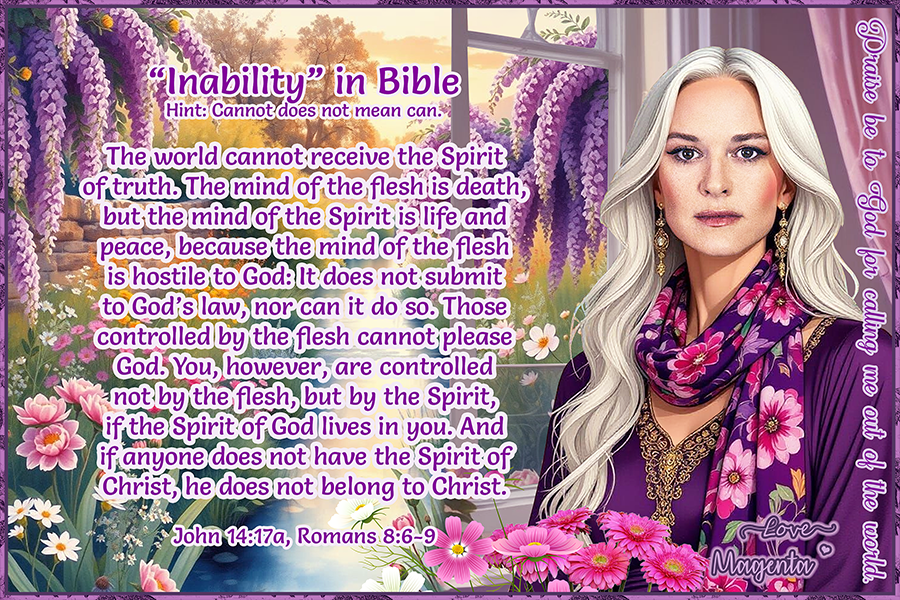
John14-17a-Romans8-6-9.png

John 14 v 17a, Romans 8 v 6-9 ~ “Inability” in Bible. The world cannot receive the Spirit of truth. The mind of the flesh is death, but the mind of the Spirit is life and peace, because the mind of the flesh is hostile to God: It does not submit to God’s law, nor can it do so. Those controlled by the flesh cannot please God. You, however, are controlled not by the flesh, but by the Spirit, if the Spirit of God lives in you. And if anyone does not have the Spirit of Christ, he does not belong to Christ. Praise be to God for calling me out of the world.
 
A. If you believe Paul was setting up a "stark textual contrast"between TWO SEPARATE KINDS OF CALLS, one which is outward and human and the other which is inward and divine. Please cite the verses where Paul does makes this point?
Chapter 7 is about the inadequacy of the law to produce life in us. After struggling with and failing to do what he knew he SHOULD do the Paul finally came to the conclusion (at the end of that chapter 7) that HE could not deliver himself but needed Christ to deliver Him.

B. Chapter 8 begins with how his experience radically changed once he had became a believer in Jesus. The very first change we see is that he was "set free from the law of sin and death." This began his new way of life walking in the Spirit, which he describes throughout chapter 8

C. Do you see anywhere in this passage where Paul explains your "TWO CALLS" hypothesis which you insist is the very point of these chapters? The sequence of God's redemptive plan outlined in Romans 8 BEGINS with a person already IN CHRIST.

D Paul introduces the chapter saying There is therefore NOW no condemnation for those who are IN CHRIST JESUS. 2 For the law of the Spirit of life IN CHRIST JESUS has set us free from the law of sin and death (Romans 8:1-2)
What follows is a description of what it is like to walk in the Spirit which explains why the term Spirit is mentioned in almost every verse.


So far, you have not shown yourself to be a text-critical workman. Your points are not grounded in the written text but have been imported from extra-Biblical sources like Calvin and Luther. Now you are so blinded by confirmation bias that you can no longer read the scriptures any other way.
You have attempted to recycle your previous arguments, but repetition does not cure your textual blind spots. You ask me to show you the "two calls" in the text, and then you immediately turn to John 15 to claim that salvation is a conditional tightrope where the elect can be cast into hell fire if their independent human willpower fails.

Let let us place your "plain text" claims under the absolute microscopic lens of Greek grammar to see who is actually mishandling the Word of God.

1. The Explicit Textual Proof of the "Two Calls"

You arrogantly demand: "Please cite the verses where Paul makes this point [of two calls]?"
The fact that you cannot see the two calls in Romans proves you are ignoring the clear text right in front of you. Let us compare Paul’s words in the exact same letter:
  • The Universal, Outward Call (Romans 10:18): Paul writes concerning the preaching of the gospel: "But I say, Have they not heard? Yes verily, their sound went into all the earth, and their words unto the ends of the world." This is the general, external proclamation. It lands on the physical ears of all men, Jews and Gentiles alike.
  • The Particular, Inward Call (Romans 8:30): Paul writes: "Moreover whom he did predestinate, them he also called: and whom he called, them he also justified..."
Look at the arithmetic of the text. The outward "sound" of the preacher goes out to all the earth (Romans 10:18), yet many who hear it reject it and remain under condemnation. But the inward "call" of Romans 8:30 has a 100% success rate. Every single person who receives this call is justified and glorified.

If there is only one uniform "call" as you claim, your system forces you to choose between two heresies: either Paul is flatly wrong because millions who hear preaching are never justified, or you must embrace Universalism and believe everyone who hears a sermon goes to heaven. The text forces a distinction: the outward call is the voice of the human preacher; the inward call is the sovereign, irresistible command of the Holy Spirit raising the dead sinner to life.

2. The Deception of "God Making Bogus Offers"

You claim that if an outward call is issued to those who cannot respond, it makes God "deceitful," "dishonest," and his offers "bogus."
This emotional objection stems from a completely unbiblical view of human responsibility. When a preacher commands sinners to repent and believe, he is delivering God’s preceptive will—what God rightfully demands of His creatures.
  • Does the fact that a sinner is spiritually dead and unable to obey (Romans 8:7) make God's command a lie? Absolutely not.
  • If a man owes a bank ten million dollars and is completely bankrupt, the bank is not "deceitful" or "performing theater" when they send him a bill demanding payment. The bill exposes his true debt and his total inability to pay it.
The outward call of the gospel commands all men to repent, which leaves the reprobate entirely without excuse (Romans 1:20). Their rejection is not because God "tricked" them; they reject it because they willfully hate the light (John 3:19). God is completely vindicated in his judgment, and His grace is magnified in the elect whom He sovereignly rescues from their own stubbornness.

3. John 15 and the Complete Abuse of the Imperative Mood

You attempt to shatter the unbreakable chain of Romans 8 by running to John 15:4-6, claiming that because "abide" is in the imperative mood (a command) and the present tense, it proves that remaining in Christ depends on ongoing human effort and can be permanently forfeit.
Your grammatical argument is a complete disaster. Let's look at how biblical grammar actually operates:
  • A Command Does Not Imply Human Ability: You claim that because "abide" is a command, we must possess the independent power to execute it. This is a massive theological blunder. God commands all men everywhere to be sinlessly perfect: "Be ye holy; for I am holy" (1 Peter 1:16). Does that command prove that fallen human beings have the inherent ability to live a sinless life? Of course not. The commands of Scripture are designed to show us our duty and drive us to utter dependency on the Savior, not to fluff up the pride of human free will.
  • The Subjective vs. Objective Branch: You quote John 15:6"If a man abide not in me, he is cast forth as a branch, and is withered; and men gather them, and cast them into the fire, and they are burned"—to prove a believer can lose their salvation. But you are ignoring how the New Testament explicitly defines these "withered branches."
Look at 1 John 2:19, written by the exact same author (John) using the exact same covenantal theology:

"They went out from us, but they were not of us; for if they had been of us, they would no doubt have continued with us: but they went out, that they might be made manifest that they were not all of us."
John completely shuts down your apostasy theory. If a branch does not abide, if it withers and is thrown into the fire, it does not prove that a genuinely justified, elect child of God fell out of the covenant. It proves they were a superficial, fruitless professor who lacked the vital, internal sap of the Holy Spirit from the very beginning. They were attached to the corporate visible church, but they were never organically united to the true Vine.

Conclusion

Your theology presents a weak, helpless God who builds a beautiful redemptive chain in Romans 8, only to have it completely snapped and thrown into the fire by the sovereign whim of a creature's willpower in John 15. You have a Savior who tries His best to keep the branches alive, but ultimately fails depending on how well the branch performs.

The text of Scripture presents a radically different reality. In Romans 8:38-39, Paul concludes his masterpiece by declaring that absolutely nothing—not life, nor death, nor angels, nor principalities, nor anything else in all creation—can separate us from the love of God in Christ Jesus. If a believer's independent free will could walk away and break that chain, then human free will is more powerful than the sovereign decree of the Almighty. I will stick to the text: Whom He called, He justified; and whom He justified, He guaranteed to glorify.


 
  • Love
Reactions: rogerg
Let's split some hairs. You are right in one sense. God told Israel that the Law was not too hard for them. The problem is that mankind absolutely refuses to keep God's law. There is nothing in the heart of man that seeks God or wants to obey Him. Even the greatest blessings and most terrible curses were not enough to keep Israel on the right path.

What is the effective difference between "cannot" "and "absolutely will not, no matter the incentives"? None. God's elites sinned. Abraham lied about his wife to Pharaoh, Moses disobeyed God, Elijah ran from a woman, David committed adultery and murder and the wisest man who ever lived was an idolator. So tell me again how God's commandments can be obeyed by mortal man?

If God's commandments can be obeyed, Jesus died for nothing.​
You are ignoring all the righteous acts performed by these and other individuals.

Your Calvinist “total depravity” theory is unbiblical.

God called David a man after His own heart.

Abraham is called the father of faith.


1 Kings 15:11

Asa did what was right in the eyes of the Lord, as his father David had done.


2 Chronicles 26:3-5

Uzziah was sixteen years old when he became king, and he reigned in Jerusalem fifty-two years. His mother’s name was Jekoliah; she was from Jerusalem.

He did what was right in the eyes of the Lord, just as his father Amaziah had done.

He sought God during the days of Zechariah, who instructed him in the fear of God. As long as he sought the Lord, God gave him success.
 
  • Like
Reactions: HeIsHere
Calvinism is false. Total depravity is debunked by scripture.

Romans 2

14 For when the Gentiles, which have not the law, do by nature the things contained in the law, these, having not the law, are a law unto themselves:

15 Which shew the work of the law written in their hearts, their conscience also bearing witness, and their thoughts the mean while accusing or else excusing one another;)

16 In the day when God shall judge the secrets of men by Jesus Christ according to my gospel.
 
  • Like
Reactions: HeIsHere
You are ignoring all the righteous acts performed by these and other individuals.

Your Calvinist “total depravity” theory is unbiblical.

God called David a man after His own heart.

Abraham is called the father of faith.


1 Kings 15:11

Asa did what was right in the eyes of the Lord, as his father David had done.


2 Chronicles 26:3-5

Uzziah was sixteen years old when he became king, and he reigned in Jerusalem fifty-two years. His mother’s name was Jekoliah; she was from Jerusalem.

He did what was right in the eyes of the Lord, just as his father Amaziah had done.

He sought God during the days of Zechariah, who instructed him in the fear of God. As long as he sought the Lord, God gave him success.
You accuse Calvinism of an unbiblical theory, yet your objection proves you do not even understand the definition of the doctrine you are fighting against. You are confusing Total Depravity with Utter Depravity. [1]

Calvinism has never taught that fallen man is utterly depraved—meaning as wicked as he could possibly be, or incapable of civil goodness, heroic acts, and political righteousness. "Total" depravity does not mean man is a absolute monster in every action; it means that sin has affected every single part of man's nature—his mind, his will, his emotions, and his heart—leaving him completely unable to independently perform a spiritually saving good that can justify him before a Holy God. [1, 2, 3, 4, 5]

Let’s look at the very kings you cited to see how your own examples completely validate Total Depravity.

1. The Tragically Broken Ledger of Your "Righteous" Kings

You throw out Uzziah and Asa as proof of human ability apart from sovereign grace. You need to finish reading their biographies. The Holy Spirit explicitly recorded the end of their lives to show that even their best external works were polluted by a deeply corrupt, fallen nature:
  • Look at Uzziah (2 Chronicles 26:16): You quote verses 3–5 to show his success, but look at what happened the moment God blessed him: "But when he was strong, his heart was lifted up to his destruction: for he transgressed against the Lord his God, and went into the temple of the Lord to burn incense..." Uzziah's corrupt heart hijacked his success, turned it into pride, and God struck him with leprosy until the day he died. [1, 2, 3, 4, 5]
  • Look at Asa (2 Chronicles 16:10-12): Asa did what was right early on, but later in life, when a crisis hit, he imprisoned a prophet of God, oppressed the people, and when afflicted with a severe foot disease, "he sought not to the Lord, but to the physicians." [1, 2, 3]
Your examples do not prove free-will righteousness; they prove that even the best human specimens, when left to themselves, inevitably manifest the deep, latent corruption of a fallen heart.

2. The Definition of "Right in the Eyes of the Lord"

When the Old Testament says a king did "what was right in the eyes of the Lord," the historical-grammatical context is almost always theological and political, not an assertion of sinless perfection or spiritual ability. [1]
  • It means that unlike the wicked kings, Asa and Uzziah did not worship Baal, they tore down idols, and they maintained the external, civil laws of the Mosaic covenant.
  • But does external civic obedience save a man’s soul? Absolutely not. Paul completely levels this idea in Romans 3:20: "Therefore by the deeds of the law there shall no flesh be justified in his sight." [1, 2]
A fallen man can externally give money to the poor, rule a nation justly, or tear down a pagan altar. But because his carnal heart is naturally at enmity with God (Romans 8:7), those actions are not done out of a pure love for God's glory, but out of self-preservation, national pride, or civil duty. Before the bar of God's ultimate justice, an externally good deed done by a spiritually dead heart is nothing but a glittering sin. [1, 2, 3]

3. David and Abraham: Monuments of Sovereign Grace, Not Free Will

You claim David being a "man after God's own heart" and Abraham being the "father of faith" shatters Total Depravity. You have it completely backward. They are the ultimate monuments of Total Depravity because their righteousness was entirely imputed to them by grace, not generated by their independent free will! [1, 2]
  • Abraham: Why was Abraham righteous? Did he independently generate faith? No. Genesis 15:6 and Romans 4:3 state: "Abraham believed God, and it was counted unto him for righteousness." His righteousness was an external, credited righteousness. Left to his own nature, Abraham was a pagan idolater in Ur of the Chaldees whom God sovereignly called out (Joshua 24:2). [1, 2, 3, 4, 5]
  • David: If David’s inclusion as a "man after God's own heart" was based on his inherent human goodness, then the cross of Christ was unnecessary. David was an adulterer and a murderer. How did David himself describe his standing before God? Did he boast in his righteous acts? No. In Psalm 51:5, David explicitly confesses the doctrine of Total Depravity: "Behold, I was shapen in iniquity; and in sin did my mother conceive me." [1, 2, 3, 4, 5]

Conclusion

Your argument relies on a superficial checklist of external human moral behavior. But God does not judge by the outward appearance; He looks at the heart (1 Samuel 16:7). And God's diagnostic report on the natural human heart is devastatingly clear: [1]

"The heart is deceitful above all things, and desperately wicked: who can know it?" (Jeremiah 17:9)
Asa, Uzziah, David, and Abraham were not chosen because they possessed a pocket of uncorrupted free will that allowed them to please God. They were flawed, broken, fallen men who were sovereignly rescued, sovereignly quickened, and graciously credited with a righteousness that did not belong to them. You can praise the civil virtues of fallen men all day long, but the text remains unyielding: "They that are in the flesh cannot please God" (Romans 8:8). [1, 2, 3, 4]


Calvinism is false. Total depravity is debunked by scripture.

Romans 2

14 For when the Gentiles, which have not the law, do by nature the things contained in the law, these, having not the law, are a law unto themselves:

15 Which shew the work of the law written in their hearts, their conscience also bearing witness, and their thoughts the mean while accusing or else excusing one another;)

16 In the day when God shall judge the secrets of men by Jesus Christ according to my gospel.
You confidently assert that Romans 2:14–16 "debunks" Total Depravity, but your interpretation forces you to completely rip this passage out of the overarching courtroom trial Paul is constructing. You are treating a text meant for human condemnation as if it were a text celebrating human ability.

Let’s look at the literal, historical-grammatical context of Romans 1–3 to see how your own proof-text actually slams the courtroom door shut on the human race.

1. The Context of the Courtroom: Paul's Structural Goal

To understand Romans 2, you must know what Paul is trying to accomplish. He is acting as a divine prosecutor in a cosmic courtroom.
  • In Romans 1, he proves that the pagan Gentile world is utterly guilty, wicked, and without excuse before God.
  • In Romans 2, he turns his attention to the moralist and the Jew who say, "Well, at least we aren't like those vile people in chapter 1! We have a conscience, and we try to do what is right!" [1]
  • Paul’s explicit goal in Romans 2 is to strip the self-righteous moralist of his hiding place.
When Paul says in verses 14–15 that the Gentiles "do by nature the things contained in the law" and have the "work of the law written in their hearts," he is not saying they are savingly fulfilling the law by their free will. He is explaining why God is completely just in sending them to hell even if they never owned a physical copy of the Ten Commandments!

2. The Internal Witness is for Condemnation, Not Justification

Look closely at the actual text you quoted. What is the ultimate fruit of this law written on the Gentile conscience? Does it result in their salvation or their praise? Look at verse 15:

"...their conscience also bearing witness, and their thoughts the mean while accusing or else excusing one another;"
Paul tells you exactly what the natural conscience does: it accuses them.
  • The pagan Gentile knows inherently that murder, theft, and lying are wrong because God stamped a basic moral code into human nature.
  • Even though they don't have the written Mosaic Law, they create their own civil codes that mirror God's standards.
  • But do they perfectly keep their own standards? No. Their own thoughts constantly accuse them of falling short.
Therefore, Paul’s point is devastatingly simple: on the Day of Judgment (verse 16), the heathen cannot look at God and say, "I didn't know any better." Their own conscience will stand as a prosecuting witness to prove they knew the moral law but willfully broke it anyway. This isn't a text about human goodness; it is the ultimate proof that the entire human race is legally trapped and without excuse before God.

3. The Definitive Conclusion of the Entire Argument
If you truly believe Romans 2 teaches that natural man has the spiritual ability to please God apart from sovereign grace, you have a massive problem. It means you have made Paul completely contradict himself just one chapter later.

After spending three chapters walking through the guilt of the pagan (Chapter 1), the moralist (Chapter 2), and the religious Jew (Chapter 3), Paul delivers his final, unyielding diagnostic verdict on the natural human race:
  • Romans 3:10–12: "As it is written, There is none righteous, no, not one: There is none that understandeth, there is none that seeketh after God. They are all gone out of the way, they are together become unprofitable; there is none that doeth good, no, not one." [1]
  • Romans 3:19: "Now we know that what things soever the law saith, it saith to them who are under the law: that every mouth may be stopped, and all the world may become guilty before God." [1]
If Romans 2 meant that Gentiles could independently perform spiritual good that pleased God, Paul could never have stated in Romans 3 that "there is none that doeth good, no, not one".

Conclusion
Your argument relies on a superficial confusion between civil morality and spiritual righteousness. Total Depravity has never denied that unregenerate men have a conscience, or that they can build civilized societies, pass moral laws, and avoid being absolute monsters every second of the day.

But a functioning conscience does not equal a spiritually alive heart. You can put a tuxedo on a dead corpse and place it in a courtroom, but it is still a corpse. The natural man has enough light to see his sin and be condemned by his conscience, but he does not possess a single shred of spiritual power to love, seek, or submit to the true God apart from the regenerating power of the Holy Spirit. You are trying to use Paul's tools of condemnation to build a ladder of human free will, but the text remains an unyielding executioner: "All the world stands guilty before God" (Romans 3:19).


  • Like
Reactions: DavidLamb
If God changes His mind, then God contradicts Himself.
The Bible describes God's attributes in the following;

Aseity (Self-existence): God exists in and of Himself, requiring nothing outside Himself to exist or be happy.

Immutability: God is utterly unchanging in His nature, perfections, and purposes.


Eternity: God exists outside of time; He has no beginning or end.

Omnipresence: God is not bound by space; He is fully present everywhere in His creation at all times.


Omnipotence: God is all-powerful and sovereign over all things.

Omniscience: God possesses complete, total, and simultaneous knowledge of all things—past, present, and future—including all possible realities.

Holiness: God is absolutely separate from all sin and morally perfect.

Justice and Righteousness: God perfectly administers His law and holds all of creation to an objective standard of equity.

Goodness, Mercy, and Grace: God acts with boundless benevolence, forgiving grace, and unmerited favor toward His creation.


Passages where God seemingly "changes His mind" or "relents" (e.g., Exodus 32:14 or Jonah 3:10) are understood as anthropopathisms—human-centered language. Rather than a literal alteration in God’s mind, these events describe God shifting His relationship and actions in response to changing human circumstances (such as repentance), which He ordained from the beginning.

If God didn't preordain His elect to repent, then they never would. So God is the Author and Finisher of our salvation.
I was once an enemy and a child of wrath. When I believed the gospel, I became a son. God changed his mind about me. I'm no longer an enemy and a child of wrath. Pretty simple.
 
  • Like
Reactions: HeIsHere
You confidently assert that Romans 2:14–16 "debunks" Total Depravity,…
When Paul says in verses 14–15 that the Gentiles "do by nature the things contained in the law" and have the "work of the law written in their hearts," he is not saying they are savingly fulfilling the law by their free will. He is explaining why God is completely just in sending them to hell even if they never owned a physical copy of the Ten Commandments!

2. The Internal Witness is for Condemnation, Not Justification

Look closely at the actual text you quoted. What is the ultimate fruit of this law written on the Gentile conscience? Does it result in their salvation or their praise? Look at verse 15:


Paul tells you exactly what the natural conscience does: it accuses them.
  • The pagan Gentile knows inherently that murder, theft, and lying are wrong because God stamped a basic moral code into human nature.
  • Even though they don't have the written Mosaic Law, they create their own civil codes that mirror God's standards.
  • But do they perfectly keep their own standards? No. Their own thoughts constantly accuse them of falling short.


You ignore how the scripture says the gentiles “do by nature the things contained in the law”, so they cannot be totally depraved.

You conveniently left out the “or else excusing” in

“their thoughts the mean while accusing or else excusing one another”.

And Romans 2 says nothing about sending anyone to hell.

Your Calvinism distorts the very scripture you look at.


Romans 2

14 For when the Gentiles, which have not the law, do by nature the things contained in the law, these, having not the law, are a law unto themselves:

15 Which shew the work of the law written in their hearts, their conscience also bearing witness, and their thoughts the mean while accusing or else excusing one another;)
 
  • Like
Reactions: GWH and HeIsHere
Here's the argument made simple. I don't know of any Calvinist who disagrees with this simple Biblical truth.

Romans 8:9-11 But you are not in the flesh but in the Spirit, if indeed the Spirit of God dwells in you. Now if anyone does not have the Spirit of Christ, he is not His. And if Christ is in you, the body is dead because of sin, but the Spirit is life because of righteousness. But if the Spirit of Him who raised Jesus from the dead dwells in you, He who raised Christ from the dead will also give life to your mortal bodies through His Spirit who dwells in you.

The Spirit of God in you, you have life. the Spirit is that life. If the Spirit of Christ not in you, you only have the flesh and have no life. Couple that simple clear Biblical truth with these simple yet profound statements from Scripture, which are also backed up everywhere in Scripture. Calvinists also believe these to be true as written and simply understood.

Ephesians 1:13 In Him you also trusted, after you heard the word of truth, the gospel of your salvation; in whom also, having believed, you were sealed with the Holy Spirit of promise,

Galatians 3:2 This only I want to learn from you: Did you receive the Spirit by the works of the law, or by the hearing of faith?

The life from the indwelling Spirit, the ongoing faith, is always the result of the initial faith. This is where much of todays Calvinism errors. They do not make the necessary distinction, in fact deliberately ignoring it, and use passages that are speaking of the life, like Hebrews 12:2, and apply it to the initial faith that gives us that life. Constantly muddying the waters between Scriptures that are speaking of two different things. Add to that, we have covenant theology, which will do anything to avoid the fact that the OT is different that the NT. To do so would be, at least in their minds, allowing the idea of dispensationalism to gain ground, even if it's the OT to the NT, just like the Bible says.

At this point, an honest person asks, how then did they come to faith if not by being born again, which is the life that results from that initial faith? It can still be of God, but not from being born again. The whole framing of todays Calvinism is lazy theology. This is a huge inconsistency that will be completely ignored because the system comes first, not the Bible. I know a lot of people who oppose Calvinism build their theology on humanism, and not the Bible, but not all who oppose you are like that.

Charles Spurgeon, a staunch Calvinist, who once said "Calvinism is the gospel, and nothing else", pointed out this inconsistency long ago.

Charles Spurgeon said:

“If I am to preach faith in Christ to a man who is regenerated, then the man, being regenerated, is saved already, and it is an unnecessary and ridiculous thing for me to preach Christ to him, and bid him to believe in order to be saved when he is saved already, being regenerate. But you will tell me that I ought to preach it only to those who repent of their sins. Very well; but since true repentance of sin is the work of the Spirit, any man who has repentance is most certainly saved, because evangelical repentance never can exist in an unrenewed soul. Where there is repentance there is faith already, for they never can be separated. So, then, I am only to preach faith to those who have it. Absurd, indeed! Is not this waiting till the man is cured and then bringing him the medicine? This is preaching Christ to the righteous and not to sinners.”

The problem is not so much Calvinism, it's the fact that the Calvinism of today is a stripped down easy to understand system that not only masquerades as truth, but also lays claim to the merit of the Calvinism that disagrees with their system.
 
  • Like
Reactions: Anchorite
The importance of the Gospel Doctrine of Total Depravity:

III. What Is The Importance Of This Doctrine?There are two remarks which we must make by way of conclusion.In the first place, the importance of this doctrine is theological.This means two things.First of all, the truth of total depravity is not an isolated doctrine. It is closely connected to and interwoven with the other four points of Calvinism. And because this is true, this doctrine is closely connected with the whole truth of Scripture. It is with good reason that our beautiful Heidelberg Catechism begins its entire discussion of the truth with the significant statement of totaldepravity:Are we then so corrupt that we are wholly incapable of doing any good, and inclined to all wickedness?Indeed we are; except we are regenerated by the Spirit of God.It is on this foundation that the Catechism erects the whole structure of the truth. The truth of total depravity is part of the whole truth of Scripture. If thistruth is denied, softened, vitiated in any respect, it becomes impossible to preserve any of the truth of God's Word. Historically this has proved true. And this lies in the nature of the case. And so this is true also of the five points of Calvinism. A denial of total depravity leads to a denial of sovereign grace. This in turn leads to a denial of limited atonement and unconditional election. And the preservation of the saints necessarily falls by the wayside. This cannot be demonstrated in detail in this chapter. This shall be amply made clear in the chapters to follow. But it ought to be clear that if man is not totally depraved,then grace cannot possibly be sovereign. To the extent that he is not totally depraved, he is capable of doing good. And to that extent he is capable of participating in the work of salvation. And to that extent grace is not sovereign at all. The two truths stand or fall together. And so it is with the whole of thetruth.Secondly, all this means (and this is most serious) that the truth of total depravity is the only truth which preserves intact the glory of God. To the19extent that good is ascribed to man, glory is taken away from the only adorable God. To the extent that man is said to be other than the awful sentence of Scripture. God is no more the glorious sovereign and holy God of heaven and earth.And this brings us to the last point. This truth is also important as far as the life of the child of God is concerned.The doctrine of total depravity is not cold and abstract dogma. It is the living confession of the people of God. But even that confession is not something which they make of themselves. It is the fruit of grace. For characteristic of the sinner is that he exalts himself in pride, haughtiness and arrogance. In his frightening conceit he refuses to admit his total depravity and boasts of his own goodness before the face of the Most High. But when the shining light of God's holiness and the sovereign power of grace penetrates into the heart of God's elect child, and he sees himself standing exposed before the face of Him Who searches the hearts, then he hears thundering in his ears the awful sentence of Scripture. He sees himself as worthless, corrupt, depraved,incapable of doing any good. And the words of the saints of all ages ring in his own heart: "Behold, I was shapen in iniquity; and in sin did my mother conceive me." "God be merciful to me, a sinner." "Oh, wretched man that I am.Who shall deliver me from the body of this death?"This is the living confession of the child of God. And when that confession grips his soul and he sees himself as he truly is, as God's Word describes him,then, with tear-filled eyes, he can also see the cross. Only then. For in the consciousness of sin he can see the wonder, the power of the cross; the mercy and grace revealed there; the infinite splendor and love of God manifested in that blood-spattered tree. And seeing this, he sees the wonder of sovereign grace; and from his heart arises a doxology of praise and glory to God - the God of his salvation. https://cdn.sanity.io/files/z7a7pv3g/production/37f3292dbce08bff47ae23725c09a47b072efba9.pdf
 
You ignore how the scripture says the gentiles “do by nature the things contained in the law”, so they cannot be totally depraved.

You conveniently left out the “or else excusing” in

“their thoughts the mean while accusing or else excusing one another”.

And Romans 2 says nothing about sending anyone to hell.

Your Calvinism distorts the very scripture you look at.


Romans 2

14 For when the Gentiles, which have not the law, do by nature the things contained in the law, these, having not the law, are a law unto themselves:

15 Which shew the work of the law written in their hearts, their conscience also bearing witness, and their thoughts the mean while accusing or else excusing one another;)
Romans 2:14 is talking about the unredeemed gentiles, but those who have been regenerated. They are acting according to the divine nature that has been given to them.
 
  • Like
Reactions: Magenta
Romans 2:14 is talking about the unredeemed gentiles, but those who have been regenerated. They are acting according to the divine nature that has been given to them.
Wrong. This says nothing about a regenerated divine nature.

Romans 2

14 For when the Gentiles, which have not the law, do by nature the things contained in the law, these, having not the law, are a law unto themselves:

15 Which shew the work of the law written in their hearts, their conscience also bearing witness, and their thoughts the mean while accusing or else excusing one another;)
 
  • Like
Reactions: HeIsHere
Status
Not open for further replies.