Jerusalem’s most important Muslim religious site facing ‘imminent’ threat of Israeli takeover, says Jordan

  • Christian Chat is a moderated online Christian community allowing Christians around the world to fellowship with each other in real time chat via webcam, voice, and text, with the Christian Chat app. You can also start or participate in a Bible-based discussion here in the Christian Chat Forums, where members can also share with each other their own videos, pictures, or favorite Christian music.

    If you are a Christian and need encouragement and fellowship, we're here for you! If you are not a Christian but interested in knowing more about Jesus our Lord, you're also welcome! Want to know what the Bible says, and how you can apply it to your life? Join us!

    To make new Christian friends now around the world, click here to join Christian Chat.

ZNP

Well-known member
Sep 14, 2020
51,361
10,714
113

Country convenes emergency meeting of ministers from Arab and Islamic world, fearing such a move could ‘trigger a religious conflict’

Julian Borger in Amman
Tue 4 Aug 2026 09.15 EDT
Share


Prefer the Guardian on Google
Jordan is convening an emergency meeting of foreign ministers from the Arab and Islamic world over what it says is an “imminent” threat of an Israeli takeover of the most important Muslim site in Jerusalem, with the potential to “trigger a religious conflict”.

The meeting on Wednesday – and the Jordanian warning – follow an escalating pattern of government-backed incursions by Jewish religious extremists on the compound around al-Aqsa mosque and Dome of the Rock, in violation of a status quo treaty overseen by Jordan’s Hashemite monarchy, by which only Muslims can pray at the site.

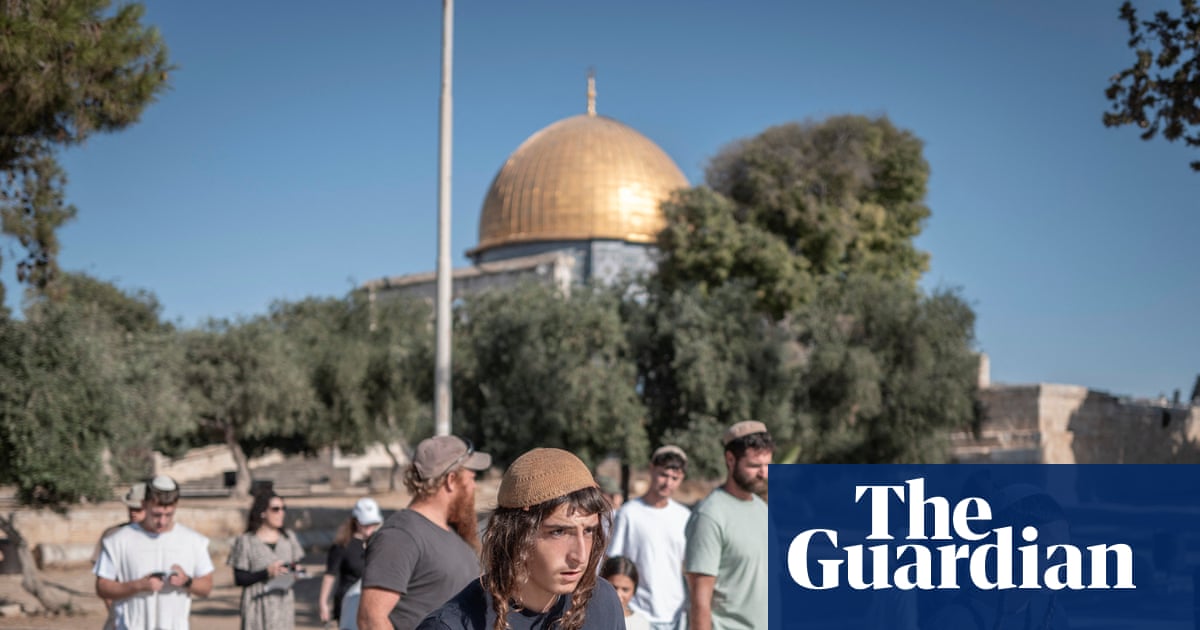
On 23 July, more than 2,000 Israelis from the religious right – mostly settlers led by the national security minister, Itamar Ben Gvir – stormed the area, known to Jews as the Temple Mount. They prayed and performed rituals all around the compound in what Jordanian officials said was the worst violation in modern history.

The Temple Mount is also the holiest site in Judaism, the site of two temples which were built and then destroyed by invaders in ancient times. Under the status quo agreement, the Western Wall - which was a retaining wall that survived the destruction of the Second Temple by the Romans in 70 CE - is reserved for Jewish prayer.

Amman has also been alarmed at a recent recruitment drive for religious Jews for a special Temple Mount police unit, and is braced for more direct challenges to traditional Jordanian custodianship by extremist Israeli leaders in the major Jewish holidays in September. This year, those holidays will come amid an intense election campaign, in which the far-right coalition of the prime minister, Benjamin Netanyahu, will be fighting for survival.

“This is a constant threat, a dangerous threat that we’re trying to counter in every tool that we have possible,” Jordan’s foreign minister, Ayman Safadi, told the Guardian. “We warn that tampering with the status quo … could trigger a religious conflict that will reverberate beyond Palestine and Jordan into the whole Muslim world.”

Safadi, who will host Wednesday’s emergency meeting, bringing together his counterparts from Arab League countries, as well as Turkey, Indonesia, Malaysia and Pakistan, said it was “something that the whole international community should be aware of. Jerusalem is a tinderbox.

“We’re trying to explain the danger. We’re protesting legally. We are trying to create awareness of the imminent danger in the continuation of those Israeli measures.”

“Our position that this is a red line that we will not allow to be crossed. We have made that known to everybody that we will do whatever it takes to prevent any attempt at Israeli displacement of Palestinians into Jordan,” Safadi said. “Not only will that be a violation of international law and of the right of the Palestinians to stay on their land, but that will also be a tremendous escalation.”

Jordanians descended from previous waves of Palestinian refugees already represent more than half of Jordan’s 11.5-million population, and the country’s original residents, the “East Bankers”, are wary of what they see as a further dilution of national identity.

Israel has already refused to renew a 2021 water agreement under which it shared 100m cubic metres a year to its parched neighbour, one of the most water-scarce countries in the world. It reverted to the 50m cubic metres originally agreed in the 1994 treaty, which falls far short of the needs of a much bigger population than the Jordan of 32 years ago.

The Israeli government reportedly halved the water supply in retaliation for criticism from the Jordanian government of the mass killing of Palestinian civilians by Israel in the Gaza war, and officials have hinted that the taps could be turned back on if the criticism ended.

The Israeli government’s provocative actions in Jerusalem and the West Bank and over water raise the political cost to the monarchy of maintaining normal relations with its western neighbour.


Two peoples, two States: The unwavering position of the Popes and the Holy See​

Pope Leo XIV’s appeal on the Middle East at the Angelus in Castel Gandolfo on 16 August is the latest expression of the Holy See’s longstanding support for a two-State solution as the only path to a “just and lasting” peace for Israel and Palestine.

By Salvatore Cernuzio

The “two-State” solution is, and remains, the only possible path to peace between Israel and Palestine. Popes have changed, as has the situation in the Middle East, where violence and division have intensified dramatically since 7 October 2023. Yet for almost eighty years, the Holy See’s diplomatic position has remained unshakeable: “two States” as the only prospect capable of guaranteeing justice and a just and lasting peace. Pope Leo XIV is the latest to forcefully reaffirm this historic position, which has endured through the decades despite the Israeli government’s firm rejection of it.

“I urgently call on the international community to work toward advancing the two-state solution, for a just and lasting peace,” Pope Leo said at the Angelus in Castel Gandolfo on Sunday, 16 August, after condemning the abuses and violence suffered by Palestinians in the West Bank. The Pope called for renewed momentum so that this project—first formally outlined in 1947 in the plan adopted by the United Nations General Assembly to partition Mandatory Palestine into two States—might finally become a reality.

A firmly established diplomatic position​

Beginning with the call for the internationalisation of Jerusalem’s holy sites in 1947, the two-State solution became, from the 1980s onwards, a cornerstone of the Holy See’s diplomatic position on the Israeli-Palestinian conflict. It is a steadfast stance, not shaped by emotional reactions to repeated escalations, but firmly rooted in history and consistently reinforced by successive Popes.

Pius XII’s call to protect the holy places​

The first statements date back to 1948, when Pius XII, in the Encyclical In multiplicibus curis, called for “an order that may guarantee security of existence and, at the same time, the moral and physical conditions of life conducive to spiritual and material well-being” for each of the parties to the conflict.

In the subsequent Encyclical Redemptoris nostri cruciatus of 1949, concerned that the holy places associated with the life of the Saviour might suffer the devastation of war, Pope Pius XII urged the faithful to “use every legitimate means” to persuade world leaders to accord Jerusalem and its surroundings “a juridical status” whose stability could be adequately guaranteed by the united efforts of peace-loving nations.

Paul VI and the legitimate rights of the Palestinians​

Paul VI, the first Pope to travel to the Holy Land, in 1964, spoke explicitly of the legitimate rights of the Palestinian people on the eve of the Six-Day War in 1967, reframing the issue from a humanitarian emergency into a fundamental political question.

In a heartfelt message to United Nations Secretary-General U Thant, Pope Paul VI appealed on behalf of the entire Christian world for “every effort” to be made to ensure that Jerusalem, “because of its peculiarly sacred and holy character,” might be declared “an open and inviolable city,” free from military operations and spared the consequences of war.

The decisive impetus of John Paul II​

The decisive impetus, however, came from John Paul II, the first Pope to call forcefully for the Palestinians’ right to an independent homeland while at the same time reaffirming Israel’s right to live in security.

This twofold appeal was enshrined in the 1984 Apostolic Letter Redemptionis anno.

“For the Jewish people who live in the State of Israel and who preserve in that land such precious testimonies to their history and their faith, we must ask for the desired security and the due tranquillity that is the prerogative of every nation and condition of life and of progress for every society,” the Pope said.

“The Palestinian people, who find their historical roots in that land and for decades have been dispersed, have the natural right in justice to find once more a homeland and to be able to live in peace and tranquillity with the other peoples of the area.”

He reiterated the same message in 2000 during his pilgrimage to the Holy Land—not the first by a Pope, but one acclaimed as “historic” because of its significance.

Benedict XVI’s support​

Nine years later, another Pope set foot in the holy yet wounded land of Jesus. It was May 2009, when Benedict XVI travelled to the Middle East.

Following in his predecessor’s footsteps, he stressed that the “two-State” formula was not a utopian vision, but a necessary condition for ending the spiral of violence and securing a future for the region.

“The Holy See supports the right of your people to a sovereign Palestinian homeland in the land of your forefathers, secure and at peace with its neighbors, within internationally recognized borders,” Pope Benedict said.

He urged Palestinians to “keep alive the flame of hope, hope that a way can be found of meeting the legitimate aspirations of both Israelis and Palestinians for peace and stability.”

The words and gestures of Pope Francis​

Under Pope Francis, this commitment took on a more international and formal character. It was reinforced by diplomatic initiatives—including the Holy See’s signing in 2015 of the Comprehensive Agreement officially recognising the State of Palestine—as well as by more pastoral gestures, such as the 2014 prayer for peace in the Vatican Gardens with Israeli President Shimon Peres and Palestinian President Mahmoud Abbas.

That gathering was one of the fruits of Pope Francis’ journey to the Holy Land in late May, during which Jorge Mario Bergoglio stated unequivocally: “The time has come for everyone to find the courage to be generous and creative in the service of the common good, the courage to forge a peace which rests on the acknowledgment by all of the right of two States to exist and to live in peace and security within internationally recognized borders.”

In the years that followed, until his death, Pope Francis sought to give greater diplomatic and symbolic momentum to the implementation of the solution. His words and gestures were consistently supported by statements from the Holy See’s Permanent Missions to international organisations and by Cardinal Secretary of State Pietro Parolin, who repeatedly stressed that the “two peoples, two States” solution is the most urgent political path to pursue.

Pope Leo XIV’s appeals​

This legacy is now in the hands of Pope Leo XIV, who from the outset has placed the two-State framework back at the centre of the global debate.

Particularly memorable were his remarks aboard the flight from Istanbul to Beirut, during his Apostolic Journey to Türkiye and Lebanon: “The Holy See for several years has publicly supported the proposal of a two-state solution. We all know that in this moment Israel still does not accept this solution, but we see it as the only solution that could offer—let us say—a solution to the conflict that they continuously live.”

He reiterated this position during his address to the Diplomatic Corps on 9 January 2026: “In particular, the two-State solution remains the institutional perspective for meeting the legitimate aspirations for both peoples.”

The appeals of Pope Leo and his predecessors still await a response. War continues to devastate peoples, while the path towards peace appears increasingly clouded. Yet for the Popes and the Holy See, political deadlock and humanitarian tragedy do not invalidate the solution; on the contrary, they demonstrate its urgency. This is the urgency Pope Leo XIV has highlighted by calling upon the international community to assume its responsibility.
 

LIVE: Jordan Hosts Emergency Arab Summit On Gaza And West Bank Escalation | DWS News | AC14
 

Country convenes emergency meeting of ministers from Arab and Islamic world, fearing such a move could ‘trigger a religious conflict’

Julian Borger in Amman
Tue 4 Aug 2026 09.15 EDT
Share


Prefer the Guardian on Google
Jordan is convening an emergency meeting of foreign ministers from the Arab and Islamic world over what it says is an “imminent” threat of an Israeli takeover of the most important Muslim site in Jerusalem, with the potential to “trigger a religious conflict”.

The meeting on Wednesday – and the Jordanian warning – follow an escalating pattern of government-backed incursions by Jewish religious extremists on the compound around al-Aqsa mosque and Dome of the Rock, in violation of a status quo treaty overseen by Jordan’s Hashemite monarchy, by which only Muslims can pray at the site.

On 23 July, more than 2,000 Israelis from the religious right – mostly settlers led by the national security minister, Itamar Ben Gvir – stormed the area, known to Jews as the Temple Mount. They prayed and performed rituals all around the compound in what Jordanian officials said was the worst violation in modern history.

The Temple Mount is also the holiest site in Judaism, the site of two temples which were built and then destroyed by invaders in ancient times. Under the status quo agreement, the Western Wall - which was a retaining wall that survived the destruction of the Second Temple by the Romans in 70 CE - is reserved for Jewish prayer.

Amman has also been alarmed at a recent recruitment drive for religious Jews for a special Temple Mount police unit, and is braced for more direct challenges to traditional Jordanian custodianship by extremist Israeli leaders in the major Jewish holidays in September. This year, those holidays will come amid an intense election campaign, in which the far-right coalition of the prime minister, Benjamin Netanyahu, will be fighting for survival.

“This is a constant threat, a dangerous threat that we’re trying to counter in every tool that we have possible,” Jordan’s foreign minister, Ayman Safadi, told the Guardian. “We warn that tampering with the status quo … could trigger a religious conflict that will reverberate beyond Palestine and Jordan into the whole Muslim world.”

Safadi, who will host Wednesday’s emergency meeting, bringing together his counterparts from Arab League countries, as well as Turkey, Indonesia, Malaysia and Pakistan, said it was “something that the whole international community should be aware of. Jerusalem is a tinderbox.

“We’re trying to explain the danger. We’re protesting legally. We are trying to create awareness of the imminent danger in the continuation of those Israeli measures.”

“Our position that this is a red line that we will not allow to be crossed. We have made that known to everybody that we will do whatever it takes to prevent any attempt at Israeli displacement of Palestinians into Jordan,” Safadi said. “Not only will that be a violation of international law and of the right of the Palestinians to stay on their land, but that will also be a tremendous escalation.”

Jordanians descended from previous waves of Palestinian refugees already represent more than half of Jordan’s 11.5-million population, and the country’s original residents, the “East Bankers”, are wary of what they see as a further dilution of national identity.

Israel has already refused to renew a 2021 water agreement under which it shared 100m cubic metres a year to its parched neighbour, one of the most water-scarce countries in the world. It reverted to the 50m cubic metres originally agreed in the 1994 treaty, which falls far short of the needs of a much bigger population than the Jordan of 32 years ago.

The Israeli government reportedly halved the water supply in retaliation for criticism from the Jordanian government of the mass killing of Palestinian civilians by Israel in the Gaza war, and officials have hinted that the taps could be turned back on if the criticism ended.

The Israeli government’s provocative actions in Jerusalem and the West Bank and over water raise the political cost to the monarchy of maintaining normal relations with its western neighbour.


Good, now they'll know what it feels like when someone "desecrates" their "holy" sites. Actually Mecca and Medina are their holy places. Muhammad was never in Jerusalem.
 
  • Like
Reactions: Lightbeamrider

AUGUST 16, 2026 13:45Updated: AUGUST 16, 2026 20:58
Jewish men were permitted to bring prayer books onto the Temple Mount on Sunday, National Security Minister Itamar Ben-Gvir confirmed to The Jerusalem Post, after right-wing journalist Arnon Segal shared a photo of Jewish men praying and reading from prayer books, claiming the photo was taken from the Temple Mount.

“Still no blanket permit, but an initial experiment aimed at ensuring the Middle East doesn’t lose its mind over this,” Segal claimed in his post. “History.”

The minister had no further comment for the Post.

“The Israel Police operates on the Temple Mount in accordance with the directives of the political echelon, the established rules governing the site, and operational assessments, with the aim of safeguarding public safety, security, and public order,” Israel Police said in response to the Post’s request for comment.

Under the longstanding status quo, Jews and Christians are permitted to visit the Temple Mount but are generally prohibited from praying there, while Muslims are permitted to worship.

Temple Mount status quo for Jewish prayer shifting

In January, Israel Police began relaxing some restrictions on Jewish prayer at the site, according to the Jewish Telegraphic Agency. Jewish visitors may now enter with a single printed prayer page prepared in advance, although prayer books remain prohibited.

On August 5, Arab and Muslim officials meeting in Amman condemned what they described as an Israeli “escalation” in “the occupied city of Jerusalem,” according to the Jordanian Foreign Ministry.

The officials agreed to condemn recent Israeli policies and measures that they claimed were intended to alter the “Arab, Islamic, and Christian identity” of Jerusalem, including what they called the “inflammatory” statements and actions of extremist settlers and Israeli government ministers at the al-Aqsa Mosque and Christian holy sites.


Prophecy In Motion — The Week Everything Converged
 

Jerusalem Building Third Temple ❗❗😱 New Update...​


Sanhedrin Issues Historic Ruling Calling to Heaven for Messiah and Third Temple​

By James Lasher Jul 29, 2026
Third-temple.jpg


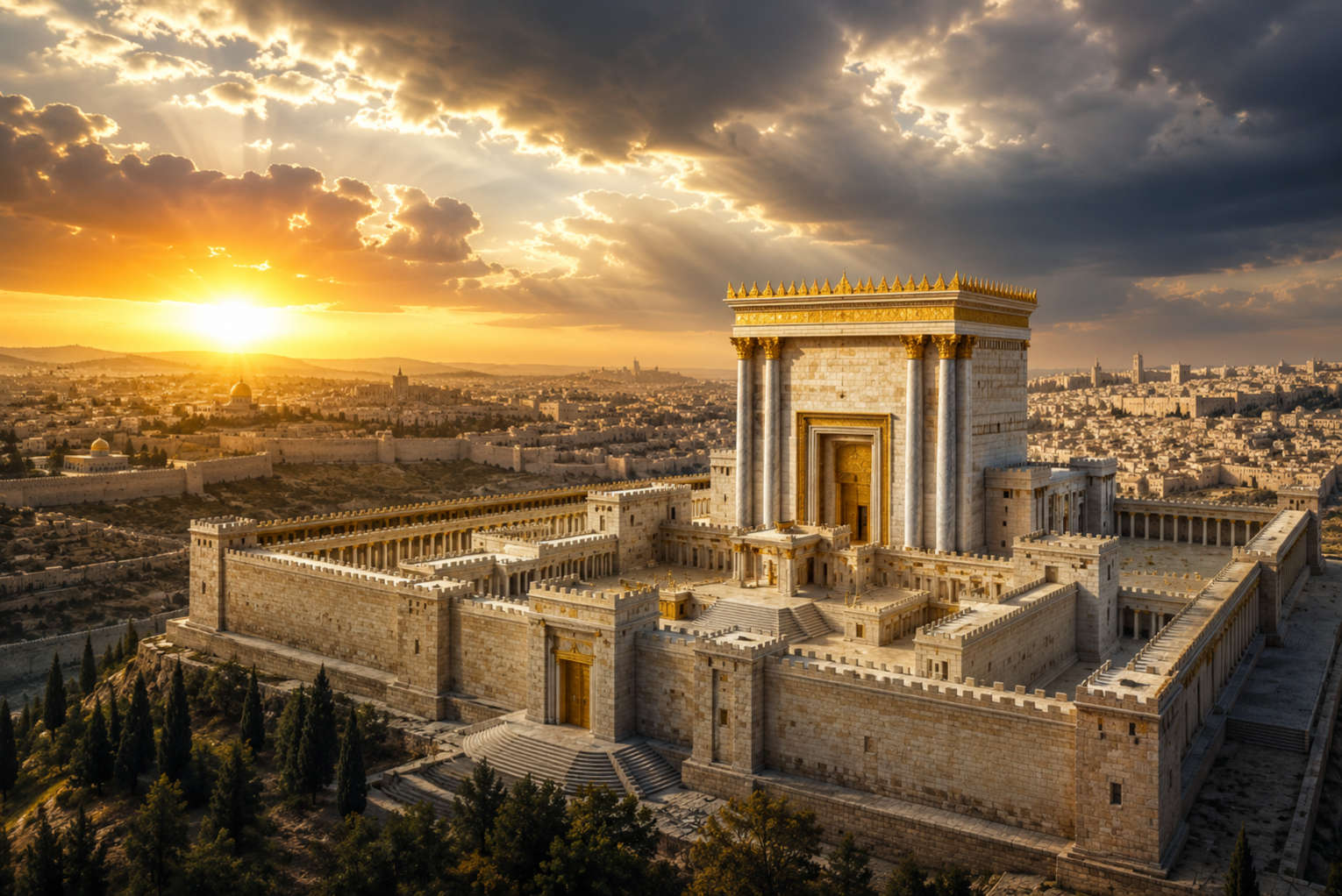
The nascent Sanhedrin has issued a formal ruling asking God to remove Israel’s enemies, reveal the Messiah, rebuild the Third Temple and restore prophecy, marking another significant step by modern Temple advocates as many Christians continue watching developments in Israel through the lens of biblical prophecy.

According to Israel365 News, the ruling followed several hours of deliberation by the rabbinical court, with members ultimately approving a three-part petition they believe should be recognized in Heaven as well as on earth.

The Three Resolutions​

Removing hostile forces​

The Sanhedrin’s first resolution calls for the removal of hostile forces from Israel and the Jewish people.

Courts & Judiciary
lg.php

“The court rules that every kind of erev rav, every kind of Amalekite, every kind of Ishmaelite, every kind of traitor of every stripe, and all the forces of evil shall leave the Jewish people and the Land of Israel,” the ruling states.

Revealing the Messiah and rebuilding the Temple​

The court’s second resolution asks God to reveal the Mashiach and remove every obstacle preventing construction of the Third Temple.

“The court asks that the Holy One, Blessed Be He, reveal our righteous Mashiach,” the ruling states. “The court asks that the Holy One, Blessed Be He, remove and erase every obstacle so that we may build the Beit HaMikdash.”

Restoring prophecy​

The final resolution petitions God to restore prophecy to Israel.

The ruling asks “that the Holy One, Blessed Be He, restore prophecy to the Jewish people, and guard the prophets from all those who seek to harm the prophets of Israel.”

According to Israel365 News, the Sanhedrin believes an earthly rabbinical court has the authority to issue rulings that are recognized in Heaven, though the report notes that not all Jewish authorities accept that interpretation.

Rabbi Explains the Decision​

Rabbi Josh Wander, who participated in the deliberations, said he initially questioned whether the court should move forward.

“By speeding things up, we also risk making things a lot worse in the short term, and much more painful,” Wander said.


Wander said the court viewed the resolutions as a series of stages leading toward redemption rather than a single request.

“It’s not just about Mashiach,” he said. “It’s about stages that have to happen before, including getting rid of our enemies.”

He also offered a warning: “If this has the effect that we hope it has, or believe it has, you should buckle up, because things are going to get really rough very soon.”


The Sanhedrin’s latest action is another reminder that preparations and expectations surrounding a future Temple continue to grow in Israel. While we believe Jesus Christ is the promised Messiah, Scripture also points to a future Temple playing a role in events leading up to His Second Coming, making developments like these especially noteworthy for those watching biblical prophecy unfold.

Courts & Judiciary

James Lasher, a seasoned writer and editor at Charisma Media, combines faith and storytelling with a journalism background from Otterbein University and ministry experience in Guatemala and at the LA Dream Center. A Marine Corps and Air Force veteran, he is the author of The Revelation of Jesus: A Common Man’s Commentary and a contributor to Charisma magazine. For interviews and media inquiries, please contact [email protected].
 

Summary of transcript from Sling and Stones post.​

Sanhedrin Petitions Heaven For Messiah and Third Temple​

In light of this article that recently came out, the Sanhedrin rules, it will formally petition heaven to reveal Messiah or Messiah and rebuild the temple. I did a deeper dive into what exactly the Sanhedrin has been up to these past previous years.

Sanhedrin Calls On Trump To Uphold The Seven Noahide Laws​


"The Sanhedrin calls on President Trump to uphold seven Noah laws." I've been covering this whole Noah Hyde laws thing recently because the first law is to not blasphe and some recordings say that they enforce that through the death penalty and according to what they believe the Jewish people believe that following Jesus would constitute blasphemy under their noahide laws. [Please note, in the gospels Jesus was convicted of Blasphemy and that was the crime they used to justify His death sentence.]

The main significance of this instance was that the modern Sanhedrin movement was directly appealing to a US president to help promote the Noahide laws and the Noahide principles internationally.

Sanhedrins Letter Of Support To Trump​

The Sanhedrin sent strong support letter to President Trump. And so, what happened here is that the modern Sanhedrin sent President Trump a letter strongly supporting his policies towards Iran and Gaza. And again, that was back in 2025. They praised his actions against Iran's nuclear program and described Iran's leadership as a major threat to Israel and the United States and encouraged him to take a stronger position against the Iranian government.

Sanhedrin Says Trump Has Been Positioned By God​

The Sanhedrin also sent a letter to Trump. This is from 2025 in February. You have been elected to fulfill a heavenly mission. In this letter to President Trump, the Sanhedrin said that they believe that Trump had been chosen for a heavenly mission, comparing him to biblical King Cyrus. They praised Trump for promoting faith in public life and urged him to support the seven noahide laws as a universal moral code for all nations.

Sanhedrin Calls on Biblical Covenants​

This is something that they just continue to petition anyone who pretty much supports them. And now we'll look at this article from January 16th, 2026.

Sanhedrin addresses Iran and Syria invoking Cyrus and biblical covenants. The Sanhedrin issued declarations concerning Iran and Syria, interpreting current upheaval in the region through a biblical and messianic lens. Regarding Iran, the Sanhedrin calls on the Iranian people to reject the current Islamist regime and follow the example of Cyrus the Great, the Persian king who allowed the Jews to return to Jerusalem and rebuild the temple.

The Sanhedrins Role In Israel Politics

I'll say again that this Sanhedrin is just a group of religious Jews who have started to create their own Sanhedrin once again in Israel. They are not formally connected with the government of Israel.