Replacement theology? Yes or No.

  • Christian Chat is a moderated online Christian community allowing Christians around the world to fellowship with each other in real time chat via webcam, voice, and text, with the Christian Chat app. You can also start or participate in a Bible-based discussion here in the Christian Chat Forums, where members can also share with each other their own videos, pictures, or favorite Christian music.

    If you are a Christian and need encouragement and fellowship, we're here for you! If you are not a Christian but interested in knowing more about Jesus our Lord, you're also welcome! Want to know what the Bible says, and how you can apply it to your life? Join us!

    To make new Christian friends now around the world, click here to join Christian Chat.
So this is what I kept saying, God do not need us to commit murdering to help His process.

For example, Jesus didn't instruct Judas ischariot to sell him and praise Judas action, correct?

Jesus didn't instruct the jew leaders and crowd to shout crucify and later praise their actions, correct?

Jesus have plan for all remnants to be saved, including all nations. So which nation do we pick to murder other nation today?

The answer should be none. Stay away from secular things.

Only stay loyal to God, obey His commands.
If your Church is wasting its time ruminating about world politics while brainwashing the congregants, I suggest that you bail out.
 
If your Church is wasting its time ruminating about world politics while brainwashing the congregants, I suggest that you bail out.
Actually we don't talk about politics on pulpit.

But we do teach whoever rejecting Jesus today is not children of God.

Whoever saying Jesus is a lier today is not children of God.

What about your church?
 
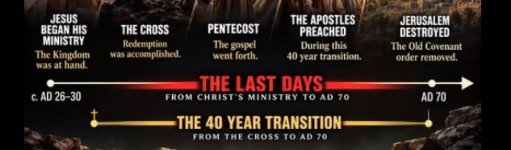
View attachment 296464

(author anonymous, but is truth)
I think we are agreeing just in different way. I pointed out that the work was accomplished at the cross. Marking the "beginning" of the end of the OT and the beginning of the NT. What I believe you were saying is the transition from old to new was on going till the temple destruction, marking the complete end of OT?
 
View attachment 296464

(author anonymous, but is truth)

Here's what you should know about "the last days" as they are written in the Bible:

The Bible uses the phrases "last days" or "latter days" to describe multiple distinct time periods and events, primarily categorized into three main contexts:
  • The Church Age: In the New Testament, these terms often refer to the period inaugurated by Jesus Christ’s first coming and continuing until His second coming. This includes the pouring out of the Holy Spirit at Pentecost (Acts 2:17) and the current era of the Church (Hebrews 1:2; 1 Peter 1:5).
  • Future Eschatological Events: Other passages use the terms to describe future events associated with Christ’s Second Coming, the Great Tribulation, and the establishment of the Millennial Kingdom (Isaiah 2:2; Micah 4:1; Daniel 10:14).
  • Historical Judgment on Israel: In the Old Testament, the phrases frequently refer to the final days of the Old Covenant or the Jewish state, specifically pointing to events like the destruction of Jerusalem in AD 70 or the Babylonian exile (Jeremiah 23:20; Jeremiah 49:39; Deuteronomy 4:30).
Additionally, some scholars distinguish "the last day" (singular) as the specific day of resurrection and judgment (John 6:39), separate from the plural "last days" which denotes a broader era. The Hebrew word translated as "last" or "latter" appears roughly 61 times in the Bible, with translations varying based on whether the context points to distant future prophecy or the inaugurated kingdom of Christ.
 
I think we are agreeing just in different way. I pointed out that the work was accomplished at the cross. Marking the "beginning" of the end of the OT and the beginning of the NT. What I believe you were saying is the transition from old to new was on going till the temple destruction, marking the complete end of OT?

Yes, that happens quite a bit on CC.

I think the image I posted is the best way to explain what scripture is saying, there was still work to be done on earth during the time of transition with the believers.

Yes Christ Jesus clearly stated it is finished and that is why futurism is so every wrong.
 
Exegete these passages.....if you are able. We already know that you are not willing.....:cautious:

Mat 12:32 - “Anyone who speaks a word against the Son of Man, it will be forgiven him; but whoever speaks against the Holy Spirit, it will not be forgiven him, either in this age or in the age to come.

Isa 65:20
“No more shall an infant from there live but a few days,
Nor an old man who has not fulfilled his days;
For the child shall die one hundred years old,
But the sinner being one hundred years old shall be accursed.

And then read Isaiah 65:17-25.

In fact only in the millennial age the AGE TO COME, will sinners be born who can CHOOSE to reject Christ.
 
Here's what you should know about "the last days" as they are written in the Bible:

The Bible uses the phrases "last days" or "latter days" to describe multiple distinct time periods and events, primarily categorized into three main contexts:
  • The Messianic Age (Church Age): In the New Testament, these terms often refer to the period inaugurated by Jesus Christ’s first coming and continuing until His second coming. This includes the pouring out of the Holy Spirit at Pentecost (Acts 2:17) and the current era of the Church (Hebrews 1:2; 1 Peter 1:5).
  • Future Eschatological Events: Other passages use the terms to describe future events associated with Christ’s Second Coming, the Great Tribulation, and the establishment of the Millennial Kingdom (Isaiah 2:2; Micah 4:1; Daniel 10:14).
  • Historical Judgment on Israel: In the Old Testament, the phrases frequently refer to the final days of the Old Covenant or the Jewish state, specifically pointing to events like the destruction of Jerusalem in AD 70 or the Babylonian exile (Jeremiah 23:20; Jeremiah 49:39; Deuteronomy 4:30).
Additionally, some scholars distinguish "the last day" (singular) as the specific day of resurrection and judgment (John 6:39), separate from the plural "last days" which denotes a broader era. The Hebrew word translated as "last" or "latter" appears roughly 61 times in the Bible, with translations varying based on whether the context points to distant future prophecy or the inaugurated kingdom of Christ
Your summary treats “last days” as three categories, but biblically the controlling definition is the one the inspired writers explicitly give.
The Messianic age inaugurated by Christ’s first coming (Acts 2:17; Heb 1:2; 1 John 2:18), while the other usages (future prophecy or national judgment) are contextual applications of the same phrase, not separate doctrinal categories;
Isaiah, Micah, and Daniel use “latter days” for distant future events, and Jeremiah uses it for covenant‑judgment, but the New Testament defines the theological meaning as the era between Christ’s first and second coming, which is why the apostles say we are already in the last days and why every other usage must be interpreted through that lens rather than treated as independent systems.
 
I think the image I posted is the best way to explain what scripture is saying, there was still work to be done on earth during the time of transition with the believers.

Yes Christ Jesus clearly stated it is finished and that is why futurism is so every wrong.

There is still work to be done on earth and prophecies to be fulfilled. The only thing that is "finished" is God/Jesus' plan for salvation where Jesus died for all of our sins.
 
  • Love
Reactions: LTTexan
Your summary treats “last days” as three categories, but biblically the controlling definition is the one the inspired writers explicitly give.
The Messianic age inaugurated by Christ’s first coming (Acts 2:17; Heb 1:2; 1 John 2:18), while the other usages (future prophecy or national judgment) are contextual applications of the same phrase, not separate doctrinal categories;
Isaiah, Micah, and Daniel use “latter days” for distant future events, and Jeremiah uses it for covenant‑judgment, but the New Testament defines the theological meaning as the era between Christ’s first and second coming, which is why the apostles say we are already in the last days and why every other usage must be interpreted through that lens rather than treated as independent systems.

That's because history is repeating itself and NOT ALL PROPHECY has been fulfilled yet. If it had, we wouldn't still be here.

Even you believe in another Tribulation and Anti-Christ, correct?
 
Do you got any wisdom on when the age to come starts? Is it after the second coming or only after the millennium?
Many fail to understand that the Day of the Lord BEGINS with the 70th week of Daniel tribulation.
The tribulation itself is the beginning of the DOTL, the AGE TO COME.

There are vast tracts of Scripture both OT and NT that CLEARLY state that the BIRTH PAINS themselves are the beginning of the Day of the Lord.

Do the CT's and amils understand any of this? Are they WATCHING? Are they preaching WARNING to the world?
No, no and no.

Many fail to recognize that the Day of the LORD is not restricted to the single moment of Christ's visible Second Coming. Scripture presents it as a broader eschatological period of divine intervention and judgment.

The birth pains themselves belong to the opening phase of that judgment complex.

Paul explicitly states:

“The day of the Lord so cometh as a thief in the night… then sudden destruction cometh upon them, as travail upon a woman with child” (1 Thess. 5:2–3).

Christ likewise calls the wars, famines, pestilences, earthquakes, and associated upheavals “the beginning of birth pains” (Matt. 24:4–8), after which the discourse advances through persecution, the Abomination of Desolation, the Great Tribulation, cosmic disturbances, and finally the visible return of Christ (Matt. 24:9–31).

This imagery comes directly from the prophets. Isaiah 13 describes the approaching “Day of the LORD” and says men will be seized with “pangs and sorrows” like “a woman that travaileth” (Isa. 13:6–13). Jeremiah 30 similarly compares the Time of Jacob's Trouble to labor pains and calls it an unparalleled “day” from which Jacob will ultimately be delivered (Jer. 30:6–11).

Zephaniah 1, Joel 2, Isaiah 13, Jeremiah 30, and numerous other passages portray the Day of the LORD as a period of wrath, distress, warfare, cosmic upheaval, judgment, and eventual deliverance—not merely the instantaneous appearance of Christ at its climax.

Thus, within the futurist-dispensational framework, Daniel's 70th week belongs to the opening judgment phase of the Day of the LORD. The judgments intensify through the birth pains and Great Tribulation, culminate in the Second Advent, and are followed by the judgments and kingdom events associated with Christ's earthly reign.

The Second Coming therefore does not initiate everything described as the Day of the LORD; rather, it is the climactic intervention toward which the preceding Day-of-the-LORD judgments have been moving.

 
  • Like
Reactions: Komentaja
That's because history is repeating itself and NOT ALL PROPHECY has been fulfilled yet. If it had, we wouldn't still be here.

Even you believe in another Tribulation and Anti-Christ, correct?
I believe we are in tribulation and it will continue to get worse till the man of sin is reveled. Then the last 7 years of the world as we know it winds down to Christs arrival.
 
  • Like
Reactions: Revelation1v8
"This generation" applies to every generation that's being spoken about for each time, event and category.
“this generation” never floats as a universal principle applied to any group at any time.
Jesus uses hautē (“this”) as a specific demonstrative pointing to the audience He is addressing in that moment,
and every usage in Matthew proves it (Matt 11:16; 12:41–42; 12:45; 23:36; 24:34),
while the future‑oriented demonstrative ekeinē (“that”) is used for eschatological events (Matt 24:36),
meaning “this generation” is always the generation in view, not a timeless category applied across eras.