Is Knowledge of the Original Languages Necessary for KJV Believers?

  • Christian Chat is a moderated online Christian community allowing Christians around the world to fellowship with each other in real time chat via webcam, voice, and text, with the Christian Chat app. You can also start or participate in a Bible-based discussion here in the Christian Chat Forums, where members can also share with each other their own videos, pictures, or favorite Christian music.

    If you are a Christian and need encouragement and fellowship, we're here for you! If you are not a Christian but interested in knowing more about Jesus our Lord, you're also welcome! Want to know what the Bible says, and how you can apply it to your life? Join us!

    To make new Christian friends now around the world, click here to join Christian Chat.
I am sorry that my talking about the Bibliology topic or textual issues bores you.
For me, this is fun and exciting to talk about such matters because I love the words of God.

I strongly suspect you have never looked critically at the KJV to find the verses there that "water down" the deity of Christ when compared with the modern versions. Yours is a one-way lens.
There is no such thing. Even if one could cobble together such a list, it would be very weak and thin by comparison. I mean, can you show me how the KJV has 20 some places that water down the deity of Christ that is really disturbing like on the level with Modern versions? No. I don't believe you or anyone else would be able to really do that. Does the KJV have 25 Catholic ideas in it like the Modern Bibles do? No. I listed a bunch of other bad doctrines in just passing to you and I did not even cover them all from my writeup. I just gave you a taste and you spit it out and did not even bother to really care if it was true or not. That's what concerns me. Your not connecting the dots when it is so obvious. It's like no matter what evidence is presented, it must be rejected because you already made up your mind on this topic.


....
 
The debate centers around two different KJV-believing positions. My position is that I am KJV, anchored in the underlying Hebrew and Greek texts. My brother, Matthew Verschuur (my opponent in the debate), is comfortable identifying as KJV-only, and he primarily focuses on defending the English of the KJV for understanding Scripture. While I believe one can be saved and even live a holy life through the King James Bible alone, there are words in the original languages (not all of them) that sometimes convey a deeper layer of meaning not fully expressed in the English of the KJV. This does not mean that I believe the KJV contains errors. Rather, I believe that the underlying original language printed texts (primarily the Beza 1598 Greek New Testament and the Ben Chayyim Hebrew Text) also convey truths that enrich the KJV believer’s understanding and spiritual life.

The focus of this debate is between two KJV believers and their respective positions. Please note that my debate opponent says he is not anti-TR by any means. He believes the best form of the TR is the King James Bible. Edward F. Hills expressed the view that the King James Bible is a unique form of the Textus Receptus. I would personally rather say that the TR refers to the Greek printed editions themselves.

I hope you get a chance to check it out, even if you may not agree with either of our positions.

May the Lord Jesus Christ bless you richly.

....


.....FFrom my perspective
 
I have a slightly different take on the Bible debates. My view is this-its God's book, and He knows what He wants it to say. To say that man has control over it is to limit God and that is not possible. Man cannot control God, they just wish they could.
 
  • Heart
Reactions: Bible_Locket
I have a slightly different take on the Bible debates. My view is this-its God's book, and He knows what He wants it to say. To say that man has control over it is to limit God and that is not possible. Man cannot control God, they just wish they could.
Yes, I believe God does control His word in what He wants it to say and He was the One preserving it ultimately. God was able to accomplish this through men copying His words. When referring to the Greek New Testament: Today there are two major Bible lines in existence that have the most influence. One is the Textus Receptus / KJV and the other is the Critical Text / Modern English Bibles. There really is not any other influential contenders.

Oh, and comparing the two major Bible lines should naturally lead a person to make the right choice if they are an unbiased investigator who goes with stats, facts, and figures. I believe the true text or the inspired words of God is the underlying Hebrew, Aramaic, and Greek that underlies the King James Bible. I believe the KJV is a providential translation that is without error. But the actual inspired words of God are the Hebrew, Aramaic, and Greek. All evidence points in that direction.


....
 
I strongly suspect you have never looked critically at the KJV to find the verses there that "water down" the deity of Christ when compared with the modern versions. Yours is a one-way lens.
There are times I have looked at the KJV critically before. In fact, it was even this very year. But when I looked into the matter more deeply, I realized I was wrong. In other words, we need to keep digging and look at look at the Middle English dictionary, early church writers, and more. We need to keep praying to the Lord and ask for His help.

Anyway, the lesson for me in all of this was that God's words are preserved for us today and that I should have never had any doubts.


....
 
  • Like
Reactions: Bible_Locket
So you think the Middle English dictionary is lying?
Do you need me to take a screen capture of the pages because you cannot access the links I gave?
Or are you referring to how need to see the original document that the MED site refers to in order to believe it?

While I do prefer original scans of older lexicons, this is because there is a movement set out to change what modern lexicons say.
There does not appear to be anything like that with the MED. There is no real motivation for anyone to do that.

The Critical Text Modern Bible Movement has motive to attack the TR and the KJV because it goes against their narrative that their text is better, when it clearly is not. Thus, they make up stories about Erasmus, and say Pseudo before the name of any writer who supports the Johannine Comma in some way (like Jerome, etc.). They say King James was a rainbow person and all kinds of other non-factual things. No doubt it is to keep their billion dollar modern Bible industrial complex running. But we are living in age where you can get information and sources unlike ever before. Thus, your original attack against the KJV using the word "silence" does not stand in light of the facts of history. Then again, I have seen this behavior with Critical Text advocates many times. Even when faced with the facts, they still cannot see the evidence you present to them. It's as if such evidence is invisible and you are speaking a foreign language to them. They just cannot see it. Most likely this is due to the fact that if a person repeats a lie long enough, they believe it to be fact. So new evidence or facts that challenge that belief is usually just dismissed or made as if it is impossible to ever reach or know in this life. Thus, they protect the belief they have always known or the belief they prefer to be true (despite the new evidence).
....
I am, in fact, someone who prefers the KJV over the many translations based on the Westcott and Hort tossed Greek salad text. But I am not one who ascribes plenary divine inspiration to any translation of the Bible. The only text I trust would be Greek versions, and I would put the greatest trust in those Greek versions attested to by the majority of extant early manuscripts, and that is IMO not the Alexandrian text.

It is quite possible that the compilers of the ME Dictionary have mistakenly broadened the semantic range of “silence” based on Bible translators misapplying the word to hEsuchia in certain texts because they wanted their women to be silent, not because the Holy Spirit wanted them to be silent. I have not yet seen any clear extra-biblical use of “silence” where it must equate to "speaking calmly”. the examples you are presenting don’t require silence to mean speaking calmly. You seem to be falling into the Argumentum ad auctoritātem fallacy (also called appeal to authority). The ME Dictionary may be an authority and may be claiming “in silence” can mean calmly, but it has not provided any compelling proof for the claim. The examples you have presented from the ME Dictionary don’t do so.
 
In addition, I have catalogued 20 some verses in Modern Bibles that water down the deity of Jesus Christ. This is simply a fact. It is on my 77 changed doctrines PDF that was on my site, but I took it down because I am re-working that writeup to align it with the original languages and sourcing it with the older lexicons that any person can verify for themselves. Uncommon or archaic KJV words of note will also be sourced when applicable or important. Textual differences (or manuscript differences) are also sourced, as well (So a person can examine the Hebrew and Greek from the two different major Bible lines). While I could add a lot more to my 77 changed doctrines list, I do have other projects that I want to do for the Lord.....
I’m slowly working my way through your list but there’s quite a significant difference between your approach to the translation question and mine. Two significant differences, in fact. First, as you repeatedly state in your posts #493-497, your main criteria for judging which of the two translations is to be preferred are (1) “The ESV changes or weakens doctrine” and (2) “Certain ESV readings can support Calvinistic teaching.” In my view, both those considerations are secondary, at best. The real criterion for comparing different translations of the same text is how closely each of them has been successful in conveying the meaning intended by the original author.

The other difference, no less important, is the wording of the Greek text that the translator has been commissioned to translate. You have made it clear in your posts #534 and 544 that you have a distinct preference for the Textus Receptus over Westcott & Hort. I certainly don’t challenge your right to hold that view. However, in the cases where one publisher has commissioned a translator to translate the Textus Receptus and another publisher (or even the same publisher) has commissioned a translation of Westcott & Hort, then any resulting difference in the English text is not a question of a better or poorer translation. The discrepancy is between two differing versions of the original Greek. The translator is not to be blamed for the discrepancy, which has arisen because of a decision made by somebody else, not the translator.

As a result, I now need to go through the whole list once again, this time checking to see whether each discrepancy is properly to be attributed to the respective translators or to a difference between one Greek text and the other.
 
You did not address any of the verses I put forth to you, and now you want me to engage with you on new verses? Okay, but that is not how these kinds of discussions are supposed to work. If I take the time to present specific Scriptures in support of my position, those passages need to be addressed before simply moving on to a different set of arguments.

Also, I generally do not engage in extended theological debates with people whose beliefs fall into categories such as liberal Christianity, agnosticism, atheism, Islam, Universalism, and similar positions. Seeing you do not regard the Trinity as a doctrine that deals with salvation, and thus, you are fine with others worshiping a false god not described in Scripture, I take this as a liberal position. There has to be enough common ground concerning the authority of Scripture for a productive biblical discussion to take place. So while I respect that some Christians may feel called to these types outreaches, that is not my calling or desire at this time in my life. I generally do not have patience for such extreme nonsense. Prayer in my opinion is the key to reaching these kinds of people.


....
are you high? I am no way a liberal person of theology. Why do you continue to make false accusations? Where did I speak about the Trinity and the doctrine that deals with salvation? And I am fine with others worshiping false gods? Stop lying. You keep creating false narratives of others who have not said anything to which you accuse them of. That is a liar. The verses you put forth that you say I did not address?

Bible_highlighter:
"Of course Jesus saves. The question is: Does God use His Word as the means by which the gospel is communicated, faith comes, and a person is born again? According to 1 Peter 1:23–25, the answer is plainly "yes."

And John 1 does not change that. Jesus being personally called “the Word” does not mean that every biblical reference to “the word of God” is another name for Jesus personally. In 1 Peter 1:25, Peter specifically says, “this is the word which by the gospel is preached unto you.”

You have not addressed 1 Peter 1:23–25, which explicitly says we are “born again… by the word of God,” and then identifies this with “the word which by the gospel is preached unto you.” You also have not addressed Romans 10:17, “faith cometh by hearing, and hearing by the word of God,” or Christ’s statement that “the words that I speak unto you, they are spirit, and they are life” (John 6:63). Peter likewise said that Jesus has “the words of eternal life” (John 6:68)."


The context of 1Peter 1:22- 25

22 Since you have purified your souls in obeying the truth through the Spirit in a sincere love of the brethren, love one another fervently with a pure heart, 23 having been born again, not of corruptible seed but incorruptible, through the word of God which lives and abides forever, 24 because

“All flesh is as grass, And all the glory of man as the flower of the grass. The grass withers, And its flower falls away, 25 But the word of the Lord endures forever.”
Now this is the word which by the gospel was preached to you.

What or who is the seed? the word of God ? yes in John chapter one Logos is used just as it is here in context to who is the word that we as Peter says here : Verse 23 "through the word of God which lives and abides forever, : Who lives and abides forever?


John chapter 1:1-3:


"In John, denotes the essential Word of God, Jesus Christ, the personal wisdom and power in union with God, his minister in creation and government of the universe, the cause of all the world's life both physical and ethical, which for the procurement of man's salvation put on human nature in the person of Jesus the Messiah, the second person in the Godhead, and shone forth conspicuously from His words and deeds."(Cambridge Dictionary of Philosophy (2nd ed): Heraclitus, 1999).

1Peter 1:22-25 is saying the same thing. The seed, He who lives and abides forever through the word of God is The Lord Jesus Christ.
Jesus is the word of God by which we are born again. Now, I addressed 1Pet 1:22-25.
That is a foundational truth. Jesus is the only way to the Father.
 
are you high? I am no way a liberal person of theology. Why do you continue to make false accusations? Where did I speak about the Trinity and the doctrine that deals with salvation? And I am fine with others worshiping false gods? Stop lying. You keep creating false narratives of others who have not said anything to which you accuse them of. That is a liar. The verses you put forth that you say I did not address?

Bible_highlighter:
"Of course Jesus saves. The question is: Does God use His Word as the means by which the gospel is communicated, faith comes, and a person is born again? According to 1 Peter 1:23–25, the answer is plainly "yes."

And John 1 does not change that. Jesus being personally called “the Word” does not mean that every biblical reference to “the word of God” is another name for Jesus personally. In 1 Peter 1:25, Peter specifically says, “this is the word which by the gospel is preached unto you.”

You have not addressed 1 Peter 1:23–25, which explicitly says we are “born again… by the word of God,” and then identifies this with “the word which by the gospel is preached unto you.” You also have not addressed Romans 10:17, “faith cometh by hearing, and hearing by the word of God,” or Christ’s statement that “the words that I speak unto you, they are spirit, and they are life” (John 6:63). Peter likewise said that Jesus has “the words of eternal life” (John 6:68)."


The context of 1Peter 1:22- 25

22 Since you have purified your souls in obeying the truth through the Spirit in a sincere love of the brethren, love one another fervently with a pure heart, 23 having been born again, not of corruptible seed but incorruptible, through the word of God which lives and abides forever, 24 because

“All flesh is as grass, And all the glory of man as the flower of the grass. The grass withers, And its flower falls away, 25 But the word of the Lord endures forever.”
Now this is the word which by the gospel was preached to you.

What or who is the seed? the word of God ? yes in John chapter one Logos is used just as it is here in context to who is the word that we as Peter says here : Verse 23 "through the word of God which lives and abides forever, : Who lives and abides forever?


John chapter 1:1-3:


"In John, denotes the essential Word of God, Jesus Christ, the personal wisdom and power in union with God, his minister in creation and government of the universe, the cause of all the world's life both physical and ethical, which for the procurement of man's salvation put on human nature in the person of Jesus the Messiah, the second person in the Godhead, and shone forth conspicuously from His words and deeds."(Cambridge Dictionary of Philosophy (2nd ed): Heraclitus, 1999).

1Peter 1:22-25 is saying the same thing. The seed, He who lives and abides forever through the word of God is The Lord Jesus Christ.
Jesus is the word of God by which we are born again. Now, I addressed 1Pet 1:22-25.
That is a foundational truth. Jesus is the only way to the Father.
Other believers can see your being okay that others denying the Trinity as being okay in my post here.

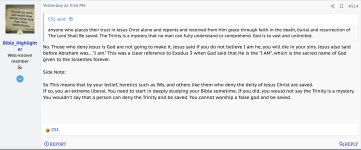
Screenshot 2026-08-25 at 10.16.48 AM.png

Look above at the screen-cap of my post (that shows my reply to you):

You basically said the Trinity is a mystery that no man can fully understand.​

Then when I said that those who deny Jesus is God are not going to make it (i.e., they will not be saved), you put the laugh emoticon to my reply, suggesting or implying that such a thing was not true.

I asked specifically if you believed those who deny the Trinity would be saved and you said the Trinity is a mystery.
So either you did not understand what I was saying or you think Christians who deny the Trinity are saved.
If you want to backtrack that statement, please feel free to do so any time.
Yes, I know there are Christians who do not understand the Trinity but they still believe in it because that is what the Bible teaches plainly. That is not the same category as those who deny the Trinity.


....
 
I am no way a liberal person of theology. Why do you continue to make false accusations? Where did I speak about the Trinity and the doctrine that deals with salvation? And I am fine with others worshiping false gods?

Historically, belief in the Trinity was not regarded as some minor or optional Christian doctrine. Early Christian writers and Protestant Reformers, including non-Calvinist Reformers, treated rejection of the Trinity or the deity of Christ as heresy or serious doctrinal error.

Scripture also establishes the principle that it is not enough merely to claim that one worships God or believes in Jesus. God must be worshiped according to truth, and a false conception of God or Christ can amount to false worship.

Biblical Basis:

John 4:22–24


Jesus says, “Ye worship ye know not what... the true worshippers shall worship the Father in spirit and in truth.”​

True worship therefore requires truth about God, not merely sincerity or religious devotion.

John 8:24

Jesus says, “if ye believe not that I am he, ye shall die in your sins.”​

Jesus makes correct belief concerning His identity a matter of eternal consequence.

Romans 1:23–25

Paul says that men “changed the glory of the uncorruptible God,” “changed the truth of God into a lie,” and “worshipped and served the creature more than the Creator.”​

This directly condemns replacing the truth about God with a false conception and then worshiping according to that error.

Taken together, these passages establish an important biblical principle: it is not enough merely to claim that one worships God or believes in Jesus. God must be worshiped “in truth,” Christ must be believed according to who He truly is, and changing the truth about God into a false conception is condemned by Scripture.

This is particularly relevant to the Trinity. A person may still use the words “Father,” “Son,” “Holy Ghost,” or “Jesus,” while redefining who they are. Scripture shows that merely retaining biblical names does not make a fundamentally altered conception of God acceptable.

#1. Athanasius — c. A.D. 356–360 — Against the Arians, Discourse I

Athanasius says,​
“the faith of Christians acknowledges the blessed Triad.”​
He contrasts this Christian faith with the Arians and says, “such heretics no Christian would bear.”​
He also refers to their teachings as “Arian blasphemies.”​
This is particularly significant because Athanasius does not merely say that he personally believes in the Trinity. He explicitly says that “the faith of Christians” acknowledges the Trinity and describes those opposing this doctrine as heretics.​

Source:
https://www.newadvent.org/fathers/28161.htm


#2. Gregory Nazianzen — A.D. 381 — Oration 42

Gregory warns against departing from the Trinity in either direction. He says Christians must not be “like the Sabellians, assailing the Trinity” nor “like the Arians, assailing the Unity.”​
He calls the Arian position “an impious distinction” and then gives the Christian confession: “the Father, the Son and the Holy Ghost, of one Substance and glory.”​
Gregory therefore does not treat rejection or corruption of the Trinity as merely another acceptable interpretation among Christians. He explicitly describes the Arian alternative as impious.​

Source:
https://www.newadvent.org/fathers/310242.htm


#3. Martin Luther — 16th century

Luther says that the doctrine concerning the Trinity “has been always assaulted and opposed.”​
He then refers to Cerinthus, who denied Christ's true deity, as “that heretic.”​
Luther states, “Christ is true God with God the Father, and that the Holy Ghost is true God,” while also explaining that “there are not three Gods.”​
Thus, Luther directly associates the denial of Christ's true deity with heresy, while affirming the full deity of the Father, Son, and Holy Ghost.​

Source:
https://ccel.org/ccel/l/luther/tabletalk/cache/tabletalk.pdf


#4. Menno Simons — 16th century — Complete Works

Menno Simons is particularly interesting because he was a leading Anabaptist Reformer, not a Calvinist, and his theology strongly emphasized obedience and perseverance rather than unconditional eternal security.​
Menno specifically discusses Arius and says, “Arius was deemed a heretic, because he said that Christ had a beginning!”​
Menno responds, “This is right,” and elsewhere plainly confesses, “the Father, his Word, and his Holy Ghost are one God.”​
So even among the non-Calvinist Anabaptist wing of the Reformation, Arian denial of Christ's eternal deity was not regarded as an acceptable alternative Christian interpretation. Menno expressly accepts the classification of Arius as a heretic while affirming the Father, Son, and Holy Ghost as one God.​

Source:
https://ccel.org/ccel/simon/works2/works2.xv.vi.html

Conclusion:

So this is not merely a modern Fundamentalist position.

Scripture itself teaches that true worship must be “in truth” in John 4:24, that failing to believe rightly concerning Christ's identity can leave a person to “die in your sins” in John 8:24, and that changing “the truth of God into a lie” results in false worship in Romans 1:23–25.

Around A.D. 356–360, Athanasius said that “the faith of Christians acknowledges the blessed Triad” and called its Arian opponents heretics.

In A.D. 381, Gregory Nazianzen described the Arian corruption of the doctrine of God as impious.

During the Reformation, Luther likewise called a denier of Christ's true deity a heretic.

And even Menno Simons, representing the non-Calvinist Anabaptist side of the Reformation, agreed that Arius was rightly regarded as a heretic for teaching that Christ had a beginning.

Whatever disagreements these men had with one another on other doctrines, they were remarkably united on this point: the Trinity and the true deity of Christ belonged to fundamental Christian belief, while its outright rejection or fundamental redefinition was historically regarded as heresy rather than an ordinary secondary doctrinal disagreement.


....

 
Other believers can see your being okay that others denying the Trinity as being okay in my post here.

View attachment 294735

Look above at the screen-cap of my post (that shows my reply to you):

You basically said the Trinity is a mystery that no man can fully understand.​

Then when I said that those who deny Jesus is God are not going to make it (i.e., they will not be saved), you put the laugh emoticon to my reply, suggesting or implying that such a thing was not true.

I asked specifically if you believed those who deny the Trinity would be saved and you said the Trinity is a mystery.
So either you did not understand what I was saying or you think Christians who deny the Trinity are saved.
If you want to backtrack that statement, please feel free to do so any time.
Yes, I know there are Christians who do not understand the Trinity but they still believe in it because that is what the Bible teaches plainly. That is not the same category as those who deny the Trinity.


....
What does mystery concerning the Trinity have to do with someone accepting Jesus as their Lord, God, and Savior?
 
are you high? I am no way a liberal person of theology. Why do you continue to make false accusations? Where did I speak about the Trinity and the doctrine that deals with salvation? And I am fine with others worshiping false gods? Stop lying. You keep creating false narratives of others who have not said anything to which you accuse them of. That is a liar. The verses you put forth that you say I did not address?

Bible_highlighter:
"Of course Jesus saves. The question is: Does God use His Word as the means by which the gospel is communicated, faith comes, and a person is born again? According to 1 Peter 1:23–25, the answer is plainly "yes."

And John 1 does not change that. Jesus being personally called “the Word” does not mean that every biblical reference to “the word of God” is another name for Jesus personally. In 1 Peter 1:25, Peter specifically says, “this is the word which by the gospel is preached unto you.”

You have not addressed 1 Peter 1:23–25, which explicitly says we are “born again… by the word of God,” and then identifies this with “the word which by the gospel is preached unto you.” You also have not addressed Romans 10:17, “faith cometh by hearing, and hearing by the word of God,” or Christ’s statement that “the words that I speak unto you, they are spirit, and they are life” (John 6:63). Peter likewise said that Jesus has “the words of eternal life” (John 6:68)."


The context of 1Peter 1:22- 25

22 Since you have purified your souls in obeying the truth through the Spirit in a sincere love of the brethren, love one another fervently with a pure heart, 23 having been born again, not of corruptible seed but incorruptible, through the word of God which lives and abides forever, 24 because

“All flesh is as grass, And all the glory of man as the flower of the grass. The grass withers, And its flower falls away, 25 But the word of the Lord endures forever.”
Now this is the word which by the gospel was preached to you.

What or who is the seed? the word of God ? yes in John chapter one Logos is used just as it is here in context to who is the word that we as Peter says here : Verse 23 "through the word of God which lives and abides forever, : Who lives and abides forever?


John chapter 1:1-3:


"In John, denotes the essential Word of God, Jesus Christ, the personal wisdom and power in union with God, his minister in creation and government of the universe, the cause of all the world's life both physical and ethical, which for the procurement of man's salvation put on human nature in the person of Jesus the Messiah, the second person in the Godhead, and shone forth conspicuously from His words and deeds."(Cambridge Dictionary of Philosophy (2nd ed): Heraclitus, 1999).

1Peter 1:22-25 is saying the same thing. The seed, He who lives and abides forever through the word of God is The Lord Jesus Christ.
Jesus is the word of God by which we are born again. Now, I addressed 1Pet 1:22-25.
That is a foundational truth. Jesus is the only way to the Father.
One historical example worth mentioning at the outset is Unitarianism, which is one form of anti-Trinitarianism. Historically, Unitarianism became strongly associated with theological liberalism, particularly during and after the Enlightenment. A Cambridge University Press article notes:

“While Unitarianism spread among the liberal minded during the Enlightenment...”​

Cambridge University Press:
https://www.cambridge.org/core/jour...-antislavery/DC9C7736585723D4D0DC1E4D19FDFC96

This connection is not merely something asserted by conservative churches. The Stanford Encyclopedia of Philosophy, an academic reference work published by Stanford University, describes American Unitarianism as historically being regarded by other Christians as:

“a version of theological liberalism”​

or as not a form of Christianity at all.

Stanford Encyclopedia of Philosophy:
https://plato.stanford.edu/entries/trinity/unitarianism.html

There is also useful academic support from historian Leigh E. Schmidt, a scholar of American religion. In discussing the history of liberal religion, he identifies the Unitarians as:

“the first group, the Unitarians, to self-describe as liberal Christians”​

This is significant because it shows that the connection between Unitarianism and liberal Christianity is historical, not merely a modern label placed upon them by conservative Christians.

Washington University in St. Louis:
https://profiles.wustl.edu/en/publications/liberal-religious-movements-and-the-enlightenment/

The 1911 Encyclopædia Britannica also defines Unitarianism specifically in contrast to:

“orthodox Trinitarianism”​

and explains how anti-Trinitarian thought developed historically into distinct religious communities.

1911 Encyclopædia Britannica:
https://en.wikisource.org/wiki/1911_Encyclopædia_Britannica/Unitarianism


....
 
What does mystery concerning the Trinity have to do with someone accepting Jesus as their Lord, God, and Savior?
I believe a person can accept Jesus as their Savior and be born again without knowledge of the Trinity, but once that truth is revealed to them, especially with Scripture, they cannot reject that truth because then they would be rejecting how God is revealed in the Bible. One cannot reject the true God as revealed in Scripture and worship a false god and be saved. It's also the historic conservative orthodox Christian understanding of the Scriptures, as well.


....
 
  • Like
Reactions: lrs68
I believe a person can accept Jesus as their Savior and be born again without knowledge of the Trinity, but once that truth is revealed to them, especially with Scripture, they cannot reject that truth because then they would be rejecting how God is revealed in the Bible. One cannot reject the true God as revealed in Scripture and worship a false god and be saved. It's also the historic conservative orthodox Christian understanding of the Scriptures, as well.


....
God is Spirit
God is our Father
God is the WORD made flesh
God lives in us through the Spirit of God

All represents One God
 
I am, in fact, someone who prefers the KJV over the many translations based on the Westcott and Hort tossed Greek salad text.
That's a step in the right direction. But that does not mean a believer who rejects the Critical Text would be completely out of the woods. There are still many who love to be their own textual critics and create a Bible to their own imagining (picking this reading here and choosing that other one over there that has no general historic church agreement, etc.).


But I am not one who ascribes plenary divine inspiration to any translation of the Bible.
I also do not regard any translation as inspired, either. Only the original Hebrew, Aramaic, and Greek was inspired. Any accurate copies of those originals would also be considered inspired, as well.

I see the KJV as a providential and accurate translation. However, that does not mean it conveys every Hebrew, Aramaic, and Greek nuance, grammatical feature, etcetera.


The only text I trust would be Greek versions, and I would put the greatest trust in those Greek versions attested to by the majority of extant early manuscripts, and that is IMO not the Alexandrian text.
Ah, so you are either Byzantine Priority, or you are for the Majority Text position. I do not see this as providential or influential today. There is no standard Greek text of all of the Majority Text today. What you have is a minority of the Majority. There is also no English translation that perfectly represents the Majority text either. So its still a movement that is under huge construction and not all Majority Text folk or Byzantine Priority believers agree. In other words, there is no real standard exactly or precisely. That would be more the TR/KJV position. That is a settled text. Why is that important? Well, you cannot add or take away from God's words in Revelation 22:18-19 if there is no settled word of God.

It is quite possible that the compilers of the ME Dictionary have mistakenly broadened the semantic range of “silence” based on Bible translators misapplying the word to hEsuchia in certain texts because they wanted their women to be silent, not because the Holy Spirit wanted them to be silent. I have not yet seen any clear extra-biblical use of “silence” where it must equate to "speaking calmly”. the examples you are presenting don’t require silence to mean speaking calmly. You seem to be falling into the Argumentum ad auctoritātem fallacy (also called appeal to authority). The ME Dictionary may be an authority and may be claiming “in silence” can mean calmly, but it has not provided any compelling proof for the claim. The examples you have presented from the ME Dictionary don’t do so.
If I am understanding you correctly here, you appear to be incorrectly seeing KJV conspiracy theories where none exists.

The Middle English Dictionary (MED) was not a King James Only project, and it was not created to defend the KJV.

It is a major academic historical dictionary of the English language, produced principally at the University of Michigan. The idea goes back to 1919, when William A. Craigie, an editor of the Oxford English Dictionary, proposed separate historical dictionaries for different periods of English. The Middle English project began formally in 1925 under the involvement of the Modern Language Association, moved to the University of Michigan in 1930, and eventually became a massive university lexicographical project.

The principal editors were scholars such as Hans Kurath, Sherman M. Kuhn, and later Robert E. Lewis. The first printed fascicle appeared in 1952, and publication continued through 2001, eventually totaling about 15,000 pages, 54,000+ entries, and nearly 900,000 illustrative quotations.


Source:
 
I’m slowly working my way through your list but there’s quite a significant difference between your approach to the translation question and mine. Two significant differences, in fact. First, as you repeatedly state in your posts #493-497, your main criteria for judging which of the two translations is to be preferred are (1) “The ESV changes or weakens doctrine” and (2) “Certain ESV readings can support Calvinistic teaching.” In my view, both those considerations are secondary, at best.
I do not consider inserted Calvinistic ideas as some kind of secondary thing. If one is Calvinist, then I can understand maybe a little. But it still would be a change not found in the actual Greek and it is pushing a new idea that favors a particular wrong belief that is somewhat popular today. I have shown 28 changed doctrines and they are for the worse and not for the better. This is just proven fact unless one does not care about truth or one cannot see patterns for the worse. If you have a critical text mindset where you see the word of God as like a jigsaw puzzle for you to piece together your own way, then what I say here will be alien or foreign to you. No amount of bad changes in Modern Bibles whether textual or translational will matter. You will not see it because you have chosen not to see it due to the fact that you have some kind of "Pick-And-Choose-Your-Own-Adventure-Bible" mentality. I hope that is not the case, but that is the impression I am getting from this conversation.


The real criterion for comparing different translations of the same text is how closely each of them has been successful in conveying the meaning intended by the original author.
Well, one of the ways to see where the true text is by comparing to the corrupt one.
The Modern Bibles show a continual PATTERN that is BAD.
If five million dollars was at stake here, I am sure you would see the light on this.
But you may have been conditioned to have an eclectic mindset type approach to the Bible by Critical Text scholars or believers whereby this pattern is somehow invisible for you to see.

I mean, have you ever tried to show a truth to somebody and they just couldn't see it no matter what evidence you showed them?
I know radical leftists in this country are like that. No evidence will convince them. They think Socialism is good and Trump is the bad orange man. Granted, I don't think Trump is perfect, but the point here is that people sometimes do not want to see certain things in the real world for whatever motivations or reasons that they have.


The other difference, no less important, is the wording of the Greek text that the translator has been commissioned to translate. You have made it clear in your posts #534 and 544 that you have a distinct preference for the Textus Receptus over Westcott & Hort. I certainly don’t challenge your right to hold that view. However, in the cases where one publisher has commissioned a translator to translate the Textus Receptus and another publisher (or even the same publisher) has commissioned a translation of Westcott & Hort, then any resulting difference in the English text is not a question of a better or poorer translation.
People have believed false things because of the corrupted Modern English Bibles.
Sure, you can say that about the KJV, but it was not the text of the KJV itself that led them to believe that way.
The Critical text says Jesus is the begotten God in John 1:18. That's heresy. (Note: Vaticanus and Sinaiticus render the Greek word θεός (theos) meaning "God ”as “ⲑ̅ⲥ̅”). The real Scriptures teach that Jesus has always existed. Your modern Bibles tell you to marry your rapist. Atheists love to bring this up, but yet they do not know that this is from the corrupted Modern English Bibles and not from the long time trusted KJV. There is a watering down of the deity of Jesus Christ in 20 some places. 25 Catholic ideas. 9 New Age Ideas. 18 places where either the purity, certainty, or preservation of God's words is attacked. Fornication is attacked. The list goes on and on. A pattern that is not for the better. This is like the biggest clue. Bad doctrines should make it obvious that such a text has been clearly corrupted. Its kind of really super obvious.


The discrepancy is between two differing versions of the original Greek. The translator is not to be blamed for the discrepancy, which has arisen because of a decision made by somebody else, not the translator.
If one rejects the Scriptures testimony that teaches that God's words are certain, pure, and preserved forever, then I can see you coming to that conclusion, but your position here is not biblical in the slightest. Jesus and His followers never treated the Scriptures as containing errors and in many cases we can see the New Testament that when they referred to actual Scriptures, they were not the originals.


As a result, I now need to go through the whole list once again, this time checking to see whether each discrepancy is properly to be attributed to the respective translators or to a difference between one Greek text and the other.
Some are translation differences, and some are textual differences. I do have a PDF on my site that catalogues some of them at www.affectionsabove.com. But the point is not for you to just try and refute them because you want to treat the Bible like it is a piece of meat like a butcher shop. That's not the right way to do it. You have to take the faith approach instead. Faith comes by hearing, and hearing the word of God. Our mission is not to have a serpent "Yea, hath god said?" type mentality like in the garden. Our mission is to believe and follow the Scriptures. Nothing ever tells us to go on a easter egg hunt to hopefully find those lost readings we never had before. That would be a waste of our Christian life.
New One.png
 
I’m slowly working my way through your list but there’s quite a significant difference between your approach to the translation question and mine. Two significant differences, in fact. First, as you repeatedly state in your posts #493-497, your main criteria for judging which of the two translations is to be preferred are (1) “The ESV changes or weakens doctrine” and (2) “Certain ESV readings can support Calvinistic teaching.” In my view, both those considerations are secondary, at best. The real criterion for comparing different translations of the same text is how closely each of them has been successful in conveying the meaning intended by the original author.

The other difference, no less important, is the wording of the Greek text that the translator has been commissioned to translate. You have made it clear in your posts #534 and 544 that you have a distinct preference for the Textus Receptus over Westcott & Hort. I certainly don’t challenge your right to hold that view. However, in the cases where one publisher has commissioned a translator to translate the Textus Receptus and another publisher (or even the same publisher) has commissioned a translation of Westcott & Hort, then any resulting difference in the English text is not a question of a better or poorer translation. The discrepancy is between two differing versions of the original Greek. The translator is not to be blamed for the discrepancy, which has arisen because of a decision made by somebody else, not the translator.

As a result, I now need to go through the whole list once again, this time checking to see whether each discrepancy is properly to be attributed to the respective translators or to a difference between one Greek text and the other.
Please know that if you write any kind of future refutation, it is not something I probably will respond to directly here. If you do so, I would simply use that to sharpen my own write-up maybe. In other words, if I answered every person who wanted to refute every clear bad doctrine in Modern Bibles I would not have a life. I do have other projects and things I want to do for the Lord Jesus. My 77 changed doctrines list will have links to the older lexicons for the translation differences, and it will provide links to see the textual differences. It would be up to the person or individual to see the pattern is generally bad or not. Personally, I think a person has serious issues on a mental level if they deny the bad pattern of corrupted doctrines in Modern Bibles because they are simply denying the obvious truth. It's as if they are saying red is blue or rain is not wet. That's how dumb this is from my perspective. To not recognize the pattern I gave as not being bad is like one who cannot see the forest for the trees. Sorry, that is just how I feel about it. Can you maybe enlighten me why you don't see the bad pattern of changed doctrines? It really is a mystery to me why you cannot see it. It's so obvious. I mean, good detectives piece together a pattern of evidence to solve the crime. If they failed to recognize any kind of pattern, they would not be good investigators or detectives. Can you maybe look at the list again from an unbiased way with no Critical Text mindset maybe?


....
 
I’m slowly working my way through your list but there’s quite a significant difference between your approach to the translation question and mine. Two significant differences, in fact. First, as you repeatedly state in your posts #493-497, your main criteria for judging which of the two translations is to be preferred are (1) “The ESV changes or weakens doctrine” and (2) “Certain ESV readings can support Calvinistic teaching.” In my view, both those considerations are secondary, at best. The real criterion for comparing different translations of the same text is how closely each of them has been successful in conveying the meaning intended by the original author.

The other difference, no less important, is the wording of the Greek text that the translator has been commissioned to translate. You have made it clear in your posts #534 and 544 that you have a distinct preference for the Textus Receptus over Westcott & Hort. I certainly don’t challenge your right to hold that view. However, in the cases where one publisher has commissioned a translator to translate the Textus Receptus and another publisher (or even the same publisher) has commissioned a translation of Westcott & Hort, then any resulting difference in the English text is not a question of a better or poorer translation. The discrepancy is between two differing versions of the original Greek. The translator is not to be blamed for the discrepancy, which has arisen because of a decision made by somebody else, not the translator.

As a result, I now need to go through the whole list once again, this time checking to see whether each discrepancy is properly to be attributed to the respective translators or to a difference between one Greek text and the other.
Do you see Catholicism as bad?
If so, then seeing Catholic ideas in Modern Bibles is bad, right?
Do you see a Bible translation telling a woman to marry her rapist as bad?
If so, then seeing that a Modern Bible teaches that is bad, right?
Do you see new age ideas and concepts as bad?
If so, then obviously a Modern bible that teaches such things on even a small way is bad, right?
Do you see wishing that a Judaizer should hack off his man parts as bad?
If so, then Modern Bibles that teach that is bad, right?
The list goes on and on and on and on and on and on, and you want to tear these all down in some way.
If we were talking about maybe 2-3 only or something or even 10, but the sheer number of bad changed doctrines should make it obvious that your effort to take them down is futile and it is simply ignore the larger patter that is for the worse.
Please, I really hope you see this here. If not, it's time to move on, and all I can do is pray for you so that your eyes are open to what is so obvious for any real truth seeker to see.


....