Eternal Hell Is a Logical Lie

  • Christian Chat is a moderated online Christian community allowing Christians around the world to fellowship with each other in real time chat via webcam, voice, and text, with the Christian Chat app. You can also start or participate in a Bible-based discussion here in the Christian Chat Forums, where members can also share with each other their own videos, pictures, or favorite Christian music.

    If you are a Christian and need encouragement and fellowship, we're here for you! If you are not a Christian but interested in knowing more about Jesus our Lord, you're also welcome! Want to know what the Bible says, and how you can apply it to your life? Join us!

    To make new Christian friends now around the world, click here to join Christian Chat.
Forevers.png

"Forever"

Paul never mentioned the word hell and he told us to follow his example, assuring us he had
given us the full council of God straight from Jesus. Paul said we should do as He did, and how
many times in all his books (28% of the NT) did he preach eternal conscious torment via hellfire
damnation? Did he ever even use the word hell? No, he did not. Paul, who claimed he was caught
up into heaven and given the Gospel directly by Jesus, that all men would be judged according to
his gospel, that he had declared to people the whole counsel of God, that he kept back nothing
profitable from the people he taught, and that he was the apostle to the gentiles... never once used
the word hell. Paul uses the Greek word "Hades" in 1 Corinthians 15:55, where it is translated "grave."
(KJV) O death, where is thy sting? O grave, where is thy victory? In Galatians 1:8, he says: But though

we, or an angel from heaven, preach any other gospel unto you than that which we have preached
unto you, let him be accursed. That would include those claiming the soul is inherently eternal.
The fact that Paul never uses a particular term does not prove he rejected the concept.
Paul never uses the phrase "Trinity" either, yet Christians derive that doctrine from the totality of Scripture.
I think your stronger point is this: if Paul truly declared "the whole counsel of God" (Acts 20:27), why is the language of final judgment in his writings overwhelmingly framed as death, destruction, and perishing rather than endless conscious torment?
That is a fair question.
At the same time, Galatians 1:8 does not settle the issue.
To use that text, one must first prove that eternal conscious torment is a false gospel rather than simply a disputed interpretation of final judgment.
 
The fact that Paul never uses a particular term does not prove he rejected the concept.
Paul never uses the phrase "Trinity" either, yet Christians derive that doctrine from the totality of Scripture.
I think your stronger point is this: if Paul truly declared "the whole counsel of God" (Acts 20:27), why is the language of final judgment in his writings overwhelmingly framed as death, destruction, and perishing rather than endless conscious torment?
That is a fair question.
At the same time, Galatians 1:8 does not settle the issue.
To use that text, one must first prove that eternal conscious torment is a false gospel rather than simply a disputed interpretation of final judgment.
Thank you. Paul did frequently link the Father, Jesus Christ, and the Holy Spirit in early Christian
worship and salvation. Many love their philosophical constructs over sound theological doctrine,
and their adherence to beliefs never articulated in Scripture is rarely overcome even by a plethora
of verses proving their viewpoints and un-Biblical opinions wrong. Dust to dust. The dead know nothing.
 
  • Like
Reactions: OMC
I think your stronger point is this: if Paul truly declared "the whole counsel of God" (Acts 20:27), why is the language of final judgment in his writings overwhelmingly framed as death, destruction, and perishing rather than endless conscious torment?

Once again one has to assume into the text that those terms are referring to the next life and seems to me the context shows otherwise.
 
Now I saw a new heaven and a new earth, for the first heaven and the first earth had passed away. Also there was no more sea. Then I, John, saw the holy city, New Jerusalem, coming down out of heaven from God, prepared as a bride adorned for her husband. And I heard a loud voice from heaven saying, “Behold, the tabernacle of God is with men, and He will dwell with them, and they shall be His people. God Himself will be with them and be their God. 4 And God will wipe away every tear from their eyes; there shall be no more death, nor sorrow, nor crying. There shall be no more pain, for the former things have passed away.”

Then He who sat on the throne said, “Behold, I make all things new.” And He said to me, “Write, for these words are true and faithful.”


This is God's declaration after the White Throne Judgement. I believe "all things" means "all things". So, anything prepared in the prior age "for the devil and his angels" is not included in the "new" unless we assume a new Lake of Fire is created.

But then, God could not be "all in all" as was revealed to Paul in 1 Corinthians 15. God would be "all in all except those in the Lake of Fire".

"The last enemy that will be destroyed is death. For “He has put all things under His feet.” But when He says “all things are put under Him,” it is evident that He who put all things under Him is excepted. Now when all things are made subject to Him, then the Son Himself will also be subject to Him who put all things under Him, that God may be all in all."
In the end, God will be "All in All". At this time He will not exist within the Lake of Fire because the Lake is no more and He is never subject to judgement.

IMO: Eternal Conscious Torment was created to scare people into conversion and is one way the church was made weak: I mean, when you give people the choice between Eternal Conscious Torment and something else they will always choose something else. So the pews were filled by people wanting to avoid Hell and not necessarily wanting to follow the Lord.
 
God says things very simply and clearly....

Genesis 2:17 — God says: "in the day you eat of it you shall surely die."

Genesis 3:4 — The serpent says: "You will not surely die."

You see how that applies to the topic of this thread?


🕊️
 
IMO: Eternal Conscious Torment was created to scare people into conversion and is one way the church was made weak: I mean, when you give people the choice between Eternal Conscious Torment and something else they will always choose something else. So the pews were filled by people wanting to avoid Hell and not necessarily wanting to follow the Lord.

Yes even if this be true, there is no support for the concept of "annihilation" "ad nihilum" in scripture.

I see no place in scripture where the term death means "ad nihilum"

It is quite ridiculous to equate the two. IMO
 
Amen, this we both know full well. But the poster has issues with death. He equates it with annihilation.
OP equates perishing and being no more as Scriptures say, with annihilation.
Quite unlike and very different from those who claim death means life ever after.
 
  • Like
Reactions: Aaron56
Calling an existence of everlasting torment "life" is the contradiction.
You are still confusing the condition in which life is experienced with the possession of life itself. Life does not cease to be life merely because the individual experiences suffering. A person experiencing unbearable pain remains alive; their suffering does not negate their existence. Likewise, if the condemned remain conscious, thinking, feeling, and experiencing torment forever, then their conscious existence continues forever, regardless of its quality. Torment describes what they experience; it does not establish that they have ceased living. Romans 6:23 explicitly contrasts death, the wages of sin, with eternal life, God's gift. Revelation 20:14 identifies the final punishment as the second death. If the condemned remain consciously alive throughout eternity, what exactly constitutes their death? Simply insisting that their existence is miserable does not answer that question. You must demonstrate why everlasting conscious existence should be understood as death rather than life under conditions of suffering.
 
We all will die once, some will die twice. Our bodies will die, but our soul remains alive somewhere, either with the Lord, or in the lake of fire, which is the second death.
Ah! You are one of those who believe man is eternal apart from Christ even though Scriptures say otherwise.

God alone dwells in immortality. Believers put on immortality through faith in Christ's death and resurrection.

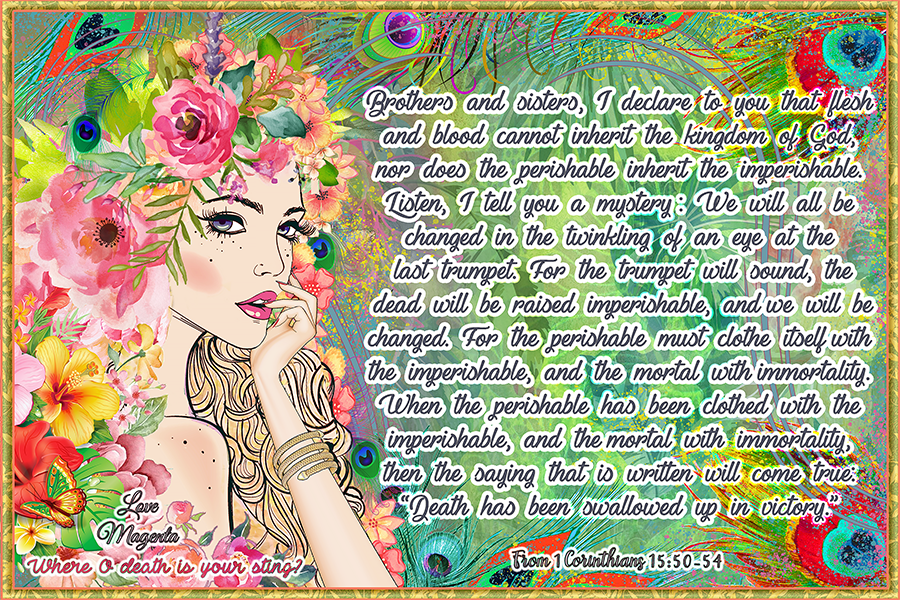
1 Corinthians ch 15 v 53–54 For the perishable must be clothed with the imperishable, and the mortal
with immortality. When the perishable has been clothed with the imperishable and the mortal with
immortality, then the saying that is written will come to pass: “Death has been swallowed up in victory.”


From1-Corinthians15-50-54s.png

From 1 Corinthians ch 15 v 50-54 Brothers and sisters, I declare to you that flesh and blood cannot inherit the kingdom of God, nor does the perishable inherit the imperishable. Listen, I tell you a mystery: We will all be changed in the twinkling of an eye at the last trumpet. For the trumpet will sound, the dead will be raised imperishable, and we will be changed. For the perishable must clothe itself with the imperishable, and the mortal with immortality. When the perishable has been clothed with the imperishable and the mortal with immortality, then the saying that is written will come to pass: “Death has been swallowed up in victory.”
 
  • Like
Reactions: Aaron56
We all will die once, some will die twice. Our bodies will die, but our soul remains alive somewhere, either with the Lord, or in the lake of fire, which is the second death.
Your statement contains a fundamental contradiction that requires explanation. You acknowledge that the wicked experience the second death, yet simultaneously claim their souls remain alive forever. What, then, actually dies the second time? Genesis 2:7 declares that man became a living soul when God imparted the breath of life; it does not describe an independently immortal soul inhabiting a disposable body. Ezekiel 18:4 explicitly states, "The soul who sins shall die." Furthermore, Matthew 10:28 declares that God can "destroy both soul and body in hell." If the soul is inherently indestructible, how can God destroy it? Romans 6:23 identifies death as sin's wages and eternal life as God's gift. You cannot simply assume that the soul survives eternally and then use that assumption to redefine the second death as everlasting conscious existence. Please demonstrate from Scripture what dies in the second death if, according to your interpretation, the person remains consciously alive forever.
 
Yes even if this be true, there is no support for the concept of "annihilation" "ad nihilum" in scripture.

I see no place in scripture where the term death means "ad nihilum"

It is quite ridiculous to equate the two. IMO

My post wasn't directed at anyone in particular.

Help me to understand your position: do you believe in eternal conscious torment or something else?
 
  • Like
Reactions: HeIsHere
You are still confusing consciousness and existence with life.
You continue repeating the same assertion without demonstrating it. Consciousness, existence, and life are distinguishable concepts, but that does not establish that a person can remain consciously aware forever while being dead. Job 32:8 declares, "But it is the spirit in a person, the breath of the Almighty, that gives them understanding." Scripture thus connects human understanding with God's impartation of spirit. Genesis 2:7 likewise describes Adam becoming a living soul when God imparted the breath of life. Romans 6:23 identifies death as sin's wages, while Revelation 20:14 identifies the final punishment as the second death. If the condemned continue thinking, feeling, understanding, and consciously suffering forever, what exactly dies in the second death? You have repeatedly insisted that consciousness is not life, but you have yet to demonstrate how everlasting conscious experience constitutes the cessation of life. Repeating a distinction is not the same as substantiating it.
 
  • Like
Reactions: Magenta