Eternal Hell Is a Logical Lie

  • Christian Chat is a moderated online Christian community allowing Christians around the world to fellowship with each other in real time chat via webcam, voice, and text, with the Christian Chat app. You can also start or participate in a Bible-based discussion here in the Christian Chat Forums, where members can also share with each other their own videos, pictures, or favorite Christian music.

    If you are a Christian and need encouragement and fellowship, we're here for you! If you are not a Christian but interested in knowing more about Jesus our Lord, you're also welcome! Want to know what the Bible says, and how you can apply it to your life? Join us!

    To make new Christian friends now around the world, click here to join Christian Chat.
You continue repeating the same assertion without demonstrating it. Consciousness, existence, and life are distinguishable concepts, but that does not establish that a person can remain consciously aware forever while being dead. Job 32:8 declares, "But it is the spirit in a person, the breath of the Almighty, that gives them understanding." Scripture thus connects human understanding with God's impartation of spirit. Genesis 2:7 likewise describes Adam becoming a living soul when God imparted the breath of life. Romans 6:23 identifies death as sin's wages, while Revelation 20:14 identifies the final punishment as the second death. If the condemned continue thinking, feeling, understanding, and consciously suffering forever, what exactly dies in the second death? You have repeatedly insisted that consciousness is not life, but you have yet to demonstrate how everlasting conscious experience constitutes the cessation of life. Repeating a distinction is not the same as substantiating it.
What dies in the second death? Their ability to experience God’s light, love, and mercy. The same thing that died in Adam and Eve when they sinned. It died the very day they ate the forbidden fruit. Humans need to be regenerated, born again, ever since.

Those who reject God will suffer torment endlessly, with no rest day or night, in the lake of fire. Being thrown into the lake of fire is the second death. But though it is called death, inhabitants will still be conscious in torment forever.

I believe the torment is the worm of their conscience accusing them of sins they never repented of and that were not atoned for by their believing in Christ.


Revelation 20:15

15 And whosoever was not found written in the book of life was cast into the lake of fire.


Revelation 20:13-15

And the sea gave up the dead which were in it, and death and Hades gave up the dead which were in them; and they were judged, every one of them according to their deeds. Then death and Hades were thrown into the lake of fire. This is the second death, the lake of fire. And if anyone’s name was not found written in the book of life, he was thrown into the lake of fire.


Revelation 21:8


But for the cowardly and unbelieving and abominable and murderers and immoral persons and sorcerers and idolaters and all liars, their part will be in the lake that burns with fire and brimstone, which is the second death.


Revelation 14

9 And the third angel followed them, saying with a loud voice, If any man worship the beast and his image, and receive his mark in his forehead, or in his hand,

10 The same shall drink of the wine of the wrath of God, which is poured out without mixture into the cup of his indignation; and he shall be tormented with fire and brimstone in the presence of the holy angels, and in the presence of the Lamb:

11 And the smoke of their torment ascendeth up for ever and ever: and they have no rest day nor night, who worship the beast and his image, and whosoever receiveth the mark of his name.
 
What dies in the second death? Their ability to experience God’s light, love, and mercy. The same thing that died in Adam and Eve when they sinned. It died the very day they ate the forbidden fruit. Humans need to be regenerated, born again, ever since.

Those who reject God will suffer torment endlessly, with no rest day or night, in the lake of fire. Being thrown into the lake of fire is the second death. But though it is called death, inhabitants will still be conscious in torment forever.

I believe the torment is the worm of their conscience accusing them of sins they never repented of and that were not atoned for by their believing in Christ.


Revelation 20:15

15 And whosoever was not found written in the book of life was cast into the lake of fire.


Revelation 20:13-15

And the sea gave up the dead which were in it, and death and Hades gave up the dead which were in them; and they were judged, every one of them according to their deeds. Then death and Hades were thrown into the lake of fire. This is the second death, the lake of fire. And if anyone’s name was not found written in the book of life, he was thrown into the lake of fire.


Revelation 21:8


But for the cowardly and unbelieving and abominable and murderers and immoral persons and sorcerers and idolaters and all liars, their part will be in the lake that burns with fire and brimstone, which is the second death.


Revelation 14

9 And the third angel followed them, saying with a loud voice, If any man worship the beast and his image, and receive his mark in his forehead, or in his hand,

10 The same shall drink of the wine of the wrath of God, which is poured out without mixture into the cup of his indignation; and he shall be tormented with fire and brimstone in the presence of the holy angels, and in the presence of the Lamb:

11 And the smoke of their torment ascendeth up for ever and ever: and they have no rest day nor night, who worship the beast and his image, and whosoever receiveth the mark of his name.
I appreciate that you have finally attempted to explain what you believe dies in the second death. However, you have supplied a definition that Revelation itself does not provide, and then treated that definition as though Scripture established it. Let us examine your explanation.

You claim that the second death means losing the ability to experience God's light, love, and mercy while remaining consciously alive forever. Where does Revelation 20:14 or 21:8 define the second death that way? Neither passage says that consciousness survives while access to divine blessings dies. They explicitly identify the lake of fire as the second death. You are entitled to propose a figurative interpretation, but you must substantiate it rather than simply announce it.

You then appeal to Adam and Eve, claiming they died spiritually on the day they sinned. Certainly, sin disrupted their relationship with God. But Genesis 3:19 explicitly declares, "For dust you are and to dust you will return." Genesis 3:22–24 then records God preventing them from accessing the tree of life and living forever. Why would God prevent fallen humanity from living forever if everlasting conscious existence were already an unavoidable human condition? Your interpretation addresses spiritual alienation while overlooking the mortality explicitly introduced into the narrative.

Furthermore, you suggest that the undying worm represents the conscience endlessly accusing sinners. Where does Scripture identify that worm as human conscience? Mark 9:48 draws directly from Isaiah 66:24, which explicitly describes worms consuming the dead bodies of those who rebelled against God. The objects of judgment are corpses, not immortal consciousnesses. Reinterpreting the worm as psychological torment requires evidence that neither passage supplies.

Finally, you quote Revelation 14:11 concerning smoke ascending forever and the absence of rest. I have already addressed this through Isaiah 34:9–10, where similarly everlasting smoke describes Edom's judgment. The language of torment is serious, but the permanence of judgment does not, by itself, establish the perpetual conscious survival of every individual judged. Revelation 20:13–15 identifies the final event as the second death, while Romans 6:23 contrasts death with eternal life as God's gift.

Your explanation therefore leaves my original question unanswered in its essential form: What biblical text establishes that the second death means only the loss of divine fellowship while the person continues consciously existing forever?

You have asserted that the wicked remain conscious, interpreted death as separation, and identified the worm as conscience. But none of those three propositions is explicitly established by the passages you supplied.

I am not asking you to repeat that the lake of fire is the second death. We agree that Scripture says so. I am asking you to demonstrate why the word "death" in that declaration must mean endless conscious life deprived of God's blessings rather than the final destruction described in Matthew 10:28, Malachi 4:1–3, and 2 Thessalonians 1:9.

A theological definition is not proved merely because you attach it to a biblical term. The connection itself must be demonstrated.
 
Good to see you and hope you and your family are well, and Greece is beautiful indeed.😊

Regarding Romans 2:5-11,
I agree that it belongs in the discussion because Paul explicitly speaks of God rendering:
"to every man according to his deeds" (Rom. 2:6).
The passage certainly establishes judgment according to works and demonstrates that God's judgment is perfectly just and impartial.

Where I would hesitate is the next step.
Romans 2 teaches proportional judgment, but it does not explicitly state that souls are punished for a period and then annihilated. That conclusion still has to be derived from other passages.

That said, I think your distinction between eternal punishment and eternal punishing is a legitimate exegetical argument.
The text of Matthew 25:46 does not explicitly say the act of punishing continues forever.
Likewise, texts such as Romans 6:23, John 3:16, Matthew 10:28, 2 Thessalonians 1:9, Revelation 20:14, and Revelation 21:8 repeatedly describe the fate of the wicked as death, destruction, perishing, and the second death.

So I would frame the question this way: If the wicked are consciously tormented forever, why does Scripture so consistently describe their final fate as death and destruction?
And conversely: If the wicked are ultimately destroyed, how should Revelation 14:11 and Revelation 20:10 be understood?

Those remain, in my view, the strongest texts that both sides must honestly address without explaining away either set of passages.
I realize you have difficulty understanding implication, but proportional judgment in Rom. 2:5-11 logically indicates that souls are punished for a period and then annihilated, so no other passages are needed for that conclusion, but I am glad you are aware of Romans 6:23, John 3:16, Matthew 10:28, 2 Thessalonians 1:9, Revelation 20:14, and Revelation 21:8. To these we also need to add
John 17:12, Rom. 9:22, Gal. 6:8, Phil. 3:19, 2Thes. 1:9, 2Pet. 3:7 & Rev. 20:13-14, which teach that unforgiven souls are destroyed.

Regarding Rev. 14:11: In Rev. 14:1-13 John saw the Lamb on Mount Zion (cf. Psa. 2:6-7, Matt. 21:5, John 12:15, Rom. 9:33, 11:26, Heb. 12:22, 1Pet. 2:6) with 144,000 disciples (Israelites per Rev. 7:4-8, cf. Rom. 11:5), and he heard a loud sound from heaven like that of harpists (Rev. 5:8), who sang a new song (Rev. 5:8-9, Psa. 98:5, 96:1, 40:3, 149:1) before the throne that only the redeemed could learn. John described the redeemed as those who were sexually pure or were not adulterers (Rev. 14:8, 2:14&20-22), the firstfruits (Rom. 8:23, 1Cor. 15:23) of those who followed the Lamb (Matt. 9:9, 10:38, 16:24) and as those who never lied (Zeph. 3:12-13, cf. Rom. 1:22-25, Eph. 4:24-27).

Then John saw an angel flying to every nation on earth with the eternal gospel (Mark 1:14-15, Matt. 24:14, Rom. 10:15-18) and urging people to glorify God the Creator at this hour of final judgment (Heb. 9:26-28). A second angel announced the fall of Babylon the Great, which had made all nations mad with the wine of adultery. It is not clear whether this refers to Jerusalem or to Rome or is symbolic of worldwide anti-Christian atheism.

A third angel warned that anyone who worshipped the beast and received his mark (Rev. 13:8&16) would drink the wine of God’s wrath (Rev. 6:16, 19:15, Isa. 51:17, Jer. 25:15, Ezek. 20:18, Zeph. 1:15, Rom. 1:18) and be tormented forever with no rest (Matt. 11:28-30, 25:46). Enduring persecution calls for persevering faith in Jesus and obeying God’s commandments (Matt. 10:22, 24:45-51, Jam. 5:7-9). Then John was told to write: Blessed are those who die in the Lord, for they will rest from their labor and reap reward for their deeds (cf. Matt. 5:10-12, Rom. 2:5-13, Heb. 4:9-11).

I choose to believe Rom. 2:5-11 re proportionality/karma, because eternal punishment would only be warranted/just if a person's sins were infinite, which no finite mortal is capable of, although a few probably deserve a few eons., with Satan reaping the longest misery.
 
I appreciate that you have finally attempted to explain what you believe dies in the second death. However, you have supplied a definition that Revelation itself does not provide, and then treated that definition as though Scripture established it. Let us examine your explanation.

You claim that the second death means losing the ability to experience God's light, love, and mercy while remaining consciously alive forever. Where does Revelation 20:14 or 21:8 define the second death that way? Neither passage says that consciousness survives while access to divine blessings dies. They explicitly identify the lake of fire as the second death. You are entitled to propose a figurative interpretation, but you must substantiate it rather than simply announce it.

You then appeal to Adam and Eve, claiming they died spiritually on the day they sinned. Certainly, sin disrupted their relationship with God. But Genesis 3:19 explicitly declares, "For dust you are and to dust you will return." Genesis 3:22–24 then records God preventing them from accessing the tree of life and living forever. Why would God prevent fallen humanity from living forever if everlasting conscious existence were already an unavoidable human condition? Your interpretation addresses spiritual alienation while overlooking the mortality explicitly introduced into the narrative.

Furthermore, you suggest that the undying worm represents the conscience endlessly accusing sinners. Where does Scripture identify that worm as human conscience? Mark 9:48 draws directly from Isaiah 66:24, which explicitly describes worms consuming the dead bodies of those who rebelled against God. The objects of judgment are corpses, not immortal consciousnesses. Reinterpreting the worm as psychological torment requires evidence that neither passage supplies.

Finally, you quote Revelation 14:11 concerning smoke ascending forever and the absence of rest. I have already addressed this through Isaiah 34:9–10, where similarly everlasting smoke describes Edom's judgment. The language of torment is serious, but the permanence of judgment does not, by itself, establish the perpetual conscious survival of every individual judged. Revelation 20:13–15 identifies the final event as the second death, while Romans 6:23 contrasts death with eternal life as God's gift.

Your explanation therefore leaves my original question unanswered in its essential form: What biblical text establishes that the second death means only the loss of divine fellowship while the person continues consciously existing forever?

You have asserted that the wicked remain conscious, interpreted death as separation, and identified the worm as conscience. But none of those three propositions is explicitly established by the passages you supplied.

I am not asking you to repeat that the lake of fire is the second death. We agree that Scripture says so. I am asking you to demonstrate why the word "death" in that declaration must mean endless conscious life deprived of God's blessings rather than the final destruction described in Matthew 10:28, Malachi 4:1–3, and 2 Thessalonians 1:9.

A theological definition is not proved merely because you attach it to a biblical term. The connection itself must be demonstrated.
Virtually every paragraph is polished to the same academic level.
Most forum posters naturally fluctuate between short, sharp remarks and longer explanations.
This piece maintains a remarkably consistent style from beginning to end.
That often happens when, AI writes the draft.
I asked you use your own words, but you insist that you are. Yet to those of us that know better its obvious.
Having an AI preach for you is a bad idea.
When you learn to speak for yourself I will be back.
Till then, good day.
 
I realize you have difficulty understanding implication, but proportional judgment in Rom. 2:5-11 logically indicates that souls are punished for a period and then annihilated, so no other passages are needed for that conclusion, but I am glad you are aware of Romans 6:23, John 3:16, Matthew 10:28, 2 Thessalonians 1:9, Revelation 20:14, and Revelation 21:8. To these we also need to add
John 17:12, Rom. 9:22, Gal. 6:8, Phil. 3:19, 2Thes. 1:9, 2Pet. 3:7 & Rev. 20:13-14, which teach that unforgiven souls are destroyed.

Regarding Rev. 14:11: In Rev. 14:1-13 John saw the Lamb on Mount Zion (cf. Psa. 2:6-7, Matt. 21:5, John 12:15, Rom. 9:33, 11:26, Heb. 12:22, 1Pet. 2:6) with 144,000 disciples (Israelites per Rev. 7:4-8, cf. Rom. 11:5), and he heard a loud sound from heaven like that of harpists (Rev. 5:8), who sang a new song (Rev. 5:8-9, Psa. 98:5, 96:1, 40:3, 149:1) before the throne that only the redeemed could learn. John described the redeemed as those who were sexually pure or were not adulterers (Rev. 14:8, 2:14&20-22), the firstfruits (Rom. 8:23, 1Cor. 15:23) of those who followed the Lamb (Matt. 9:9, 10:38, 16:24) and as those who never lied (Zeph. 3:12-13, cf. Rom. 1:22-25, Eph. 4:24-27).

Then John saw an angel flying to every nation on earth with the eternal gospel (Mark 1:14-15, Matt. 24:14, Rom. 10:15-18) and urging people to glorify God the Creator at this hour of final judgment (Heb. 9:26-28). A second angel announced the fall of Babylon the Great, which had made all nations mad with the wine of adultery. It is not clear whether this refers to Jerusalem or to Rome or is symbolic of worldwide anti-Christian atheism.

A third angel warned that anyone who worshipped the beast and received his mark (Rev. 13:8&16) would drink the wine of God’s wrath (Rev. 6:16, 19:15, Isa. 51:17, Jer. 25:15, Ezek. 20:18, Zeph. 1:15, Rom. 1:18) and be tormented forever with no rest (Matt. 11:28-30, 25:46). Enduring persecution calls for persevering faith in Jesus and obeying God’s commandments (Matt. 10:22, 24:45-51, Jam. 5:7-9). Then John was told to write: Blessed are those who die in the Lord, for they will rest from their labor and reap reward for their deeds (cf. Matt. 5:10-12, Rom. 2:5-13, Heb. 4:9-11).

I choose to believe Rom. 2:5-11 re proportionality/karma, because eternal punishment would only be warranted/just if a person's sins were infinite, which no finite mortal is capable of, although a few probably deserve a few eons., with Satan reaping the longest misery.
Your personal attacks on my understanding says much about you.
Your position is not merely "Scripture alone."
It is Conditional Immortality combined with a proportional-justice model of final judgment.
Romans 2 plainly teaches judgment according to deeds.
What it does not explicitly teach is the duration of punishment prior to destruction.
That conclusion comes from combining Romans 2 with your broader annihilationist framework and your understanding of divine justice.
Whether that framework is correct is the very point under debate.
 
Your personal attacks on my understanding says much about you.
Your position is not merely "Scripture alone."
It is Conditional Immortality combined with a proportional-justice model of final judgment.
Romans 2 plainly teaches judgment according to deeds.
What it does not explicitly teach is the duration of punishment prior to destruction.
That conclusion comes from combining Romans 2 with your broader annihilationist framework and your understanding of divine justice.
Whether that framework is correct is the very point under debate.

I made no personal attack but merely noted your difficulty with implication,
which you illustrated again by saying "What it does not explicitly teach is the duration of punishment prior to destruction",
again demonstrating demeaning logical implication in language.
You would do well to expand your exegetical framework by including the ability to discern what is implied as well as
what is specified in texts.
How do you say "happy trails" in Greek?
:love:
 
I made no personal attack but merely noted your difficulty with implication,
which you illustrated again by saying "What it does not explicitly teach is the duration of punishment prior to destruction",
again demonstrating demeaning logical implication in language.
You would do well to expand your exegetical framework by including the ability to discern what is implied as well as
what is specified in texts.
How do you say "happy trails" in Greek?
:love:
Καλό ταξίδι!
 
Virtually every paragraph is polished to the same academic level.
Most forum posters naturally fluctuate between short, sharp remarks and longer explanations.
This piece maintains a remarkably consistent style from beginning to end.
That often happens when, AI writes the draft.
I asked you use your own words, but you insist that you are. Yet to those of us that know better its obvious.
Having an AI preach for you is a bad idea.
When you learn to speak for yourself I will be back.
Till then, good day.
My apologies if the precision, clarity, and consistency of my arguments are proving somewhat inconvenient. I take God, His Word, and the responsibility of discussing Scripture extremely seriously, and that seriousness is reflected in how I construct and present my responses. I do not believe biblical discussions deserve careless assertions, unsupported conclusions, or interpretations that cannot withstand examination. If my reasoning is precise, it is because I believe the subject deserves nothing less. I make no apologies for examining Scripture thoroughly, distinguishing what it says from what people assume it means, and expecting the same intellectual responsibility from those who challenge my conclusions. You are welcome to disagree with me, but the appropriate response to a well-reasoned argument is a better argument, not discomfort with its precision. If you can't keep up with me its okay
 
My apologies if the precision, clarity, and consistency of my arguments are proving somewhat inconvenient. I take God, His Word, and the responsibility of discussing Scripture extremely seriously, and that seriousness is reflected in how I construct and present my responses. I do not believe biblical discussions deserve careless assertions, unsupported conclusions, or interpretations that cannot withstand examination. If my reasoning is precise, it is because I believe the subject deserves nothing less. I make no apologies for examining Scripture thoroughly, distinguishing what it says from what people assume it means, and expecting the same intellectual responsibility from those who challenge my conclusions. You are welcome to disagree with me, but the appropriate response to a well-reasoned argument is a better argument, not discomfort with its precision. If you can't keep up with me its okay
Thats not the problem. But nice way of deflecting.
 
  • Like
Reactions: Anchorite
Καλό ταξίδι!

Okay, Καλό ταξίδι until we meet again, hopefully after you mull over the importance of discerning implication in texts/language.
Was that logic/ability not taught at ATS? (Not at SWBTS either, which is why I view it as divinely given to me.)
 
Thats not the problem. But nice way of deflecting.
Then by all means, identify what the problem actually is. You have declared that I am deflecting without identifying the question I supposedly avoided, the argument I failed to address, or the evidence I neglected. Calling something a deflection does not make it one; you must demonstrate what I am deflecting from. I am perfectly willing to address a substantive objection, but I cannot rebut an objection you have not articulated. If there is an error in my reasoning, identify it and substantiate it. Otherwise, you are not exposing a flaw in my argument; you are merely expressing dissatisfaction with it.
 
Then by all means, identify what the problem actually is. You have declared that I am deflecting without identifying the question I supposedly avoided, the argument I failed to address, or the evidence I neglected. Calling something a deflection does not make it one; you must demonstrate what I am deflecting from. I am perfectly willing to address a substantive objection, but I cannot rebut an objection you have not articulated. If there is an error in my reasoning, identify it and substantiate it. Otherwise, you are not exposing a flaw in my argument; you are merely expressing dissatisfaction with it.
Post #68
Virtually every paragraph is polished to the same academic level.
Most forum posters naturally fluctuate between short, sharp remarks and longer explanations.
This piece maintains a remarkably consistent style from beginning to end.
That often happens when, AI writes the draft.
I asked you use your own words, but you insist that you are. Yet to those of us that know better its obvious.
Having an AI preach for you is a bad idea.
When you learn to speak for yourself I will be back.
Till then, good day.

Answer for yourself, I told you, I am not interested in debating your AI.
 
  • Like
Reactions: Anchorite
Eternal conscious torment?; Leaving out pertinent Scriptures?:

The preface to That Biblical Doctrine can be seen in Luke 16:19-31 AV.

Since there are degrees of punishment, then annihilation (the same degree for all )
does not make logical sense, now does it?

Thus, we have to have Christ's Precious DEATH Brought Into The Equation, Correct:

"Of How Much Sorer Punishment, suppose ye, shall he be thought worthy, who​
hath trodden underfoot The SON of God, and hath counted The BLOOD of the​
covenant, wherewith he was sanctified, an unholy thing, and hath done despite​
unto the Spirit of Grace?" (Hebrews 10:29 AV)​
​
compare: ​
​
"Woe unto you, scribes and Pharisees, hypocrites! for ye devour widows’ ​
houses, and for a pretence make long prayer: therefore ye shall receive ​
The Greater damnation." (Matthew 23:14 AV) ​
​
Leaving God's Undiluted Wrath out of the equation brings little Conviction , eh?​
Once that is accomplished, then we can preach the Gospel ( Good News ) of​
Undiluted Grace Correct?:​
​
The Three Tenses Of God's Eternal Salvation! = Undiluted Grace, Peace, Mercy, And Love!
 
Post #68
Virtually every paragraph is polished to the same academic level.
Most forum posters naturally fluctuate between short, sharp remarks and longer explanations.
This piece maintains a remarkably consistent style from beginning to end.
That often happens when, AI writes the draft.
I asked you use your own words, but you insist that you are. Yet to those of us that know better its obvious.
Having an AI preach for you is a bad idea.
When you learn to speak for yourself I will be back.
Till then, good day.

Answer for yourself, I told you, I am not interested in debating your AI.
Let me address you. Your response is quite remarkable. You have somehow convinced yourself that consistently articulate, structured, and precise writing constitutes proof of AI authorship. Since when did intellectual consistency become suspicious? Is your argument genuinely that because someone maintains a particular standard of expression throughout a discussion, they cannot possibly be responsible for their own words? Your inability to conceive of someone communicating differently from your expectations is not evidence against their authorship. It merely exposes the limitations of your reasoning. And declaring that “those of us that know better” can recognize AI is particularly amusing when you have provided absolutely nothing beyond your personal impressions.

You seem to be confusing your certainty with proof, and your suspicions with established facts. You have made an accusation, repeated it, declared it obvious, and apparently decided that repetition removes your obligation to substantiate it. It does not. If you possess evidence, produce it. Otherwise, stop presenting your assumptions as facts. You have devoted considerable energy to questioning the authorship of my responses while failing to demonstrate how those suspicions invalidate their substance. That is not a rebuttal; it is a change of subject.

As for your rather theatrical announcement that you will return when I “learn to speak for myself,” you appear to have forgotten something rather important: you approached me. You voluntarily entered a discussion I initiated through my own post. I did not invite you personally, summon you, or request an assessment of my writing abilities. If you have decided that you no longer wish to engage with me or the imaginary AI author you have constructed in your mind, you are entirely free to leave. You do not need to announce your departure as though your participation were a privilege I had been desperately trying to retain. You can simply close the discussion and continue living your life, exactly as you were doing before deciding to respond to me.

Finally, I will not assume responsibility for disproving an accusation you have failed to establish. The burden belongs to the person making the claim. Your repeated declarations of what is “obvious” do not constitute evidence, your supposed expertise does not exempt you from demonstrating your conclusions, and your refusal to continue does not establish that you were correct. You entered a biblical discussion, redirected it toward speculation about authorship, and are now announcing your exit without having demonstrated the accusation you repeatedly made. That sequence speaks for itself. Good day.
 
  • Like
Reactions: GRACE_ambassador
Let me address you. Your response is quite remarkable. You have somehow convinced yourself that consistently articulate, structured, and precise writing constitutes proof of AI authorship. Since when did intellectual consistency become suspicious? Is your argument genuinely that because someone maintains a particular standard of expression throughout a discussion, they cannot possibly be responsible for their own words? Your inability to conceive of someone communicating differently from your expectations is not evidence against their authorship. It merely exposes the limitations of your reasoning. And declaring that “those of us that know better” can recognize AI is particularly amusing when you have provided absolutely nothing beyond your personal impressions.

You seem to be confusing your certainty with proof, and your suspicions with established facts. You have made an accusation, repeated it, declared it obvious, and apparently decided that repetition removes your obligation to substantiate it. It does not. If you possess evidence, produce it. Otherwise, stop presenting your assumptions as facts. You have devoted considerable energy to questioning the authorship of my responses while failing to demonstrate how those suspicions invalidate their substance. That is not a rebuttal; it is a change of subject.

As for your rather theatrical announcement that you will return when I “learn to speak for myself,” you appear to have forgotten something rather important: you approached me. You voluntarily entered a discussion I initiated through my own post. I did not invite you personally, summon you, or request an assessment of my writing abilities. If you have decided that you no longer wish to engage with me or the imaginary AI author you have constructed in your mind, you are entirely free to leave. You do not need to announce your departure as though your participation were a privilege I had been desperately trying to retain. You can simply close the discussion and continue living your life, exactly as you were doing before deciding to respond to me.

Finally, I will not assume responsibility for disproving an accusation you have failed to establish. The burden belongs to the person making the claim. Your repeated declarations of what is “obvious” do not constitute evidence, your supposed expertise does not exempt you from demonstrating your conclusions, and your refusal to continue does not establish that you were correct. You entered a biblical discussion, redirected it toward speculation about authorship, and are now announcing your exit without having demonstrated the accusation you repeatedly made. That sequence speaks for itself. Good day.

If you truly wrote that response yourself, then my concern was never about intelligence or capability.
My observation was about style.
An AI-assisted post and a highly edited human post often share similar characteristics.
It's very dry and lacks the human element that makes conversations engaging.
I may have been mistaken. If so, then I freely acknowledge that possibility.
But you sound very robotic and even I, A teacher have a hard time with it as it feels like reading a textbook and no one speaks like that. Not even the highly educated.
If I was wrong about AI involvement, then I was wrong. That question is not important enough for me to spend further time debating.
Therefore, I'll gladly withdraw the authorship question entirely.
And just say when I feel the need to read a book, I will come visit.
 
Yeah lots of people are going to be shocked when they get to hell to find out it's actually real and they will be spending eternity being tormented there.
 
  • Like
Reactions: Caan
You continue repeating the same assertion without demonstrating it. Consciousness, existence, and life are distinguishable concepts, but that does not establish that a person can remain consciously aware forever while being dead. Job 32:8 declares, "But it is the spirit in a person, the breath of the Almighty, that gives them understanding." Scripture thus connects human understanding with God's impartation of spirit. Genesis 2:7 likewise describes Adam becoming a living soul when God imparted the breath of life. Romans 6:23 identifies death as sin's wages, while Revelation 20:14 identifies the final punishment as the second death. If the condemned continue thinking, feeling, understanding, and consciously suffering forever, what exactly dies in the second death? You have repeatedly insisted that consciousness is not life, but you have yet to demonstrate how everlasting conscious experience constitutes the cessation of life. Repeating a distinction is not the same as substantiating it.
Since we agree that consciousness, existence, and life are distinguishable concepts; then let us do the math. If we have existence, consciousness and life, and then lose our life in death; we are then left with consciousness and existence without life.
 
Ah! You are one of those who believe man is eternal apart from Christ even though Scriptures say otherwise.

God alone dwells in immortality. Believers put on immortality through faith in Christ's death and resurrection.

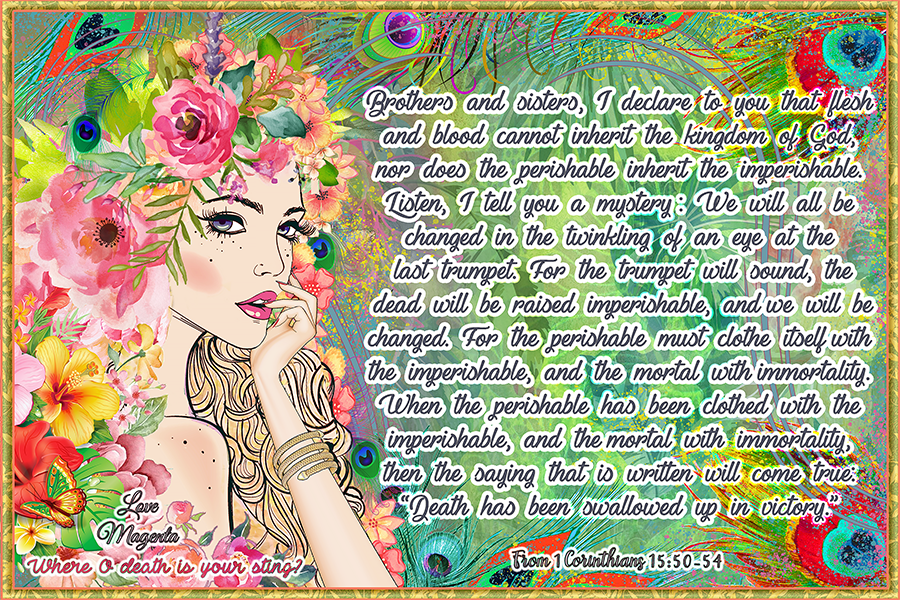
1 Corinthians ch 15 v 53–54 For the perishable must be clothed with the imperishable, and the mortal
with immortality. When the perishable has been clothed with the imperishable and the mortal with
immortality, then the saying that is written will come to pass: “Death has been swallowed up in victory.”


From1-Corinthians15-50-54s.png

From 1 Corinthians ch 15 v 50-54 Brothers and sisters, I declare to you that flesh and blood cannot inherit the kingdom of God, nor does the perishable inherit the imperishable. Listen, I tell you a mystery: We will all be changed in the twinkling of an eye at the last trumpet. For the trumpet will sound, the dead will be raised imperishable, and we will be changed. For the perishable must clothe itself with the imperishable, and the mortal with immortality. When the perishable has been clothed with the imperishable and the mortal with immortality, then the saying that is written will come to pass: “Death has been swallowed up in victory.”
Revelation 14
9 And the third angel followed them, saying with a loud voice, If any man worship the beast and his image, and receive his mark in his forehead, or in his hand,
10 The same shall drink of the wine of the wrath of God, which is poured out without mixture into the cup of his indignation; and he shall be tormented with fire and brimstone in the presence of the holy angels, and in the presence of the Lamb:
11 And the smoke of their torment ascendeth up for ever and ever: and they have no rest day nor night, who worship the beast and his image, and whosoever receiveth the mark of his name.
 
  • Like
Reactions: GRACE_ambassador
Your statement contains a fundamental contradiction that requires explanation. You acknowledge that the wicked experience the second death, yet simultaneously claim their souls remain alive forever. What, then, actually dies the second time? Genesis 2:7 declares that man became a living soul when God imparted the breath of life; it does not describe an independently immortal soul inhabiting a disposable body. Ezekiel 18:4 explicitly states, "The soul who sins shall die." Furthermore, Matthew 10:28 declares that God can "destroy both soul and body in hell." If the soul is inherently indestructible, how can God destroy it? Romans 6:23 identifies death as sin's wages and eternal life as God's gift. You cannot simply assume that the soul survives eternally and then use that assumption to redefine the second death as everlasting conscious existence. Please demonstrate from Scripture what dies in the second death if, according to your interpretation, the person remains consciously alive forever.
Man is a tripart being: body, soul, and spirit.
 
No Rapture for you then.
Ha ha, it is appointed for man once to die...that is not a declarative statement of will. Obviously, those caught up to be with the Lord will not die. There are men and women in the bible that were resurrected only to die again.