Acts 2:38-39 Desperately seeking an accurate translation?

  • Christian Chat is a moderated online Christian community allowing Christians around the world to fellowship with each other in real time chat via webcam, voice, and text, with the Christian Chat app. You can also start or participate in a Bible-based discussion here in the Christian Chat Forums, where members can also share with each other their own videos, pictures, or favorite Christian music.

    If you are a Christian and need encouragement and fellowship, we're here for you! If you are not a Christian but interested in knowing more about Jesus our Lord, you're also welcome! Want to know what the Bible says, and how you can apply it to your life? Join us!

    To make new Christian friends now around the world, click here to join Christian Chat.

Dave123

Active member
Jun 17, 2026
352
214
43
It's my belief that many of what I would call 50/50 passages, that is, passages used by some to claim that water baptism in combination with faith are required for salvation, can linguistically, equally, be translated two different ways. Acts 2:38-39 for one. The word "eis" can mean "for," "unto," or "in regard to". The grammar allows for multiple angles. So, that means that while water baptism is connected to the moment, because people in that time usually were water baptized the moment that they came to faith, it also means that linguistically, it is not necessary to claim that those verses say that water baptism is part of the the cause of receiving the Spirit. It was part of the moment, but not part of the cause, and not necessarily the correct order in which it was translated.

But, I'm not even going to bother getting into the Greek. Lets just look at the English and use sound minds, shall we? While I'll will give a few examples, this does not by any means represent the whole of Scripture that can be used to defend my stance. In fact, the Gospel message itself, everywhere in Scripture says, believe and be saved. I'll use the NKJV.

Acts 2:38-39 Then Peter said to them, "Repent, and let every one of you be baptized in the name of Jesus Christ for the remission of sins; and you shall receive the gift of the Holy Spirit. For the promise is to you and to your children, and to all who are afar off, as many as the Lord our God will call."

If we cling to the order in Acts 2:38-39, note that here, in Acts 10, Peter uses the exact opposite order as he did in Acts 2:38-39. He also stresses that this is the same way he received the Holy Spirit (order implied) and was saved.

Acts 10:44-48 While Peter was still speaking these words, the Holy Spirit fell upon all those who heard the word. And those of the circumcision who believed were astonished, as many as came with Peter, because the gift of the Holy Spirit had been poured out on the Gentiles also. For they heard them speak with tongues and magnify God. Then Peter answered, "Can anyone forbid water, that these should not be baptized who have received the Holy Spirit just as we have?" And he commanded them to be baptized in the name of the Lord. Then they asked him to stay a few days.

Nothing of water baptism is even mentioned in Acts 11:15-17.

Acts 11:15-17 And as I began to speak, the Holy Spirit fell upon them, as upon us at the beginning. Then I remembered the word of the Lord, how He said, 'John indeed baptized with water, but you shall be baptized with the Holy Spirit.' If therefore God gave them the same gift as He gave us when we believed on the Lord Jesus Christ, who was I that I could withstand God?"

Even in this unique transitional period, these true OT believers in Acts 19 who missed the whole thing. Jesus, came in the flesh, died on the cross, rose on the third day, and later ascended, and these OT believers missed it all. Their understanding ending with John the Baptist. Understanding that, we see the significance of the dialog between them and Paul here in Acts 19. Also notice that John s baptism is not contrasted with being baptized in the name of Jesus, it's contrasted with the baptism that saves. A baptism by faith. The baptism with the Holy Spirit. The answer is right there in the passage. Can you see it?

Acts 19:1-6 And it happened, while Apollos was at Corinth, that Paul, having passed through the upper regions, came to Ephesus. And finding some disciples he said to them, "Did you receive the Holy Spirit when you believed?" So they said to him, "We have not so much as heard whether there is a Holy Spirit." And he said to them, "Into what then were you baptized?" So they said, "Into John's baptism." Then Paul said, "John indeed baptized with a baptism of repentance, saying to the people that they should believe on Him who would come after him, that is, on Christ Jesus." When they heard this, they were baptized in the name of the Lord Jesus. And when Paul had laid hands on them, the Holy Spirit came upon them, and they spoke with tongues and prophesied.

Here's more from the Book of Acts that say the same.

Acts 16:30-31 And he brought them out and said, "Sirs, what must I do to be saved?" So they said, "Believe on the Lord Jesus Christ, and you will be saved, you and your household."

Acts 13:39 and by Him everyone who believes is justified from all things from which you could not be justified by the law of Moses.

Acts 10:43 To Him all the prophets witness that, through His name, whoever believes in Him will receive remission of sins."

Given the rest of the Bible, even the Gospel message itself, believe and be saved, it seems unnecessary to rewrite the entire Bible for a few passages that can equally be translated as water baptism not being part of the cause of salvation, but the result of it. Especially in a unique and unrepeatable time.

Even in the Gospels, these 'proof passages' that are used are prove the idea that water baptism saves are intentionally interpreted as half truths. Remember, water baptism and belief went hand in hand at that time. BUT, that does not mean that the power unto salvation comes from both, water baptism and believing. It's the Spirit baptism that saves, not water. Water baptism points, Spirit baptism saves. Why? Because it is the Spirit baptism that places us into Christ (1 Corinthians 12:13). That baptism is from the receiving of the indwelling of the Holy Spirit. Believe and be saved, that's the Gospel. The indwelling of the Holy Spirit (Spirit baptism) places us into Christ, the One True Church. Water baptism places us into water, as a symbolic testimony of the the spiritual placing into that came as a result of the Spirit indwelling. That which is born of Spirit is spirit, and that which is born of flesh is flesh. There is a clear reason why water baptism is absent from the one condemned in Mark 16:16. Water baptism is not the cause, and never was. This is just another instance where water baptism is connected with the moment, but not the cause of salvation.

Mark 16:16 He who believes and is baptized will be saved; but he who does not believe will be condemned.

See Ephesians 1:13, Romans 10:9-10, John 3:16, 5:24, 6:47.

1 Corinthians 1:14-17 I thank God that I baptized none of you except Crispus and Gaius, lest anyone should say that I had baptized in my own name. Yes, I also baptized the household of Stephanas. Besides, I do not know whether I baptized any other. For Christ did not send me to baptize, but to preach the gospel, not with wisdom of words, lest the cross of Christ should be made of no effect.
 
  • Like
Reactions: wattie
It's my belief that many of what I would call 50/50 passages, that is, passages used by some to claim that water baptism in combination with faith are required for salvation, can linguistically, equally, be translated two different ways. Acts 2:38-39 for one. The word "eis" can mean "for," "unto," or "in regard to". The grammar allows for multiple angles. So, that means that while water baptism is connected to the moment, because people in that time usually were water baptized the moment that they came to faith, it also means that linguistically, it is not necessary to claim that those verses say that water baptism is part of the the cause of receiving the Spirit. It was part of the moment, but not part of the cause, and not necessarily the correct order in which it was translated.

But, I'm not even going to bother getting into the Greek. Lets just look at the English and use sound minds, shall we? While I'll will give a few examples, this does not by any means represent the whole of Scripture that can be used to defend my stance. In fact, the Gospel message itself, everywhere in Scripture says, believe and be saved. I'll use the NKJV.

Acts 2:38-39 Then Peter said to them, "Repent, and let every one of you be baptized in the name of Jesus Christ for the remission of sins; and you shall receive the gift of the Holy Spirit. For the promise is to you and to your children, and to all who are afar off, as many as the Lord our God will call."

If we cling to the order in Acts 2:38-39, note that here, in Acts 10, Peter uses the exact opposite order as he did in Acts 2:38-39. He also stresses that this is the same way he received the Holy Spirit (order implied) and was saved.

Acts 10:44-48 While Peter was still speaking these words, the Holy Spirit fell upon all those who heard the word. And those of the circumcision who believed were astonished, as many as came with Peter, because the gift of the Holy Spirit had been poured out on the Gentiles also. For they heard them speak with tongues and magnify God. Then Peter answered, "Can anyone forbid water, that these should not be baptized who have received the Holy Spirit just as we have?" And he commanded them to be baptized in the name of the Lord. Then they asked him to stay a few days.

Nothing of water baptism is even mentioned in Acts 11:15-17.

Acts 11:15-17 And as I began to speak, the Holy Spirit fell upon them, as upon us at the beginning. Then I remembered the word of the Lord, how He said, 'John indeed baptized with water, but you shall be baptized with the Holy Spirit.' If therefore God gave them the same gift as He gave us when we believed on the Lord Jesus Christ, who was I that I could withstand God?"

Even in this unique transitional period, these true OT believers in Acts 19 who missed the whole thing. Jesus, came in the flesh, died on the cross, rose on the third day, and later ascended, and these OT believers missed it all. Their understanding ending with John the Baptist. Understanding that, we see the significance of the dialog between them and Paul here in Acts 19. Also notice that John s baptism is not contrasted with being baptized in the name of Jesus, it's contrasted with the baptism that saves. A baptism by faith. The baptism with the Holy Spirit. The answer is right there in the passage. Can you see it?

Acts 19:1-6 And it happened, while Apollos was at Corinth, that Paul, having passed through the upper regions, came to Ephesus. And finding some disciples he said to them, "Did you receive the Holy Spirit when you believed?" So they said to him, "We have not so much as heard whether there is a Holy Spirit." And he said to them, "Into what then were you baptized?" So they said, "Into John's baptism." Then Paul said, "John indeed baptized with a baptism of repentance, saying to the people that they should believe on Him who would come after him, that is, on Christ Jesus." When they heard this, they were baptized in the name of the Lord Jesus. And when Paul had laid hands on them, the Holy Spirit came upon them, and they spoke with tongues and prophesied.

Here's more from the Book of Acts that say the same.

Acts 16:30-31 And he brought them out and said, "Sirs, what must I do to be saved?" So they said, "Believe on the Lord Jesus Christ, and you will be saved, you and your household."

Acts 13:39 and by Him everyone who believes is justified from all things from which you could not be justified by the law of Moses.

Acts 10:43 To Him all the prophets witness that, through His name, whoever believes in Him will receive remission of sins."

Given the rest of the Bible, even the Gospel message itself, believe and be saved, it seems unnecessary to rewrite the entire Bible for a few passages that can equally be translated as water baptism not being part of the cause of salvation, but the result of it. Especially in a unique and unrepeatable time.

Even in the Gospels, these 'proof passages' that are used are prove the idea that water baptism saves are intentionally interpreted as half truths. Remember, water baptism and belief went hand in hand at that time. BUT, that does not mean that the power unto salvation comes from both, water baptism and believing. It's the Spirit baptism that saves, not water. Water baptism points, Spirit baptism saves. Why? Because it is the Spirit baptism that places us into Christ (1 Corinthians 12:13). That baptism is from the receiving of the indwelling of the Holy Spirit. Believe and be saved, that's the Gospel. The indwelling of the Holy Spirit (Spirit baptism) places us into Christ, the One True Church. Water baptism places us into water, as a symbolic testimony of the the spiritual placing into that came as a result of the Spirit indwelling. That which is born of Spirit is spirit, and that which is born of flesh is flesh. There is a clear reason why water baptism is absent from the one condemned in Mark 16:16. Water baptism is not the cause, and never was. This is just another instance where water baptism is connected with the moment, but not the cause of salvation.

Mark 16:16 He who believes and is baptized will be saved; but he who does not believe will be condemned.

See Ephesians 1:13, Romans 10:9-10, John 3:16, 5:24, 6:47.

1 Corinthians 1:14-17 I thank God that I baptized none of you except Crispus and Gaius, lest anyone should say that I had baptized in my own name. Yes, I also baptized the household of Stephanas. Besides, I do not know whether I baptized any other. For Christ did not send me to baptize, but to preach the gospel, not with wisdom of words, lest the cross of Christ should be made of no effect.
 
There can be a case made that water baptism was only for Israel. Israel was to be a nation of priests and water baptism was a requirement for priest. This is why Jesus was water baptized.

If one considers the gospel of the kingdom as a gospel for the nation of Israel to receive the earthly kingdom distinct from the gospel of grace given to Paul mostly for the gentiles, one can also see a difference in baptisms (immersions).

Paul describe "one baptism" for the gospel of grace, that being the immersion of the believer into the body of Christ.

In Acts 2:38 Peter is responding to the question "What should we do?" The baptism of repentance was an established practice that also demonstrated the change of mind (metanoia) that understanding that they had put to death the Messiah meant. The word eis has a broad number of meaning. The AV translates it as "unto" the remission of sins. This may be more accurate as Jesus said that if people did not believe he was the Messiah, they were still in their sins. The Acts 2:38 verse might be saying that the faith of those Peter was answering and demonstrated in repentance and baptism would be unto the forgiveness of sins as well as the door through which they could have the Spirit fall on them.
 
You asked about an accurate translation before you switched to looking at things in English, where someone else has already decided what the proper translation is. Translating is a difficult task because, as you accurately noted. Greek grammar is difficult, much of it was conveyed by verbal tones rather than included in the writing as we do today. The person delivering a written message carried it to be certain, but they were also schooled in just to read it, with proper inflections and pauses, so ensure that the proper message was delivered.

Today, to gain an accurate translation, one really needs to consider the entire piece being translated, and in many cases, the entire corpus of writings from the individual. Any portions that are difficult to translate and require special assumptions might well be indications that the entire translation and understanding of the work(s) is wrong unless we assume inconsistency in the writer themselves. Difficult portions, if the ancient writer was being consistent, will often mean that we, as modern translators, are making false assumptions.
 
John 3:5 Jesus answered, Verily, verily, I say unto thee, Except a man be born of water and of the Spirit, he cannot enter into the kingdom of God.

Water
ὕδωρ hudōr, hoo'-dore; gen.
ὕδατος hudōtŏs, hoo'-dat-os, etc.; from the base of G5205; water (as if rainy) literally or figuratively:—water.

John 2:7 Jesus saith unto them, Fill the waterpots with water. And they filled them up to the brim.

Same as water here.

Acts 2: 38 Then Peter said unto them, Repent, and be baptized every one of you in the name of Jesus Christ for the remission of sins, and ye shall receive the gift of the Holy Ghost.

Baptized.
βαπτίζω baptízō, bap-tid'-zo; from a derivative of G911; to immerse, submerge; to make whelmed (i.e. fully wet); used only (in the New Testament) of ceremonial ablution, especially (technically) of the ordinance of Christian baptism:—Baptist, baptize, wash.

Remission
ἄφεσις áphesis, af'-es-is; from G863; freedom; (figuratively) pardon:—deliverance, forgiveness, liberty, remission.

Acts 22:16 And now why tarriest thou? arise, and be baptized, and wash away thy sins, calling on the name of the Lord.

Water baptism washes away our sins, remission.

Romans 6:3 Know ye not, that so many of us as were baptized into Jesus Christ were baptized into his death?

Romans 6:4 Therefore we are buried with him by baptism into death: that like as Christ was raised up from the dead by the glory of the Father, even so we also should walk in newness of life.

Romans 6:5 For if we have been planted together in the likeness of his death, we shall be also in the likeness of his resurrection.

Water baptism is to identify with Jesus' death and if we do that we will rise to newness of life.

We have to identify with the man Christ Jesus who took away the sins of the world and died, was buried laying down those sins, and was resurrected, by repenting dying out to sin, water baptized laying down those sins, and receiving the Spirit.

You cannot cut out the middle man.

1 Peter 3:20 Which sometime were disobedient, when once the longsuffering of God waited in the days of Noah, while the ark was a preparing, wherein few, that is, eight souls were saved by water.

1 Peter 3:21 The like figure whereunto even baptism doth also now save us (not the putting away of the filth of the flesh, but the answer of a good conscience toward God,) by the resurrection of Jesus Christ.

Water baptism does now save us.

1 Thessalonians 1:3 Remembering without ceasing your work of faith, and labour of love, and patience of hope in our Lord Jesus Christ, in the sight of God and our Father.

They say water baptism is a work and not required but faith is a work for all we do and think is a work.

James said Abraham was justified by works for a man is justified by works and not faith alone.

And Paul said he could have all faith so as to remove mountains but if he did not have charity, love in action, works, then he is nothing.

We are saved by faith, and not works, when we first confess Christ for that is all we can do, but after we receive the Spirit we have to have works of love or our faith is not valid.

Just because it says they received the Spirit but does not mention water baptism does not mean it is not required.

Like confess Jesus you will be saved but another scripture says everyone that names the name of Christ has to depart from iniquity.

And Jesus said not everyone that says Lord Lord will enter heaven because they were workers of iniquity.

Which some people deny the power thereof and love sin more than God because they will not give up the flesh and do not come to the truth.

Which a person led of the Spirit will not fulfill the lusts of the flesh.

But some people say they cannot abstain from sin but the Bible says you can by the Spirit.

Some people say God chooses who will be saved and not saved without their choice but the Bible says God wants all to people to be saved and the Spirit and bride say Come and any person can have that salvation.

As well as they say water baptism is not required
 
It's my belief that many of what I would call 50/50 passages, that is, passages used by some to claim that water baptism in combination with faith are required for salvation, can linguistically, equally, be translated two different ways. Acts 2:38-39 for one. The word "eis" can mean "for," "unto," or "in regard to". The grammar allows for multiple angles. So, that means that while water baptism is connected to the moment, because people in that time usually were water baptized the moment that they came to faith, it also means that linguistically, it is not necessary to claim that those verses say that water baptism is part of the the cause of receiving the Spirit. It was part of the moment, but not part of the cause, and not necessarily the correct order in which it was translated.

But, I'm not even going to bother getting into the Greek. Lets just look at the English and use sound minds, shall we? While I'll will give a few examples, this does not by any means represent the whole of Scripture that can be used to defend my stance. In fact, the Gospel message itself, everywhere in Scripture says, believe and be saved. I'll use the NKJV.

Acts 2:38-39 Then Peter said to them, "Repent, and let every one of you be baptized in the name of Jesus Christ for the remission of sins; and you shall receive the gift of the Holy Spirit. For the promise is to you and to your children, and to all who are afar off, as many as the Lord our God will call."

If we cling to the order in Acts 2:38-39, note that here, in Acts 10, Peter uses the exact opposite order as he did in Acts 2:38-39. He also stresses that this is the same way he received the Holy Spirit (order implied) and was saved.

Acts 10:44-48 While Peter was still speaking these words, the Holy Spirit fell upon all those who heard the word. And those of the circumcision who believed were astonished, as many as came with Peter, because the gift of the Holy Spirit had been poured out on the Gentiles also. For they heard them speak with tongues and magnify God. Then Peter answered, "Can anyone forbid water, that these should not be baptized who have received the Holy Spirit just as we have?" And he commanded them to be baptized in the name of the Lord. Then they asked him to stay a few days.

Nothing of water baptism is even mentioned in Acts 11:15-17.

Acts 11:15-17 And as I began to speak, the Holy Spirit fell upon them, as upon us at the beginning. Then I remembered the word of the Lord, how He said, 'John indeed baptized with water, but you shall be baptized with the Holy Spirit.' If therefore God gave them the same gift as He gave us when we believed on the Lord Jesus Christ, who was I that I could withstand God?"

Even in this unique transitional period, these true OT believers in Acts 19 who missed the whole thing. Jesus, came in the flesh, died on the cross, rose on the third day, and later ascended, and these OT believers missed it all. Their understanding ending with John the Baptist. Understanding that, we see the significance of the dialog between them and Paul here in Acts 19. Also notice that John s baptism is not contrasted with being baptized in the name of Jesus, it's contrasted with the baptism that saves. A baptism by faith. The baptism with the Holy Spirit. The answer is right there in the passage. Can you see it?

Acts 19:1-6 And it happened, while Apollos was at Corinth, that Paul, having passed through the upper regions, came to Ephesus. And finding some disciples he said to them, "Did you receive the Holy Spirit when you believed?" So they said to him, "We have not so much as heard whether there is a Holy Spirit." And he said to them, "Into what then were you baptized?" So they said, "Into John's baptism." Then Paul said, "John indeed baptized with a baptism of repentance, saying to the people that they should believe on Him who would come after him, that is, on Christ Jesus." When they heard this, they were baptized in the name of the Lord Jesus. And when Paul had laid hands on them, the Holy Spirit came upon them, and they spoke with tongues and prophesied.

Here's more from the Book of Acts that say the same.

Acts 16:30-31 And he brought them out and said, "Sirs, what must I do to be saved?" So they said, "Believe on the Lord Jesus Christ, and you will be saved, you and your household."

Acts 13:39 and by Him everyone who believes is justified from all things from which you could not be justified by the law of Moses.

Acts 10:43 To Him all the prophets witness that, through His name, whoever believes in Him will receive remission of sins."

Given the rest of the Bible, even the Gospel message itself, believe and be saved, it seems unnecessary to rewrite the entire Bible for a few passages that can equally be translated as water baptism not being part of the cause of salvation, but the result of it. Especially in a unique and unrepeatable time.

Even in the Gospels, these 'proof passages' that are used are prove the idea that water baptism saves are intentionally interpreted as half truths. Remember, water baptism and belief went hand in hand at that time. BUT, that does not mean that the power unto salvation comes from both, water baptism and believing. It's the Spirit baptism that saves, not water. Water baptism points, Spirit baptism saves. Why? Because it is the Spirit baptism that places us into Christ (1 Corinthians 12:13). That baptism is from the receiving of the indwelling of the Holy Spirit. Believe and be saved, that's the Gospel. The indwelling of the Holy Spirit (Spirit baptism) places us into Christ, the One True Church. Water baptism places us into water, as a symbolic testimony of the the spiritual placing into that came as a result of the Spirit indwelling. That which is born of Spirit is spirit, and that which is born of flesh is flesh. There is a clear reason why water baptism is absent from the one condemned in Mark 16:16. Water baptism is not the cause, and never was. This is just another instance where water baptism is connected with the moment, but not the cause of salvation.

Mark 16:16 He who believes and is baptized will be saved; but he who does not believe will be condemned.

See Ephesians 1:13, Romans 10:9-10, John 3:16, 5:24, 6:47.

1 Corinthians 1:14-17 I thank God that I baptized none of you except Crispus and Gaius, lest anyone should say that I had baptized in my own name. Yes, I also baptized the household of Stephanas. Besides, I do not know whether I baptized any other. For Christ did not send me to baptize, but to preach the gospel, not with wisdom of words, lest the cross of Christ should be made of no effect.
Forget about the salvation part of it for the time being. Should new believers get baptized or can they just take it or leave it?
 
water baptism interpretation?

Rightly Divided, we find:

Three Baptism Scriptural Summary!:

LORD JESUS, please open our hearts to All of Thy Truth. Amen:

Prophecy/Law: ►►► The Twelve WERE SENT to {water} baptize! ◄◄◄
The TWO "Main" (of 12) baptismS =
A) water, For remission of sins!:
(Matthew 3:5-6; Mark 1:4; Luke 3:3; John 1:31; Luke 7:29-30; Acts 10:37)
(Matthew 28:19; Mark 16:16; Acts 2:38; Acts 22:16; Ezekiel 36:25 AV)
+
B) "WITH" The Holy Spirit, Poured Out By CHRIST, for power, signs And wonders!
(Isaiah 44:3; Matthew 3:11; Mark 1:8, 16:17-18; Luke 24:49; Joel 2:28;
Acts 2:17-18, 38; Acts 8:15-17; Acts 11:16 AV)
Prophecy / Covenants / Law

BBS Rightly Divided (2 Timothy 2:15 AV) From “Things That Differ!" (BBS)

Mystery / GRACE!:
►►► Paul Was Not Sent to { water } baptize! Why Not?: ◄◄◄
Does not God Specifically Teach:

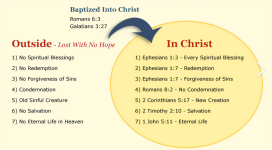
Today: Only One Baptism = "BY" The One Spirit = God's Operation,
Spiritually "Identifying" members In ( The One Body Of ) CHRIST!!
(Ephesians 4:5; Colossians 2:12; Galatians 3:27;
Romans 6:3-4; 1 Corinthians 12:13 AV)

+
Timing Of This One and Only One Spiritual Baptism, Today, Under Grace?:

"That we should be to The Praise Of His Glory, who first trusted In Christ.
In Whom ye also trusted, after that ye heard The Word Of Truth, The Gospel
of your Salvation: In Whom also after that ye believed, ye Were Sealed With
That Holy Spirit Of Promise, Which Is The Earnest Of our inheritance Until The
Redemption Of The Purchased Possession, Unto The Praise Of His Glory."

Amen.

Baptized Into Christ.png

And, precious friend(s), Please Be Very Richly Encouraged and Edified
In The Lord Jesus Christ and In His Precious Word Of Truth, Rightly
Divided:


The Bible: The BIG Picture

Amen.
 
  • Like
Reactions: Dave123
There can be a case made that water baptism was only for Israel. Israel was to be a nation of priests and water baptism was a requirement for priest. This is why Jesus was water baptized.

If one considers the gospel of the kingdom as a gospel for the nation of Israel to receive the earthly kingdom distinct from the gospel of grace given to Paul mostly for the gentiles, one can also see a difference in baptisms (immersions).

Paul describe "one baptism" for the gospel of grace, that being the immersion of the believer into the body of Christ.

In Acts 2:38 Peter is responding to the question "What should we do?" The baptism of repentance was an established practice that also demonstrated the change of mind (metanoia) that understanding that they had put to death the Messiah meant. The word eis has a broad number of meaning. The AV translates it as "unto" the remission of sins. This may be more accurate as Jesus said that if people did not believe he was the Messiah, they were still in their sins. The Acts 2:38 verse might be saying that the faith of those Peter was answering and demonstrated in repentance and baptism would be unto the forgiveness of sins as well as the door through which they could have the Spirit fall on them.
Completely false. The jailer got baptized in water as well. Everyone did, only in these past few decades did we get a truncated view.
 
Completely false. The jailer got baptized in water as well. Everyone did, only in these past few decades did we get a truncated view.
Is that the jailer in Philippi in Acts 16?

25About midnight Paul and Silas were praying and singing hymns to God, and the prisoners were listening to them, 26and suddenly there was a great earthquake, so that the foundations of the prison were shaken. And immediately all the doors were opened, and everyone’s bonds were unfastened. 27When the jailer woke and saw that the prison doors were open, he drew his sword and was about to kill himself, supposing that the prisoners had escaped. 28But Paul cried with a loud voice, “Do not harm yourself, for we are all here.” 29And the jailer called for lights and rushed in, and trembling with fear he fell down before Paul and Silas. 30Then he brought them out and said, “Sirs, what must I do to be saved?” 31And they said, “Believe in the Lord Jesus, and you will be saved, you and your household.” 32And they spoke the word of the Lord to him and to all who were in his house. 33And he took them the same hour of the night and washed their wounds; and he was baptized at once, he and all his family. 34Then he brought them up into his house and set food before them. And he rejoiced along with his entire household that he had believed in God.
 
  • Like
Reactions: Vucesa
1Co 1:14 I thank God that I baptized none of you, but Crispus and Gaius;
1Co 1:15 Lest any should say that I had baptized in mine own name.
1Co 1:16 And I baptized also the household of Stephanas: besides, I know not whether I baptized any other.
1Co 1:17 For Christ sent me not to baptize, but to preach the gospel: not with wisdom of words, lest the cross of Christ should be made of none effect.

Paul's gospel of grace does not seem to have water baptism as a requirement, but it seems to have been occasionally allowed early on.
 
1Co 1:14 I thank God that I baptized none of you, but Crispus and Gaius;
1Co 1:15 Lest any should say that I had baptized in mine own name.
1Co 1:16 And I baptized also the household of Stephanas: besides, I know not whether I baptized any other.
1Co 1:17 For Christ sent me not to baptize, but to preach the gospel: not with wisdom of words, lest the cross of Christ should be made of none effect.

Paul's gospel of grace does not seem to have water baptism as a requirement, but it seems to have been occasionally allowed early on.
it's not clear to me what you're saying about baptism in this passage, 1 Cor 1:14-17. Crispus and Gaius and the others named here were all baptized with water, agreed?
 
it's not clear to me what you're saying about baptism in this passage, 1 Cor 1:14-17. Crispus and Gaius and the others named here were all baptized with water, agreed?

Act_18:8 And Crispus, the chief ruler of the synagogue, believed on the Lord with all his house; and many of the Corinthians hearing believed, and were baptized.

Assuming this is the same Crispus, it sounds like he heard about Jesus being the Messiah and trusted in that. As a result, he would be water baptized in accordance to the gospel of the kingdom. It was perhaps typical that those Jews who did not believe would become infuriated and run Crispus and others out of the synagogue.

The Corinthian church probably had these believing Jews as the core of its start. At the time of Paul, a Jew could be saved by either the kingdom gospel or the grace gospel.

The idea that those saved by the grace gospel do not need water baptism finds further support from;

Eph_4:5 One Lord, one faith, one baptism,

The "one baptism" (immersion) is;

1Co_12:13 For by one Spirit are we all baptized into one body, whether we be Jews or Gentiles, whether we be bond or free; and have been all made to drink into one Spirit.
 
The "one baptism" (immersion) is;

1Co_12:13 For by one Spirit are we all baptized into one body, whether we be Jews or Gentiles, whether we be bond or free; and have been all made to drink into one Spirit.
Thank you, @timf. Just to make sure, you seem to be saying that, in this verse (1 Cor 12:13), the one action of baptism by immersion (water baptism) brings with it baptism in the Spirit. In other words, there are not two separate actions of baptizing, iust the one action which brings both results at once ― the baptism with water and the baptism in the Spirit. Have I understood you correctly?
 
  • Pray
Reactions: GRACE_ambassador
It's my belief that many of what I would call 50/50 passages, that is, passages used by some to claim that water baptism in combination with faith are required for salvation, can linguistically, equally, be translated two different ways. Acts 2:38-39 for one. The word "eis" can mean "for," "unto," or "in regard to". The grammar allows for multiple angles. So, that means that while water baptism is connected to the moment, because people in that time usually were water baptized the moment that they came to faith, it also means that linguistically, it is not necessary to claim that those verses say that water baptism is part of the the cause of receiving the Spirit. It was part of the moment, but not part of the cause, and not necessarily the correct order in which it was translated.

-------

Acts 2:38-39 Then Peter said to them, "Repent, and let every one of you be baptized in the name of Jesus Christ for the remission of sins; and you shall receive the gift of the Holy Spirit. For the promise is to you and to your children, and to all who are afar off, as many as the Lord our God will call."

If we cling to the order in Acts 2:38-39, note that here, in Acts 10, Peter uses the exact opposite order as he did in Acts 2:38-39. He also stresses that this is the same way he received the Holy Spirit (order implied) and was saved.

Acts 10:44-48 While Peter was still speaking these words, the Holy Spirit fell upon all those who heard the word. And those of the circumcision who believed were astonished, as many as came with Peter, because the gift of the Holy Spirit had been poured out on the Gentiles also. For they heard them speak with tongues and magnify God. Then Peter answered, "Can anyone forbid water, that these should not be baptized who have received the Holy Spirit just as we have?" And he commanded them to be baptized in the name of the Lord. Then they asked him to stay a few days.

Nothing of water baptism is even mentioned in Acts 11:15-17.

Acts 11:15-17 And as I began to speak, the Holy Spirit fell upon them, as upon us at the beginning. Then I remembered the word of the Lord, how He said, 'John indeed baptized with water, but you shall be baptized with the Holy Spirit.' If therefore God gave them the same gift as He gave us when we believed on the Lord Jesus Christ, who was I that I could withstand God?"

Even in this unique transitional period, these true OT believers in Acts 19 who missed the whole thing. Jesus, came in the flesh, died on the cross, rose on the third day, and later ascended, and these OT believers missed it all. Their understanding ending with John the Baptist. Understanding that, we see the significance of the dialog between them and Paul here in Acts 19. Also notice that John s baptism is not contrasted with being baptized in the name of Jesus, it's contrasted with the baptism that saves. A baptism by faith. The baptism with the Holy Spirit. The answer is right there in the passage. Can you see it?

-------
Here's more from the Book of Acts that say the same.

Acts 16:30-31 And he brought them out and said, "Sirs, what must I do to be saved?" So they said, "Believe on the Lord Jesus Christ, and you will be saved, you and your household."

Acts 13:39 and by Him everyone who believes is justified from all things from which you could not be justified by the law of Moses.

Acts 10:43 To Him all the prophets witness that, through His name, whoever believes in Him will receive remission of sins."

Given the rest of the Bible, even the Gospel message itself, believe and be saved, it seems unnecessary to rewrite the entire Bible for a few passages that can equally be translated as water baptism not being part of the cause of salvation, but the result of it. Especially in a unique and unrepeatable time.

-------

See Ephesians 1:13, Romans 10:9-10, John 3:16, 5:24, 6:47.

1 Corinthians 1:14-17 I thank God that I baptized none of you except Crispus and Gaius, lest anyone should say that I had baptized in my own name. Yes, I also baptized the household of Stephanas. Besides, I do not know whether I baptized any other. For Christ did not send me to baptize, but to preach the gospel, not with wisdom of words, lest the cross of Christ should be made of no effect.

Translation of Scripture is the beginning of understanding, but interpretation is needed to understand more fully what the original and the translation mean. I generally agree with your interpretation, and here is how I explain the issue:

The moment of being baptized by the HS begins the process of becoming sanctified by the HS. Peter wrote that the sanctification of the Spirit is “unto obedience” (1Pet. 1:2), and Paul also wrote about faithful obedience (in Rom. 1:5). Following the act of faith (1John 3:23), believers will manifest obedience by acts of love (1John 4:19-21, John 13:35). There is no qualitative difference between faith that accepts God’s saving grace at conversion and faith that accepts God’s working grace while walking/obeying (Eph. 2:8-10, 2Cor. 5:7), but only a quantitative difference as each additional moment passes–and of course faith remains non-meritorious during the saint’s entire lifetime.

Paul wrote (in Phil. 1:6) of being confident “that he who began a good work in you will carry it on to completion until the day of Christ Jesus”. He cited the work of the HS again in 1Cor. 6:11b, “You were washed, you were sanctified, you were justified in the name of the Lord Jesus Christ and by the Spirit of our God.” Note that this verse refers to water baptism and to baptism by the HS (1Cor. 12:13, “We were all baptized by one Spirit into one body”).

Confusion may arise from the fact that Paul says there is only one baptism (Eph. 4:5), but in a few places the NT seems to refer to two types of baptism: one by water and another by the HS (Matt. 3:11, John 1:26-33, Acts 1:5). Any confusion is resolved by understanding that the two types of baptism are harmonized if baptism with water is viewed as a symbolic way of portraying baptism by the HS. (Most Bibles have a footnote for Mark 16:9-20 saying that the passage is not a reliable or well-attested part of the NT canon, so it is problematic to cite v.16 as requiring water baptism for salvation along with drinking poison or handling asps as signs of being saved.)

Both outward confession (Rom. 10:9) and water baptism may be seen as works manifesting love for God that every new Believer will want to (but we cannot say “must”) perform as soon as possible following his/her decision to have saving faith (cf. Matt. 3:13-15, Acts 2:38). Paul referred to the comparable moment for Abraham as spiritual circumcision. Although Paul did not command baptism, he administered it (in Acts 16:33, 18:8, 19:5 & 1Cor. 1:114-16) even though he said Christ did not send him to baptize but to preach the gospel (1Cor. 1:17). IOW, Paul’s focus was on preaching the Gospel about Christ's Spirit baptism and he probably left the water baptizing symbolic rite to his assistants.

The outward evidence that someone was baptized by the HS and is Spirit-filled (Eph. 5:18) or walking with God is the manifestation of the fullness of Christ (Eph. 3:19, 4:13) or fruit of the Spirit, which consists of such attributes as those listed in Gal. 5:22-23: love, joy, peace, patience, kindness, goodness, faithfulness, gentleness and self-control. Jesus said “All men will know that you are my disciples if you love one another” (John 13:35, 1John 4:7-21), because “love” sums up the moral character of God (1John 4:7-8). (Note that Jesus did NOT say “…if you are water baptized.”)

Hope this helps. :love:
 
  • Like
Reactions: Dave123
Acts 2:38 must be read alongside verses like (Luke 24:47; Acts 3:19; 5:31; 10:43-47; 11:17,18; 13:38-39; 15:7-9; 16:31; 26:18) and consider the fact that forgiveness is explicitly tied to repentance/belief/faith and not water baptism before reaching a conclusion on doctrine.

Luke 24:47 - and that repentance for the forgiveness of sins should be proclaimed in his name to all nations, beginning from Jerusalem. *What happened to baptism?

Acts 3:19 - Repent therefore and be converted, that your sins may be blotted out, so that times of refreshing may come from the presence of the Lord. *What happened to baptism?

Acts 5:31 - Him God has exalted to His right hand to be Prince and Savior, to give repentance to Israel and forgiveness of sins. *What happened to baptism?

Acts 10:43 - Of Him all the prophets bear witness that through His name everyone who believes in Him receives forgiveness of sins. *What happened to baptism?

Acts 11:17 - If therefore God gave them the same gift (Holy Spirit) as He gave us when we believed on the Lord Jesus Christ, who was I that I could withstand God?” 18 When they heard these things they became silent; and they glorified God, saying, “Then God has also granted to the Gentiles repentance unto life.” *What happened to baptism?

Acts 13:38 - Therefore, let it be known to you, brethren, that through this Man is preached to you the forgiveness of sins; 39 and by Him everyone who believes is justified from all things from which you could not be justified by the law of Moses. *What happened to baptism?

Acts 15:7 - And when there had been much dispute, Peter rose up and said to them: “Men and brethren, you know that a good while ago God chose among us, that by my mouth the Gentiles should hear the word of the gospel and believe. 8 So God, who knows the heart, acknowledged them by giving them the Holy Spirit, just as He did to us, 9 and made no distinction between us and them, purifying their hearts by faith. *What happened to baptism?

Acts 16:30 - And he brought them out and said, “Sirs, what must I do to be saved?” 31 So they said, “Believe on the Lord Jesus Christ, and you will be saved, you and your household.” *What happened to baptism?

The only logical and Biblical conclusion when properly harmonizing scripture with scripture is that faith in Jesus Christ "implied in repentance" (rather than water baptism) brings the remission of sins and the gift of the Holy Spirit. (Luke 24:47; Acts 2:38; 3:19; 5:31; 10:43-47; 11:17,18; 13:38-39; 15:7-9; 16:31; 26:18) *Perfect Harmony*
 
  • Like
Reactions: Dave123 and GWH
Your thread title says you’re asking a question about translation. How can you discuss a translation question without looking at the original text?

In case you change vour mind about that, here’s a convenient place to start:

https://biblehub.com/interlinear/acts/2-38.htm
Hey Bartholomew

The original languages in that passage has equal options in translating from them to English. All those options are valid linguistically, but not all of those options are valid theologically. So linguistically, there's nothing that anyone can really hang their hat on to support their interpretation of that passage. At least none that has been noted by anyone that I've heard. The true translation must come from comparing Scripture with Scripture, which I started to do in the OP. To just pick a passage, like Acts 2:38-39, and disregard the others that give an opposite order, is not an option. The only argument that I heard for all the other passages that leave out water baptism all together is that water baptism must was assumed into them. That's a lot of assuming throughout the Bible for just a few verses.

I don't know weather it was the old English of the KJV, reversing things, which is common in the KJV (Example - John 1:12-13), or the influence of the Catholic church back then, or just Ex Catholics who, when translating, didn't realize how deep the poison really went. Regardless, a big red flag should raise when we rewrite the whole Bible for a few, as I call them, 50/50 passages.
 
It's a shame he parted the waters and didn't preserve His word huh? Maybe He could have used a king or something.
Remember, to part water God only had to deal with nature. To preserve His word, God must deal with feckless, sinful humanity, a much harder task since He was foolish enough to give us free will and allow us to actively work against Him.
 
In other words, there are not two separate actions of baptizing, iust the one action which brings both results at once ― the baptism with water and the baptism in the Spirit. Have I understood you correctly?
I am sorry, but I see the "one baptism" as that of the Holy Spirit that puts the new believer into the body of Christ upon faith. I see water baptism as an act unrelated to what the Holy Spirit does.
 
  • Like
Reactions: Dave123