Q
Quickfire
Guest
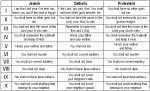
i disagree you carnt argue with scripture , let no man add or take away, you know that rightThe picture is a secular interpretation. It's not accurate regarding reality.

i disagree you carnt argue with scripture , let no man add or take away, you know that rightThe picture is a secular interpretation. It's not accurate regarding reality.
i disagree you carnt argue with scripture , let no man add or take away, you know that right
yup to the patient nope to removing something from scripture an thats a fact ,, you talkng books that had stood for 2000 centuriesMartin Luther wasn't taking away from scripture. Thoe apocrypha isn't scripture.
If you remove cancer from a patient, have you taken something that belongs in the patient out? No.
Maybe you misread my question. Are you saying the cancer belongs in the patient?yup to the patient
nope to removing something from scripture an thats a fact

Um, no.,, you talkng books that had stood for 2000 centuries
The Catholic Bible contains more books than the Protestant. If your looking at a bible with 66 books, its Protestant.Maybe you misread my question. Are you saying the cancer belongs in the patient?
Nothing was removed from scripture.
These are the books of scripture.
Um, no.
A century is 100 years.
So 2000 x 100 = 200000 years
The Catholic Bible contains more books than the Protestant. If your looking at a bible with 66 books, its Protestant.
catholic bibles have extra 6 books plus chapters of daniel and esther the 6 are tobit judith maccabees 1&2
if there not part of scripture then what are they doing in catholic bibles, ????
You have asked a good question, and it will lead to many more good questions about why the Catholics disobey scripture.if there not part of scripture then what are they doing in catholic bibles, ????
is that just catholics though ????You have asked a good question, and it will lead to many more good questions about why the Catholics disobey scripture.
Nope, it includes Eastern Orthodox, the Copts, Mormons, and many other groups that claim to be Christianis that just catholics though ????

yup to the patient nope to removing something from scripture an thats a fact ,, you talkng books that had stood for 2000 centuries

yup and also baptists tooNope, it includes Eastern Orthodox, the Copts, Mormons, and many other groups that claim to be Christian
if there not part of scripture then what are they doing in catholic bibles, ????
The Counter-Reformation I think. In the Fourth Session on the Council of Trent, the Catholics decided in 1546 that the books in question were canonical, basically because they were in Jerome's Latin Vulgate.
CT04can
The Council of Trent
The Fourth Session
The canons and decrees of the sacred
and oecumenical Council of Trent,
Trans. J. Waterworth (London: Dolman, 1848), 17-21.
SESSION THE FOURTH
Celebrated on the eighth day of the month of April, in the year MDXLVI.
DECREE CONCERNING THE CANONICAL SCRIPTURES
The sacred and holy, ecumenical, and general Synod of Trent, --lawfully assembled in the Holy Ghost, the Same three legates of the Apostolic Sec presiding therein,--keeping this always in view, that, errors being removed, the purity itself of the Gospel be preserved in the Church; which (Gospel), before promised through the prophets in the holy Scriptures, our Lord Jesus Christ, the Son of God, first promulgated with His own mouth, and then commanded to be preached by His Apostles to every creature, as the fountain of all, both saving truth, and moral discipline; and seeing clearly that this truth and discipline are contained in the written books, and the unwritten traditions which, received by the Apostles from the mouth of Christ himself, or from the Apostles themselves, the Holy Ghost dictating, have come down even unto us, transmitted as it were from hand to hand; (the Synod) following the examples of the orthodox Fathers, receives and venerates with an equal affection of piety, and reverence, all the books both of the Old and of the New Testament--seeing that one God is the author of both --as also the said traditions, as well those appertaining to faith as to morals, as having been dictated, either by Christ's own word of mouth, or by the Holy Ghost, and preserved in the Catholic Church by a continuous succession. And it has thought it meet that a list of the sacred books be inserted in this decree, lest a doubt may arise in any one's mind, which are the books that are received by this Synod. They are as set down here below: of the Old Testament: the five books of Moses, to wit, Genesis, Exodus, Leviticus, Numbers, Deuteronomy; Josue, Judges, Ruth, four books of Kings, two of Paralipomenon, the first book of Esdras, and the second which is entitled Nehemias; Tobias, Judith, Esther, Job, the Davidical Psalter, consisting of a hundred and fifty psalms; the Proverbs, Ecclesiastes, the Canticle of Canticles, Wisdom, Ecclesiasticus, Isaias, Jeremias, with Baruch; Ezechiel, Daniel; the twelve minor prophets, to wit, Osee, Joel, Amos, Abdias, Jonas, Micheas, Nahum, Habacuc, Sophonias, Aggaeus, Zacharias, Malachias; two books of the Machabees, the first and the second. Of the New Testament: the four Gospels, according [Page 19] to Matthew, Mark, Luke, and John; the Acts of the Apostles written by Luke the Evangelist; fourteen epistles of Paul the apostle, (one) to the Romans, two to the Corinthians, (one) to the Galatians, to the Ephesians, to the Philippians, to the Colossians, two to the Thessalonians, two to Timothy, (one) to Titus, to Philemon, to the Hebrews; two of Peter the apostle, three of John the apostle, one of the apostle James, one of Jude the apostle, and the Apocalypse of John the apostle. But if any one receive not, as sacred and canonical, the said books entire with all their parts, as they have been used to be read in the Catholic Church, and as they are contained in the old Latin vulgate edition; and knowingly and deliberately contemn the traditions aforesaid; let him be anathema.
Look the meaning is important but if it's written the way it's written, leave it alone! What you're saying is like saying let's delete the gospels and writing a book with the conclusion of what was taught as the theme of Jesus's life.
Both meaning and description of important. But if it's called the ten commandments, then leave it as the ten with its meaning. I'll take my opinion and you yours.You are mistaken. There are no numbers on the commandments in the bible. How they are listed is not important. The meaning is important.
Both meaning and description of important. But if it's called the ten commandments, then leave it as the ten with its meaning. I'll take my opinion and you yours.
There are ten commandments. I didn't start this debate. There are those who claimed that Catholic changed the 10 commandments. That is false.