Calvinism is Gospel !

  • Christian Chat is a moderated online Christian community allowing Christians around the world to fellowship with each other in real time chat via webcam, voice, and text, with the Christian Chat app. You can also start or participate in a Bible-based discussion here in the Christian Chat Forums, where members can also share with each other their own videos, pictures, or favorite Christian music.

    If you are a Christian and need encouragement and fellowship, we're here for you! If you are not a Christian but interested in knowing more about Jesus our Lord, you're also welcome! Want to know what the Bible says, and how you can apply it to your life? Join us!

    To make new Christian friends now around the world, click here to join Christian Chat.
Status
Not open for further replies.
Was Calvin consciously looking for a tulip in the Gospel or was he like, "Oh look! I found a tulip!" and plucked it out and ran with it to his mother to press between the pages of her Bible?

Actually, he wasn't the origin of the poisonous flower. That invention became the short form of addressing all the actual doctrine aligned with the reformed ideas of interpretation. But tulip sounds like it's a good choice
 
  • Like
Reactions: Mem
Actually, he wasn't the origin of the poisonous flower. That invention became the short form of addressing all the actual doctrine aligned with the reformed ideas of interpretation. But tulip sounds like it's a good choice
I see. He didn't get it from the bible, but it was constructed in an ode to whomever it was. Was it Luther?
 
I see. He didn't get it from the bible, but it was constructed in an ode to whomever it was. Was it Luther?
No, the TULIP acronym was not devised until the early 20th century, long after both Luther and Calvin. Besides, the acronym only works in English. Calvin was French and Luther German.
 
  • Like
Reactions: Mem
I see. He didn't get it from the bible, but it was constructed in an ode to whomever it was. Was it Luther?

Well, he didn't 'get it' at all. It did not originate from him and the acronym is like a 'reader's digest' of the entirety.

Not all Calvinists are as embedded into the doctrine either. Kind of like not all Christians are on equal understanding with each other.

We've come a long way since the authors of scripture of the NT sent out their letters which have been compiled into what we call the Bible. Well it is the Bible of course, but the authors, Paul et al, were also educated beyond what they wrote. It was a different world with a far broader application of the understanding of a world beyond the physical
 
The god of "unconditional election for salvation" while others are left with no ability to respond positively in this new covenant does not exist.

The Lord is not slack concerning his promise, as some men count slackness; but is longsuffering to us-ward, not willing that any should perish, but that all should come to repentance" (KJV).

Full Stop.
You don't believe in inability, but do you believe in unwillingness? Does Jesus talk about those who are unwilling to believe?
 
You don't believe in inability, but do you believe in unwillingness? Does Jesus talk about those who are unwilling to believe?

Is every single human born with a nature which causes him/her to hate God from their first breath?
Babies hate God?
That is the Calvinist dogma, I read it over and over again how they pluck out verses and post them over and over again to support a manufactured God nowhere found in scripture.
 
This has been addressed, and to be expected, you have ignored it.

Wrong, I just reiterated it: Tulip teaches God is NOT gracious, omniloving and just, but rather that God does NOT love the world, does NOT want everyone to be saved, and DOES show favoritism, contradicting GW in John 3:16, 1Tim. 2:3-4 and Rom. 2:11.
Thus, it is anti-Gospel heresy; believe at your own risk (Gal. 1:6-9)!

It is YOO- HOO ignores this truth.
 
In 1Timothy, Paul's use of the term "all" refers to "all kinds of people," not "each and every person." Paul is addressing the issue of leaders and rulers to say that God is saving even those who might oppress you or take advantage of you. Pray for them also.

Only per your tulip pretzel. All means everyone.
Your perverse redefinition (a la Augustine) corrupts the Gospel:
God is gracious, omniloving and just; He loves the world, wants everyone to be saved, and does not show favoritism
(per GW in John 3:16, 1Tim. 2:3-4 and Rom. 2:11). To contradict this truth is anti-Gospel heresy; believe at your own risk (Gal. 1:6-9)!
 
  • Like
Reactions: HeIsHere
No, the TULIP acronym was not devised until the early 20th century, long after both Luther and Calvin. Besides, the acronym only works in English. Calvin was French and Luther German.

The acronym may be post-Reformation, but the tulip doctrine is pre-Reformation Augustine's,
except that he had a theory that preserved MFW for a few.
 
  • Like
Reactions: Mem
Is every single human born with a nature which causes him/her to hate God from their first breath?
Babies hate God?
That is the Calvinist dogma, I read it over and over again how they pluck out verses and post them over and over again to support a manufactured God nowhere found in scripture.
No, contrary to TULIP we don't hate God by nature. You are right to reject that idea.
 
Only per your tulip pretzel. All means everyone.
Did I base my interpretation on TULIP? Be honest. No, I did not. My interpretation is based on a fair evaluation of the context.

I'm afraid your allergy to TULIP has distracted you from what I ACTUALLY said.
Look at the passage again. Paul’s argument in 1 Timothy 2 becomes far clearer when we read “all men” in the flow of his concern for all kinds of people rather than “each and every individual.” The passage begins with a call to pray for kings and authorities—precisely the social group most Christians were least inclined to include in their prayers. Paul’s point is that God’s saving purpose is not restricted to one class, ethnicity, or social tier; He saves Jews and Gentiles, rulers and subjects, the honorable and the dishonorable. This fits Paul’s consistent usage elsewhere, where “all” often means all categories rather than every individual without exception (e.g., Titus 2:11; 1 Corinthians 12:13). In context, Paul is dismantling narrow, exclusionary instincts in the church, insisting that God’s desire extends across the full spectrum of humanity. The universality is real, but it is a universality of scope—God saves without regard to class or category—not a claim that every single person will or must be saved.

God is gracious, omniloving and just; He loves the world, wants everyone to be saved, and does not show favoritism.
I fully agree that God is gracious, omniloving, and just. Scripture is unmistakably clear that He loves the world, desires all to be saved, and shows no favoritism. But alongside these truths, the Bible also teaches that God elects—that He chooses—a people for Himself.

Election doesn’t contradict God’s love or justice; it expresses them. God’s gracious character is precisely why anyone is saved at all. His universal love does not eliminate His sovereign freedom to call, draw, and appoint people to salvation. Passages like John 6, John 15, Romans 8, and Ephesians 1 show that God’s saving work includes both His desire for all and His choice of some.

So yes—God loves the world. Yes—He wants everyone to be saved. Yes—He shows no favoritism.And yes, the Bible also teaches that salvation involves God’s initiative, God’s calling, and God’s choosing. These truths are not enemies; they stand together in Scripture as different facets of the same gracious God.
 
  • Like
Reactions: Standard
No, contrary to TULIP we don't hate God by nature. You are right to reject that idea.
Thats false. By nature with our carnal mind in the flesh, the mind is enmity against God Rom 8:7-8

7 Because the carnal mind is enmity against God: for it is not subject to the law of God, neither indeed can be.

8 So then they that are in the flesh cannot please God.

That word enmity in the original is echthra :

ἔχθρα échthra, ekh'-thrah; feminine of G2190; hostility; by implication, a reason for opposition:—enmity, hatred.

Its translated hatred here Gal 5:20

Idolatry, witchcraft, hatred, variance, emulations, wrath, strife, seditions, heresies,

So thats a false statement you just made !
 
  • Like
Reactions: Magenta
The acronym may be post-Reformation, but the tulip doctrine is pre-Reformation Augustine's,
except that he had a theory that preserved MFW for a few.
The Tulip Truths are from the beginning of the world, unfortunately you cant discern them.
 
Did I base my interpretation on TULIP? Be honest. No, I did not. My interpretation is based on a fair evaluation of the context.

I'm afraid your allergy to TULIP has distracted you from what I ACTUALLY said.
Look at the passage again. Paul’s argument in 1 Timothy 2 becomes far clearer when we read “all men” in the flow of his concern for all kinds of people rather than “each and every individual.” The passage begins with a call to pray for kings and authorities—precisely the social group most Christians were least inclined to include in their prayers. Paul’s point is that God’s saving purpose is not restricted to one class, ethnicity, or social tier; He saves Jews and Gentiles, rulers and subjects, the honorable and the dishonorable. This fits Paul’s consistent usage elsewhere, where “all” often means all categories rather than every individual without exception (e.g., Titus 2:11; 1 Corinthians 12:13). In context, Paul is dismantling narrow, exclusionary instincts in the church, insisting that God’s desire extends across the full spectrum of humanity. The universality is real, but it is a universality of scope—God saves without regard to class or category—not a claim that every single person will or must be saved.


I fully agree that God is gracious, omniloving, and just. Scripture is unmistakably clear that He loves the world, desires all to be saved, and shows no favoritism. But alongside these truths, the Bible also teaches that God elects—that He chooses—a people for Himself.

Election doesn’t contradict God’s love or justice; it expresses them. God’s gracious character is precisely why anyone is saved at all. His universal love does not eliminate His sovereign freedom to call, draw, and appoint people to salvation. Passages like John 6, John 15, Romans 8, and Ephesians 1 show that God’s saving work includes both His desire for all and His choice of some.

So yes—God loves the world. Yes—He wants everyone to be saved. Yes—He shows no favoritism.And yes, the Bible also teaches that salvation involves God’s initiative, God’s calling, and God’s choosing. These truths are not enemies; they stand together in Scripture as different facets of the same gracious God.

IMO your interpretation is due to TULIP, not GW.
In 1Tim. 2:3-4 Paul reveals God's concern for both all people and all kinds of people, including kings.
Ditto re Tit. 2:11 and 1Cor. 12:13.

Denying this truth makes God hate each and every individual excluded by your definition of omnilove
and a shower of favoritism for the few you include with your warped definition of just.

God's gracious nature is precisely why He offers salvation to all.

So no, God does not love the whole world and want everyone to be saved per tulipism but only all kinds of people,
which includes few individuals--and almost no tulipists.
 
  • Like
Reactions: Standard
lol funny says the one opposing the Gospel of Truth

This one affirms the following gospel/truth:

1. There is a/one all-loving and just Lord or God (Deut. 6:4, John 3:16, 2Thes. 1:6), who is both able (2Tim. 1:12) and willing (1Tim. 2:3-4, Ezek. 33:11) to provide all morally accountable human beings salvation or heaven—a wonderful life full of love, joy and peace forever.

2. Human beings are selfish or sinful (Rom. 3:23, 2Tim. 3:2-4, Col. 3:5), miserable (Gal. 5:19-21), and hopeless (Eph. 2:12) or hell-bound at the judgment (Matt. 23:33 & 25:46) when they reject God’s salvation (John 3:18, Rom. 2:5-11).

3. Jesus is God’s Messiah/Christ and incarnate Son, the way that God has chosen (John 3:16, Acts 16:30-31, Phil. 2:9-11) of providing salvation by means of his atoning death on the cross for the payment of the penalty for the sins of humanity (Rom. 3:22-25 & 5:9-11), followed by his resurrection to reign in heaven (1Cor. 15:14-28).

4. Thus, every person who hears the NT Gospel needs to repent and accept God’s justification in Jesus as Christ/Messiah the Lord or Supreme Commander (Luke 2:11, John 14:6, Acts 16:31), which means trying to obey (Phil. 3:12, 1John 1:8) His commandment to love one another (Matt. 22:37-40, John 13:35, Rom. 13:9)—forever (Matt. 10:22, Psa. 113:2).

5. Then God’s Holy Spirit will establish a saving relationship with those who freely accept Him (Rev. 3:20) that will eventually achieve heaven when by means of persevering in learning Truth/God’s Word/sanctification everyone cooperates fully with His will (John 14:6, 17&26, Rom. 8:6-17, Gal. 6:7-9, Eph. 1:13-14, Heb. 10:36, 12:1, Jam. 1:2-4).

6. This creed summarizes revelation of the NT Gospel/Truth (Matt. 26:13, John 14:6), which fulfilled the OT revelation (Matt. 5:17, John 19:30, Heb. 7:11-10:10) and culminates the search for salvation by souls who know only general revelation (Rom. 1:20, 2:14-16, Matt. 7:12). Seeking begins when souls love truth/repent of false beliefs (2Thes. 2:10&13, Matt. 4:17, 7:7), which is the Way to eternal life God wills, who is the Lord Jesus (Matt. 7:14, John 1:14, 4:24, 14:6). Lacking this love leads to believing lies and debauchery (Matt. 7:6, Rom. 1:18&25-26, 2Thes. 2:11-12).

 
No, contrary to TULIP we don't hate God by nature. You are right to reject that idea.
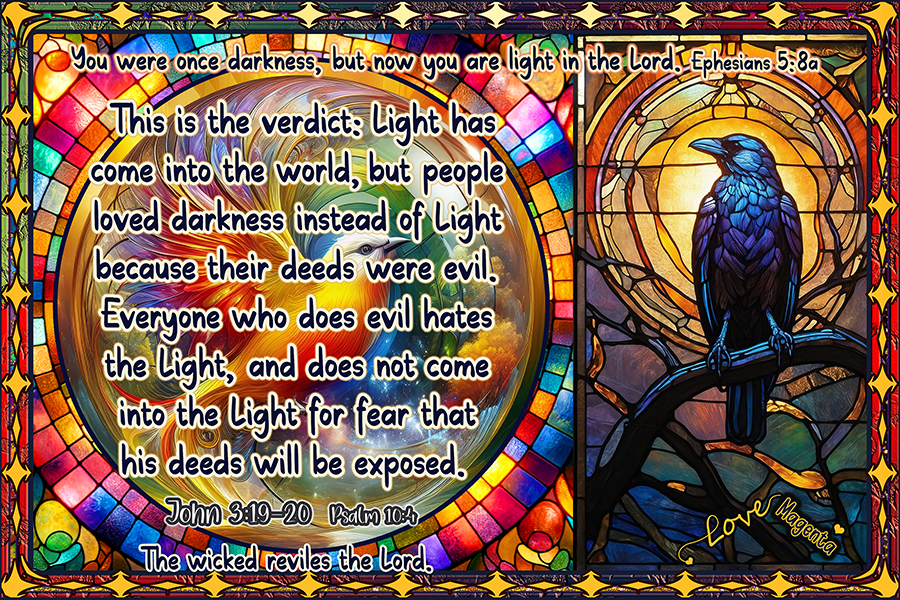
John3-19-20-Psalm10-4s.png

John 3 verses 19-20 and from Psalm 10 verse 4 This is the verdict: Light has come into the world, but people loved darkness instead of Light because their deeds were evil. Everyone who does evil hates the Light, and does not come into the Light for fear that his deeds will be exposed. The wicked reviles the Lord
 
Status
Not open for further replies.