Daniel's 2300 evening and mornings prophecy

  • Christian Chat is a moderated online Christian community allowing Christians around the world to fellowship with each other in real time chat via webcam, voice, and text, with the Christian Chat app. You can also start or participate in a Bible-based discussion here in the Christian Chat Forums, where members can also share with each other their own videos, pictures, or favorite Christian music.

    If you are a Christian and need encouragement and fellowship, we're here for you! If you are not a Christian but interested in knowing more about Jesus our Lord, you're also welcome! Want to know what the Bible says, and how you can apply it to your life? Join us!

    To make new Christian friends now around the world, click here to join Christian Chat.

JustThinking

Active member
Mar 14, 2026
378
117
43
In chapter 8, Daniel gives us an extremely important prophecy that centers on the cleansing of the sanctuary. The 2,300 evenings and mornings has been read in more than one way. Many interpreters apply a year-for-a-day principle and treat it as 2,300 years, often anchored to 457 BC alongside the seventy weeks. Others take “evenings and mornings” as related to the daily offerings and therefore understand the period as 1,150 days. The range of views shows how much debate this text has generated.

Therefore, I would like to ask if we might discuss this valuable prophetic prophecy.

What is the meaning of this prophecy?

What is it intended purpose?

Who is responsible for fulfilling this prophecy?

How will this prophecy be fulfilled?

What does this time element of 2300 evenings and mornings mean in this prophecy?
 
  • Love
Reactions: Researcher
Most Historist see the short term fulfilment of the 2300 days as being fulfilled by Antiochus Epiphanes (same as Preterist view), and a long term fulfilment of 2300 years, starting from the rise of the He-Goat (the Grecian Empire ) crossing into Europe from Asia - 334BC - forward 2300 years we come to 1967 which was the Mohameddan power was removed from the Holy Land and the temple site was lost by them.

I have a problem with the Antiochus Epiphanes interpretation, not saying it is wrong just that I have doubts.

When observing the sucession of world empires Daniel says Medo-Persia is "great" (Daniel 8:4), Greece is "very great" (Daniel 8:8) but the little horn is "exceeding great" (Daniel 8:9). Now if you was to ask the average person have they ever heard of Antiochus Epiphanes, they will not know who he is, why? because he was not exceeding great, if he was then everyone would know who he is. Plus he died about 164 years before Christ came in the flesh.
 
  • Like
Reactions: JustThinking
Most Historist see the short term fulfilment of the 2300 days as being fulfilled by Antiochus Epiphanes (same as Preterist view), and a long term fulfilment of 2300 years, starting from the rise of the He-Goat (the Grecian Empire ) crossing into Europe from Asia - 334BC - forward 2300 years we come to 1967 which was the Mohameddan power was removed from the Holy Land and the temple site was lost by them.

I have a problem with the Antiochus Epiphanes interpretation, not saying it is wrong just that I have doubts.

When observing the sucession of world empires Daniel says Medo-Persia is "great" (Daniel 8:4), Greece is "very great" (Daniel 8:8) but the little horn is "exceeding great" (Daniel 8:9). Now if you was to ask the average person have they ever heard of Antiochus Epiphanes, they will not know who he is, why? because he was not exceeding great, if he was then everyone would know who he is. Plus he died about 164 years before Christ came in the flesh.
Yea, Antiochus, the Ptolemy's, the Seleucid's have absolutely nothing to do with Daniel.
 
@Researcher - Just wanted to see if you wanted to make any comments or offer your interpretation on this topic... thanks.

Hi @JustThinking . I would love to share my interpretations. Sorry if my replies are delayed as I am a nine to five slave. :p

What is the meaning of this prophecy?

The meaning was to announce the number of days until the Sanctuary would be cleansed as one of the main aspects of fulfilling the Holy Covenant which is referred to several times in the Book of Daniel as well as Luke 1:72-73.

What is it intended purpose?

It's purpose was to demonstrate that the Plan of Salvation, written before man ever existed, would be fulfilled at the exact appointed time. Not sooner and not later.

Who is responsible for fulfilling this prophecy?

Only Jesus could fulfil the prophecy.

How will this prophecy be fulfilled?

I believe it has already been fulfilled at the Cross.

What does this time element of 2300 evenings and mornings mean in this prophecy?

Let's look at the verse:

Daniel 8:14 - And he said unto me, Unto two thousand and three hundred days; then shall the sanctuary be cleansed.

An easy way to interpret the verse is to find the ending point and work backwards. We know what that is. The ending point is when the 2300 days ends. So far, so good. Next we need to determine what 'Sanctuary being cleansed' means. In my opinion, Scripture makes it clear that Jesus cleansed the Sanctuary once and for all when he entered the Temple and obtained Salvation for us:

Hebrews 9:12 - Neither by the blood of goats and calves, but by his own blood he entered in once into the holy place, having obtained eternal redemption for us.

Again, the 2300 days is about the Holy Covenant, not some silly 'swine event' that is not even mentioned in the Bible.

So now we are faced with a decision. Are the 2300 days (or 'evenings and mornings' in some translations) literal twenty-four-hour periods of time? Are they symbolic?

If we go backwards 2300 literal days (about 6 years and 3 months) from the Crucifixion, the timeline doesn't make much sense. There is nothing significant happening. No Biblical milestone is there for us to discover.

Since Daniel's seventy weeks is based on the day/year principle, then logic would tell us to stay with that and not 'flip-flop' back and forth between literal and symbolic days to fit some preconceived dogma.

Of course, when one stays with the day/year principle and looks back 2300 years into the history that the Word of God has given us, we find exactly what the 2300 days is all about:

Genesis 6:18 - But with thee will I establish my covenant; and thou shalt come into the ark, thou, and thy sons, and thy wife, and thy sons’ wives with thee.

Genesis 9:9 - And I, behold, I establish my covenant with you, and with your seed after you;

Genesis 9:11 - And I will establish my covenant with you; neither shall all flesh be cut off any more by the waters of a flood; neither shall there any more be a flood to destroy the earth.

Genesis 9:12 - And God said, This is the token of the covenant which I make between me and you and every living creature that is with you, for perpetual generations:

Genesis 9:13 - I do set my bow in the cloud, and it shall be for a token of a covenant between me and the earth.

Genesis 9:15 - And I will remember my covenant, which is between me and you and every living creature of all flesh; and the waters shall no more become a flood to destroy all flesh.

Genesis 9:16 - And the bow shall be in the cloud; and I will look upon it, that I may remember the everlasting covenant between God and every living creature of all flesh that is upon the earth.

Genesis 9:17 - And God said unto Noah, This is the token of the covenant, which I have established between me and all flesh that is upon the earth.

How many times does God have to say the word 'Covenant' before we get it? Most of them are in the same chapter!

Again, it's all over Daniel 11:

Daniel 11:28 - Then shall he return into his land with great riches; and his heart shall be against the holy covenant; and he shall do exploits, and return to his own land.

Daniel 11:30 For the ships of Chittim shall come against him: therefore he shall be grieved, and return, and have indignation against the holy covenant: so shall he do; he shall even return, and have intelligence with them that forsake the holy covenant.

A quick check shows that 2300 years can fit pretty well within Biblical timeframes:

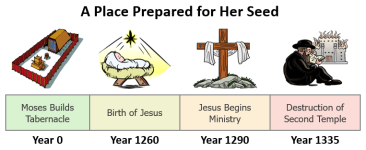
1784574403727.png

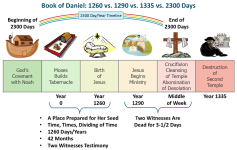
Once this information is cross-checked with other verses (such as the Abomination of Desolation), the 2300 days timeline being years after the Flood is too accurate to be a theory. It becomes fact. It has always been, and always will be, about Jesus and his plan of Salvation.

1784574583705.png

1260 vs 1290 vs 1335 vs 2300 SM.png
 
@Researcher


Part 1 - 2300 evenings and mornings prophecy.


Here is a partial carve out from the narrative for 8:13-14 found within the chapter 8 commentary on Daniel.

In verses 13–14, Daniel is allowed to overhear a brief but extraordinary exchange between two heavenly beings. One is the “Certain One” (often understood as the Lord Himself), and the other is Gabriel, who asks a direct, weighty question:

“How long will the vision be, concerning the daily sacrifices and the transgression of desolation, the giving of both the sanctuary and the host to be trampled underfoot?”

At first glance, it sounds like a simple “How long?” But—as in verses 11–12—these words bring together more than one actor and more than one time period. In 11–12 we saw this clearly: part of the interpretation described the Messiah’s work in the final week of the seventy-weeks-of-years prophecy, and part described the later activity of the little horn. Verses 13–14 follow the same pattern and need the same careful attention.

Gabriel is asking about the length of the chazon—the broad, sweeping vision that began back in 8:1–2 and runs all the way to “the time of the end.” His question gathers up four elements: the daily sacrifices, the transgression of desolation, the trampling of the sanctuary, and the trampling of the host. These do not all belong to the same moment in history.

The daily sacrifices and the transgression of desolation point us into the final “week” of the seventy-weeks-of-years prophecy—the time of the Messiah’s ministry and crucifixion. The daily is brought to an end not by force, but by fulfillment: Christ’s once-for-all offering of Himself brings the entire sacrificial system to its true completion. The “transgression of desolation” refers to the climactic act of rejection—when the Holy One is delivered up and crucified by His own people. That act, though carried out by earthly authorities, becomes the moral turning point of the covenant. It is the desolating transgression that reveals the depth of human rebellion even as it accomplishes divine redemption.

The trampling of the sanctuary and the trampling of the host belong later, in the long post-cross period tied to the rise of the little horn. This corrupt, self-exalting power casts truth to the ground, distorts the meaning of Christ’s finished work, and brings prolonged spiritual oppression both to God’s people and to His sanctuary. So in verse 13 the question is explicitly about the chazon—the long-range panorama of kingdoms, conflicts, and rebellion that stretches to the time of the end. But before Gabriel receives an answer to that broad “How long?”, something striking happens in verse 14: God Himself steps in and answers Daniel directly. It is as if the Lord says:

Daniel, the rise and fall of empires matters—but what matters most is the moment when I step into history Myself. The heart of this whole vision is the appearance of the Messiah and the cleansing He will accomplish. I want you to know when that will happen.

So the Lord answers—not Gabriel, but Daniel:

For two thousand three hundred evenings and mornings; then the sanctuary shall be cleansed.”

Here the focus narrows from the vast chazon to the inner core: the mareh vision, the appearance-centered vision of the Messiah and His redemptive work. The 2,300 evenings and mornings are not a vague symbol; they are the time measure God gives for this central work to reach its goal: the cleansing of the sanctuary. Just as verses 11–12 required us to separate two actors and two time periods within one explanation, verses 13–14 ask us to do the same—but now with the added weight of a specific time prophecy. The 2,300-days prophecy sits at the very heart of the chapter: it ties the Messiah’s once-for-all sacrifice to the cleansing of the sanctuary and anchors that saving work on a precise, God-appointed timeline.

Evenings and Mornings – Creation, Daily Sacrifices, and the Cross

The phrase “evenings and mornings” is precise and deeply symbolic. First, it echoes Genesis, where each day is marked by “evening and morning.” That pattern signals God’s order, intentionality, and completeness in creation. Second, it recalls the daily rhythm of the morning and evening offerings in the earthly sanctuary. In the Temple, the continual sacrifice framed each day before God and represented an ongoing covenant relationship between Him and His people.

That language is not accidental. The Messiah’s suffering and death occur within that same sanctuary-shaped framework of time. The Gospels mark His crucifixion and death with specific hours, and the shadow of the daily offerings stands behind the scene. The “evenings and mornings” of Daniel 8:14 therefore do more than measure a span of days—they point to the entire daily system that foreshadowed Christ and reaches its completion in Him.

By using this phrase, God ties together the redemptive arc. In creation, “evening and morning” marked each completed day. In the sanctuary, the daily offerings marked each day of covenant life. At the cross, the true Lamb of God fulfilled what those offerings could only symbolize. Once His sacrifice is offered and accepted, the earthly daily no longer carries a divine role. The system it sustained is brought to its God-intended conclusion, and the focus shifts from the earthly pattern to the reality—the heavenly sanctuary and the cleansing work that follows.

This is why Daniel’s vision becomes so remarkable at this point. The mareh is not showing us merely a distant ritual in an earthly building, but the Messiah’s own work at the center of redemption—work that fulfills the sacrificial system and anchors the sanctuary message in heaven itself. And just as God once gave Moses the Ten Words as a foundation within the larger Torah, and the Torah is found within the Tanakh, so here He gives Daniel the time-marker tied to the Messiah’s appearance and offering as a foundation within the broader vision. The mareh belongs within the final week of the seventy-weeks-of-years prophecy, and that seventy-week block belongs within the larger chazon. The Messiah’s sacrifice is therefore not a side-note in the prophecy—it is its beating heart, the turning point around which both the mareh and the larger chazon must be understood.

 
@Researcher


Part 2 - 2300 evenings and mornings prophecy.


The Mareh Calculation – theFrom Seventy Weeks and the to 2,300 Days


Within the broader chazon vision, Daniel 9 supplies a concrete time framework: the seventy weeks of years. That structure is what allows us to locate the 2,300 “evenings and mornings” within history. The first sixty-nine weeks (483 years) describe the long restoration of Jerusalem and the sanctuary system after Babylon—every element of worship gradually re-established in the reverse order of its removal.

One sacred element, however, never returns: the Ark of the Covenant. Taken out first by Jeremiah and never restored, its absence is intentional. The Ark’s meaning—God’s throne, His presence, His law—will be restored not as a gold covered wooden box, but in the Messiah Himself during the final, seventieth week. That last week (7 years × 360 days) contains 2,520 days. Therefore, Jesus’ public ministry begins on day 1 of that final week at His baptism in the Jordan. God arranges the events of that week so that His ministry spans four Passovers, and fulfilling the Spring festivals (Passover, Unleavened Bread, First fruits, and Pentecost). The first Passover falls exactly six months after His baptism, and by that same pattern the seventh Passover of the week would occur exactly six months before the end of the final seven years. From His baptism to that seventh Passover is therefore 6½ years:

6.5 × 360 = 2,340 days.​

Jesus is “cut off in the midst of the week” (Daniel 9:26–27), but His atonement stretches across the entire week, fulfilling everything that week represents. He does not need to live through every calendar day of it to bring the whole period to its intended meaning. His sacrifice reaches backward and forward within that final week and completes its purpose. Now comes the final step factor in this calculation: the forty days.

Throughout Scripture, the number forty often marks a period of preparation, purification, or proving. Immediately after His baptism, Jesus goes into the wilderness and fasts for forty days. Though sinless, He willingly enters the pattern of Levitical consecration and human testing. Those forty days:

Consecrate Him as the true High Priest, the living Temple, and the Passover Lamb of God,​
Confirm His purity, and,​
Mark the formal beginning of His redemptive ministry.​

If we start counting at the beginning of that wilderness consecration and run forward to the seventh Passover, you move through the full span of 2,340 days. But when you subtract those forty days of consecration, you arrive at 2,300 days: 2,340 − 40 = 2,300.

In this framework, that is not a numerical trick but a deliberate stamp of divine precision:

The 2,300 evenings and mornings begin with His wilderness consecration,​
And they culminate in the full completion and acceptance of His sacrifice—when the heavenly sanctuary is cleansed and the “daily” system is spiritually finished.​

Within that final prophetic week, every condition the Father set for the Son is perfectly met. Though He is cut off in the midst of the week, nothing in the Father’s plan is left unfinished. Just before He yields His spirit on the cross, Jesus declares, “It is finished.” At that moment, the mareh vision—the appearance-centered vision of the Messiah—was fulfilled. The sanctuary is cleansed in the only way that ever truly mattered. And the 2,300 evenings and mornings, instead of being a prophecy to frighten readers or push everything into a distant future, become a testimony to treasure: God’s plan was exact. God’s timing was complete. And in Christ, it was finished.
 
In chapter 8, Daniel gives us an extremely important prophecy that centers on the cleansing of the sanctuary. The 2,300 evenings and mornings has been read in more than one way. Many interpreters apply a year-for-a-day principle and treat it as 2,300 years, often anchored to 457 BC alongside the seventy weeks. Others take “evenings and mornings” as related to the daily offerings and therefore understand the period as 1,150 days. The range of views shows how much debate this text has generated.

Therefore, I would like to ask if we might discuss this valuable prophetic prophecy.

What is the meaning of this prophecy?

What is it intended purpose?

Who is responsible for fulfilling this prophecy?

How will this prophecy be fulfilled?

What does this time element of 2300 evenings and mornings mean in this prophecy?
The true intended meaning is perfectly clear.......to this Messianic Jewish scholar. As you would expect.

Dr. Arnold Fruchtenbaum’s exegesis of **Daniel 8:14** (*“For 2,300 evenings and mornings; then the sanctuary shall be restored”*) rests on a strictly literal, dispensational, and historical-grammatical framework.

He approaches the passage by addressing three core technical questions: the time unit, the primary historical fulfillment, and the future/prophetic implications.

## 1. The Meaning of "Evenings and Mornings" (*'Erev Boqer*)
Fruchtenbaum rejects symbolic interpretations (such as the historicist "day-for-a-year" principle) and takes the phrase **2,300 evenings and mornings** literally. However, in dispensational scholarship, there are two primary ways this count is understood, and Fruchtenbaum aligns with the **sacrificial count** view:
* **1,150 Days (2,300 Offerings):** The Hebrew phrase *'erev boqer* mirrors the language of Genesis 1 and the specific daily temple ritual—the *Tamid*—which required two burnt offerings per day: one in the evening and one in the morning (Exodus 29:38–42). Thus, 2,300 "evening-mornings" represents **2,300 individual daily sacrifices**, which translates to **1,150 full literal days** (just over 3 years and 2 months).

Fruchtenbaum understands the truth of this passage: that the 1,150-day calculation fits the exact historical duration of the intense desecration and suspension of the daily sacrifices under Antiochus IV Epiphanes.

## 2. Primary Historical Fulfillment: Antiochus IV Epiphanes
In Fruchtenbaum’s exposition of Daniel 8, the "Little Horn" of chapter 8 is **not** the end-times Antichrist directly, but rather **Antiochus IV Epiphanes**, the Seleucid tyrant.

* **The Scope:** While Daniel 7's "little horn" arises out of the Fourth (Roman) Empire and represents the future Antichrist, Daniel 8's "little horn" arises out of one of the four divisions of Alexander the Great's Greek Empire (specifically the Seleucid branch).

* **The Event:** Antiochus suppressed Jewish religious practices, halted the *Tamid* (daily sacrifices), and desecrated the Second Temple by erecting an altar to Zeus Over the Jewish altar (the historical "abomination of desolation" of the Maccabean period).

* **The Restoration:** The period of 1,150 days closely measures the timeframe from the severe defilement and cessation of the regular sacrifices until the Temple was re-consecrated by Judas Maccabeus in 164 BC (an event commemorated annually by Hanukkah).

## 3. Typological Dual Fulfillment (The Antichrist Connection)
While the 2,300 evening-mornings had a **literal, historical fulfillment in the 2nd century BC**, Fruchtenbaum emphasizes the principle of **double reference / typology**:
* **Antiochus as a Type:** Antiochus IV Epiphanes serves as the ultimate Old Testament *type* or pattern of the future Antichrist.

* **The Pattern:** Just as Antiochus abolished the daily sacrifice in Jerusalem, set up a blasphemous image in the sanctuary, and persecuted Israel for a set time period, the future Antichrist (Daniel 9:27, 11:36–45) will break his covenant with Israel in the middle of the 70th Week, halt temple sacrifices, and desecrate the rebuilt Third Temple.

## Summary of Fruchtenbaum's Position
| Passage Element | Fruchtenbaum's Exegetical Interpretation |
|---|---|
| **2,300 Evenings & Mornings** | 2,300 daily sacrifices = **1,150 literal 24-hour days**. |
| **Historical Target** | Antiochus IV Epiphanes (167–164 BC). |
| **Cleansing of the Sanctuary** | The removal of pagan idols, repair of the altar, and rededication of the Temple by the Maccabees. |
| **Prophetic Application** | Historical event serving as a prophetic blueprint (*type*) for the Antichrist's future mid-Tribulation
temple desecration. |
 
In Fruchtenbaum’s exposition of Daniel 8, the "Little Horn" of chapter 8 is **not** the end-times Antichrist directly, but rather **Antiochus IV Epiphanes**, the Seleucid tyrant.

The above can easily be proven to be incorrect. Sorry.

While Daniel 7's "little horn" arises out of the Fourth (Roman) Empire and represents the future Antichrist,

I agree with that statement.

Daniel 8's "little horn" arises out of one of the four divisions of Alexander the Great's Greek Empire (specifically the Seleucid branch).

The above is close. Julius Caesar becomes the new King of the North in Daniel 11:20. The Little Horn of Daniel 8 rises out of that era. The 'Ships of Chittim' is the Battle of Actium. The final King of the South is Mark Antony. After his defeat, the King of the North becomes the supreme winner.

Antiochus suppressed Jewish religious practices, halted the *Tamid* (daily sacrifices), and desecrated the Second Temple by erecting an altar to Zeus Over the Jewish altar (the historical "abomination of desolation" of the Maccabean period).

There is nothing in the Bible describing that. The Abomination of Desolation caused Jerusalem to become desolated. You should study the word 'desolation'. You are watering it down to be almost meaningless.

The period of 1,150 days closely measures the timeframe from the severe defilement and cessation of the regular sacrifices until the Temple was re-consecrated by Judas Maccabeus in 164 BC (an event commemorated annually by Hanukkah).

There is a difference between a temporary and permanent halt.

Just as Antiochus abolished the daily sacrifice in Jerusalem, set up a blasphemous image in the sanctuary, and persecuted Israel for a set time period,

The truth is that the mainstream, so called 'scholars' interpreted Daniel 11 wrong. The history of that chapter keeps going all the way to the destruction of Jerusalem in 70 AD.

Yes, Antiochus IV Epiphanes is there, but he dies in 11:19:

Daniel 11:19 - Then he shall turn his face toward the fort of his own land: but he shall stumble and fall, and not be found.

Then he shall turn his face toward the fort of his own land…:
Antiochus IV Epiphanes was on a military and plundering campaign in Persia/Elam when his forces suffered defeats. Around the same time, he received infuriating news that his armies in Judea had been defeated by the Maccabees. He tried to urgently rush back to his capital in Antioch to restore order and his authority, but he fell gravely ill and died on the way in the city of Tabae (modern-day Isfahan, Iran) in 164 BCE

…but he shall stumble and fall, and not be found.:
The way in which Antiochus IV Epiphanes died is debated. Interestingly, one rumor is that he stumbled and fell off of his chariot. He would later succumb to the injuries. Not only is this is the end of Antiochus IV Epiphanes in the Book of Daniel, but it is also the end of the 'Prince of Grecia' era and the belly and thighs of Brass. From this point forward, the Book of Daniel transitions into the alluded to 'Prince of Rome' era and the legs of Iron.

Rome takes over as King of the North. The Little Horn of Daniel 8 is involved with the times that Jesus was here.

the future Antichrist (Daniel 9:27, 11:36–45) will break his covenant with Israel in the middle of the 70th Week, halt temple sacrifices, and desecrate the rebuilt Third Temple.

That theory is about as relevant as flat earth. It has been debunked ad nauseam. Time to put it in the rubbish bin of history where it belongs.
 
The above can easily be proven to be incorrect. Sorry.


I agree with that statement.


The above is close. Julius Caesar becomes the new King of the North in Daniel 11:20. The Little Horn of Daniel 8 rises out of that era. The 'Ships of Chittim' is the Battle of Actium. The final King of the South is Mark Antony. After his defeat, the King of the North becomes the supreme winner.


There is nothing in the Bible describing that. The Abomination of Desolation caused Jerusalem to become desolated. You should study the word 'desolation'. You are watering it down to be almost meaningless.


There is a difference between a temporary and permanent halt.


The truth is that the mainstream, so called 'scholars' interpreted Daniel 11 wrong. The history of that chapter keeps going all the way to the destruction of Jerusalem in 70 AD.

Yes, Antiochus IV Epiphanes is there, but he dies in 11:19:


Then he shall turn his face toward the fort of his own land…:
Antiochus IV Epiphanes was on a military and plundering campaign in Persia/Elam when his forces suffered defeats. Around the same time, he received infuriating news that his armies in Judea had been defeated by the Maccabees. He tried to urgently rush back to his capital in Antioch to restore order and his authority, but he fell gravely ill and died on the way in the city of Tabae (modern-day Isfahan, Iran) in 164 BCE

…but he shall stumble and fall, and not be found.:
The way in which Antiochus IV Epiphanes died is debated. Interestingly, one rumor is that he stumbled and fell off of his chariot. He would later succumb to the injuries. Not only is this is the end of Antiochus IV Epiphanes in the Book of Daniel, but it is also the end of the 'Prince of Grecia' era and the belly and thighs of Brass. From this point forward, the Book of Daniel transitions into the alluded to 'Prince of Rome' era and the legs of Iron.

Rome takes over as King of the North. The Little Horn of Daniel 8 is involved with the times that Jesus was here.


That theory is about as relevant as flat earth. It has been debunked ad nauseam. Time to put it in the rubbish bin of history where it belongs.
Antiochus suppressed Jewish religious practices, halted the *Tamid* (daily sacrifices), and desecrated the Second Temple by erecting an altar to Zeus Over the Jewish altar (the historical "abomination of desolation" of the Maccabean period).

There is nothing in the Bible describing that. The Abomination of Desolation caused Jerusalem to become desolated. You should study the word 'desolation'. You are watering it down to be almost meaningless.

You would do well to brush up on the actual historical facts that this prophecy outlines. These are well known.
And no, the city was not, nor can it be, desolated, only the TEMPLE.

And YES, this is but a foreshadowing of the heinous acts of the "greater Antiochus", the "greater Goliath", the "greater Judas", the "greater Pharaoh" who we know to be the coming Satan-man.

Oh yes, the futurist dispensationalists are correct in their views. Stay tuned.

Oh and you might want to take a look out of your window and discover that INDEED, the Nation Israel has been reformed "in a day" just as the prophets saith. You also fail to understand that Ezekiels dry bones prophecy is now being actualized day by day in these "latter days"?

Oh and BTW, everyone is likewise dead wrong about the 2300 days. Clearly it is actually 1150 solar days!
Trust a Messianic Jew like Dr. Fruchtenbaum to rightly exegete the Hebrew in this matter.

The Hebrew is:


עַד עֶרֶב בֹּקֶר אַלְפַּיִם וּשְׁלֹשׁ מֵאוֹת
ʿad ʿerev bōqer ʾalpayim ûšəlōš mēʾôt

Literally: “Until evening–morning, two thousand and three hundred.”