

Heiner Bielefeldt gives boost to Jewish organizations battling to protect ancient ritual.
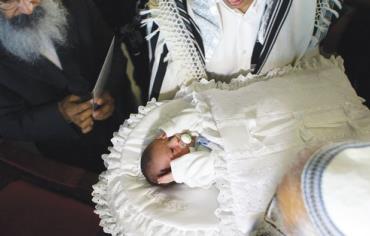
Baby undergoes circumcision Photo: REUTERS
A United Nations official gave a boost to the battle Jewish organizations are waging to protect the ancient ritual of circumcision, when he told the Human Rights Council it was a right that should be protected.
“Freedom of religion and belief in its application goes far beyond any pre-defined lists of classical religions,” Heiner Bielefeldt said in Geneva on Wednesday. “It protects human beings in their broad variety of convictions, and also conviction-based practices. So issues like male circumcision are part of that.”
Bielefeldt, who is the UNHRC’s special rapporteur on freedom of religion, made his brief comment on circumcision one day after he delivered a global report to the council on freedom of religion.
The report did not deal with circumcision, but the World Jewish Congress discussed the issue when it addressed the council and Bielefeldt on Wednesday morning, in a statement delivered by Lisa Rahmani.
Rahmani, a member of the WJC’s Jewish Diplomatic Corps program, urged the council to protect Jewish male circumcision and shechita, ritual slaughter of animals. She added that religious Muslims who eat halal meat also needed protection for their ritual slaughter practices.
Shechita and circumcision are cornerstones of Jewish religious practice that date back thousands of years, Rahmani said.
“However, today we are witnessing an increasing number of government actions that seek to condemn and ban these religious practices,” Rahmani said. “We call on the special rapporteur to recognize that these practices are forms of religious expression, to recognize that they are not trumped by other values, and to ask him to consider limitations on ritual slaughter and circumcision as violations of freedom of religion in his next report to the council.”
She spoke on behalf of the WJC after European countries such as Poland, Iceland, Norway, Sweden, Switzerland and Denmark banned shechita on humanitarian grounds. There is also a growing movement in Europe to ban circumcision, though no country has done so yet.
“Judaism was the first culture to teach that animals, and even plants, should be treated with respect, at a time when humanity had not begun to think in terms of animal rights,” Rahmani said. “Quite conveniently, some prefer to ignore the origin of the values they claim to defend.”
She added: “If opponents of shechita really cared about animals, they would have banned, for example, the cooking of live seafood in pots of boiling water; they would have banned force-feeding of geese and ducks; they would have banned hunting for sport.”
None of these things have been banned, Rahmani said, and instead the focus has been on ritual slaughter.
“In the same way, it is ironic and distressing to observe that circumcision is considered to be a mutilation when performed for religious reason, but is acceptable, and often encouraged, if performed for medical reasons,” Rahmani said.
On Thursday, Michael Colson, the WJC’s representative in Geneva, told The Jerusalem Post he was encouraged that Bielefeldt responded to them so quickly during the same session.
He was hopeful, he said, that if the next report on freedom of religion called for the protection of circumcision practices, it could influence European lawmakers who might otherwise be inclined to outlaw it.
Religious Tolerance
The First Amendment to the Constitution of the United States
"AN ACT FOR ESTABLISHING RELIGIOUS FREEDOM", VIRGINIA
"II. Be it enacted by the General Assembly, That no man shall be compelled to frequent or support any religious worship, place or ministry whatsoever, nor shall be enforced, restrained, molested or burdened in his body or goods, nor shall otherwise suffer on account of his religious opinions or belief; but that all men shall be free to profess, and by argument to maintain, their opinion in matters of religion, and that the same shall in no wise diminish, enlarge, or affect their civil capacities."
Elsewhere, the act reads:
"To compel a man to furnish contributions of money for the propagation of opinions which he disbelieves and abhors, is sinful and tyrannical..."
And:
"...our civil rights have no dependence on our religious opinions ..."
Religious freedom is often called the "first freedom."
https://en.wikipedia.org/wiki/Virginia_Statute_for_Religious_Freedom
An Act for establishing religious Freedom.
Whereas, Almighty God hath created the mind free;
That all attempts to influence it by temporal punishments or burthens, or by civil incapacitations tend only to beget habits of hypocrisy and meanness, and therefore are a departure from the plan of the holy author of our religion, who being Lord, both of body and mind yet chose not to propagate it by coercions on either, as was in his Almighty power to do,
That the impious presumption of legislators and rulers, civil as well as ecclesiastical, who, being themselves but fallible and uninspired men have assumed dominion over the faith of others, setting up their own opinions and modes of thinking as the only true and infallible, and as such endeavouring to impose them on others, hath established and maintained false religions over the greatest part of the world and through all time;
That to compel a man to furnish contributions of money for the propagation of opinions, which he disbelieves is sinful and tyrannical;
That even the forcing him to support this or that teacher of his own religious persuasion is depriving him of the comfortable liberty of giving his contributions to the particular pastor, whose morals he would make his pattern, and whose powers he feels most persuasive to righteousness, and is withdrawing from the Ministry those temporary rewards, which, proceeding from an approbation of their personal conduct are an additional incitement to earnest and unremitting labours for the instruction of mankind;
That our civil rights have no dependence on our religious opinions any more than our opinions in physics or geometry,
That therefore the proscribing any citizen as unworthy the public confidence, by laying upon him an incapacity of being called to offices of trust and emolument, unless he profess or renounce this or that religious opinion, is depriving him injuriously of those privileges and advantages, to which, in common with his fellow citizens, he has a natural right,
That it tends only to corrupt the principles of that very Religion it is meant to encourage, by bribing with a monopoly of worldly honours and emoluments those who will externally profess and conform to it;
That though indeed, these are criminal who do not withstand such temptation, yet neither are those innocent who lay the bait in their way;
That to suffer the civil magistrate to intrude his powers into the field of opinion and to restrain the profession or propagation of principles on supposition of their ill tendency is a dangerous fallacy which at once destroys all religious liberty because he being of course judge of that tendency will make his opinions the rule of judgment and approve or condemn the sentiments of others only as they shall square with or differ from his own;
That it is time enough for the rightful purposes of civil government, for its officers to interfere when principles break out into overt acts against peace and good order;
And finally, that Truth is great, and will prevail if left to herself, that she is the proper and sufficient antagonist to error, and has nothing to fear from the conflict, unless by human interposition disarmed of her natural weapons free argument and debate, errors ceasing to be dangerous when it is permitted freely to contradict them:
Be it enacted by General Assembly that no man shall be compelled to frequent or support any religious worship, place, or ministry whatsoever, nor shall be enforced, restrained, molested, or burthened in his body or goods, nor shall otherwise suffer on account of his religious opinions or belief, but that all men shall be free to profess, and by argument to maintain, their opinions in matters of Religion, and that the same shall in no wise diminish, enlarge or affect their civil capacities. And though we well know that this Assembly elected by the people for the ordinary purposes of Legislation only, have no power to restrain the acts of succeeding Assemblies constituted with powers equal to our own, and that therefore to declare this act irrevocable would be of no effect in law; yet we are free to declare, and do declare that the rights hereby asserted, are of the natural rights of mankind, and that if any act shall be hereafter passed to repeal the present or to narrow its operation, such act will be an infringement of natural right.[SUP][4][/SUP]
https://en.wikipedia.org/wiki/First_Amendment_to_the_United_States_Constitution
International Religious Freedom
International Religious Freedom Report for 2012
Baby undergoes circumcision Photo: REUTERS
A United Nations official gave a boost to the battle Jewish organizations are waging to protect the ancient ritual of circumcision, when he told the Human Rights Council it was a right that should be protected.
“Freedom of religion and belief in its application goes far beyond any pre-defined lists of classical religions,” Heiner Bielefeldt said in Geneva on Wednesday. “It protects human beings in their broad variety of convictions, and also conviction-based practices. So issues like male circumcision are part of that.”
Bielefeldt, who is the UNHRC’s special rapporteur on freedom of religion, made his brief comment on circumcision one day after he delivered a global report to the council on freedom of religion.
The report did not deal with circumcision, but the World Jewish Congress discussed the issue when it addressed the council and Bielefeldt on Wednesday morning, in a statement delivered by Lisa Rahmani.
Rahmani, a member of the WJC’s Jewish Diplomatic Corps program, urged the council to protect Jewish male circumcision and shechita, ritual slaughter of animals. She added that religious Muslims who eat halal meat also needed protection for their ritual slaughter practices.
Shechita and circumcision are cornerstones of Jewish religious practice that date back thousands of years, Rahmani said.
“However, today we are witnessing an increasing number of government actions that seek to condemn and ban these religious practices,” Rahmani said. “We call on the special rapporteur to recognize that these practices are forms of religious expression, to recognize that they are not trumped by other values, and to ask him to consider limitations on ritual slaughter and circumcision as violations of freedom of religion in his next report to the council.”
She spoke on behalf of the WJC after European countries such as Poland, Iceland, Norway, Sweden, Switzerland and Denmark banned shechita on humanitarian grounds. There is also a growing movement in Europe to ban circumcision, though no country has done so yet.
“Judaism was the first culture to teach that animals, and even plants, should be treated with respect, at a time when humanity had not begun to think in terms of animal rights,” Rahmani said. “Quite conveniently, some prefer to ignore the origin of the values they claim to defend.”
She added: “If opponents of shechita really cared about animals, they would have banned, for example, the cooking of live seafood in pots of boiling water; they would have banned force-feeding of geese and ducks; they would have banned hunting for sport.”
None of these things have been banned, Rahmani said, and instead the focus has been on ritual slaughter.
“In the same way, it is ironic and distressing to observe that circumcision is considered to be a mutilation when performed for religious reason, but is acceptable, and often encouraged, if performed for medical reasons,” Rahmani said.
On Thursday, Michael Colson, the WJC’s representative in Geneva, told The Jerusalem Post he was encouraged that Bielefeldt responded to them so quickly during the same session.
He was hopeful, he said, that if the next report on freedom of religion called for the protection of circumcision practices, it could influence European lawmakers who might otherwise be inclined to outlaw it.
Religious Tolerance
The First Amendment to the Constitution of the United States
"AN ACT FOR ESTABLISHING RELIGIOUS FREEDOM", VIRGINIA
"II. Be it enacted by the General Assembly, That no man shall be compelled to frequent or support any religious worship, place or ministry whatsoever, nor shall be enforced, restrained, molested or burdened in his body or goods, nor shall otherwise suffer on account of his religious opinions or belief; but that all men shall be free to profess, and by argument to maintain, their opinion in matters of religion, and that the same shall in no wise diminish, enlarge, or affect their civil capacities."
Elsewhere, the act reads:
"To compel a man to furnish contributions of money for the propagation of opinions which he disbelieves and abhors, is sinful and tyrannical..."
And:
"...our civil rights have no dependence on our religious opinions ..."
Religious freedom is often called the "first freedom."
https://en.wikipedia.org/wiki/Virginia_Statute_for_Religious_Freedom
An Act for establishing religious Freedom.
Whereas, Almighty God hath created the mind free;
That all attempts to influence it by temporal punishments or burthens, or by civil incapacitations tend only to beget habits of hypocrisy and meanness, and therefore are a departure from the plan of the holy author of our religion, who being Lord, both of body and mind yet chose not to propagate it by coercions on either, as was in his Almighty power to do,
That the impious presumption of legislators and rulers, civil as well as ecclesiastical, who, being themselves but fallible and uninspired men have assumed dominion over the faith of others, setting up their own opinions and modes of thinking as the only true and infallible, and as such endeavouring to impose them on others, hath established and maintained false religions over the greatest part of the world and through all time;
That to compel a man to furnish contributions of money for the propagation of opinions, which he disbelieves is sinful and tyrannical;
That even the forcing him to support this or that teacher of his own religious persuasion is depriving him of the comfortable liberty of giving his contributions to the particular pastor, whose morals he would make his pattern, and whose powers he feels most persuasive to righteousness, and is withdrawing from the Ministry those temporary rewards, which, proceeding from an approbation of their personal conduct are an additional incitement to earnest and unremitting labours for the instruction of mankind;
That our civil rights have no dependence on our religious opinions any more than our opinions in physics or geometry,
That therefore the proscribing any citizen as unworthy the public confidence, by laying upon him an incapacity of being called to offices of trust and emolument, unless he profess or renounce this or that religious opinion, is depriving him injuriously of those privileges and advantages, to which, in common with his fellow citizens, he has a natural right,
That it tends only to corrupt the principles of that very Religion it is meant to encourage, by bribing with a monopoly of worldly honours and emoluments those who will externally profess and conform to it;
That though indeed, these are criminal who do not withstand such temptation, yet neither are those innocent who lay the bait in their way;
That to suffer the civil magistrate to intrude his powers into the field of opinion and to restrain the profession or propagation of principles on supposition of their ill tendency is a dangerous fallacy which at once destroys all religious liberty because he being of course judge of that tendency will make his opinions the rule of judgment and approve or condemn the sentiments of others only as they shall square with or differ from his own;
That it is time enough for the rightful purposes of civil government, for its officers to interfere when principles break out into overt acts against peace and good order;
And finally, that Truth is great, and will prevail if left to herself, that she is the proper and sufficient antagonist to error, and has nothing to fear from the conflict, unless by human interposition disarmed of her natural weapons free argument and debate, errors ceasing to be dangerous when it is permitted freely to contradict them:
Be it enacted by General Assembly that no man shall be compelled to frequent or support any religious worship, place, or ministry whatsoever, nor shall be enforced, restrained, molested, or burthened in his body or goods, nor shall otherwise suffer on account of his religious opinions or belief, but that all men shall be free to profess, and by argument to maintain, their opinions in matters of Religion, and that the same shall in no wise diminish, enlarge or affect their civil capacities. And though we well know that this Assembly elected by the people for the ordinary purposes of Legislation only, have no power to restrain the acts of succeeding Assemblies constituted with powers equal to our own, and that therefore to declare this act irrevocable would be of no effect in law; yet we are free to declare, and do declare that the rights hereby asserted, are of the natural rights of mankind, and that if any act shall be hereafter passed to repeal the present or to narrow its operation, such act will be an infringement of natural right.[SUP][4][/SUP]
https://en.wikipedia.org/wiki/First_Amendment_to_the_United_States_Constitution
International Religious Freedom
International Religious Freedom Report for 2012