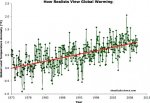
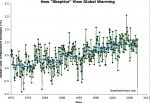
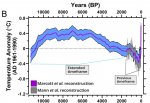
But what makes this a Christian issue instead of an individual issue? We still have no general consensus on global warming but everyone has their opinions and (dare I say) feelings about this and BOTH sides skew the issues to their leaning. People want to make this a global initiative without looking at the entire globe. But back to my point, this isn't a Christian issue but a political one.
No general consensus? Every major scientific organization on Earth recognizes the validity of human catalyzed negative climate change. There most definitely IS a general consensus, and has been for over ten years. From 'Science' publication, 3 December 2004:
.. while discussing a major U.S. Environmental Protection Agency report on the risks of climate change, then-EPA administrator Christine Whitman argued, “As [the report] went through review, it seemed there was less consensus on the science and conclusions on climate change” (1). Some corporations whose revenues might be adversely affected by controls on carbon dioxide emissions have alleged major uncertainties in the science (2). Such statements suggest that there might be substantive disagreement in the scientific community about the reality of anthropogenic climate change. This is not the case.
The scientific consensus is clearly expressed in the reports of the Intergovernmental Panel on Climate Change (IPCC). Created in 1988 by the World Meteorological Organization and the United Nations Environmental Programme, IPCC’s purpose is to evaluate the state of climate science as a basis for informed policy action, primarily on the basis of peer-reviewed and published scientific literature (3). In its most recent assessment, IPCC states unequivocally that the consensus of scientific opinion is that Earth’s climate is being affected by human activities: “Human activities … are modifying the concentration of atmospheric constituents … that absorb or scatter radiant energy. … [M]ost of the observed warming over the last 50 years is likely to have been due to the increase in greenhouse gas concentrations” [p. 21 in (4)].
IPCC is not alone in its conclusions. In recent years, all major scientific bodies in the United States whose members’ expertise bears directly on the matter have issued similar statements. For example, the National Academy of Sciences report, Climate Change Science: An Analysis of Some Key Questions, begins: “Greenhouse gases are accumulating in Earth’s atmosphere as a result of human activities, causing surface air temperatures and subsurface ocean temperatures to rise” [p. 1 in (5)]. The report explicitly asks whether the IPCC assessment is a fair summary of professional scientific thinking, and answers yes: “The IPCC’s conclusion that most of the observed warming of the last 50 years is likely to have been due to the increase in greenhouse gas concentrations accurately reflects the current thinking of the scientific community on this issue” [p. 3 in (5)].
Others agree. The American Meteorological Society (6), the American Geophysical Union (7), and the American Association for the Advancement of Science (AAAS) all have issued statements in recent years concluding that the evidence for human modification of climate is compelling (8).
The drafting of such reports and statements involves many opportunities for comment, criticism, and revision, and it is not likely that they would diverge greatly from the opinions of the societies’ members. Nevertheless, they might downplay legitimate dissenting opinions. That hypothesis was tested by analyzing 928 abstracts, published in refereed scientific journals between 1993 and 2003, and listed in the ISI database with the keywords “climate change” (9).
The 928 papers were divided into six categories: explicit endorsement of the consensus position, evaluation of impacts, mitigation proposals, methods, paleoclimate analysis, and rejection of the consensus position. Of all the papers, 75% fell into the first three categories, either explicitly or implicitly accepting the consensus view; 25% dealt with methods or paleoclimate, taking no position on current anthropogenic climate change. Remarkably, none of the papers disagreed with the consensus position.
Admittedly, authors evaluating impacts, developing methods, or studying paleoclimatic change might believe that current climate change is natural. However, none of these papers argued that point.
This analysis shows that scientists publishing in the peer-reviewed literature agree with IPCC, the National Academy of Sciences, and the public statements of their professional societies. Politicians, economists, journalists, and others may have the impression of confusion, disagreement, or discord among climate scientists, but that impression is incorrect.
The scientific consensus might, of course, be wrong. If the history of science teaches anything, it is humility, and no one can be faulted for failing to act on what is not known. But our grandchildren will surely blame us if they find that we understood the reality of anthropogenic climate change and failed to do anything about it.
Many details about climate interactions are not well understood, and there are ample grounds for continued research to provide a better basis for understanding climate dynamics. The question of what to do about climate change is also still open. But there is a scientific consensus on the reality of anthropogenic climate change. Climate scientists have repeatedly tried to make this clear. It is time for the rest of us to listen.
References and Notes
- A. C. Revkin, K. Q. Seelye, New York Times, 19 June 2003, A1.
- S. van den Hove, M. Le Menestrel, H.-C. de Bettignies, Climate Policy 2 (1), 3 (2003).
- See www.ipcc.ch/about/about.htm.
- J. J. McCarthy et al., Eds., Climate Change 2001: Impacts, Adaptation, and Vulnerability (Cambridge Univ. Press, Cambridge, 2001).
- National Academy of Sciences Committee on the Science of Climate Change, Climate Change Science: An Analysis of Some Key Questions (National Academy Press, Washington, DC, 2001).
- American Meteorological Society, Bull. Am. Meteorol. Soc. 84, 508 (2003).
- American Geophysical Union, Eos 84 (51), 574 (2003).
- See www.ourplanet.com/aaas/pages/atmos02.html.
- The first year for which the database consistently published abstracts was 1993. Some abstracts were deleted from our analysis because, although the authors had put “climate change” in their key words, the paper was not about climate change.
- This essay is excerpted from the 2004 George Sarton Memorial Lecture, “Consensus in science: How do we know we’re not wrong,” presented at the AAAS meeting on 13 February 2004. I am grateful to AAAS and the History of Science Society for their support of this lectureship; to my research assistants S. Luis and G. Law; and to D. C. Agnew, K. Belitz, J. R. Fleming, M. T. Greene, H. Leifert, and R. C. J. Somerville for helpful discussions.
Every scientific organization from
NASA to
WHO agree that humans are the major cause of global warming. Have a look at this graph, show the atmospheric PPM (parts per million) of several industrially produces gases in the last 100 years or so:
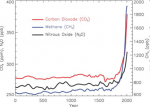
There's absolutely no doubt that such gases have increased exponentially in the atmosphere since the industrial revolution. They are produced en masse in practically every country on Earth, and they do cause warming. I challenge you to study the science rather than blindly accept the conspiracy theories. C
arbon Dioxide is transparent to the radiation form the sun, but opaque to the heat from the Earth. In the most simple scientific terms I can use, basically, carbon dioxide does not reflect vacuum transmitted radiation from the sun, but does reflect and re-disperse the longer wavelength heat that bounces back of the Earth. It traps heat, and the more CO2 there is, the more heat that gets trapped.
Since the dawn of industry, we have added
42% more CO2, with a temperature rise of almost two degrees farenheit. This increase may seem trivial, but many of the Earth's ecosystems have been decimated by it, floods have occured on low lying plans causing mass evacuations and emmigrations, storms have become more intense and frequent, sea levels have risen almost 4mm annually, 1.5 million sq km of forest has been destroyed and most alarmingly, the decrease in Arctic ice rises by 14% every decade.
The increase in CO2 is also not equally positively corelative with heat increase. In fact, the more CO2, the more severely temperatures rise. It is an exponential increase in temperature. So, fo instance, with a 42% increase in CO2, the Earth's temperature has increased by almost 2 degrees F. With an 84% increase in CO2, the Earth's temperature will have increase beyond 4% Farenheit.
There are several short term solutions. Dispersal of aerosols in the atmosphere to cool the Earth, the planting of many, many more trees to convert CO2 into Oxygen, heavy regulations on logging (which is absurdly irresponsible in the US, with somewhere betweeen 85 and 95% of forest having been logged in the last century), and heavy regulations on emissions. But these are only temporary hinderances to climate change. What we really need is a worldwide push for renewable, environmentally friendly energy sources, mass production of hydrogen engines, mass installation of hydrogen pumps, abolishment of fossil fuel use, a turn towards sustainable farming, fair trade and regulation of corporate cattle industry, a massive reduction in transatlantic or transpacific food transportation for irradiation and/or washing etc (a practice where food grown in America, for instance, is flown to South Africa for washing, then to Europe for waxing, then back to America for retailing). There needs to be a lot more done about the problems, because currently, the very reason fuel is so expensive, why travel is a heavy cost, why food is overpriced and why people are poor is because of the capitalist, corporatist, globalized fiat money culture we live in.
There's no reason six organic apples need to cost £3, except that they've been flown here and there by corporate powers via jet liners that burn extremely expensive fossils fuels. There's no reason you have to pay usury on a government loan funded by fiat money printed by private financial institutions other than that they money is borrowed by your government at usury to the banks. There's no reason you have to pay £35 for a train ticket 50 miles away other than the fact that a rich oil oligarch holds sway in your political system and appoints people who profit off of oil. There's no reason we have to pay £1.40 for a litre of fuel other than we use the same oil that is fast running out and which is supported by the politicians who can profit from its use. Hydrogen is cheaper to manufacture, more abundant, and completely non toxic, with 0% emissions. In fact, hydrogen is 275% cheaper than American gasoline. There's no reason your sons and daughters need be fighting in some foreign land for oil control when more viable, safer, cheaper, healthier alternatives are available. The only people stopping this are the people in power.
It's absurd to think that people should want to hold on to our current oil-debt-conflict-climate damaging culture when the alternative would be more profitable for everyone, create more jobs, create cheaper energy, cheaper foods, better quality of product, higher life expectancy, less flooding, less debt, better provisions and a localized farming-consumption culture that's better for everyone involved. The only people who would benefit less from such a system are, unfortunately, the same insanely wealthy people that control the system, and the don't want it to change.
Think you can work out why?




 May I suggest starting with a survey of a variety of studies from a cross-section of reputable institutional and academic bodies?