God's Dispensers continued In II and III...

  • Christian Chat is a moderated online Christian community allowing Christians around the world to fellowship with each other in real time chat via webcam, voice, and text, with the Christian Chat app. You can also start or participate in a Bible-based discussion here in the Christian Chat Forums, where members can also share with each other their own videos, pictures, or favorite Christian music.

    If you are a Christian and need encouragement and fellowship, we're here for you! If you are not a Christian but interested in knowing more about Jesus our Lord, you're also welcome! Want to know what the Bible says, and how you can apply it to your life? Join us!

    To make new Christian friends now around the world, click here to join Christian Chat.

GRACE_ambassador

Well-known member
Feb 22, 2021
4,124
2,758
113
Midwest
Precious friends, I humbly apologize for the shortcoming of these studies.
Here are the other parts of it, And, Please Be Very RICHLY Encouraged And
Edified In The LORD Jesus Christ, And In His Word Of Truth, Rightly
Divided:

(Borrowed from CR Stam)
"...Moses did not personally decide to impose laws upon Israel...
...Nor did God Appoint Moses by some indirect method...

“And The LORD Spake Unto Moses Face to face, as a man speaketh​
unto his friend...” (Ex. 33:11). And [The LORD] Said, Hear now My​
Words: If there be a prophet among you, I The LORD Will Make​
Myself Known Unto him in a vision, and Will Speak Unto him in​
a dream.​
​
My servant Moses is not so, who is faithful in all Mine house.​
With him Will I Speak Mouth to mouth, even apparently, and​
not in dark speeches; and the similitude of The LORD Shall he​
behold: wherefore then were ye not afraid to speak against My​
servant Moses?​
​
And The Anger of The LORD Was Kindled Against them; and He​
Departed” (Num. 12:6-9)...​

...Moses’ own brother and sister Are Sternly Rebuked for questioning Moses’ unique
authority. They were rebelling against God when they rebelled against the one
whom He Had Personally and Directly Appointed. Hence The LORD Asked them:

“Wherefore then were ye not afraid to speak against My servant Moses?”...​

...The argument for Pauline authority today is fully as strong...
"
Moses and Paul (II)

"
...Moses...he was the man, the one man, to whom God Had Committed the
dispensation of the law, and every other man of God for the fifteen hundred
years that followed had to take his place under Moses, so that Even Christ
on earth Was Obedient to Moses’ law and Taught His followers to be
(Matt. 23:1-3)...

...Korah, Dathan and Abiram, with “two hundred and fifty princes...famous in
the congregation, men of renown” (Num. 16:2) gathered themselves together
against Moses...

...at God’s Command, Moses had his critics stand together in a company and
said to them:

“Hereby ye shall know that The LORD Hath Sent me to do all these​
works; for I have not done them of mine own mind” (16:28). And​
it came to pass, as he had made an end of speaking all these words,​
that the ground clave asunder that was under them:​
​
And the earth opened her mouth, and swallowed them up, and their​
houses, and all the men that appertained unto Korah, and all their​
goods” (16:31,32).​

It is fortunate for most believers today that this is the Dispensation of GRACE
rather than of law, for how many, alas, have rebelled against the God-Ordained
authority of Paul as His apostle for this age!

How many, even among Fundamentalists, have fallen into the sin of the
Corinthians and keep forever comparing Paul’s merits with those of the
other apostles or with Those Of Christ...
"
Moses and Paul (III)

Study to Be APPROVED Open Bible.png

GRACE And Peace...
 
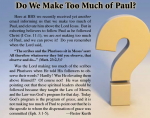
"Then spake Jesus to the multitude, and to his disciples, Saying The scribes and the Pharisees sit in Moses' seat: All therefore whatsoever they bid you observe, that observe and do; but do not ye after their works: for they say, and do not." - Mat 23:1-3 KJV

This states to observe the law.

"And Jesus came and spake unto them, saying, All power is given unto me in heaven and in earth. Go ye therefore, and teach all nations, baptizing them in the name of the Father, and of the Son, and of the Holy Ghost: Teaching them to observe all things whatsoever I have commanded you: and, lo, I am with you always, even unto the end of the world. Amen." - Mat 28:18-20 KJV

This states that the commands of Jesus are to be taught to all nations and observed by all nations. It is the duty of his disciples to do so.

So by extension, all Christians are commanded to follow the law. But, obviously there is some missing context with this conclusion. And it is difficult to explain without going into details about what the law is, what the ordinances of the law are, what is the priesthood of the faith, and who is Chief Priest.

"For the priesthood being changed, there is made of necessity a change also of the law. [...] For such an high priest became us, who is holy, harmless, undefiled, separate from sinners, and made higher than the heavens; Who needeth not daily, as those high priests, to offer up sacrifice, first for his own sins, and then for the people's: for this he did once, when he offered up himself." - Heb 7& 26-27 KJV

The ordinances of the law changed, but the applicability of the law to everyone of the faith of God's chosen (as a commandment to righteousness) never did. Those in Christ are God's chosen people, and still satisfy the law by Christ who fulfills it. It's not that the law of the OT doesn't apply to Christians, it is just that the provisions and ordinances of old regime of the priesthood have been made old, obsolete, and ready to fade away. It was true even in Peter's day that Jews that followed after the old priesthood were being called to leave the false/nullified priesthood and accept Christ as their chief priest. Nowhere does it state that there are two concurrent priesthoods of the faith. One either accepts Christ as the chief priest of the faith or blindly rejects the faith. There is only one faith, though its form has changed over time with the changing priesthood. The current priesthood in Christ stands everlasting by a Chief Priest with everlasting life. And this came into effect at the tearing of the veil, at the resurrection of Christ unto everlasting life.

The priesthoods of the past were the voice of authority before Christ, whether it was Moses or Melchisedec. And now that Christ has taken the seat of that authority within those of the faith, it is His provisions that stand to satisfy the law.

There are two Great Commandments: 1) Love God with all your heart, soul and mind, and 2) Love thy neighbour as thyself (cf. Mat 22).

Christ gave instruction for the teaching all of the nations to observe all things whatsoever he commanded. Christ never said that he was there to remove the law but through Christ the law is fulfilled.

There can be some abiguity regarding what "law" means in different passages, and a thorough exploration of the texts takes time to make proper sense of things. I believe it is worth the time to talk about and discuss. The Law and the ordinances of law under a priesthood are different things and it can sometimes be hard to differentiate between which of the two that a given text is talking about.

A troublesome concept that Dispensationalists put forward is the idea that "Dispensation of Grace" would somehow be mutually exclusive to the law or specifically the law as fulfilled in Christ. There is no evidence of that being the case. The fact that Christ fulfils the law is problematic for Dispensationalism.

Dispensationalists don't respect the whole scope of the authority of the words of Paul and other NT authors, even if some concession is made in part.
 
A troublesome concept that Dispensationalists put forward is the idea that "Dispensation of Grace" would somehow be mutually exclusive to the law or specifically the law as fulfilled in Christ. There is no evidence of that being the case.
Precious friend, did you Overlook the discussion of "Gentiles" in Acts 15?:

1) Judaizers/legalists?:

Act 15:5 But there rose up certain of the sect of the Pharisees​
which believed, saying, That it was needful to circumcise them, ​
and to command them to keep the law of Moses.​
​
2) Peter's rebuke?:

Act 15:10 Now therefore why tempt ye God, to put a yoke upon ​
the neck of the disciples, which neither our fathers nor we were​
able to bear?​
​
3) Concluding With James decision?:

Act 15:19 Wherefore my sentence is, that we trouble not them, ​
which from among the Gentiles are turned to God:​
​
Seems like "Clear Biblical Evidence" to me.

GRACE And Peace...
 
Precious friend, did you Overlook the discussion of "Gentiles" in Acts 15?:

1) Judaizers/legalists?:

Act 15:5 But there rose up certain of the sect of the Pharisees​
which believed, saying, That it was needful to circumcise them, ​
and to command them to keep the law of Moses.​
​
2) Peter's rebuke?:

Act 15:10 Now therefore why tempt ye God, to put a yoke upon ​
the neck of the disciples, which neither our fathers nor we were​
able to bear?​
​
3) Concluding With James decision?:

Act 15:19 Wherefore my sentence is, that we trouble not them, ​
which from among the Gentiles are turned to God:​
​
Seems like "Clear Biblical Evidence" to me.

GRACE And Peace...

I believe you are still missing the difference between the law itself (as in the spirit of the law) and the ordinances of the law (as in the letter of the law). The spirit of the law points to righteousness and does not change. The letter of the law is embodied by the ordinances set out by each respective priesthoods. Every time the Chief Priest changes (by death), the ordinances of the law (the letter of the law) changes. Since the resurrected Christ is immortal and not subject to death, and has taken the seat of the Chief Priest in the faith, the current priesthood is everlasting, unlike all that came before.

All Christians are under law (the spirit of the law) but not under the ordinances of Moses (the letter of the law given to those before Christ's role as the Chief Priest in the current priesthood of the faith).

"But we know that the law is good, if a man use it lawfully; Knowing this, that the law is not made for a righteous man, but for the lawless and disobedient, for the ungodly and for sinners, for unholy and profane, for murderers of fathers and murderers of mothers, for manslayers," - 1 Tim 1:8-9 KJV

A great example to show the difference and the fact that "law" can mean two different things is when we see two types of law referenced in 1 Tim 1:8. The first "law" references the ordinances under Moses (and the ordinances of subsequent mortal priesthoods), the second instance, "lawfully", refers to righteousness or the spirit of the law. Christians are under the spiritual law through the ordinances of the law of Christ, but are not obliged under the former Mosaic ordinances (as they have expired).