How should we account for Evil in the Garden?

  • Christian Chat is a moderated online Christian community allowing Christians around the world to fellowship with each other in real time chat via webcam, voice, and text, with the Christian Chat app. You can also start or participate in a Bible-based discussion here in the Christian Chat Forums, where members can also share with each other their own videos, pictures, or favorite Christian music.

    If you are a Christian and need encouragement and fellowship, we're here for you! If you are not a Christian but interested in knowing more about Jesus our Lord, you're also welcome! Want to know what the Bible says, and how you can apply it to your life? Join us!

    To make new Christian friends now around the world, click here to join Christian Chat.
Neither of those verses claim what your wishful thinking indicates.

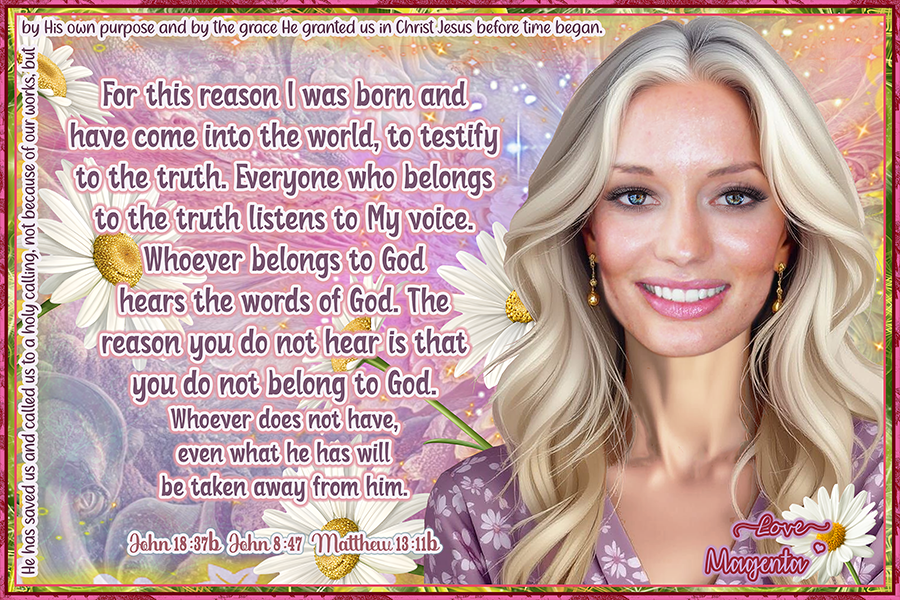
John18-37b-John8-47-Matthew13-11b.png

John 18 v 37b John 8 v 47 Matthew 13 v 11b For this reason I was born and have come into the world, to testify to the truth. Everyone who belongs to the truth listens to My voice. Whoever belongs to God hears the words of God. The reason you do not hear is that you do not belong to God. Whoever does not have, even what he has will be taken away from him. Plus 2 Timothy 1 v 9, He has saved us and called us to a holy calling, not because of our works, but by His own purpose and by the grace He granted us in Christ Jesus before time began.
Well, even though you do not believe those verses, IMO you should make an artistic panel that quotes them in order to balance the verses you prefer.
Everything I share on CC is what God has spoken to me during my lifetime. What He has taught me via interaction with you is humility, which is why I keep apologizing for offending you.
 
Without a doubt, there was evil that crept into the a garden of Eden. It took the form of a talking snake. If God+ did not put the evil in the garden, where did it come from and what does your answer imply about the omnipotence and omnipotence of God+?
Personally, I focus more on the omniscience or foreknowledge of God. Jesus was foreordained to be the Lamb of God before the foundation of the world or before the garden of Eden, the serpent, and Adam and Eve even existed. 1 Peter 1:18-21. That tells me that God has a solution to all of my problems before I even face them, and I find comfort and hope in that.​
 
  • Like
  • Heart
Reactions: Ruthie and Magenta
Well, even though you do not believe those verses, IMO you should make an artistic panel that quotes them in order to balance the verses you prefer.
Everything I share on CC is what God has spoken to me during my lifetime. What He has taught me via interaction with you is humility, which is why I keep apologizing for offending you.
I have never been offended by you. I enjoy our interactions. We may disagree on an issue or two but that has nothing to do with the respect I hold for all who profess the Holy name of Jesus.
 
You are not considering a third option. That God knew what could happen and is wise enough to deal with whatever man would choose to do.
To say that God only knew what "could happen" is to impune the all knowing nature of God. Was creating mankind just God flipping a coin to see what the result would be? Were God+ handicapping the outcome?

Supposed you told your one yr old son not to eat the candy you put on the table in front of him. Then your pet dog told him how great candy tasted and how you would not be mad if he ate it. He did. As a result you punish your child for the rest of your life and his. Welcome to the short version of the garden of eden story.

Neither your one yr old nor Adam had ever heard a lie. Neither your one yr old nor Adam had ever been deceived by anything or anyone. Adam had no idea that he was already eternal until he ate the wrong fruit. He certainly did not understand he would lose his eternal life for eating the forbidden fruit so he had no opportunity to make a moral choice between obedience + eternal life and a sudden mortality. Adam did not know the difference between good and evil until AFTER he had eaten the fruit of the knowledge of good and evil. Thus, he did not know that disobeying God was evil as he did only after he gained the knowledge of good and evil.

Does this read more like a story written by ancient Hebrew writers, borrowing strongly from Mesopotamian origin stories or an accurate and historical story about a God+ that got creation wrong? Remember, God+ repented that they ever created mankind and every living thing in creation. Anger, regret and frustration are "characteristics" of the same God of creation of a few chapters earlier. Do you see God as a God of anger, regret and frustration that his grand plan went so wrong that He demanded a "do over"? According to Genesis, God+ must have also been angry, regretting and frustrated by a host of sexually lustful male members of Heaven who came to breed with earth women. I can see why that would make any creator angry, frustrated and revengeful.

On the other hand, did they build their Hebrew God from the same myths as did the Mesopotamian God myths? Afterall, the early civilizations were the Sumerians and that Akkadians each of which were founded "between the rivers" of the euphrates and tigris rivers exactly where the writes of Genesis put the garden of eden.

The gods of the Mesopotamians and the God+ of the Hebrews all exhibited the same foibles as humans. The God+ of Genesis is exactly like the human conceptualizations of the Mesopotamians. There was no single God in Mesopotamian myths either. Both the ancient mythical gods and the Hebrew created God share most of the same characteristics. Both get frustrated with the their creation. Both find one family to save via building a god designed boat on which their families and two of all the animals of the earth were placed. Both lived in the boat for a long time (Noah is the longest at 377 days.) Both land on mountains about 300 miles apart. Both send out birds to see if there was any dry land doves and ravens in both stories. Both stories have the survivors building an altar and offering a sacrifice. Both get a promise that God or gods will never destroy man by water again.

So, to me Genesis looks much more like an origin story lifted from the much more ancient origin story that had been told for a thousand years before the Hebrew's had even invented their own written narrative capable language around 800 BC.

Whether you see this as a case of "divine inspiration" or ancient myths repurposed, the outcome is the same. Both agree mankind was created by God. In the earliest interactions between man and God things did not go well and mankind was lucky to exist at all. The mesopotamians told their theological stories in 5 great volumes leaving behind thousands of clay tablets. The Hebrews produced 5 great theological volumes on the same God/Man subject. Genesis, Exodus, Leviticus, Number and Deuteronomy.

 
To say that God only knew what "could happen" is to impune the all knowing nature of God. Was creating mankind just God flipping a coin to see what the result would be? Were God+ handicapping the outcome?
Who are you referringto as God+, by the way?

It does not impune the all-knowing nature of God to say that He may have known what could happen. It may impugn your conception of the all knowing nature of God. But your concept of divine omniscience may be incorrect. Knowing all things may mean knowing all things that are true. Maybe the future is not yet true.

No, personally, I don’t think "creating mankind [was] just God flipping a coin to see what the result would be”.
 
Who are you referringto as God+, by the way?

It does not impune the all-knowing nature of God to say that He may have known what could happen. It may impugn your conception of the all knowing nature of God. But your concept of divine omniscience may be incorrect. Knowing all things may mean knowing all things that are true. Maybe the future is not yet true.

No, personally, I don’t think "creating mankind [was] just God flipping a coin to see what the result would be”.
In Genesis God is plural....Let us create.....After Adam and Eve had eaten the forbidden fruit "and God said, now that man has become like one of us." To suggest that God does not know "what could happen" clearly indicates a divine limitation on God's will. What God wills happens. What God does not want to happen does not happen. There is no indication that God engages in divine guessing or that what happens is a complete surprise and against His will. Either God rules or circumstances rule. Pick one.
 
In Genesis God is plural....Let us create.....After Adam and Eve had eaten the forbidden fruit "and God said, now that man has become like one of us." To suggest that God does not know "what could happen" clearly indicates a divine limitation on God's will. What God wills happens. What God does not want to happen does not happen. There is no indication that God engages in divine guessing or that what happens is a complete surprise and against His will. Either God rules or circumstances rule. Pick one.
Open theism posits that God does not definitively know the future. It is one of a
number of theological aberrations born of the philosophical construct of "free will."
 
  • Like
Reactions: biblestudent78
I have never been offended by you. I enjoy our interactions. We may disagree on an issue or two but that has nothing to do with the respect I hold for all who profess the Holy name of Jesus.

That's weird! I thought that my post replied to what Magenta said in #61.

Glad we are simpatico!
:cool:
 
In Genesis God is plural....Let us create.....After Adam and Eve had eaten the forbidden fruit "and God said, now that man has become like one of us." To suggest that God does not know "what could happen" clearly indicates a divine limitation on God's will. What God wills happens. What God does not want to happen does not happen. There is no indication that God engages in divine guessing or that what happens is a complete surprise and against His will. Either God rules or circumstances rule. Pick one.
You seem to like to reduce issues to false dilemmas. It is possible for authority A who rules, to rule that others be allowed a measure of authority and freedom to disagree with and act against the will of authority A. You may be arbitrarily imposing your own authoritarian attitudes onto God.

If God is omnipotent, does that not mean He is must have the ability to limit His own exercise of His own power, if He chooses to do so for His own private reasons ? Your idea that God cannot limit His own power would seem to be you saying that God lacks an ability that His creatures have, and therefore, logically, your version of God would be not be omnipotent.

The Pharisees rejected God’s will for them by refusing John’s baptism. How can you say that "there is no indication that … what happens is… against His will.”

Luk 7:30
But the Pharisees and lawyers rejected the will of God for themselves, not having been baptized by him.
 
  • Like
Reactions: GWH
Personally, I focus more on the omniscience or foreknowledge of God. Jesus was foreordained to be the Lamb of God before the foundation of the world or before the garden of Eden, the serpent, and Adam and Eve even existed. 1 Peter 1:18-21. That tells me that God has a solution to all of my problems before I even face them, and I find comfort and hope in that.​

Yes, that solution is called heaven.