Ēostre (also spelled Ostara) is the goddess of spring, not Easter. Satan is clever isn't he?I only use the KJV because it's been the most accurate but it's not without error
Here's an example of an error in the KJV
Why does King James Bible Acts 12:4 say "Easter"?
Acts 12:4
And when he had apprehended him, he put him in prison, and delivered him to four quaternions of soldiers to keep him; intending after easter to bring him forth to the people.
meta to pascha means "after Passover", but the same term, Pascha, is used for Easter in most languages. English and German are peculiar in calling it Easter (or in German, Ostern) rather than using a term derived from Pesach (Hebrew) / Pascha (Greek) for Passover.
The actual word the KJV translators translated in error to say "easter" is pascha (Strong's G3957)
of Aramaic origin (compare H6453); the Passover (the meal, the day, the festival or the special sacrifices connected with it): KJV -- Easter, Passover.
H6453 - pecach -- pronounced: peh'-sakh
from 6452; a pretermission, i.e. exemption; used only technically of the Jewish Passover (the festival or the victim): KJV -- passover (offering).
Pagan origins of easter
the Easter story comes from the Sumerian legend of Damuzi (Tammuz) and his wife Inanna (Ishtar), an epic myth called “The Descent of Inanna” found inscribed on cuneiform clay tablets dating back to 2100 BC. When Tammuz dies, Ishtar is grief–stricken and follows him to the underworld. In the underworld, she enters through seven gates, and her worldly attire is removed. "Naked and bowed low" she is judged, killed, and then hung on display. In her absence, the earth loses its fertility, crops cease to grow and animals stop reproducing. Unless something is done, all life on earth will end.
After Inanna has been missing for three days her assistant goes to other gods for help. Finally one of them Enki, creates two creatures who carry the plant of life and water of life down to the Underworld, sprinkling them on Inanna and Damuzi, resurrecting them, and giving them the power to return to the earth as the light of the sun for six months. After the six months are up, Tammuz returns to the underworld of the dead, remaining there for another six months, and Ishtar pursues him, prompting the water god to rescue them both. Thus were the cycles of winter death and spring life.
The Sumerian goddess Inanna is known outside of Mesopotamia by her Babylonian name, "Ishtar". In ancient Canaan Ishtar is known as Astarte, and her counterparts in the Greek and Roman pantheons are known as Aphrodite and Venus.
the story of Inanna and Damuzi is just one of a number of accounts of dying and rising gods that represent the cycle of the seasons and the stars. For example, the resurrection of Egyptian Horus; the story of Mithras, who was worshipped at Springtime; and the tale of Dionysus, resurrected by his grandmother. Among these stories are prevailing themes of fertility, conception, renewal, descent into darkness, and the triumph of light over darkness or good over evil.
Easter as a Celebration of the Goddess of Spring
A related perspective is that, rather than being a representation of the story of Ishtar, Easter was originally a celebration of Eostre, goddess of Spring, otherwise known as Ostara, Austra, and Eastre. One of the most revered aspects of Ostara for both ancient and modern observers is a spirit of renewal.
Celebrated at Spring Equinox on March 21, Ostara marks the day when light is equal to darkness, and will continue to grow. As the bringer of light after a long dark winter, the goddess was often depicted with the hare, an animal that represents the arrival of spring as well as the fertility of the season.

Is Knowledge of the Original Languages Necessary for KJV Believers?
- Thread starter Bible_Highlighter
- Start date
-
Christian Chat is a moderated online Christian community allowing Christians around the world to fellowship with each other in real time chat via webcam, voice, and text, with the Christian Chat app. You can also start or participate in a Bible-based discussion here in the Christian Chat Forums, where members can also share with each other their own videos, pictures, or favorite Christian music.
If you are a Christian and need encouragement and fellowship, we're here for you! If you are not a Christian but interested in knowing more about Jesus our Lord, you're also welcome! Want to know what the Bible says, and how you can apply it to your life? Join us!
To make new Christian friends now around the world, click here to join Christian Chat.
You are using an out of date browser. It may not display this or other websites correctly.
You should upgrade or use an alternative browser.
You should upgrade or use an alternative browser.

I think everyone who reads the KJV should do two things as a regular practice or ask it to find another source to explain it. All too often, folks just think there are errors in the Bible. Yet, Jesus and His followers did not think that about the Scriptures.I only use the KJV because it's been the most accurate but it's not without error
Here's an example of an error in the KJV
Why does King James Bible Acts 12:4 say "Easter"?
Acts 12:4
And when he had apprehended him, he put him in prison, and delivered him to four quaternions of soldiers to keep him; intending after easter to bring him forth to the people.
meta to pascha means "after Passover", but the same term, Pascha, is used for Easter in most languages. English and German are peculiar in calling it Easter (or in German, Ostern) rather than using a term derived from Pesach (Hebrew) / Pascha (Greek) for Passover.
The actual word the KJV translators translated in error to say "easter" is pascha (Strong's G3957)
of Aramaic origin (compare H6453); the Passover (the meal, the day, the festival or the special sacrifices connected with it): KJV -- Easter, Passover.
H6453 - pecach -- pronounced: peh'-sakh
from 6452; a pretermission, i.e. exemption; used only technically of the Jewish Passover (the festival or the victim): KJV -- passover (offering).
Pagan origins of easter
the Easter story comes from the Sumerian legend of Damuzi (Tammuz) and his wife Inanna (Ishtar), an epic myth called “The Descent of Inanna” found inscribed on cuneiform clay tablets dating back to 2100 BC. When Tammuz dies, Ishtar is grief–stricken and follows him to the underworld. In the underworld, she enters through seven gates, and her worldly attire is removed. "Naked and bowed low" she is judged, killed, and then hung on display. In her absence, the earth loses its fertility, crops cease to grow and animals stop reproducing. Unless something is done, all life on earth will end.
After Inanna has been missing for three days her assistant goes to other gods for help. Finally one of them Enki, creates two creatures who carry the plant of life and water of life down to the Underworld, sprinkling them on Inanna and Damuzi, resurrecting them, and giving them the power to return to the earth as the light of the sun for six months. After the six months are up, Tammuz returns to the underworld of the dead, remaining there for another six months, and Ishtar pursues him, prompting the water god to rescue them both. Thus were the cycles of winter death and spring life.
The Sumerian goddess Inanna is known outside of Mesopotamia by her Babylonian name, "Ishtar". In ancient Canaan Ishtar is known as Astarte, and her counterparts in the Greek and Roman pantheons are known as Aphrodite and Venus.
the story of Inanna and Damuzi is just one of a number of accounts of dying and rising gods that represent the cycle of the seasons and the stars. For example, the resurrection of Egyptian Horus; the story of Mithras, who was worshipped at Springtime; and the tale of Dionysus, resurrected by his grandmother. Among these stories are prevailing themes of fertility, conception, renewal, descent into darkness, and the triumph of light over darkness or good over evil.
Easter as a Celebration of the Goddess of Spring
A related perspective is that, rather than being a representation of the story of Ishtar, Easter was originally a celebration of Eostre, goddess of Spring, otherwise known as Ostara, Austra, and Eastre. One of the most revered aspects of Ostara for both ancient and modern observers is a spirit of renewal.
Celebrated at Spring Equinox on March 21, Ostara marks the day when light is equal to darkness, and will continue to grow. As the bringer of light after a long dark winter, the goddess was often depicted with the hare, an animal that represents the arrival of spring as well as the fertility of the season.
#1. The moment you think there is an error in the KJV, ask AI to look up the word in the MED (Middle English dictionary).
#2. Study and read the older lexicons before 1611. This way you will not get modernist definitions but you will be getting the same lexical information that the KJV translators would have most likely used, along with other sources of course. Just ask AI to give you a list of the best lexicons in Hebrew and Greek before 1611 and start doing word studies with these older lexicons. Many of them are viewable at Archive.org and some of them you can download as a PDF at Archive and upload it to ChatGPT to find the word you are interested in. You can use Latin to English sites to double check the Latin translations given by ChatGPT.
Anyway, as for Easter, in Acts 12:4 here ya go:
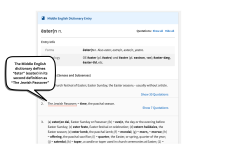
Source: https://quod.lib.umich.edu/m/middle-english-dictionary/dictionary/MED14534
Note:
In Acts 12:4, I see this as the Jewish passover week (i.e., the passover festival / season) and not the Passover day (i.e., Nisan the 14th).
At the time of the events in Acts 12:4, there is no historical evidence that the Greek word πάσχα (pascha) named a pagan festival. In A.D. 725, Bede discussed the Anglo-Saxon month name Eosturmonath and its association with Eostre. He was not saying that pascha was a pagan name or that the Passover was a pagan celebration. Hislop later claimed that Easter came from Ishtar or Astarte, largely by connecting similar sounding names from different cultures. That was Hislop’s conjecture, not an established historical fact; scholars have rejected the claimed Babylonian origin as unsupported.
....
Yep, Christ our passover and Easter is the designated word for such.Jesus going to the Cross for our sins and being raised from the dead is the REAL passover that the passover in the old testament was pointing to.

Ēostre (also spelled Ostara) is the goddess of spring, not Easter. satan is clever isn't he?
Not so cleaver for those who have the Holy Spirit leading them in to Truth (God's Word)
#1. The moment you think there is an error in the KJV, ask AI to look up the word in the MED (Middle English dictionary).
Using AI would be their first mistake.
Yep, Christ our passover and Easter is the designated word for such.
No, passover is the word that the Lord used when He dictated the Book of Acts to Luke.
The Lord would not be taking the name used by followers of the devil for their demonic rituals to describe passover.
Canal minded people would do that, but the Lord would not.
Jesus going to the Cross for our sins and being raised from the dead is the REAL passover that the passover in the old testament was pointing to as in that was the real Passover!
The word Ēostre was not a part of the original inspired Greek text. πάσχα (pascha) is what was in the text and that word has never been used of a pagan festival in history. If you think otherwise, then please supply the historic account of such a thing for this Greek word.Ēostre (also spelled Ostara) is the goddess of spring, not Easter. Satan is clever isn't he?
This is why folks looking to English alone have things backwards.
The KJV translators said that the Hebrew and Greek were the two golden pipes that they translated from.
Lancelot Andrews has done a ton of sermons using certain Greek words.
....
The KJV translators knew very well what pascha meant. They didn't have a brain lapse when translating it as Easter, nor was the intention to direct it towards a pagan holiday that wouldn't come about until many years after the event in the passage. Easter is the English word for the fulfillment of Passover, Christ our Passover Lamb.I think everyone who reads the KJV should do two things as a regular practice or ask it to find another source to explain it. All too often, folks just think there are errors in the Bible. Yet, Jesus and His followers did not think that about the Scriptures.
#1. The moment you think there is an error in the KJV, ask AI to look up the word in the MED (Middle English dictionary).
#2. Study and read the older lexicons before 1611. This way you will not get modernist definitions but you will be getting the same lexical information that the KJV translators would have most likely used, along with other sources of course. Just ask AI to give you a list of the best lexicons in Hebrew and Greek before 1611 and start doing word studies with these older lexicons. Many of them are viewable at Archive.org and some of them you can download as a PDF at Archive and upload it to ChatGPT to find the word you are interested in. You can use Latin to English sites to double check the Latin translations given by ChatGPT.
Anyway, as for Easter, in Acts 12:4 here ya go:
View attachment 296534
Source: https://quod.lib.umich.edu/m/middle-english-dictionary/dictionary/MED14534
Note:
In Acts 12:4, I see this as the Jewish passover week (i.e., the passover festival / season) and not the Passover day (i.e., Nisan the 14th).
At the time of the events in Acts 12:4, there is no historical evidence that the Greek word πάσχα (pascha) named a pagan festival. In A.D. 725, Bede discussed the Anglo-Saxon month name Eosturmonath and its association with Eostre. He was not saying that pascha was a pagan name or that the Passover was a pagan celebration. Hislop later claimed that Easter came from Ishtar or Astarte, largely by connecting similar sounding names from different cultures. That was Hislop’s conjecture, not an established historical fact; scholars have rejected the claimed Babylonian origin as unsupported.
....
Well, it can be a mistake if you do not ask it for links for you to verify the truth for yourself with your own two eyes.Not so cleaver for those who have the Holy Spirit leading them in to Truth (God's Word)
Using AI would be their first mistake.
The problem would only arise if you just blindly believed what it said without any source links that it can give you.
As for not using AI: I am sorry, but that is what everyone is mostly using to do searches these days. The old days of just doing a Google search with no AI is the way of the dinosaur. Even Google gives you an AI answer.
I imagine that when people first started to learn of the internet, they probably expressed similar doubts in its use. I would tell the people back then the same thing I would tell others now. Check your sources and do your homework. People back then could just read an article and blindly believe it when it is not true. They did not take the time to verify the sources and carefully weigh the facts and seek out the truth.
In any event, you can verify what the MED says. AI did not create it.
AI also did not create the older pre-1611 lexicons, either. Ai can help you find these sources.
You also did not really address what I said involving the point I made with Acts 12:4, either.
Do you have trusted sources that contradict the information I brought up?
....
Well, it can be a mistake if you do not ask it for links for you to verify the truth for yourself with your own two eyes.
So before AI you were just bumbling through life with no direction?
I can find things on the net without AI just fine.
Truth comes from God's Word through the Holy Spirit, not AI
The old days of just doing a Google search with no AI is the way of the dinosaur.
Yeah and dinosaurs are on the look out for deception as to not be deceived.
AI also did not create the older pre-1611 lexicons, either. Ai can help you find these sources.
Yeah and AI can inject things in to the text that's not true which it's probably already doing to start controlling how people think and what they believe
AI is the devil's best tool to use to deceive the masses. This will become evident to those that actually know the Lord.
The bottom line of understanding is the people thought the gods had returned. It's interesting that in 2,000 years even though the gods have not returned they are looking for them today more than ever. While speaking of the judgment of God, people say "well it hasn't happened yet, probably never will."I think everyone who reads the KJV should do two things as a regular practice or ask it to find another source to explain it. All too often, folks just think there are errors in the Bible. Yet, Jesus and His followers did not think that about the Scriptures.
#1. The moment you think there is an error in the KJV, ask AI to look up the word in the MED (Middle English dictionary).
#2. Study and read the older lexicons before 1611. This way you will not get modernist definitions but you will be getting the same lexical information that the KJV translators would have most likely used, along with other sources of course. Just ask AI to give you a list of the best lexicons in Hebrew and Greek before 1611 and start doing word studies with these older lexicons. Many of them are viewable at Archive.org and some of them you can download as a PDF at Archive and upload it to ChatGPT to find the word you are interested in. You can use Latin to English sites to double check the Latin translations given by ChatGPT.
Anyway, as for Easter, in Acts 12:4 here ya go:
View attachment 296534
Source: https://quod.lib.umich.edu/m/middle-english-dictionary/dictionary/MED14534
Note:
In Acts 12:4, I see this as the Jewish passover week (i.e., the passover festival / season) and not the Passover day (i.e., Nisan the 14th).
At the time of the events in Acts 12:4, there is no historical evidence that the Greek word πάσχα (pascha) named a pagan festival. In A.D. 725, Bede discussed the Anglo-Saxon month name Eosturmonath and its association with Eostre. He was not saying that pascha was a pagan name or that the Passover was a pagan celebration. Hislop later claimed that Easter came from Ishtar or Astarte, largely by connecting similar sounding names from different cultures. That was Hislop’s conjecture, not an established historical fact; scholars have rejected the claimed Babylonian origin as unsupported.
....
Jupiter is the supreme god. The new Bibles substitute Zeus for Jupiter and Hermes for Mercury. The world was ruled by Rome (Jupiter, Latin) not Greece (Zeus, Greek). Consequently Roman gods were worshipped. Mercury was the interpreter or spokesman, thus Paul's designation. See Rev. 13:10-17.
Sorry, that's not going to work. You need to establish in some pre-1611 lexicon or pre-1611 English dictionary the KJV translators would have had possible access to in order to establish that fact. Until then, all you have are assumptions in your own mind on what you think the KJV translators meant. I have shown an actual dictionary (the MED) that clearly shows that your definition did not exist from 1100s to 1500s.The KJV translators knew very well what pascha meant. They didn't have a brain lapse when translating it as Easter, nor was the intention to direct it towards a pagan holiday that wouldn't come about until many years after the event in the passage. Easter is the English word for the fulfillment of Passover, Christ our Passover Lamb.
....