
Male leading the church services in some churches
- Thread starter roysudha84
- Start date
-
Christian Chat is a moderated online Christian community allowing Christians around the world to fellowship with each other in real time chat via webcam, voice, and text, with the Christian Chat app. You can also start or participate in a Bible-based discussion here in the Christian Chat Forums, where members can also share with each other their own videos, pictures, or favorite Christian music.
If you are a Christian and need encouragement and fellowship, we're here for you! If you are not a Christian but interested in knowing more about Jesus our Lord, you're also welcome! Want to know what the Bible says, and how you can apply it to your life? Join us!
To make new Christian friends now around the world, click here to join Christian Chat.
You are using an out of date browser. It may not display this or other websites correctly.
You should upgrade or use an alternative browser.
You should upgrade or use an alternative browser.

T
TruthDefender
Guest
Women are to keep quiet during worship.Some churches allow only males to perform services, and barring females to lead is not recommended in the Bible it permits advice appreciated
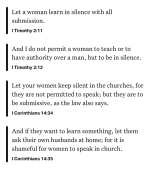
Women can preach, Jesus did not said anytime not to preach, then who is Magdalena Maria who went onto preach the good news after Jesus's resurrection, the Timothy and corinthians are pointing towards the message to those women in Greece at that time not to all women, as women at those times in corinthians were very inappropriate, as everybody knows to whom Paul is witnessing to
At the same time wife need to obey her husband and husband need to love his wife
At the same time wife need to obey her husband and husband need to love his wife

Mary Magdalene was the first witness of the resurrection, and Jesus commanded her, “Go to my brothers and say…” — which means women absolutely proclaim the gospel.
The mistake is thinking that this single fact automatically cancels Paul’s instructions in 1 Timothy 2 and 1 Corinthians 14; those passages are not about silencing women, nor about Greek women being “inappropriate,” nor about temporary cultural chaos.
Paul grounds his instruction in creation order (“For Adam was formed first…”) — not Corinthian culture — which means he is addressing authoritative teaching and governing office, not Spirit‑empowered proclamation.
Women in the NT prophesy, evangelize, teach other women, instruct children, host churches, and even correct apostles (Priscilla with Apollos), but Paul draws a line at elder‑level authority, not at preaching the gospel.
Your argument collapses because you treat Paul’s words as culturally limited when Paul himself roots them in Genesis, and because you confuse apostolic witness (which women clearly had) with pastoral office (which Paul restricts).
The NT vision is not “women can’t preach”; it is “women can proclaim Christ boldly, but the governing office of the church follows creation order.”
You just briefed my commentMary Magdalene was the first witness of the resurrection, and Jesus commanded her, “Go to my brothers and say…” — which means women absolutely proclaim the gospel.
The mistake is thinking that this single fact automatically cancels Paul’s instructions in 1 Timothy 2 and 1 Corinthians 14; those passages are not about silencing women, nor about Greek women being “inappropriate,” nor about temporary cultural chaos.
Paul grounds his instruction in creation order (“For Adam was formed first…”) — not Corinthian culture — which means he is addressing authoritative teaching and governing office, not Spirit‑empowered proclamation.
Women in the NT prophesy, evangelize, teach other women, instruct children, host churches, and even correct apostles (Priscilla with Apollos), but Paul draws a line at elder‑level authority, not at preaching the gospel.
Your argument collapses because you treat Paul’s words as culturally limited when Paul himself roots them in Genesis, and because you confuse apostolic witness (which women clearly had) with pastoral office (which Paul restricts).
The NT vision is not “women can’t preach”; it is “women can proclaim Christ boldly, but the governing office of the church follows creation order.”
ah yeah, as he needed the details of scripture that you didn't provide in your rebuttal. Your welcome.You just briefed my comment
"You want the scriptural and historical details? Let’s look at exactly what was happening with the women in Greece (Corinth and Ephesus) at that time, which proves Paul was addressing local, inappropriate behavior—not making a universal rule.1. Inappropriate and Disruptive Behavior in Corinth (Greece)When Paul tells women to be silent in 1 Corinthians 14:34-35, he reveals exactly what the inappropriate behavior was. He writes: 'If they want to inquire about something, they should ask their own husbands at home; for it is disgraceful for a woman to speak in the church.'The Scriptural Proof: The Greek word used here for 'speak' means chatting, whispering, or interrupting. Because women in ancient Greece were generally uneducated and kept separate in public, they were sitting in the Christian assemblies and loudly interrupting the service to ask questions they didn't understand. Paul wasn't banning them from preaching; he was stopping them from causing chaotic disruptions.2. The Wild and Inappropriate Heresies in Ephesus (1 Timothy)1 Timothy was written to Timothy while he was leading the church in Ephesus, a major Greek city. The city was the world center for the Cult of Artemis, a pagan religion completely dominated by female priests who taught that women were superior to men and that Eve was created before Adam.The Scriptural Proof: In 1 Timothy 5:13, Paul describes the exact behavior of the younger Greek women in that church: they were 'getting into the habit of being idle... and not only idlers but also busybodies who talk nonsense, saying things they ought not to.'These uneducated women were bringing pagan ideas into the church and trying to dominate the men. This is why Paul writes in 1 Timothy 2:12: 'I do not permit a woman to teach or to assume authority (authentein) over a man.' The Greek word authentein means 'to usurp, dominate, or control.' Paul was stopping an inappropriate, aggressive takeover caused by Greek pagan culture.3. Why Paul Brought Up 'Creation Order'You claim that because Paul mentions Adam and Eve, it applies to everyone forever. But Paul used Genesis specifically to correct the Ephesian/Greek heresy. The pagan myths in Ephesus taught that woman was created first and man was the deceiver. Paul uses Genesis in 1 Timothy 2:13-14 ('For Adam was formed first, then Eve...') to correct their bad history and false teaching, not to ban holy, educated women from ever speaking.The Bottom Line: If Paul meant women can never speak or hold authority over men universally, he would be a hypocrite. He praised Phoebe as a deacon in Greece (Romans 16:1), Junia as an apostle (Romans 16:7), and Priscilla who authoritatively corrected and taught a male preacher named Apollos (Acts 18:26). Paul corrected the inappropriate Greek culture of that specific time, he didn't silence godly women for eternity."ah yeah, as he needed the details of scripture that you didn't provide in your rebuttal. Your welcome.
The idea that Paul’s instructions in Corinth and Ephesus were merely shutting down “chatty, uneducated Greek women” or “pagan Artemis‑influenced female dominance” is a modern harmonization, not what Paul actually says; in 1 Cor 14 Paul grounds his command in order in worship, not female ignorance, and the verb lalein does not mean “whispering or chatting” but “speaking,” the same verb used for prophecy and tongues, which is why your definition collapses."You want the scriptural and historical details? Let’s look at exactly what was happening with the women in Greece (Corinth and Ephesus) at that time, which proves Paul was addressing local, inappropriate behavior—not making a universal rule.1. Inappropriate and Disruptive Behavior in Corinth (Greece)When Paul tells women to be silent in 1 Corinthians 14:34-35, he reveals exactly what the inappropriate behavior was. He writes: 'If they want to inquire about something, they should ask their own husbands at home; for it is disgraceful for a woman to speak in the church.'The Scriptural Proof: The Greek word used here for 'speak' means chatting, whispering, or interrupting. Because women in ancient Greece were generally uneducated and kept separate in public, they were sitting in the Christian assemblies and loudly interrupting the service to ask questions they didn't understand. Paul wasn't banning them from preaching; he was stopping them from causing chaotic disruptions.2. The Wild and Inappropriate Heresies in Ephesus (1 Timothy)1 Timothy was written to Timothy while he was leading the church in Ephesus, a major Greek city. The city was the world center for the Cult of Artemis, a pagan religion completely dominated by female priests who taught that women were superior to men and that Eve was created before Adam.The Scriptural Proof: In 1 Timothy 5:13, Paul describes the exact behavior of the younger Greek women in that church: they were 'getting into the habit of being idle... and not only idlers but also busybodies who talk nonsense, saying things they ought not to.'These uneducated women were bringing pagan ideas into the church and trying to dominate the men. This is why Paul writes in 1 Timothy 2:12: 'I do not permit a woman to teach or to assume authority (authentein) over a man.' The Greek word authentein means 'to usurp, dominate, or control.' Paul was stopping an inappropriate, aggressive takeover caused by Greek pagan culture.3. Why Paul Brought Up 'Creation Order'You claim that because Paul mentions Adam and Eve, it applies to everyone forever. But Paul used Genesis specifically to correct the Ephesian/Greek heresy. The pagan myths in Ephesus taught that woman was created first and man was the deceiver. Paul uses Genesis in 1 Timothy 2:13-14 ('For Adam was formed first, then Eve...') to correct their bad history and false teaching, not to ban holy, educated women from ever speaking.The Bottom Line: If Paul meant women can never speak or hold authority over men universally, he would be a hypocrite. He praised Phoebe as a deacon in Greece (Romans 16:1), Junia as an apostle (Romans 16:7), and Priscilla who authoritatively corrected and taught a male preacher named Apollos (Acts 18:26). Paul corrected the inappropriate Greek culture of that specific time, he didn't silence godly women for eternity."
In 1 Tim 2 Paul does not appeal to local heresy but to creation order (“Adam was formed first”), which is the opposite of a cultural correction; when Paul uses Genesis to correct error, he uses it because it is universal, not because it is local.
Your claim that Artemis myths taught Eve was created first is historically unsupported; no extant Artemis tradition teaches that, and Paul never mentions Artemis in 1 Timothy.
Your appeal to 1 Tim 5:13 misfires because Paul is addressing younger widows, not “Greek women bringing pagan ideas into the church.”
And authentein does not mean “dominate or usurp” in this context; its lexical range includes “exercise authority,” which is why every major lexicon translates it that way.
Phoebe, Junia, and Priscilla do not overturn Paul’s restriction on elder‑level authority; none of them are presented as elders, and Priscilla’s instruction of Apollos is private, not congregational.
Paul’s pattern is consistent: women prophesy, teach, evangelize, witness, and serve, but the governing office of the church follows creation order, not Greek culture.
"You claim to be standing on 'pure scripture,' but your argument falls apart under the weight of basic Greek grammar and biblical text.Here is why your logic fails, using the exact scriptures you are misreading:1. The Literal Translation of 1 Corinthians 14 Demands a Cultural LimitYou claim lalein only means formal public speaking. If you want to be a literalist about lalein ('to speak') and verse 34 ('women should remain silent in the churches. They are not allowed to speak'), then you must admit Paul contradicts himself.The Scriptural Trap: In 1 Corinthians 11:5, Paul explicitly gives instructions for women praying and prophesying in church. If lalein in chapter 14 means a absolute, total ban on speaking, then women cannot sing worship songs, cannot say 'Amen,' and cannot prophesy.Because Paul allowed them to prophesy in chapter 11, the 'silence' in chapter 14 must be a restricted, situational silence. Verse 35 gives it away: 'If they want to inquire about something, they should ask their own husbands at home.' A universal rule wouldn't exclude single women and widows. It was a local correction to stop disruptive questions.2. The Universal Application Fallacy (Head Coverings)You insist that because Paul mentions Genesis ('creation order') in 1 Timothy, the rule is instantly universal and eternal.The Scriptural Proof: Look at 1 Corinthians 11:7-9. Paul argues that women must wear head coverings/veils, and he grounds it directly in creation order: 'For man did not come from woman, but woman from man; neither was man created for woman, but woman for man.'By your exact logic, any rule Paul roots in Genesis is universal. Therefore, you must demand that all women in your church wear fabric head veils today. If you confess that head coverings were a cultural application of a creation principle, you have already admitted that Paul uses creation order to address temporary cultural settings. You cannot double-down on one and ignore the other.3. The Pure Grammar of Authentein (1 Timothy 2:12)You claim every major lexicon translates authentein as standard 'exercise authority.' That is factually false.The Lexical Fact: The standard, authoritative Greek-English Lexicon of the New Testament (BDAG) defines authentein as: 'to assume a stance of independent authority, give orders to, dictate to.'In the 1st century, standard pastoral authority was exousia. Paul purposely chose authentein—a word used only once in the whole Bible—because he was stopping an aggressive, inappropriate usurpation of authority happening in Ephesus.4. The Biblical Reality of Women in Governing OfficesYou claim Phoebe, Junia, and Priscilla were just 'helpers' who didn't hold governing offices. Scripture explicitly says otherwise:Junia the Apostle (Romans 16:7): You claim the highest office follows 'creation order' (men only). Yet Paul explicitly calls Junia an Apostle. In 1 Corinthians 12:28, Paul lists the governing hierarchy of the church: 'And God has placed in the church first of all apostles, second prophets, third teachers...' Scripture places the Office of Apostle above elders and pastors. If a woman could hold the highest governing office (Apostle), your entire 'creation order office' restriction completely collapses.The Bottom Line: You are attempting to turn a localized letter written to fix specific, chaotic cultural issues in Greece into an eternal law to silence half of the Body of Christ. God promised women would preach (Acts 2:17), Paul affirmed a female Apostle (Romans 16:7), and no amount of theological gymnastics can erase those facts. The debate is over."
"You claim to be standing on 'pure scripture,' but your argument falls apart under the weight of basic Greek grammar and biblical text.Here is why your logic fails, using the exact scriptures you are misreading:1. The Literal Translation of 1 Corinthians 14 Demands a Cultural LimitYou claim lalein only means formal public speaking. If you want to be a literalist about lalein ('to speak') and verse 34 ('women should remain silent in the churches. They are not allowed to speak'), then you must admit Paul contradicts himself.The Scriptural Trap: In 1 Corinthians 11:5, Paul explicitly gives instructions for women praying and prophesying in church. If lalein in chapter 14 means a absolute, total ban on speaking, then women cannot sing worship songs, cannot say 'Amen,' and cannot prophesy.Because Paul allowed them to prophesy in chapter 11, the 'silence' in chapter 14 must be a restricted, situational silence. Verse 35 gives it away: 'If they want to inquire about something, they should ask their own husbands at home.' A universal rule wouldn't exclude single women and widows. It was a local correction to stop disruptive questions.2. The Universal Application Fallacy (Head Coverings)You insist that because Paul mentions Genesis ('creation order') in 1 Timothy, the rule is instantly universal and eternal.The Scriptural Proof: Look at 1 Corinthians 11:7-9. Paul argues that women must wear head coverings/veils, and he grounds it directly in creation order: 'For man did not come from woman, but woman from man; neither was man created for woman, but woman for man.'By your exact logic, any rule Paul roots in Genesis is universal. Therefore, you must demand that all women in your church wear fabric head veils today. If you confess that head coverings were a cultural application of a creation principle, you have already admitted that Paul uses creation order to address temporary cultural settings. You cannot double-down on one and ignore the other.3. The Pure Grammar of Authentein (1 Timothy 2:12)You claim every major lexicon translates authentein as standard 'exercise authority.' That is factually false.The Lexical Fact: The standard, authoritative Greek-English Lexicon of the New Testament (BDAG) defines authentein as: 'to assume a stance of independent authority, give orders to, dictate to.'In the 1st century, standard pastoral authority was exousia. Paul purposely chose authentein—a word used only once in the whole Bible—because he was stopping an aggressive, inappropriate usurpation of authority happening in Ephesus.4. The Biblical Reality of Women in Governing OfficesYou claim Phoebe, Junia, and Priscilla were just 'helpers' who didn't hold governing offices. Scripture explicitly says otherwise:Junia the Apostle (Romans 16:7): You claim the highest office follows 'creation order' (men only). Yet Paul explicitly calls Junia an Apostle. In 1 Corinthians 12:28, Paul lists the governing hierarchy of the church: 'And God has placed in the church first of all apostles, second prophets, third teachers...' Scripture places the Office of Apostle above elders and pastors. If a woman could hold the highest governing office (Apostle), your entire 'creation order office' restriction completely collapses.The Bottom Line: You are attempting to turn a localized letter written to fix specific, chaotic cultural issues in Greece into an eternal law to silence half of the Body of Christ. God promised women would preach (Acts 2:17), Paul affirmed a female Apostle (Romans 16:7), and no amount of theological gymnastics can erase those facts. The debate is over."The idea that Paul’s instructions in Corinth and Ephesus were merely shutting down “chatty, uneducated Greek women” or “pagan Artemis‑influenced female dominance” is a modern harmonization, not what Paul actually says; in 1 Cor 14 Paul grounds his command in order in worship, not female ignorance, and the verb lalein does not mean “whispering or chatting” but “speaking,” the same verb used for prophecy and tongues, which is why your definition collapses.
In 1 Tim 2 Paul does not appeal to local heresy but to creation order (“Adam was formed first”), which is the opposite of a cultural correction; when Paul uses Genesis to correct error, he uses it because it is universal, not because it is local.
Your claim that Artemis myths taught Eve was created first is historically unsupported; no extant Artemis tradition teaches that, and Paul never mentions Artemis in 1 Timothy.
Your appeal to 1 Tim 5:13 misfires because Paul is addressing younger widows, not “Greek women bringing pagan ideas into the church.”
And authentein does not mean “dominate or usurp” in this context; its lexical range includes “exercise authority,” which is why every major lexicon translates it that way.
Phoebe, Junia, and Priscilla do not overturn Paul’s restriction on elder‑level authority; none of them are presented as elders, and Priscilla’s instruction of Apollos is private, not congregational.
Paul’s pattern is consistent: women prophesy, teach, evangelize, witness, and serve, but the governing office of the church follows creation order, not Greek culture.
You’re insisting that 1 Cor 14 must be “cultural” because Paul allows women to prophesy in 1 Cor 11, but that only works if lalein means “chatting,” which it doesn’t — Paul uses lalein for tongues, prophecy, teaching, and revelation, so your definition cannot stand. You argue that creation‑order reasoning in 1 Tim 2 must be cultural because Paul uses creation order in 1 Cor 11 for head coverings, but that ignores Paul’s own distinction: head coverings are a symbol, creation order is the reason, and symbols can be cultural while the reason is universal. You claim BDAG proves authentein means “dominate,” but BDAG’s definition (“assume authority, give orders to”) is still authority‑exercise, not “violent usurpation,” and Paul contrasts it with didaskein (teaching), not with abuse. You claim Junia was an apostle in the technical sense, but the phrase “well‑known to the apostles” is grammatically valid, and even if she were an apostle, apostleship is not a local elder office, and Paul never uses Junia to overturn his own restrictions. And your final claim — that Paul’s instructions were “localized chaos fixes” — is exactly what Paul contradicts when he grounds his teaching in Adam and Eve, not Artemis, not Greek culture, not Corinthian disorder. Brother, you’re arguing hard, but you’re arguing from modern harmonization, not from the Greek text. Paul’s actual argument for elder qualification is grounded in creation order, not in exceptional missionary roles, and he never appeals to Junia, Phoebe, or Priscilla to redefine the office. So no — the debate is not “over,” because your conclusion depends on treating one debated phrase as if it were an explicit doctrinal statement."You claim to be standing on 'pure scripture,' but your argument falls apart under the weight of basic Greek grammar and biblical text.Here is why your logic fails, using the exact scriptures you are misreading:1. The Literal Translation of 1 Corinthians 14 Demands a Cultural LimitYou claim lalein only means formal public speaking. If you want to be a literalist about lalein ('to speak') and verse 34 ('women should remain silent in the churches. They are not allowed to speak'), then you must admit Paul contradicts himself.The Scriptural Trap: In 1 Corinthians 11:5, Paul explicitly gives instructions for women praying and prophesying in church. If lalein in chapter 14 means a absolute, total ban on speaking, then women cannot sing worship songs, cannot say 'Amen,' and cannot prophesy.Because Paul allowed them to prophesy in chapter 11, the 'silence' in chapter 14 must be a restricted, situational silence. Verse 35 gives it away: 'If they want to inquire about something, they should ask their own husbands at home.' A universal rule wouldn't exclude single women and widows. It was a local correction to stop disruptive questions.2. The Universal Application Fallacy (Head Coverings)You insist that because Paul mentions Genesis ('creation order') in 1 Timothy, the rule is instantly universal and eternal.The Scriptural Proof: Look at 1 Corinthians 11:7-9. Paul argues that women must wear head coverings/veils, and he grounds it directly in creation order: 'For man did not come from woman, but woman from man; neither was man created for woman, but woman for man.'By your exact logic, any rule Paul roots in Genesis is universal. Therefore, you must demand that all women in your church wear fabric head veils today. If you confess that head coverings were a cultural application of a creation principle, you have already admitted that Paul uses creation order to address temporary cultural settings. You cannot double-down on one and ignore the other.3. The Pure Grammar of Authentein (1 Timothy 2:12)You claim every major lexicon translates authentein as standard 'exercise authority.' That is factually false.The Lexical Fact: The standard, authoritative Greek-English Lexicon of the New Testament (BDAG) defines authentein as: 'to assume a stance of independent authority, give orders to, dictate to.'In the 1st century, standard pastoral authority was exousia. Paul purposely chose authentein—a word used only once in the whole Bible—because he was stopping an aggressive, inappropriate usurpation of authority happening in Ephesus.4. The Biblical Reality of Women in Governing OfficesYou claim Phoebe, Junia, and Priscilla were just 'helpers' who didn't hold governing offices. Scripture explicitly says otherwise:Junia the Apostle (Romans 16:7): You claim the highest office follows 'creation order' (men only). Yet Paul explicitly calls Junia an Apostle. In 1 Corinthians 12:28, Paul lists the governing hierarchy of the church: 'And God has placed in the church first of all apostles, second prophets, third teachers...' Scripture places the Office of Apostle above elders and pastors. If a woman could hold the highest governing office (Apostle), your entire 'creation order office' restriction completely collapses.The Bottom Line: You are attempting to turn a localized letter written to fix specific, chaotic cultural issues in Greece into an eternal law to silence half of the Body of Christ. God promised women would preach (Acts 2:17), Paul affirmed a female Apostle (Romans 16:7), and no amount of theological gymnastics can erase those facts. The debate is over."
"You can attempt to hide behind selective grammar, but you just walked into your own theological trap.You’re insisting that 1 Cor 14 must be “cultural” because Paul allows women to prophesy in 1 Cor 11, but that only works if lalein means “chatting,” which it doesn’t — Paul uses lalein for tongues, prophecy, teaching, and revelation, so your definition cannot stand. You argue that creation‑order reasoning in 1 Tim 2 must be cultural because Paul uses creation order in 1 Cor 11 for head coverings, but that ignores Paul’s own distinction: head coverings are a symbol, creation order is the reason, and symbols can be cultural while the reason is universal. You claim BDAG proves authentein means “dominate,” but BDAG’s definition (“assume authority, give orders to”) is still authority‑exercise, not “violent usurpation,” and Paul contrasts it with didaskein (teaching), not with abuse. You claim Junia was an apostle in the technical sense, but the phrase “well‑known to the apostles” is grammatically valid, and even if she were an apostle, apostleship is not a local elder office, and Paul never uses Junia to overturn his own restrictions. And your final claim — that Paul’s instructions were “localized chaos fixes” — is exactly what Paul contradicts when he grounds his teaching in Adam and Eve, not Artemis, not Greek culture, not Corinthian disorder. Brother, you’re arguing hard, but you’re arguing from modern harmonization, not from the Greek text. Paul’s actual argument for elder qualification is grounded in creation order, not in exceptional missionary roles, and he never appeals to Junia, Phoebe, or Priscilla to redefine the office. So no — the debate is not “over,” because your conclusion depends on treating one debated phrase as if it were an explicit doctrinal statement.
Let’s address your points directly so we can put this to rest:
1. The Head Covering Trap (The Fatal Flaw in Your Logic)You claim that in 1 Corinthians 11, the head covering is just a 'cultural symbol' but the 'creation order' reason behind it is universal.
The Reality Check: If the underlying reason (Creation Order) is universal, then the command to express it must be followed. Paul explicitly states in 1 Corinthians 11:7-10 that a man must not cover his head because he is the image of God, but a woman must cover her head because of creation and 'because of the angels.'If you are logically consistent, you must go to your pastor today and demand that every woman in your church wear a physical fabric veil, because Paul directly roots that specific command in Genesis. If you don't enforce veils, you are admitting that a command rooted in creation order can be culturally limited. You are cherry-picking which Genesis-rooted commands you want to enforce.
2. The Lalein ContradictionYou claim lalein cannot mean disruptive chatting because Paul uses it for formal prophecy and tongues. You miss the point entirely.
The Scriptural Fact: If lalein in 1 Corinthians 14:34 ('women are not allowed to speak [lalein]') is an absolute, universal ban on public speech, then women are forbidden from speaking tongues, forbidden from prophesying, and forbidden from singing in church.But since 1 Corinthians 11:5 explicitly permits women to prophesy, the ban on lalein in chapter 14 cannot be universal. It is restricted by verse 35: 'If they want to inquire about something, they should ask their own husbands at home.' The text itself restricts the speaking to disruptive questioning.
3. You Can't Explain Away Junia the ApostleYou claim Junia was just 'well-known to the apostles.' The premier Greek grammarian Daniel Wallace (a complementarian himself) admitted that the phrase episēmoi en tois apostolois in Romans 16:7 historically and grammatically means 'outstanding among the apostles' (inclusive), not 'well-known to' (exclusive).
The Hierarchy Fact: In 1 Corinthians 12:28, Paul outlines church authority: 'And God has placed in the church first of all apostles, second prophets...'Apostleship is the highest governing and teaching office in the New Testament, far outranking a local elder or pastor. If God placed a woman (Junia) in the highest office of apostolic authority over men, your entire theory that 'creation order restricts governing offices to men' completely collapses.
4. The Context of AuthenteinYou claim BDAG's definition of authentein ('assume authority, give orders to') implies standard pastoral authority. It does not. The standard word for healthy pastoral authority used throughout the New Testament is exousia or proistēmi. Paul avoids those words and chooses authentein—a word used exactly once in the entire New Testament. He used a rare, harsh word because he was correcting a rare, harsh situation in Ephesus where uneducated women were dictating false doctrines to men.
Conclusion:You are trying to use a few isolated, highly debated verses to silence half of the Body of Christ, while totally ignoring the parts of the Greek text that don't fit your narrative. God poured His Spirit out on daughters to prophesy (Acts 2:17), and Paul proudly served alongside a female Apostle (Romans 16:7). The New Testament does not silence women; it empowers them."
Your head‑covering argument fails because Paul himself distinguishes symbol from reason: the veil is cultural, the creation‑order rationale is universal — symbols shift, the grounding does not."You can attempt to hide behind selective grammar, but you just walked into your own theological trap.
Let’s address your points directly so we can put this to rest:
1. The Head Covering Trap (The Fatal Flaw in Your Logic)You claim that in 1 Corinthians 11, the head covering is just a 'cultural symbol' but the 'creation order' reason behind it is universal.
The Reality Check: If the underlying reason (Creation Order) is universal, then the command to express it must be followed. Paul explicitly states in 1 Corinthians 11:7-10 that a man must not cover his head because he is the image of God, but a woman must cover her head because of creation and 'because of the angels.'If you are logically consistent, you must go to your pastor today and demand that every woman in your church wear a physical fabric veil, because Paul directly roots that specific command in Genesis. If you don't enforce veils, you are admitting that a command rooted in creation order can be culturally limited. You are cherry-picking which Genesis-rooted commands you want to enforce.
2. The Lalein ContradictionYou claim lalein cannot mean disruptive chatting because Paul uses it for formal prophecy and tongues. You miss the point entirely.
The Scriptural Fact: If lalein in 1 Corinthians 14:34 ('women are not allowed to speak [lalein]') is an absolute, universal ban on public speech, then women are forbidden from speaking tongues, forbidden from prophesying, and forbidden from singing in church.But since 1 Corinthians 11:5 explicitly permits women to prophesy, the ban on lalein in chapter 14 cannot be universal. It is restricted by verse 35: 'If they want to inquire about something, they should ask their own husbands at home.' The text itself restricts the speaking to disruptive questioning.
3. You Can't Explain Away Junia the ApostleYou claim Junia was just 'well-known to the apostles.' The premier Greek grammarian Daniel Wallace (a complementarian himself) admitted that the phrase episēmoi en tois apostolois in Romans 16:7 historically and grammatically means 'outstanding among the apostles' (inclusive), not 'well-known to' (exclusive).
The Hierarchy Fact: In 1 Corinthians 12:28, Paul outlines church authority: 'And God has placed in the church first of all apostles, second prophets...'Apostleship is the highest governing and teaching office in the New Testament, far outranking a local elder or pastor. If God placed a woman (Junia) in the highest office of apostolic authority over men, your entire theory that 'creation order restricts governing offices to men' completely collapses.
4. The Context of AuthenteinYou claim BDAG's definition of authentein ('assume authority, give orders to') implies standard pastoral authority. It does not. The standard word for healthy pastoral authority used throughout the New Testament is exousia or proistēmi. Paul avoids those words and chooses authentein—a word used exactly once in the entire New Testament. He used a rare, harsh word because he was correcting a rare, harsh situation in Ephesus where uneducated women were dictating false doctrines to men.
Conclusion:You are trying to use a few isolated, highly debated verses to silence half of the Body of Christ, while totally ignoring the parts of the Greek text that don't fit your narrative. God poured His Spirit out on daughters to prophesy (Acts 2:17), and Paul proudly served alongside a female Apostle (Romans 16:7). The New Testament does not silence women; it empowers them."
Your lalein argument fails because the verb never means “chatting”; Paul uses lalein for tongues, prophecy, teaching, and revelation, so your “disruptive questioning” definition cannot carry the weight you’re putting on it.
Your Junia argument fails because episēmoi en tois apostolois is grammatically ambiguous, and even if Junia were an apostle, apostleship is a foundational missionary role, not a local elder office, and Paul never uses Junia to overturn his own restrictions.
Your authentein argument fails because BDAG’s definition (“assume authority, give orders to”) is still authority‑exercise, not “violent domination,” and Paul contrasts it with didaskein, not with abuse.
And your conclusion fails because Paul grounds his teaching in Adam and Eve, not in Corinthian disorder, not in Ephesian heresy, not in Artemis mythology — meaning Paul himself refuses the cultural‑only reading you’re defending. Brother, you’re arguing hard, but you’re arguing from modern harmonization, not from the Greek text
"You are repeating yourself because you cannot answer the massive logical contradiction in your own theology.Your head‑covering argument fails because Paul himself distinguishes symbol from reason: the veil is cultural, the creation‑order rationale is universal — symbols shift, the grounding does not.
Your lalein argument fails because the verb never means “chatting”; Paul uses lalein for tongues, prophecy, teaching, and revelation, so your “disruptive questioning” definition cannot carry the weight you’re putting on it.
Your Junia argument fails because episēmoi en tois apostolois is grammatically ambiguous, and even if Junia were an apostle, apostleship is a foundational missionary role, not a local elder office, and Paul never uses Junia to overturn his own restrictions.
Your authentein argument fails because BDAG’s definition (“assume authority, give orders to”) is still authority‑exercise, not “violent domination,” and Paul contrasts it with didaskein, not with abuse.
And your conclusion fails because Paul grounds his teaching in Adam and Eve, not in Corinthian disorder, not in Ephesian heresy, not in Artemis mythology — meaning Paul himself refuses the cultural‑only reading you’re defending. Brother, you’re arguing hard, but you’re arguing from modern harmonization, not from the Greek text
Let’s lay it bare so there is nowhere left for you to hide:
1. The Head-Covering Dodge ExposedYou claim the 'veil is just a cultural symbol, but the creation grounding is universal.' You are completely dodging the text.
The Scriptual Fact: Paul does not say 'the principle of authority is grounded in creation.' He explicitly writes in 1 Corinthians 11:7-10 that the physical act of a woman covering her head is what is demanded by creation and the angels.By your own logic, if the reason is universal, the command must be obeyed. If a modern woman refuses to wear a veil today, she is actively violating the 'creation order' Paul laid out. Yet, you don't enforce veils in your church. You have completely cherry-picked which commands you want to label 'cultural symbols' and which ones you want to label 'eternal laws' based entirely on modern convenience. You are doing the exact 'modern harmonization' you accuse me of.
2. The Lalein Trap You Can't EscapeYou keep insisting lalein only means formal public preaching. Fine. Let’s use your exact definition.
The Self-Destruction: If lalein means formal preaching/speaking, and 1 Corinthians 14:34 says 'women should remain silent... they are not allowed to speak [lalein],' then Paul has placed a total, absolute ban on women ever formally preaching or speaking in church.But in 1 Corinthians 11:5, Paul explicitly permits women to prophesy (which you admit is formal public speaking). If your definition of lalein stands, then Paul directly contradicts himself within a span of three chapters.The only way Paul is not a hypocrite is if the 'silence' in chapter 14 is situational and local. By insisting it is universal, you are making Paul look incompetent.
3. Deborah: The Ultimate Old Testament ContradictionYou claim that 'creation order' means God never intends for women to hold elder-level governing authority over men.
The Scriptural Proof: Look at Judges 4:4-5. God Himself chose Deborah to be the Judge, Prophet, and highest governing leader over the entire nation of Israel. She authoritatively commanded male generals (Barak) and sat in judgment over all men.Did God forget His own 'creation order' when He chose Deborah? Did God violate Genesis when He placed a woman in the ultimate governing office over His people? Absolutely not. God appoints leaders based on gifting and calling, not gender.
4. The Ultimate Authority: Jesus ChristYou are working overtime to twist Paul's letters into a tool to silence women, while completely ignoring the actions of Jesus.The Reality: The first person commissioned to preach the most important message in human history—the Resurrection—was Mary Magdalene (John 20:17). Jesus did not look for a male disciple to establish 'creation order authority.' He authoritatively commanded a woman to go and instruct the future male Apostles.
The Final Word:You are defending a theology that forces you to ignore the governance of Deborah, ignore the commission of Mary Magdalene, minimize the Apostleship of Junia, and arbitrarily decide that head veils are cultural but silencing women is eternal. You are not arguing from the text; you are arguing from a rigid, selective system. I stand with the full counsel of God’s Word—which empowers women to preach, prophesy, and lead. I am done running in circles with your double standards.
You keep repeating the same claims even after the Greek, the syntax, the context, and the canonical patterns have been laid out plainly, which means you’re no longer disagreeing with an interpretation — you’re disagreeing with Paul’s own stated grounds."You are repeating yourself because you cannot answer the massive logical contradiction in your own theology.
Let’s lay it bare so there is nowhere left for you to hide:
1. The Head-Covering Dodge ExposedYou claim the 'veil is just a cultural symbol, but the creation grounding is universal.' You are completely dodging the text.
The Scriptual Fact: Paul does not say 'the principle of authority is grounded in creation.' He explicitly writes in 1 Corinthians 11:7-10 that the physical act of a woman covering her head is what is demanded by creation and the angels.By your own logic, if the reason is universal, the command must be obeyed. If a modern woman refuses to wear a veil today, she is actively violating the 'creation order' Paul laid out. Yet, you don't enforce veils in your church. You have completely cherry-picked which commands you want to label 'cultural symbols' and which ones you want to label 'eternal laws' based entirely on modern convenience. You are doing the exact 'modern harmonization' you accuse me of.
2. The Lalein Trap You Can't EscapeYou keep insisting lalein only means formal public preaching. Fine. Let’s use your exact definition.
The Self-Destruction: If lalein means formal preaching/speaking, and 1 Corinthians 14:34 says 'women should remain silent... they are not allowed to speak [lalein],' then Paul has placed a total, absolute ban on women ever formally preaching or speaking in church.But in 1 Corinthians 11:5, Paul explicitly permits women to prophesy (which you admit is formal public speaking). If your definition of lalein stands, then Paul directly contradicts himself within a span of three chapters.The only way Paul is not a hypocrite is if the 'silence' in chapter 14 is situational and local. By insisting it is universal, you are making Paul look incompetent.
3. Deborah: The Ultimate Old Testament ContradictionYou claim that 'creation order' means God never intends for women to hold elder-level governing authority over men.
The Scriptural Proof: Look at Judges 4:4-5. God Himself chose Deborah to be the Judge, Prophet, and highest governing leader over the entire nation of Israel. She authoritatively commanded male generals (Barak) and sat in judgment over all men.Did God forget His own 'creation order' when He chose Deborah? Did God violate Genesis when He placed a woman in the ultimate governing office over His people? Absolutely not. God appoints leaders based on gifting and calling, not gender.
4. The Ultimate Authority: Jesus ChristYou are working overtime to twist Paul's letters into a tool to silence women, while completely ignoring the actions of Jesus.The Reality: The first person commissioned to preach the most important message in human history—the Resurrection—was Mary Magdalene (John 20:17). Jesus did not look for a male disciple to establish 'creation order authority.' He authoritatively commanded a woman to go and instruct the future male Apostles.
The Final Word:You are defending a theology that forces you to ignore the governance of Deborah, ignore the commission of Mary Magdalene, minimize the Apostleship of Junia, and arbitrarily decide that head veils are cultural but silencing women is eternal. You are not arguing from the text; you are arguing from a rigid, selective system. I stand with the full counsel of God’s Word—which empowers women to preach, prophesy, and lead. I am done running in circles with your double standards.
Paul himself says his instructions on church order are “the Lord’s command” (1 Cor 14:37), and he warns that if someone refuses to acknowledge that, “he is not recognized” (v. 38). That’s the line.
You can keep appealing to Deborah, Mary Magdalene, Junia, head coverings, and lalein, but none of those overturn Paul’s explicit grounding in Adam and Eve, his distinction between symbol and principle, or his separation of prophetic gifting from governing office. When you insist Paul contradicts himself, misuses Genesis, ignores Deborah, and needs to be corrected by modern cultural logic, you’re not wrestling with me — you’re wrestling with apostolic authority.
"You are trying to weaponize apostolic authority to avoid answering the text, but you just completely misread the context of 1 Corinthians 14:37–38.You keep repeating the same claims even after the Greek, the syntax, the context, and the canonical patterns have been laid out plainly, which means you’re no longer disagreeing with an interpretation — you’re disagreeing with Paul’s own stated grounds.
Paul himself says his instructions on church order are “the Lord’s command” (1 Cor 14:37), and he warns that if someone refuses to acknowledge that, “he is not recognized” (v. 38). That’s the line.
You can keep appealing to Deborah, Mary Magdalene, Junia, head coverings, and lalein, but none of those overturn Paul’s explicit grounding in Adam and Eve, his distinction between symbol and principle, or his separation of prophetic gifting from governing office. When you insist Paul contradicts himself, misuses Genesis, ignores Deborah, and needs to be corrected by modern cultural logic, you’re not wrestling with me — you’re wrestling with apostolic authority.
Let’s look at 'the Lord’s command' in that exact chapter and see if you actually follow it:
1. Paul’s Commanded Silence Applies to Men Too
You claim chapter 14 is a universal rule specifically targeting women. But Paul uses the exact same Greek word for silence (sigao) three separate times in this exact chapter to correct different groups causing disorder:
- Verse 28: Paul commands tongue-speakers (who were mostly men) to keep silent (sigao) if there is no interpreter.
- Verse 30: Paul commands a prophet (a male speaker) to keep silent (sigao) if someone else receives a revelation [0.6.1).
- Verse 34: Paul commands women to keep silent (sigao). [1, 2, 3]
2. You Still Cannot Answer the Head-Covering Contradiction
You claim the veil is just a 'shifting symbol' but the 'creation grounding is universal.' You are making things up that are not in the text.
- Paul does not say 'the abstract concept of authority is rooted in creation.' He explicitly writes that the physical act of a man praying with his head uncovered, and a woman praying with her head covered, is what creation order demands (1 Corinthians 11:7-10).
- If you truly tremble at apostolic authority and creation order, why aren't the women in your church wearing physical veils today? You decided the veil was cultural because society changed, but you insist silencing women is eternal. That is not submitting to Paul; that is picking and choosing which apostolic commands fit your personal comfort level.
3. Deborah and Junia Cannot Be Erased
You claim Deborah was just an 'exceptional role' and Junia wasn't a local elder. You are missing the entire theological point.
- The Legal Fact: Your entire position relies on the claim that 'creation order' makes it inherently sinful and against God's design for a woman to hold a governing office over a man. [1]
- If that were an eternal creation law, God would never violate His own character by putting Deborah in charge of all Israel (Judges 4), and Paul would never affirm Junia as an outstanding Apostle (Romans 16:7). An Apostle is a foundational office that holds authority over every local elder and pastor (1 Corinthians 12:28). If a woman can hold the highest office of Apostle, she can certainly hold the office of a local elder. [1]
I am not wrestling with apostolic authority; I am wrestling with your selective application of it. You are demanding absolute literalism for verses that silence women, while using 'cultural shifting' excuses to ignore the verses that demand veils.
Paul's broader theology clearly states that in Christ there is no male or female (Galatians 3:28), and Peter confirmed that God anoints daughters to preach (Acts 2:17). I stand on the total, unified counsel of Scripture. If you choose to reply, address why you ignore Paul's command on veils and male silence—otherwise, you are just talking to hear yourself speak." [1]
You say I’m “weaponizing apostolic authority,” but the problem is simpler: you’re refusing to let Paul define his own terms."You are trying to weaponize apostolic authority to avoid answering the text, but you just completely misread the context of 1 Corinthians 14:37–38.
Let’s look at 'the Lord’s command' in that exact chapter and see if you actually follow it:
1. Paul’s Commanded Silence Applies to Men Too
You claim chapter 14 is a universal rule specifically targeting women. But Paul uses the exact same Greek word for silence (sigao) three separate times in this exact chapter to correct different groups causing disorder:
If sigao means an eternal, universal ban on a person's office, then tongue-speakers and male prophets are permanently banned from ministry too. But it doesn't. Paul was issuing situational, structural rules to fix corporate disorder. You are isolating verse 34 to enforce a gender ban while ignoring the exact same command given to the men. [1, 2]
- Verse 28: Paul commands tongue-speakers (who were mostly men) to keep silent (sigao) if there is no interpreter.
- Verse 30: Paul commands a prophet (a male speaker) to keep silent (sigao) if someone else receives a revelation [0.6.1).
- Verse 34: Paul commands women to keep silent (sigao). [1, 2, 3]
2. You Still Cannot Answer the Head-Covering Contradiction
You claim the veil is just a 'shifting symbol' but the 'creation grounding is universal.' You are making things up that are not in the text.
- Paul does not say 'the abstract concept of authority is rooted in creation.' He explicitly writes that the physical act of a man praying with his head uncovered, and a woman praying with her head covered, is what creation order demands (1 Corinthians 11:7-10).
- If you truly tremble at apostolic authority and creation order, why aren't the women in your church wearing physical veils today? You decided the veil was cultural because society changed, but you insist silencing women is eternal. That is not submitting to Paul; that is picking and choosing which apostolic commands fit your personal comfort level.
3. Deborah and Junia Cannot Be Erased
You claim Deborah was just an 'exceptional role' and Junia wasn't a local elder. You are missing the entire theological point.
The Bottom Line:
- The Legal Fact: Your entire position relies on the claim that 'creation order' makes it inherently sinful and against God's design for a woman to hold a governing office over a man. [1]
- If that were an eternal creation law, God would never violate His own character by putting Deborah in charge of all Israel (Judges 4), and Paul would never affirm Junia as an outstanding Apostle (Romans 16:7). An Apostle is a foundational office that holds authority over every local elder and pastor (1 Corinthians 12:28). If a woman can hold the highest office of Apostle, she can certainly hold the office of a local elder. [1]
I am not wrestling with apostolic authority; I am wrestling with your selective application of it. You are demanding absolute literalism for verses that silence women, while using 'cultural shifting' excuses to ignore the verses that demand veils.
Paul's broader theology clearly states that in Christ there is no male or female (Galatians 3:28), and Peter confirmed that God anoints daughters to preach (Acts 2:17). I stand on the total, unified counsel of Scripture. If you choose to reply, address why you ignore Paul's command on veils and male silence—otherwise, you are just talking to hear yourself speak." [1]
Sigao in 1 Cor 14 is not a universal ban on men any more than it is on women — Paul applies silence to three different groups in three different situations, and you keep flattening those distinctions because you need verse 34 to be purely situational.
Your head‑covering argument still fails because Paul explicitly distinguishes symbol (veil) from grounding (creation), and symbols can shift while grounding does not; you keep insisting the symbol must be eternal because you need that to collapse Paul’s logic.
Your Deborah argument still fails because judgeship is not priestly or elder governance — Deborah is a charismatic deliverer, not a covenant‑administrator — and your Junia argument still fails because even if she were an apostle, apostleship is a foundational missionary role, not a local elder office, and Paul never uses her to overturn his own restrictions.
And your appeal to Gal 3:28 still fails because Paul is talking about soteriological equality, not ecclesial function — the same way Jew and Gentile are equal in Christ but still have distinct covenant histories.
So here’s the direct truth: you’re not exposing contradictions in Paul; you’re creating them by refusing to accept his distinctions between symbol and grounding, prophecy and governance, charismatic roles and elder qualifications. I’ve answered every point you’ve raised; if you still insist Paul contradicts himself, then your argument is no longer with me — it’s with Paul’s own categories.
"Let’s stop the circular logic and look at the actual text, because you just admitted the fatal flaw in your entire position.You say I’m “weaponizing apostolic authority,” but the problem is simpler: you’re refusing to let Paul define his own terms.
Sigao in 1 Cor 14 is not a universal ban on men any more than it is on women — Paul applies silence to three different groups in three different situations, and you keep flattening those distinctions because you need verse 34 to be purely situational.
Your head‑covering argument still fails because Paul explicitly distinguishes symbol (veil) from grounding (creation), and symbols can shift while grounding does not; you keep insisting the symbol must be eternal because you need that to collapse Paul’s logic.
Your Deborah argument still fails because judgeship is not priestly or elder governance — Deborah is a charismatic deliverer, not a covenant‑administrator — and your Junia argument still fails because even if she were an apostle, apostleship is a foundational missionary role, not a local elder office, and Paul never uses her to overturn his own restrictions.
And your appeal to Gal 3:28 still fails because Paul is talking about soteriological equality, not ecclesial function — the same way Jew and Gentile are equal in Christ but still have distinct covenant histories.
So here’s the direct truth: you’re not exposing contradictions in Paul; you’re creating them by refusing to accept his distinctions between symbol and grounding, prophecy and governance, charismatic roles and elder qualifications. I’ve answered every point you’ve raised; if you still insist Paul contradicts himself, then your argument is no longer with me — it’s with Paul’s own categories.
1. You Formally Conceded the Head-Covering Trap
You wrote: 'symbols can shift while grounding does not.' Thank you. You just admitted my exact point. You agree that a specific command written in the text ('a woman must cover her head') can completely shift and no longer be required today, even if Paul explicitly uses Genesis to justify it.
- By your own admission, Paul’s commands rooted in creation can be culturally applied and can change over time. You have officially given up the argument that grounding a command in Genesis makes the action an eternal law. You are just arbitrarily deciding that the 'veil action' can change, but the 'silence action' cannot. That is a theological double standard.
2. The Myth of the 'Elder Office' Restriction
You claim Paul draws a strict line at the 'local elder office,' separating it from 'charismatic roles' like prophets or apostles.
- The Scriptural Reality: Show me where the word 'Elder' or 'Pastor' appears in 1 Corinthians 14 or 1 Timothy 2. It doesn't.
- In 1 Timothy 2:12, Paul doesn't say, 'I do not permit a woman to hold the elder office.' He says, 'I do not permit a woman to teach or to assume authority over a man.'
- If you take this as a universal law, it bans women from any teaching or authority over any man, anywhere. But you already admitted women can hold 'foundational missionary roles' (Apostles) and 'charismatic delivery roles' (Prophets)—both of which involve authoritatively teaching and speaking God's word to men! You are inventing a modern theological category ('elder office vs. charismatic role') that Paul never uses in these passages to justify why you let women do some things but not others.
3. The Galatians 3:28 Fallacy
You claim Galatians 3:28 ('neither male nor female... all one in Christ') is only about salvation (soteriology) and has nothing to do with how the church functions (ecclesiology).
- The Scriptural Fact: Look at what Paul says in that exact verse: 'There is neither Jew nor Gentile, neither slave nor free, nor is there male and female...'
- Did the breakdown of the Jew/Gentile barrier only apply to salvation? Absolutely not. It completely revolutionized church function! It meant Gentiles could now hold leadership, preach, and eat at the same table as Jewish leaders (Galatians 2). If the elimination of the Jew/Gentile distinction changed church structure and leadership, then the elimination of the male/female distinction does the exact same thing. You cannot split the verse in half.
You claim I am creating contradictions in Paul, but the contradictions belong entirely to your system. You are forced to argue that an Apostle (Junia) has less authority than a local elder, that a Judge chosen by God (Deborah) doesn't count as a covenant leader, and that Paul's commands on veils can be ignored while his commands on silence must be eternal.
I am not fighting Paul's categories; I am rejecting yours. I stand with the God who chooses, anoints, and commands both sons and daughters to preach His word (Acts 2:17). You can have the last word if you need it to feel secure in your system, but as far as the scripture is concerned."
You didn’t catch the distinction at all: saying “symbols can shift while grounding does not” is not conceding your point — it’s repeating Paul’s point. A symbol (veil) can change because it expresses a timeless truth in a culturally intelligible way; a command tied to governance (1 Tim 2) does not shift because it’s not a symbol, it’s a structural boundary. You keep insisting that if one action rooted in creation can be culturally expressed, then every action rooted in creation must be culturally discarded, but that’s your logic, not Paul’s. Paul never treats the veil and the silence as parallel categories — one is a visible sign, the other is a governing function. Your argument only works if you erase Paul’s categories and pretend he treats symbols and offices the same way. He doesn’t.1. You Formally Conceded the Head-Covering Trap
You wrote: 'symbols can shift while grounding does not.' Thank you. You just admitted my exact point. You agree that a specific command written in the text ('a woman must cover her head') can completely shift and no longer be required today, even if Paul explicitly uses Genesis to justify it.
- By your own admission, Paul’s commands rooted in creation can be culturally applied and can change over time. You have officially given up the argument that grounding a command in Genesis makes the action an eternal law. You are just arbitrarily deciding that the 'veil action' can change, but the 'silence action' cannot. That is a theological double standard.
Paul does distinguish offices from gifts, even when the specific word “elder” isn’t in 1 Tim 2 or 1 Cor 14. In 1 Tim 2:12 he forbids teaching and exercising authority over a man in the gathered church, then immediately moves into formal overseer/elder qualifications in 1 Tim 3 — same context, same structure, same sphere. That’s governance, not every conceivable act of speaking. Apostles and prophets are foundational, itinerant, charismatic roles (Eph 2:20; 1 Cor 12:28), not settled local governors of a congregation; they can speak God’s word to men without holding the ongoing office of ruling elder. You’re treating “any teaching, any authority, anywhere” as Paul’s meaning, but Paul is talking about ordered church governance, not banning all female speech. The “elder office vs. charismatic role” distinction isn’t a modern invention — it’s Paul’s own pattern: gifts are diverse, but governing office is restricted.2. The Myth of the 'Elder Office' Restriction
You claim Paul draws a strict line at the 'local elder office,' separating it from 'charismatic roles' like prophets or apostles.
- The Scriptural Reality: Show me where the word 'Elder' or 'Pastor' appears in 1 Corinthians 14 or 1 Timothy 2. It doesn't.
- In 1 Timothy 2:12, Paul doesn't say, 'I do not permit a woman to hold the elder office.' He says, 'I do not permit a woman to teach or to assume authority over a man.'
- If you take this as a universal law, it bans women from any teaching or authority over any man, anywhere. But you already admitted women can hold 'foundational missionary roles' (Apostles) and 'charismatic delivery roles' (Prophets)—both of which involve authoritatively teaching and speaking God's word to men! You are inventing a modern theological category ('elder office vs. charismatic role') that Paul never uses in these passages to justify why you let women do some things but not others.
Your Gal 3:28 argument collapses because you’re confusing the removal of barriers to covenant membership with the removal of all functional distinctions inside the covenant community. Jew/Gentile equality in Christ absolutely opened the door for Gentiles to join the church, eat at the same table, and share in the promises — but it did not erase every functional distinction between them; Paul still speaks of Israel’s unique covenant history, the olive tree structure, and the priority of the Jew (Rom 1:16; 9:4–5; 11:17–24). Likewise, slave/free equality in Christ did not abolish all social roles overnight — Paul still gives instructions to masters and slaves (Eph 6:5–9). So when Paul says “neither male nor female,” he is speaking about soteriological access, not ecclesial structure; equality of worth does not erase every role distinction any more than equality of Jew and Gentile erased the entire covenant storyline. You’re treating Gal 3:28 as if Paul were flattening all categories everywhere, but Paul himself refuses that reading — he maintains functional distinctions even while proclaiming equal standing in Christ.3. The Galatians 3:28 Fallacy
You claim Galatians 3:28 ('neither male nor female... all one in Christ') is only about salvation (soteriology) and has nothing to do with how the church functions (ecclesiology).
- The Scriptural Fact: Look at what Paul says in that exact verse: 'There is neither Jew nor Gentile, neither slave nor free, nor is there male and female...'
- Did the breakdown of the Jew/Gentile barrier only apply to salvation? Absolutely not. It completely revolutionized church function! It meant Gentiles could now hold leadership, preach, and eat at the same table as Jewish leaders (Galatians 2). If the elimination of the Jew/Gentile distinction changed church structure and leadership, then the elimination of the male/female distinction does the exact same thing. You cannot split the verse in half.
Brother, none of the “contradictions” you’re accusing me of exist in Paul — they only exist in your system because you keep erasing the distinctions Paul actually makes.You claim I am creating contradictions in Paul, but the contradictions belong entirely to your system. You are forced to argue that an Apostle (Junia) has less authority than a local elder, that a Judge chosen by God (Deborah) doesn't count as a covenant leader, and that Paul's commands on veils can be ignored while his commands on silence must be eternal.
I am not fighting Paul's categories; I am rejecting yours. I stand with the God who chooses, anoints, and commands both sons and daughters to preach His word (Acts 2:17). You can have the last word if you need it to feel secure in your system, but as far as the scripture is concerned."

You guys kinda miss the obvious for the obscure....
To each individual God ( Who is not a respecter of persons) gives talents and gifts....
Who am I to claim otherwise?
Now in Romans the letter bearer was Phoebe...she read the letter to those in leadership and otherwise in Rome.
Now also she as a deaconess was likely given that position as the membership of the various churches was small. No real large group to choose from. Also as the letter bearing reader she had the task of explaining this letter to the Romans that was written by Paul should any questions arise.....normal everyday expectation.
Just like my pastor does while he is on this Romans series of pastoral sermons.
To each individual God ( Who is not a respecter of persons) gives talents and gifts....
Who am I to claim otherwise?
Now in Romans the letter bearer was Phoebe...she read the letter to those in leadership and otherwise in Rome.
Now also she as a deaconess was likely given that position as the membership of the various churches was small. No real large group to choose from. Also as the letter bearing reader she had the task of explaining this letter to the Romans that was written by Paul should any questions arise.....normal everyday expectation.
Just like my pastor does while he is on this Romans series of pastoral sermons.