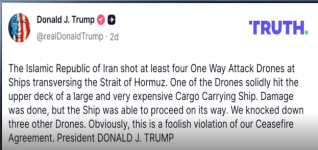
they did not ever totally open the strait, they said no passage without permission, and never agreed to u n inspections.
so, what were they deceptive about??
Well lets look at the actual Key Elements/Contents and NOT LISTEN to the Talking HEADS!!!More importantly - WE have been MORE EMPHATIC that they will NOT BE ALOUD to CONTROL the Straits on their Terms..
SEE #5 Below - IRAN FACILITATES SAFE PASSAGE with NO CHARGE!!!
The USA-Iran MOA (Memorandum of Understanding), formally the "Islamabad Memorandum of Understanding," is a 14-point framework agreement signed in mid-June 2026. It aims to end recent military hostilities (including in Lebanon), reopen key shipping routes, provide Iran with immediate economic relief, and set the stage for a more detailed final deal within 60 days (extendable by mutual consent).
It is not a comprehensive final treaty but a ceasefire and interim framework. Many details (especially on nuclear issues, sanctions timelines, and enforcement) are deferred to future negotiations, with performance-based elements. A final deal is intended to be endorsed by a binding UN Security Council resolution.
Key Elements (Summarized from the 14 Points)
Here are the main provisions based on the publicly released text:- Immediate and Permanent Ceasefire: Ends military operations on all fronts (explicitly including Lebanon). Both sides agree not to initiate war, use force, or threaten each other. The final deal will confirm this.
- Respect for Sovereignty: Mutual commitment to respect each other's territorial integrity and refrain from interfering in internal affairs.
- 60-Day Negotiation Window: Both sides commit to negotiating and reaching a final deal within a maximum of 60 days (extendable). Pending the final deal, they maintain the status quo (Iran keeps its current nuclear program activities; US imposes no new sanctions or deploys additional forces).
- US Naval Blockade and Forces: The US begins removing its naval blockade immediately and ends it fully within 30 days. US forces are to withdraw from proximity to Iran within 30 days after the final deal.
- Strait of Hormuz and Shipping: Iran facilitates safe passage for commercial vessels through the Persian Gulf to the Sea of Oman (and vice versa) with no charge for 60 days only. Traffic aims to return to pre-war levels within 30 days (after demining/obstacle removal). Future administration involves dialogue with Oman and other Gulf states per international law.
- Reconstruction Fund: The US, with regional partners, develops a plan for at least $300 billion in reconstruction and economic development for Iran. Implementation details are for the final deal; the US grants necessary licenses/waivers.
- Sanctions Relief: The US commits to terminating all sanctions (US unilateral, UNSC, IAEA-related) on an agreed schedule as part of the final deal. Negotiations prioritize this.
- Nuclear Commitments:
- Iran reaffirms it shall not procure or develop nuclear weapons.
- Both sides agree to resolve the disposition of Iran's stockpiled enriched uranium (minimum: down-blending on site under IAEA supervision).
- Further discussions on enrichment and Iran's nuclear needs for the final deal.
- Immediate Economic Relief:
- US Treasury issues waivers immediately for Iranian oil exports, petroleum products, and related services (banking, insurance, etc.).
- Frozen/restricted Iranian assets and funds become fully available upon implementation, usable for any beneficiary designated by Iran's Central Bank (with US licenses).
- Monitoring: An executive mechanism will monitor implementation of the MOU and future compliance.
- Phased Negotiations: Further talks on remaining issues begin after initial implementation steps (ceasefire, blockade removal, shipping, oil waivers, asset release).
- Final Deal: Endorsed by a binding UNSC resolution.