

Pensioners forced to ration water use… as companies make £600million profits in last two years alone
By DANIEL MARTIN and SEAN POULTER
PUBLISHED: 23:45 GMT, 31 May 2013 | UPDATED: 23:45 GMT, 31 May 2013
Water bills are becoming unaffordable ‘for a large number of people’ because water companies have cashed in so much since privatisation, a Commons report has found.
Prices have soared by almost 50 per cent in real terms since services were privatised by Margaret Thatcher 25 years ago, with two companies hiking charges by more than 60 per cent.
Read more: Pensioners forced to ration water use... as companies make £600million profits in last two years alone | Mail Online
....
it's just all about "Public-Private Partnerships", folks.
translation:
take things that used to belong to the public (who paid for them); pretend they are 'unsustainable'; sell them to private corporations who already have arranged (through "treaties") to soak up all the profits and raise prices however they choose...while pawning the risk and any losses off onto the public.
old scam.
you build stuff with your own tax money, you're told it belongs to you. they don't let you work to maintain it...it becomes old and unworkable and they say - see? we need some help from "the private sector" < banking conglomerates.
they sell your stuff, and you pay to use what was yours to begin with, and what you already paid for.
and they bought it using your money, printed out of nothing - through the private international banking mafia.
same cons over and over.
........
Neoliberalisation and Place: Deconstructing and Reconstructing Borders
Philip G. Cerny
Abstract
The territorial state defined by hard geographical space is not so much withering away as being increasingly enmeshed in a denser and more complex set of virtual political spaces that cut across traditional distinctions between inside and outside, public and private. Boundaries are less and less about distinctions between territorial units and constituencies and more and more about those between economic sectors with different asset structures, cross-cutting socio-cultural networks that span the local and the transnational, state agencies and public— private organisations with competing clienteles enmeshed in ‘transgovernmental networks’, and new groups of social and economic ‘winners’ and ‘losers’. Thus political action today involves a range of attempts to politicise what has previously been seen as a predominantly economic image of globalisation and to reinvent the social dimension of politics through new policy and coalition ‘spaces’ in both the developed and developing worlds.
Neoliberalisation and Place: Deconstructing and Reconstructing Borders - Springer
......
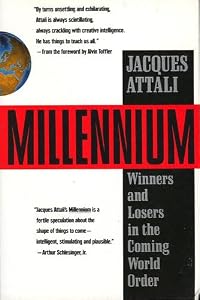
Millennium; Winners and Losers in the Coming Order
Book Description
Release date: September 29, 1992
Jacques Attali, French President Mitterand's most trusted advisor and president of the new European bank of Reconstruction and development, offers a provocative and all-too-convincing view of the future in an increasingly troubled world.
By DANIEL MARTIN and SEAN POULTER
PUBLISHED: 23:45 GMT, 31 May 2013 | UPDATED: 23:45 GMT, 31 May 2013
Water bills are becoming unaffordable ‘for a large number of people’ because water companies have cashed in so much since privatisation, a Commons report has found.
Prices have soared by almost 50 per cent in real terms since services were privatised by Margaret Thatcher 25 years ago, with two companies hiking charges by more than 60 per cent.
Read more: Pensioners forced to ration water use... as companies make £600million profits in last two years alone | Mail Online
....
it's just all about "Public-Private Partnerships", folks.
translation:
take things that used to belong to the public (who paid for them); pretend they are 'unsustainable'; sell them to private corporations who already have arranged (through "treaties") to soak up all the profits and raise prices however they choose...while pawning the risk and any losses off onto the public.
old scam.
you build stuff with your own tax money, you're told it belongs to you. they don't let you work to maintain it...it becomes old and unworkable and they say - see? we need some help from "the private sector" < banking conglomerates.
they sell your stuff, and you pay to use what was yours to begin with, and what you already paid for.
and they bought it using your money, printed out of nothing - through the private international banking mafia.
same cons over and over.
........
Neoliberalisation and Place: Deconstructing and Reconstructing Borders
Philip G. Cerny
Abstract
The territorial state defined by hard geographical space is not so much withering away as being increasingly enmeshed in a denser and more complex set of virtual political spaces that cut across traditional distinctions between inside and outside, public and private. Boundaries are less and less about distinctions between territorial units and constituencies and more and more about those between economic sectors with different asset structures, cross-cutting socio-cultural networks that span the local and the transnational, state agencies and public— private organisations with competing clienteles enmeshed in ‘transgovernmental networks’, and new groups of social and economic ‘winners’ and ‘losers’. Thus political action today involves a range of attempts to politicise what has previously been seen as a predominantly economic image of globalisation and to reinvent the social dimension of politics through new policy and coalition ‘spaces’ in both the developed and developing worlds.
Neoliberalisation and Place: Deconstructing and Reconstructing Borders - Springer
......
Millennium; Winners and Losers in the Coming Order
Book Description
Release date: September 29, 1992
Jacques Attali, French President Mitterand's most trusted advisor and president of the new European bank of Reconstruction and development, offers a provocative and all-too-convincing view of the future in an increasingly troubled world.


