
UK Pensioners forced to ration water - companies make £600million profits

  • Christian Chat is a moderated online Christian community allowing Christians around the world to fellowship with each other in real time chat via webcam, voice, and text, with the Christian Chat app. You can also start or participate in a Bible-based discussion here in the Christian Chat Forums, where members can also share with each other their own videos, pictures, or favorite Christian music.

    If you are a Christian and need encouragement and fellowship, we're here for you! If you are not a Christian but interested in knowing more about Jesus our Lord, you're also welcome! Want to know what the Bible says, and how you can apply it to your life? Join us!

    To make new Christian friends now around the world, click here to join Christian Chat.

zone

Senior Member
Jun 13, 2010
27,214
164
63
Pensioners forced to ration water use… as companies make £600million profits in last two years alone

By DANIEL MARTIN and SEAN POULTER
PUBLISHED: 23:45 GMT, 31 May 2013 | UPDATED: 23:45 GMT, 31 May 2013

Water bills are becoming unaffordable ‘for a large number of people’ because water companies have cashed in so much since privatisation, a Commons report has found.

Prices have soared by almost 50 per cent in real terms since services were privatised by Margaret Thatcher 25 years ago, with two companies hiking charges by more than 60 per cent.

Read more: Pensioners forced to ration water use... as companies make £600million profits in last two years alone | Mail Online

....

it's just all about "Public-Private Partnerships", folks.

translation:

take things that used to belong to the public (who paid for them); pretend they are 'unsustainable'; sell them to private corporations who already have arranged (through "treaties") to soak up all the profits and raise prices however they choose...while pawning the risk and any losses off onto the public.

old scam.

you build stuff with your own tax money, you're told it belongs to you. they don't let you work to maintain it...it becomes old and unworkable and they say - see? we need some help from "the private sector" < banking conglomerates.

they sell your stuff, and you pay to use what was yours to begin with, and what you already paid for.
and they bought it using your money, printed out of nothing - through the private international banking mafia.

same cons over and over.

........

Neoliberalisation and Place: Deconstructing and Reconstructing Borders

Philip G. Cerny

Abstract
The territorial state defined by hard geographical space is not so much withering away as being increasingly enmeshed in a denser and more complex set of virtual political spaces that cut across traditional distinctions between inside and outside, public and private. Boundaries are less and less about distinctions between territorial units and constituencies and more and more about those between economic sectors with different asset structures, cross-cutting socio-cultural networks that span the local and the transnational, state agencies and public— private organisations with competing clienteles enmeshed in ‘transgovernmental networks’, and new groups of social and economic ‘winners’ and ‘losers’. Thus political action today involves a range of attempts to politicise what has previously been seen as a predominantly economic image of globalisation and to reinvent the social dimension of politics through new policy and coalition ‘spaces’ in both the developed and developing worlds.

Neoliberalisation and Place: Deconstructing and Reconstructing Borders - Springer

......
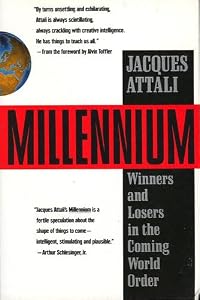
41EgOhiIswL._SL500_SY300_.jpg


Millennium; Winners and Losers in the Coming Order

Book Description
Release date: September 29, 1992
Jacques Attali, French President Mitterand's most trusted advisor and president of the new European bank of Reconstruction and development, offers a provocative and all-too-convincing view of the future in an increasingly troubled world.
 

ya. too big to fail.

haha. whoever came up with that one prolly got a huge bonus.

now you have your "bail-ins" (bailouts weren't popular).

remember wazziz face from the bush term...the tall bald guy, glasses, from the Fed? lol. tsk...can't think of it.
he said it was going to be....pick a number, any number...okay - 700 billion.
r-i-i-i-i-ight.
'member congress got threatened behind closed doors with a total economic meltdown if they didn't do it.
what was "it" that they did?

just brute blackmail and RICO stuff.
a stickup.
like you said...what profits? LOLOLOL!

every sane economist i read says you ain't seen nuthin yet though.
that was a test run.

.....

Behind The Real Size of the Bailout
A guide to the abbreviations, acronyms, and obscure programs that make up the $14 trillion federal bailout of Wall Street
Mon Dec. 21, 2009 1:23 PM PST

Public-Private Investment Fund: This joint Treasury-Federal Reserve program bought toxic assets from banks and brokerages—as much as $5 billion of assets per firm. According to SIGTARP, the government's potential exposure from the PPIF is between $500 million and $1 trillion [PDF].

Behind The Real Size of the Bailout | Mother Jones < click

i wonder why these guys never get in trouble?
i guess they just throw a Madoff under the bus now and then.
pardon the other guys later.

Scooter Libby
https://en.wikipedia.org/wiki/Scooter_Libby < click

course Obama just came up with a better idea - total and retroactive immunity.
presto.
 
Its crazy, mind you as far as I am aware its only in England that you pay by meter for your water... Not in Scotland. The Uk took a radicle change in the 80's were all the public industries were sold of to private companies. Of course you have the economic debate between public ownership and private of business. The problem is its not just pensioners its families aswell struggle to pay.

It seems to me that the Uk is going back the way...before 1948/9 there was no free medical help or financial help to anyone little alone affordable housing.. all business where private.. and the rich got richer and the poor got poorer... so for 60 years we have had a safety net for all but slowly we are going back the way.
 
I hate my water company, Southern Water, they are one of the biggest bunch of thieveing scum helping to bleed people dry, licence to print money.

In my area, SOuthern Water only deal with sewage, our water is supplied by Portsmouth Water. Portsmouth Water are a bit more helpful, they reduced my water bill and allowed me to pay over a longer period

Southern Water are scum, thats the politest word I can use on this forum. Thier policy is to look at a situation, decide if its cheaper to repair or deal with something or just run risk that it will only go wrong once every few years and the cost of fines, which is a joke, is a lot cheaper than repairing it.

Essentially they have polluted countless times, allowing raw sewage to flow for weeks and months into rivers and in my local area into Langstone Harbour, which is designated a SSI with abundance of wildlife and important eco system for rare birds.

I know of someone who just wanted the drains in thier road sorted, even in moderate rain the road and pavement would be under several inches of water. Southern Water said they could not do anything, but it wasnt until the residents launched a legal challenge and put pressure on Southern Water over 18 months they finally did something.

One thing just about all these companies do is the bare minimum required, Southen water is a good example, They have a legal obligation to keep things to a certain standard. One example is a pollution leak at Southparade Pier in Portsmouth, for decades there has been high sewage readings off the pier, that is the job for Southern Water to investigate, but they just simply do the minimum required and then just say "Its a mystery". HOwever this year, the EU has raised the bar for water quality and Portsmouth have lost thier Blue Flag staus over this, of course the councill rightly put pressure and even legal threats on Southern Water, then low and behold they find the problem. This of course proves they are only interested in profit.

I could rant on, but they really are scum, filth evil wicked. Infact the owners and board of Directors should really be in prison for the things they get away with.
 
Its crazy, mind you as far as I am aware its only in England that you pay by meter for your water... Not in Scotland. The Uk took a radicle change in the 80's were all the public industries were sold of to private companies. Of course you have the economic debate between public ownership and private of business. The problem is its not just pensioners its families aswell struggle to pay.

It seems to me that the Uk is going back the way...before 1948/9 there was no free medical help or financial help to anyone little alone affordable housing.. all business where private.. and the rich got richer and the poor got poorer... so for 60 years we have had a safety net for all but slowly we are going back the way.

ya i know. it's sad.
that little square mile, eh?

.....

Master fixer who ended up in a fix

Critics have wondered how former Tory minister Lord Wakeham, no stranger to controversy, found time for all his business

Andrew Clark and David Hencke
The Guardian, Wednesday 30 January 2002 13.28 GMT

During his 20-year parliamentary career, Lord Wakeham became known as "minister for banana skins" for his sure-footed handling of potentially tricky issues.

Nicknamed "the chief", his reputation was as a "fixer par excellence" who acted behind the scenes providing invaluable advice to the prime minister. When he was chief whip he kept tabs on backbenchers and let those at the top know exactly what was going on.

Lord Wakeham's contacts with Enron began when he was appointed energy secretary by Margaret Thatcher in 1989 with the task of privatising the electricity industry.

An accomplished accountant, the minister had both to deliver a complex privatisation programme and create an electricity energy market from scratch. At the time, the biggest private energy market was in the US, and Enron was seen as being at the cutting edge of exploiting it.

Lord Wakeham oversaw the first contracts for Britain's gas-fired power stations - to British Nuclear Fuels and Enron. Enron won the contract for a large power station in Teesside, which would include providing energy for the ICI complex there.

In 1994, months after Lord Wakeham quit as leader of the House of Lords and two years after leaving the energy brief, he became a non-executive director of Enron.

At the time, his £80,000-a-year job raised few eyebrows - it was part of a long tradition of retired ministers putting their departmental expertise to lucrative use in the private sector.

Keen to fill the rest of his diary, Lord Wakeham cast his net wider in his search for lucrative roles. In January 1995, his business career caused angry protests in the Commons when MPs discovered that he had become a director of the merchant bank NM Rothschild.

Lord Wakeham's Enron connection | Politics | The Guardian < click

It's a small world after all
It's a small, small world

images


[video=youtube;Qz8Kh3FtuCY]http://www.youtube.com/watch?v=Qz8Kh3FtuCY[/video]

is there are gold in Fort Knox? LOLOLOL. not.

which is why Bill Still said:

“Beware of calls to return to a gold standard. Why? Simple. Because never before has so much gold been so concentrated outside of American hands. And never before has so much gold been in the hands of international governmental bodies such as the World Bank and International Monetary Fund. In fact, the IMF now holds more gold then any central bank.”

.....

"I believe that banking institutions are more dangerous to our liberties than standing armies. If the American people ever allow private banks to control the issue of their currency, first by inflation, then by deflation, the banks and corporations that will grow up around [the banks] will deprive the people of all property until their children wake-up homeless on the continent their fathers conquered. The issuing power should be taken from the banks and restored to the people, to whom it properly belongs."

- Thomas Jefferson, (Attributed)

oops....wonder why not taught anymore:rolleyes:
 
Argentina – Water – Private failures, renationalisation and union cooperative

Authors: David Hall
Date published: Jul 2010

In the 1990s, Argentina, regarded as the ‘model pupil’ of the IMF, privatised water supply and sanitation services to a greater extent and from an earlier date than any other developing country. Despite widespread opposition, by the end of 1999, private operators were providing services to 71% of the country’s urban population.

Two of the largest privatisations were in Buenos Aires. In May 1993 a company called Aguas Argentinas – jointly owned by four major multinationals, in order to reduce competition - was awarded a concession covering 10 million people in the city of Buenos Aires itself. Six years later, another concession was awarded to a subsidiary of Enron, covering 2 million people in the province of Buenos Aires. Both contracts guaranteed that the companies would be able to maintain their profits in US dollars.

The actual performance of the private companies fell far short of the expectations. Aguas Argentinas only delivered about 60% of its promised investment programme, increased prices faster than inflation, failed to meet water quality standards or maintain the pipe network adequately, and only connected the poorest households in the slums when the local councils and citizens agreed to cover the costs.

At the end of 2001 Argentina, despite following IMF policies to the letter, was hit by a massive economic crisis. The currency was devalued, and the parliament revoked the private companies’ rights to ‘dollarised’ profits – otherwise water prices would have increased hugely at a time when people were already suffering loss of jobs and income. The multinationals brought lawsuits and attempted to renegotiate their contracts to maintain profitability, but the public authorities refused, and in the end the companies abandoned the services.

Argentina – Water – Private failures, renationalisation and union cooperative | Public Services International Research Unit < click


It is wrong to assume that men of immense wealth are always happy.

Attributed as a statement to his Bible class (1 April 1905) in "The Loneliness of John D. Rockefeller", Current Literature (November 1906) vol. 41 no. 5

awww.....boohoo.
poor mr. rockefeller.
 
Last edited:
25 Apr 2013 02:00

Water bills have rocketed 200% since the industry was privatised, a report reveals.

The finding comes in a study by think tank the New Policy Institute, commissioned by Unison, which shows how the sector has changed dramatically over the past 24 years.

Immediately after privatisation, most water companies were listed on the stock exchange.

Now just four are, with most of the others in the hands of foreign-owned private equity outfits.

Check out all the latest News, Sport & Celeb gossip at Mirror.co.uk Water bills have rocketed 200% since industry was privatised, New Policy Institute study finds - Mirror Online
 
You do not see the problem do you?

Its not real privatization if the government can tell which company gets the contract for the work.

If you have...TRUE competition the prices will go down and the quality will go up.

The problem is the government owns the infrastructure. Its hard to get real competition that way. So they hand it out to their buddies, get the customary kickback and people make a lot of money..and then say privatization is a bad thing because the price went up and the quality goes down.

The end result is the government gets back in control, you lose more money to the government, and the buddies and politicians get richer because....you want something for nothing.

Privatization can work in many cases, but with this, I doubt it can