When a being possesses life inside the womb

  • Christian Chat is a moderated online Christian community allowing Christians around the world to fellowship with each other in real time chat via webcam, voice, and text, with the Christian Chat app. You can also start or participate in a Bible-based discussion here in the Christian Chat Forums, where members can also share with each other their own videos, pictures, or favorite Christian music.

    If you are a Christian and need encouragement and fellowship, we're here for you! If you are not a Christian but interested in knowing more about Jesus our Lord, you're also welcome! Want to know what the Bible says, and how you can apply it to your life? Join us!

    To make new Christian friends now around the world, click here to join Christian Chat.

kv100

Member
Sep 9, 2026
32
23
8
When Does God Give the Gift of Life? The Biblical Order of Formation, Breath, and Understanding

Does biological development itself establish when a human being receives the breath of life from God? Or does Scripture distinguish the formation of a body from God's gift of life?

To answer this, we must examine the biblical account of creation, the formation of human beings in the womb, the relationship between spirit and understanding, and the biological conditions necessary for independent human survival.

1. Genesis 2:7 — God's Blueprint for Human Life

Genesis 2:7 establishes a remarkable sequence:

First: God formed man from the dust of the ground.

Second: God breathed into him the breath of life.

Third: Man became a living soul.

The distinction is significant. Adam's body was formed before the breath of life was given. The body did not become a living soul merely through the existence of its physical structure.

God first materialised a body viable to be alive, then gave the breath of life, and the man became a living soul.

This establishes a distinction between bodily formation and the divine gift by which the formed man became a living being.

The question is whether Scripture provides a comparable distinction when discussing development inside the womb.

2. Job 10:8–12 — Formation in the Womb and the Gift of Life

Job provides an extraordinary parallel.

In Job 10:8–11, he describes God shaping and making him, forming his body, clothing him with skin and flesh, and joining together his bones and sinews.

Then, in verse 12, Job declares:

"You gave me life and showed me kindness."

Notice the relationship between these statements.

Job first describes the formation of his physical body. He then acknowledges that God gave him life.

Formation and the giving of life are distinguishable within Job's description, just as they are distinguishable in Genesis 2:7.

This does not independently establish the precise gestational moment when life is granted. However, it provides a biblical foundation for investigating whether physical formation and the possession of life as a living soul should be understood as identical.

Job 33:4 reinforces God's role:

"The Spirit of God has made me; the breath of the Almighty gives me life."

Notice that making and giving life are both attributed to God.

3. Scripture Identifies God's Breath as the Source of Life

The relationship between God's breath and human existence appears repeatedly.

Job 34:14–15 teaches that if God withdrew His spirit and breath, humanity would perish and return to dust.

Ecclesiastes 12:7 describes the body returning to dust and the spirit returning to God who gave it.

Psalm 104:29–30 connects the withdrawal of breath with death and God's sending of His Spirit with the creation of life.

Ezekiel 37:5–10 presents an especially striking illustration: bodies are assembled with bones, tendons, flesh, and skin, yet they do not live until breath enters them.

These passages reinforce a central biblical principle: bodily matter is not the ultimate source of life. God is.

However, Ezekiel's vision concerns Israel's restoration, and Adam's creation concerns the first man. Applying their sequence directly to gestation requires interpretation, not merely quotation.

4. The Spirit, Thought, and Understanding

The relationship becomes more interesting when Scripture addresses cognition.

Job 32:8 declares:

"But it is the spirit in a person, the breath of the Almighty, that gives them understanding."

Observe the wording: the spirit is described as being in a person, and understanding is attributed to the breath of the Almighty.

Now consider 1 Corinthians 2:11.

Paul asks who knows a person's thoughts except that person's own spirit within them. He then makes the corresponding comparison with God's Spirit knowing God's thoughts.

These passages connect spirit, personhood, thought, and understanding.

They raise an important question: What physical capacities must a developing human possess for thought and understanding to become possible?

Human cognition is expressed through the functioning brain. Conscious perception, integrated thought, and understanding depend upon neurological structures and activity.

Consequently, it is reasonable to investigate when the developing body acquires the necessary cognitive structures.

However, neither Job 32:8 nor 1 Corinthians 2:11 explicitly says that the spirit enters the body when those structures develop. That is a proposed interpretation, not a stated biblical timetable.

5. Why Approximately 24 Weeks Matters Biologically

Human embryonic and fetal development occurs progressively.

Biological life is already present before 24 weeks: cells metabolise, divide, differentiate, and form functioning tissues and organs.

But possessing biological activity is not identical to possessing the capacity for independent survival or conscious understanding.

Around 24 weeks of gestation, two important developmental considerations arise.

First: neurological development.

During approximately 24–32 weeks, significant connections between the thalamus and cerebral cortex develop. These pathways are relevant to sensory processing and the neurological foundations of conscious perception.

Their development does not establish that mature thought, understanding, or consciousness suddenly begins at 24 weeks.

Second: medical viability.

Around 22–25 weeks, premature infants enter what medicine calls the periviable period.

At approximately 24 weeks, survival outside the womb becomes substantially more possible with intensive neonatal medical support.

This is not a point at which the body becomes completely developed. Rather, it is a period when essential physiological systems may function sufficiently to permit survival with assistance.

The overlap between neurological development and increasing viability is therefore significant to investigate, but it cannot independently prove that the breath of life is granted at this stage.

6. Why Must We Examine Medical Evidence?

Because Scripture identifies God as the Creator of the human body without supplying a week-by-week account of gestation.

Psalm 139:13–16 describes God's involvement in human formation within the womb.

Ecclesiastes 11:5 acknowledges the mystery of how a body is formed in the womb.

These passages establish divine involvement, not a clinical gestational timetable.

Medical science examines the biological processes through which fetal development occurs: the growth of organs, maturation of the brain, development of physiological functions, and capacity for survival.

We consult medical evidence because the question of bodily viability is biological.

Scripture can establish the theological distinction between the body and God's gift of life. Medicine can investigate the development and functional capacities of that body.

Neither discipline should be made to assert what it has not established.

Furthermore, medical viability is not a fixed, universal moment. It varies with fetal development, birth weight, medical circumstances, and access to neonatal care.

Therefore, viability cannot simply be treated as a scientifically established measurement of when God imparts the spirit.

7. The Central Distinction: Formation Is Not the Same as the Gift of Life

The biblical evidence establishes several interconnected truths.

Genesis 2:7 distinguishes God's formation of Adam from His imparting the breath of life.

Job 10:8–12 distinguishes the description of bodily formation from Job's acknowledgment that God gave him life.

Job 33:4 identifies God's breath as the source of life.

Job 32:8 and 1 Corinthians 2:11 associate spirit with understanding and thought.

Medical science establishes that the physical capacities associated with cognition and independent survival develop progressively during gestation.

Together, these observations support an inquiry into the relationship between bodily formation, neurological capacity, and the divine gift of life.

My position is that God's blueprint of creation should inform how we understand the development of a body viable to be alive. The emergence of the necessary physical capacities is therefore relevant when examining the biblical meaning of becoming a living soul.

But we must distinguish the evidence from the conclusion: Scripture does not explicitly identify 24 weeks as the moment God grants the breath of life, and medical viability does not measure the presence of a spirit.

Conclusion

The fundamental question is not whether God forms human beings in the womb. Scripture explicitly affirms that He does.

The question is whether the formation of biological tissue, the development of a body capable of sustaining life, and the reception of God's breath should all be treated as one indistinguishable event.

Genesis 2:7 gives us a reason to distinguish formation from the gift of life. Job 10:8–12 gives us corresponding language in the context of human development. Job 32:8 and 1 Corinthians 2:11 introduce the relationship between spirit and understanding.

If we are to identify when a developing human becomes a living soul in the biblical sense, we must establish that conclusion from evidence—not merely assume that biological development, cognitive capacity, and the divine breath are interchangeable.

God is the giver of life. The body is His creation. Understanding how those truths relate during gestation requires careful interpretation of Scripture alongside accurate biological knowledge.
 
  • Sad
Reactions: HeIsHere
It might also help to understand just what "life" is. Currently there is no generally accepted definition of what life is, and thus no means to determine when it begins of ends. Even scripture is vague on when life begins and ends. Even restricting the issue to just physical life does not totally resolve these questions, irreversible brain death is generally accepted as a sign of physical death, but even here there are rare cases where brain activity inexplicably resumes after apparently ceasing.
 
It might also help to understand just what "life" is. Currently there is no generally accepted definition of what life is, and thus no means to determine when it begins of ends. Even scripture is vague on when life begins and ends. Even restricting the issue to just physical life does not totally resolve these questions, irreversible brain death is generally accepted as a sign of physical death, but even here there are rare cases where brain activity inexplicably resumes after apparently ceasing.
I appreciate your observation, but you are addressing a different question from the one my post examines. I am not attempting to establish a universal biological definition of life or determine when cellular activity begins. I am examining how Scripture describes God's gift of life being imparted to a being. Genesis 2:7 establishes a sequence: God formed Adam's body, breathed into him the breath of life, and Adam became a living soul. Ezekiel 37:7–10 similarly describes fully formed bodies that remained lifeless until breath entered them. Job 10:8–12 also distinguishes bodily formation from God's granting of life. The distinction between biological activity, bodily formation, and becoming a living soul is central to my argument.

Your discussion of brain death concerns medical criteria for determining when an existing human life has ended, not the biblical question of how God's gift of life is imparted. The absence of a universally accepted scientific definition of life does not invalidate the distinctions Scripture makes. My post examines the scriptural relationship between a materialised body viable to be alive and God's impartation of life. If you wish to challenge that argument, the relevant question is whether my interpretation of those passages is justified, not whether modern biology has resolved every question concerning the definition of life.
 
First: God formed man from the dust of the ground.

The 'dust' is symbolic of what we now call Nucleobases. In other words, God formed a Genome. That is what comes first.

The Soul is the Genome. All life has a Genome; therefore, all life has a Soul.

Second: God breathed into him the breath of life.

God breathed Spirit into said Genome.

Third: Man became a living soul.

Soul + Spirit = Living Soul, i.e., Living Genome.

There is no physical body at this point

The distinction is significant. Adam's body was formed before the breath of life was given. The body did not become a living soul merely through the existence of its physical structure.

God first materialised a body viable to be alive, then gave the breath of life, and the man became a living soul.

I hate to say it, but you are teaching falsehoods. Let's start with the obvious:

2 Corinthians 5:6 - Therefore we are always confident, knowing that, whilst we are at home in the body, we are absent from the Lord:

The First Adam was present with the Lord, therefore he was absent from the Body. There is no getting around this fact.

Here it is again:

2 Corinthians 5:8 - We are confident, I say, and willing rather to be absent from the body, and to be present with the Lord.

You can't teach contradictions and expect to be taken seriously.

The Body came later when God clothed the man and woman with the skin and flesh we have now:

Job 10:11 - Thou hast clothed me with skin and flesh, and hast fenced me with bones and sinews.

There is way more to this, but somehow, I doubt you will care.
 
The 'dust' is symbolic of what we now call Nucleobases. In other words, God formed a Genome. That is what comes first.

The Soul is the Genome. All life has a Genome; therefore, all life has a Soul.


God breathed Spirit into said Genome.


Soul + Spirit = Living Soul, i.e., Living Genome.

There is no physical body at this point


I hate to say it, but you are teaching falsehoods. Let's start with the obvious:

2 Corinthians 5:6 - Therefore we are always confident, knowing that, whilst we are at home in the body, we are absent from the Lord:

The First Adam was present with the Lord, therefore he was absent from the Body. There is no getting around this fact.

Here it is again:

2 Corinthians 5:8 - We are confident, I say, and willing rather to be absent from the body, and to be present with the Lord.

You can't teach contradictions and expect to be taken seriously.

The Body came later when God clothed the man and woman with the skin and flesh we have now:

Job 10:11 - Thou hast clothed me with skin and flesh, and hast fenced me with bones and sinews.

There is way more to this, but somehow, I doubt you will care.
The thing is, accusing someone of teaching falsehood is a serious charge. Yet your rebuttal depends on several claims that your cited verses do not make. Confidence is not evidence, and quotation is not interpretation. Let us examine the text rather than the authority you have assigned to your conclusions.

1. “The soul is the genome” — where does Scripture say that?

You declare that the soul is a genome, that God breathed spirit into a genome, and that “living soul” means “living genome.” Not one of those equations appears in Genesis 2:7. A genome is genetic information; the Hebrew nephesh chayyah refers to a living being or creature. Calling them identical does not make them identical. My suggestion that dust may be understood in relation to the material constituents of life is an analogy, not a claim that the Hebrew word for dust literally means nucleobases. Neither your assertion nor my analogy should be mistaken for the actual wording of Scripture.

2. “There is no physical body at this point” — read Genesis 2:7 again.


The verse gives a sequence: God formed man from the dust, breathed into his nostrils the breath of life, and man became a living soul. The distinction between formation and the impartation of life comes directly from the narrative. You assert that there was no physical body before the breath. Then what exactly had God formed, and whose nostrils received that breath? A genome does not have nostrils. Your explanation does not clarify the verse; it replaces the subject described by the verse. Genesis 2:23 directly contradicts your claim that Adam and Eve had no physical bodies at that point. Adam explicitly declares, “This is now bone of my bones, and flesh of my flesh,” after God takes a rib from his side (Genesis 2:21–22). These events occurred before the Fall, establishing that Adam and Eve already possessed flesh and bones before God clothed them with garments of skin in Genesis 3:21. How could Adam possess ribs, flesh, and bones while supposedly having no physical body? Your interpretation confuses God clothing an already existing body with God creating that body in the first place.

3. Your use of 2 Corinthians 5:6–8 is a contextual error.

You reason that because Adam was in God's presence, and Paul says being at home in the body means being away from the Lord, Adam must have been bodiless. But Paul is contrasting our present mortal condition with the believer's hoped-for dwelling with the Lord (2 Corinthians 5:1–10). He is not defining a universal rule that no embodied person can encounter God. Genesis 3:8–9 describes Adam and Eve hearing God in the garden. Exodus 33:11 describes God speaking to Moses as one speaks to a friend. Were their bodies absent? Your conclusion requires Paul's words to address a question he was not discussing. That is an inference you must demonstrate, not a “fact” that settles Genesis.

4. Job 10:11 does not say Adam received a body after becoming a living soul.

Job says God clothed him with skin and flesh and knit him together with bones and sinews. Read verse 10: Job is describing his own formation in the womb. Nothing there identifies Adam or places the creation of Adam's body after the breath of life. Worse for your reading, Genesis 2:23 records Adam describing Eve as “bone of my bones and flesh of my flesh” before their disobedience. Genesis 3:21 subsequently speaks of garments of skin, not God creating their anatomical skin, bones, or flesh for the first time. Clothing a body and creating a body are not the same event.

5. Scripture itself distinguishes a formed body from the breath that gives life.


Ezekiel 37:7–10 depicts bodies assembled with sinews, flesh, and skin, yet verse 8 explicitly says “there was no breath in them.” Only after the breath enters do they live. That vision concerns Israel's restoration, not a medical account of pregnancy, but it unmistakably uses the distinction between bodily formation and imparted life. Genesis 2:7 makes that distinction in the creation narrative; Job 10:8–12 speaks of God's formation and gift of life. My argument concerns that scriptural distinction. Applying it to precisely when life is imparted in the womb calls for further argument; it is not answered by inventing a bodiless Adam.

Your closing insinuation that I will not care about further evidence is unnecessary. Bring the evidence. But first answer three simple questions: Where does Scripture define the soul as a genome? Where does it say Adam was bodiless when God breathed into his nostrils? And where does Job 10:11 identify Adam rather than Job?

Until you can substantiate those claims, announcing that I teach falsehood does not establish it. You have not demonstrated a contradiction in my reading; you have introduced propositions that the cited texts do not contain. Scripture deserves careful reading, especially before we accuse another person of misrepresenting it.
 
Where does Scripture define the soul as a genome?

Word became flesh:

John 1:14 - And the Word was made flesh, and dwelt among us, (and we beheld his glory, the glory as of the only begotten of the Father,) full of grace and truth.

Word comes first, flesh later. Think of the Resurrection. People are not raised with physical bodies. They are Soul and Spirit only. These are fundamental teachings of the Bible which you are ignoring.

Tables of the Heart is what we now call a Genome:

2 Corinthians 3:3 Forasmuch as ye are manifestly declared to be the epistle of Christ ministered by us, written not with ink, but with the Spirit of the living God; not in tables of stone, but in fleshy tables of the heart.

I happen to know a lot about this topic, but I can see you are already playing games.

Where does it say Adam was bodiless when God breathed into his nostrils?

I already gave you the answer. To be present with the Lord is to be absent from the Body. Scripture does not contradict. You lost the debate. Deal with it.

A Genome contains all of the necessary code to make a human, including nostrils. Seriously, please don't play games like this. It's childish. My time is valuable.

And where does Job 10:11 identify Adam rather than Job?

We all come from Adam, obviously. Scripture interprets Scripture. Do you not understand this?

Until you can substantiate those claims, announcing that I teach falsehood does not establish it. You have not demonstrated a contradiction in my reading; you have introduced propositions that the cited texts do not contain. Scripture deserves careful reading, especially before we accuse another person of misrepresenting it.

It's clear you are not interested in correction, but rather 'winning' by playing games like "If the Bible doesn't say this exact thing, it means I win!!!". Give me a break. You sound like a Seventh Day Adventist.

Anyhow, I will let you have the last word since that is the only thing you will listen to.
 
Word became flesh:

John 1:14 - And the Word was made flesh, and dwelt among us, (and we beheld his glory, the glory as of the only begotten of the Father,) full of grace and truth.

Word comes first, flesh later. Think of the Resurrection. People are not raised with physical bodies. They are Soul and Spirit only. These are fundamental teachings of the Bible which you are ignoring.

Tables of the Heart is what we now call a Genome:

2 Corinthians 3:3 Forasmuch as ye are manifestly declared to be the epistle of Christ ministered by us, written not with ink, but with the Spirit of the living God; not in tables of stone, but in fleshy tables of the heart.

I happen to know a lot about this topic, but I can see you are already playing games.


I already gave you the answer. To be present with the Lord is to be absent from the Body. Scripture does not contradict. You lost the debate. Deal with it.

A Genome contains all of the necessary code to make a human, including nostrils. Seriously, please don't play games like this. It's childish. My time is valuable.


We all come from Adam, obviously. Scripture interprets Scripture. Do you not understand this?


It's clear you are not interested in correction, but rather 'winning' by playing games like "If the Bible doesn't say this exact thing, it means I win!!!". Give me a break. You sound like a Seventh Day Adventist.

Anyhow, I will let you have the last word since that is the only thing you will listen to.
Your reply is remarkable for one reason: the certainty of your declarations is matched only by the absence of evidence for them. You accuse me of false teaching, announce that I have lost, call my questions childish, and speculate about my denomination. Yet none of that establishes that a soul is a genome, that Adam had no body, or that the resurrection eliminates bodily existence. Let us put the performance aside and examine the passages.

1. John 1:14 does not say the soul is a genome.

You cite “the Word became flesh” as though it describes how every human being comes into existence. But John 1:1 identifies the Word as God; John 1:14 describes Christ's incarnation. The divine Word's pre-existence does not mean ordinary humans pre-exist as disembodied genetic information. Where does John identify a human soul with DNA? He does not. You've changed the subject from Christology to genetics and treated the change as proof.

2. Your denial of bodily resurrection meets an immediate textual obstacle.

You assert that resurrected people are “Soul and Spirit only.” Yet the resurrected Jesus says: “A spirit does not have flesh and bones, as you see I have” (Luke 24:39). Paul speaks of a “spiritual body” in 1 Corinthians 15:44—not no body. Philippians 3:21 says Christ will transform our lowly bodies to be like His glorious body. A transformed body is not a nonexistent body. You need to explain these texts before calling your assertion a “fundamental teaching” everyone else has ignored.

3. The “tablets of the heart” are not chromosomes.

Second Corinthians 3:3 contrasts letters written on stone with the Spirit's work on human hearts. It echoes Jeremiah 31:33, where God says He will write His law on hearts. That is covenantal imagery about inward transformation. Neither passage calls the heart's tablets a genome. A genome carries genetic information; it is not the biblical definition of nephesh, or soul. An analogy between writing and genetic code may be imaginative, but an analogy is not an identity. You cannot invent an equation—“soul = genome”—and then announce Scripture established it.

4. Your reading of 2 Corinthians 5 would make embodied fellowship with God impossible.

Paul contrasts our present mortal condition with the hope of being with the Lord (2 Corinthians 5:1–10). He does not say Adam lacked a body because he encountered God. Indeed, Paul says in verse 4 that he does not desire to be unclothed but further clothed, so mortality may be swallowed up by life. The risen Christ has flesh and bones (Luke 24:39) and appears in God's presence (Hebrews 9:24). By your rule, how can both be true? The problem is not a contradiction in Scripture; it is the universal rule you have imposed on a passage addressing another subject.

And your answer about nostrils is astonishingly inadequate. You say a genome contains instructions to develop nostrils. Of course genetic information contributes to development. But instructions for nostrils are not nostrils. Genesis 2:7 says God formed man from dust and breathed into his nostrils. Genesis 2:21–23 then depicts God taking from Adam's side and Adam identifying Eve as “bone of my bones and flesh of my flesh”—all before the Fall. Your theory that Adam and Eve obtained bodies only later cannot account for their already possessing flesh and bones. Genesis 3:21 describes garments of skin, not God inventing human anatomy after sin.

5. Job 10:11 describes Job, not Adam.

When asked why Job's description of his own formation supposedly establishes Adam's later embodiment, your answer was, “We all come from Adam.” That establishes ancestry, not the subject of Job's sentence. Job 10:10–12 describes Job being formed in the womb. Descent from Adam does not turn every account of a descendant's formation into an account of Adam's creation. “Scripture interprets Scripture” means reading passages coherently, not swapping their subjects whenever the wording is inconvenient.

6. Your personal remarks cannot repair the missing premises.

“You lost the debate. Deal with it” is a verdict you awarded yourself, not a refutation. “You sound like a Seventh Day Adventist” is irrelevant to the meaning of any verse. “My time is valuable” is likewise no substitute for evidence. You may dislike being asked to substantiate your assertions, but asking where your conclusions follow from the text is not playing games; it is the minimum standard of biblical argument.

You claimed the soul is a genome. You have not shown a verse establishing that identity. You claimed Adam was bodiless. Genesis depicts his nostrils, ribs, flesh, and bones. You claimed resurrection excludes bodies. The risen Christ and Paul contradict that claim. You applied Job's statement about Job to Adam. You supplied ancestry instead of a textual connection.

One final matter of precision: my analogy between dust and the material constituents of life is an analogy, not a claim that the Hebrew word for dust literally means nucleobases. I can acknowledge the limits of that analogy. Can you acknowledge the limits of your unsupported equations?

I will gladly accept correction when you demonstrate an error. But accusations of falsehood, denominational jabs, and declarations of victory cannot do the work of Scripture. You have repeatedly told me how certain you are. What remains conspicuously absent is a demonstration that the verses actually say what you claim. Confidence is not exegesis. And proclaiming yourself the winner is not the same as answering the argument.
 
But we must distinguish the evidence from the conclusion: Scripture does not explicitly identify 24 weeks as the moment God grants the breath of life, and medical viability does not measure the presence of a spirit.
And it came to pass, that, when Elisabeth heard the salutation of Mary, the babe leaped in her womb; and Elisabeth was filled with the Holy Ghost:

Elizabeth was 6 months into her pregnancy when Mary greeted her.

At approximately 24 weeks the fetus has developed the pulmonary surfactant which is required for breath.

At that point the matrix has been opened. "All that openeth the matrix is mine; and every firstling among thy cattle, whether ox or sheep, that is male." Ex 34:19

It might also help to understand just what "life" is. Currently there is no generally accepted definition of what life is, and thus no means to determine when it begins of ends. Even scripture is vague on when life begins and ends. Even restricting the issue to just physical life does not totally resolve these questions, irreversible brain death is generally accepted as a sign of physical death, but even here there are rare cases where brain activity inexplicably resumes after apparently ceasing.
If not mistaken the consensus is that life is a fully autonomous systems, not a specific organ. Science holds that life begins when the system is capable of to perpetuate its own existence, or animation when it has certain characteristics such as a metabolism, responds to stimuli, capable of reproduction, etc. By that definition, a single cell organism is considered a living thing but I think they are trying use that definition so that the can validate how life can begin naturally without a Creator.
 
When Does God Give the Gift of Life? The Biblical Order of Formation, Breath, and Understanding

Does biological development itself establish when a human being receives the breath of life from God? Or does Scripture distinguish the formation of a body from God's gift of life?

To answer this, we must examine the biblical account of creation, the formation of human beings in the womb, the relationship between spirit and understanding, and the biological conditions necessary for independent human survival.

1. Genesis 2:7 — God's Blueprint for Human Life

Genesis 2:7 establishes a remarkable sequence:

First: God formed man from the dust of the ground.

Second: God breathed into him the breath of life.

Third: Man became a living soul.

The distinction is significant. Adam's body was formed before the breath of life was given. The body did not become a living soul merely through the existence of its physical structure.

God first materialised a body viable to be alive, then gave the breath of life, and the man became a living soul.

This establishes a distinction between bodily formation and the divine gift by which the formed man became a living being.

The question is whether Scripture provides a comparable distinction when discussing development inside the womb.

2. Job 10:8–12 — Formation in the Womb and the Gift of Life

Job provides an extraordinary parallel.

In Job 10:8–11, he describes God shaping and making him, forming his body, clothing him with skin and flesh, and joining together his bones and sinews.

Then, in verse 12, Job declares:

"You gave me life and showed me kindness."

Notice the relationship between these statements.

Job first describes the formation of his physical body. He then acknowledges that God gave him life.

Formation and the giving of life are distinguishable within Job's description, just as they are distinguishable in Genesis 2:7.

This does not independently establish the precise gestational moment when life is granted. However, it provides a biblical foundation for investigating whether physical formation and the possession of life as a living soul should be understood as identical.

Job 33:4 reinforces God's role:

"The Spirit of God has made me; the breath of the Almighty gives me life."

Notice that making and giving life are both attributed to God.

3. Scripture Identifies God's Breath as the Source of Life

The relationship between God's breath and human existence appears repeatedly.

Job 34:14–15 teaches that if God withdrew His spirit and breath, humanity would perish and return to dust.

Ecclesiastes 12:7 describes the body returning to dust and the spirit returning to God who gave it.

Psalm 104:29–30 connects the withdrawal of breath with death and God's sending of His Spirit with the creation of life.

Ezekiel 37:5–10 presents an especially striking illustration: bodies are assembled with bones, tendons, flesh, and skin, yet they do not live until breath enters them.

These passages reinforce a central biblical principle: bodily matter is not the ultimate source of life. God is.

However, Ezekiel's vision concerns Israel's restoration, and Adam's creation concerns the first man. Applying their sequence directly to gestation requires interpretation, not merely quotation.

-------------

Conclusion

The fundamental question is not whether God forms human beings in the womb. Scripture explicitly affirms that He does.

The question is whether the formation of biological tissue, the development of a body capable of sustaining life, and the reception of God's breath should all be treated as one indistinguishable event.

Genesis 2:7 gives us a reason to distinguish formation from the gift of life. Job 10:8–12 gives us corresponding language in the context of human development. Job 32:8 and 1 Corinthians 2:11 introduce the relationship between spirit and understanding.

If we are to identify when a developing human becomes a living soul in the biblical sense, we must establish that conclusion from evidence—not merely assume that biological development, cognitive capacity, and the divine breath are interchangeable.

God is the giver of life. The body is His creation. Understanding how those truths relate during gestation requires careful interpretation of Scripture alongside accurate biological knowledge.

The Bible does not specifically answer your OP question, kv, so here are my thoughts regarding the issue:

Logically, the crucial question is this: “When does a developing fetus become a human person with the God-given right to civil life so that to kill it is murder and warrants punishment?” Considerations other than the advent of personhood are irrelevant, unless someone would use the same rationale to justify the killing of children and adults.

As a person (which was the case for me as a naive pro-choice person at the age of 24) considers two pictures: one of a seven-month-old fetus in the womb, and one of a seven-month-old preemie outside the womb, he/she should understand that location and mode of breathing is not a valid basis for defining personhood.

Those who view conception to be the criterion of personhood should mourn miscarriages in the same way they would death of post-birth babies, but there is logical reason to consider personhood beginning the same way doctors use to consider a person to be dead: brain death or the absence of certain brain wave activity detected by an electroencephalogram (EEG).

We might call this stage “sentience”, when the fetus has brain life of the type detectable in a person deemed to be alive and to have the civil right to life. Thus, everyone should agree that the fetus becomes sentient and a legal person at least by that stage of development.

In the absence of definitive Scriptural teaching, this is only a partial solution, but it is better than allowing abortion throughout pregnancy. It recognizes that people may reasonably disagree about the status of the fetus between conception and sentience.

Implementing this solution requires educating people about fetal development until society develops a consensus that when a fetus becomes sentient, abortion is a type of manslaughter or murder and should be punished appropriately.

Over...
 
We all come from Adam, obviously. Scripture interprets Scripture. Do you not understand this?
That is called prophecy of scripture and is one's own private interpretation of what is written; yet only the author knows the true intent and meaning of what is written.

So if we all come from Adam then why is Eve called the mother of all living? Seeing that which is born of the flesh is flesh and that which is born of the Spirit is spirit, then do you not understand that the flesh without the spirit is dead?
 
Hi @UnoiAmarah . Let's see what you got...

That is called prophecy of scripture and is one's own private interpretation of what is written; yet only the author knows the true intent and meaning of what is written.

I'm not sure I follow what you are saying. Maybe I should have said we all come from Adam and Eve? The point I was making is that God clothed us all with an earthly tabernacle:

2 Corinthians 5:1-4 - For we know that if our earthly house of this tabernacle were dissolved, we have a building of God, an house not made with hands, eternal in the heavens. For in this we groan, earnestly desiring to be clothed upon with our house which is from heaven: If so be that being clothed we shall not be found naked. For we that are in this tabernacle do groan, being burdened: not for that we would be unclothed, but clothed upon, that mortality might be swallowed up of life.

The man and woman were 'naked', meaning they were not clothed with a 'house' yet. In other words, they had no physical Body yet.

The Creation Account is extremely compressed like a Zip file. It requires the rest of the Bible to 'unpack' it. One simply cannot limit themselves to the first three chapters and try and figure it all out. That would be foolish.

So if we all come from Adam then why is Eve called the mother of all living?

Believe it or not, I happen to know more about that topic than most people on the planet. I'm not trying to brag, it's just that I spent decades researching these topics. I try and stay anonymous here since many folks bombard me with questions once they find out what I know. I have to work nine to five, so I don't have the time right now. Maybe some day.

Anyhow...

I spend a lot of time on forums that are filled with non-believers who are constantly criticizing the Bible. I debate them all of the time. Many are experts in the false dogmas and false interpretations that Christians often parrot. The critics are quick to point out all of the flaws and contradictions that the Church teaches. Many are ex-Christians who left because of the lies they were told. So yeah, not only do they know the Bible, but they have huge chip on their shoulders and a deep resentment that causes them to spend years pointing out all of the problems with modern interpretations.

I set out to solve said 'contradictions' and 'mistakes' one at a time until one day, I finally had the Creation Account interpreted without contradictions or having to change words to fit some false theory. It literally took me decades to do it since I had to 'unlearn' all of the false teachings I grew up with. I can now win any Genesis debate with the harshest of critics. This is something that no one on this forum can do. This is a fact, not opinion.

The question you should be asking before that is why is the name 'Eve' not mentioned until Genesis 3:20? There is a profound reason. You need to answer that first before answering why Eve is called the Mother of All Living.

Seeing that which is born of the flesh is flesh and that which is born of the Spirit is spirit, then do you not understand that the flesh without the spirit is dead?

If you and the OP understood what the Tree of Life and the Tree of the Knowledge of Good and Evil were, you would quickly understand why God did not create the First Adam in Genesis 2:7, nor Ishshah in Genesis 2:22, with a physical body. That is why I know the OP is full of baloney.
 
The womb/egg is just like the Holy place.before it enters it "passover" from man(water) to the woman (blood.)The seed is consecrated before even entering the Holy place just like of old.When the time comes and a baby comes into the world,it is like the Levites coming out of the Holy place to give witness to the rest of the Israelites.

The seed itself when it comes from a man is alive right?And when it enters the womb/egg it is born again,and becomes a new creature.
If it wasn't born again and made a new creature it would come out as a giant sperm.
I know this because God reveals it in his creations so that they're with excuse.
The word of God is within our DNA, and that's how God has made a way for us to come into being.Our whole bodily functions, and infact ALL THINGS consist of the word of God,thereby he reconciles ALL THINGS unto himself.

This is a spiritual truth hidden plainly in the word of God.

God has made a way for us to be his witnesses unto the world.
 
We all come from Adam, obviously. Scripture interprets Scripture. Do you not understand this?
That is called prophecy of scripture and is one's own private interpretation of what is written; yet only the author knows the true intent and meaning of what is written.
I'm not sure I follow what you are saying.
I was saying is that your comment that scripture interprets scripture is a subjective opinion, that is referred unto in scripture as a prophecy of scripture.

Knowing this first, that no prophecy of the scripture is of any private interpretation.
For the prophecy came not in old time by the will of man: but holy men of God spake as they were moved by the Holy Ghost.
2 Peter 1:20-2:1

A person cannot pick up a book and read the written spoken word "unless they are first learn the letters", which is another way of saying "unless they are taught how read." Nobody has ever taught themselves how to read the written spoken word and likewise, a person cannot pick up a Bible and make an objective interpretation of scripture without having a teacher.
God breathed Spirit into said Genome.
And then what, was the human genome then placed in the womb of a primate?
Maybe I should have said we all come from Adam and Eve?
That wouldn't answer the question why Eve was called the mother of all living? But that's okay,
If you and the OP understood what the Tree of Life and the Tree of the Knowledge of Good and Evil were,
It's a book, that is either Life or Knowledge of good and evil, depending upon who your teacher is.

John 14:26
 
Let's keep it simple

Lord formed Adam from the earth

Lord breathed a living soul into Adam

---------------------------------------------

Just as we were made

Our parents made us from the earth

But the Lord gave us a soul
 
And it came to pass, that, when Elisabeth heard the salutation of Mary, the babe leaped in her womb; and Elisabeth was filled with the Holy Ghost:

Elizabeth was 6 months into her pregnancy when Mary greeted her.

At approximately 24 weeks the fetus has developed the pulmonary surfactant which is required for breath.

At that point the matrix has been opened. "All that openeth the matrix is mine; and every firstling among thy cattle, whether ox or sheep, that is male." Ex 34:19


If not mistaken the consensus is that life is a fully autonomous systems, not a specific organ. Science holds that life begins when the system is capable of to perpetuate its own existence, or animation when it has certain characteristics such as a metabolism, responds to stimuli, capable of reproduction, etc. By that definition, a single cell organism is considered a living thing but I think they are trying use that definition so that the can validate how life can begin naturally without a Creator.
Science can usually agree when independent physical life is present, but not what life is nor when life begins. The end of physical life is generally accepted as being when brain wave activity irrevocably ends, but even there, cases are encountered that challenge current knowledge.

I will warn you, the more you study and learn, the harder some questions become to give definitive answers to as you learn more and more exceptions to the simple, commonly known, rules.
 
Nobody has ever taught themselves how to read the written spoken word and likewise, a person cannot pick up a Bible and make an objective interpretation of scripture without having a teacher.

You reminded me of when I was a Catholic. We weren't allowed to study the Bible on our own. We had to be 'told' what to believe.

And then what, was the human genome then placed in the womb of a primate?

No.

Again, God clothed the man and woman with the skin and flesh we have now:

Job 10:11 - Thou hast clothed me with skin and flesh, and hast fenced me with bones and sinews.

The couple chose which body to have. They had the choice of two styles. God acknowledged the Covenant with Death that they made and gave them what they wanted.

That wouldn't answer the question why Eve was called the mother of all living? But that's okay,

You haven't answered it either. I will go first...

Eve was named after the way and method she was created. Ishshah was too.

One was created with reproductive organs, while the other was not.

It's a book, that is either Life or Knowledge of good and evil, depending upon who your teacher is.John 14:26

What if the book was already written and you chose to play one of the characters for real? Would you even know?

Would the needle following a groove on a record know that its journey was already pre-recorded?
 
...a single cell organism is considered a living thing...

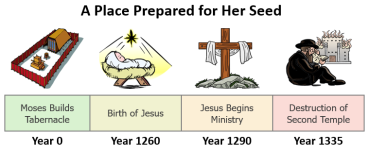
Nourished and fed for 1260 years until He was born.

Revelation 12:1 - And there appeared a great wonder in heaven; a woman clothed with the sun, and the moon under her feet, and upon her head a crown of twelve stars:

Sun = Abraham's Seed (Sperm)
Moon = Sarah's Seed (Ovum)
Twelve Stars = Children, Grandchildren, etc.

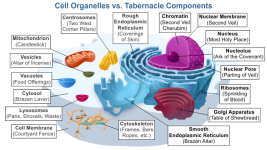
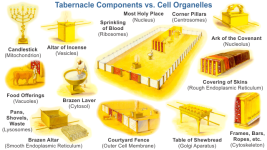
Revelation 12:1 describes conception. The 'Place Prepared' was the Tabernacle, i.e., the zygote of Jesus. The Israelites fed and nourished their Messiah until he was born.

1260 is late date Exodus. Day/Year Principle as per Daniel.

The more you know...


mhp-0707.png

mhp-0709.png

1792094243141.png
​
 
The Israelites fed and nourished their Messiah until he was born.

God's Holy Genetic Engineers. Their training centers were called Tabernacles and Temples.

People have no idea what they are reading in their Bibles.

Yom Kippur = Ovum fertilization.

DNA sprinkled seven times in the Nucleus of the cell.

Seven Eyes = Nitrogen = Fertilizer and Nitrogen Bases.

Hosea 4:6 - My people are destroyed for lack of knowledge: because thou hast rejected knowledge, I will also reject thee, that thou shalt be no priest to me: seeing thou hast forgotten the law of thy God, I will also forget thy children.

You folks better bone-up before it's too late.
 
You reminded me of when I was a Catholic. We weren't allowed to study the Bible on our own. We had to be 'told' what to believe.


No.

Again, God clothed the man and woman with the skin and flesh we have now:

Job 10:11 - Thou hast clothed me with skin and flesh, and hast fenced me with bones and sinews.

The couple chose which body to have. They had the choice of two styles. God acknowledged the Covenant with Death that they made and gave them what they wanted.


You haven't answered it either. I will go first...

Eve was named after the way and method she was created. Ishshah was too.

One was created with reproductive organs, while the other was not.


What if the book was already written and you chose to play one of the characters for real? Would you even know?

Would the needle following a groove on a record know that its journey was already pre-recorded?
What do you understand before Adam and eve had "skin"? If based on your interpretation.