

Bible Study Portion “HaAzinu” (give ear) DEUT 32:1-52
Before going into this study, I would like to go back to chapter 30:15; “See, I have set before you this day life and good, death and evil in that I command you this day to love YHVH thy God to walk in his ways and to keep his commandments…”
It is very interesting to see how Moshe words this. We are used to hearing and reading the words “life and death” associated together, and “good and evil” associated together. We see these word comparisons because they are opposites, yet here we see the words “life and good” associated together, as well as “death and evil” associated together. Is there perhaps a connection?
Perhaps the answer is in that “doing good deeds, “mitzvoth, will produce a prosperous life, a life which is blessed by Adonai, be it a short life or a long life. We can also see that living a life doing evil deeds will produce death, perhaps death very soon. It can also bring spiritual death as well as physical death if the person does not repent and turn to Yeshua/Jesus.
That is why Moshe commands us to “Love” Adonai and walk in his ways and keep his commandments. In this way, we are certain to live a life of meaning and reap the rewards when we appear before the judgment seat of the Messiah. Again, keeping the commandments does not bring salvation; salvation is a separate issue based on our faith in our risen Messiah.
“Give ear!” I am sure that we don’t hear that expression very often today, but in the times of Yeshua, it was like saying today, “Yo, listen up, dudes!” “Will ya listen t’me already?” or “Hey, listen, I have something important to say!”
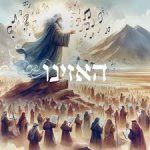
This is Moshe’s last speech, and he wants all of Israel to pay attention. He is looking into the future, and sadly, he sees the nation of Israel in apostasy, going against the commandments of YHVH, going after strange gods, and heading to corruption. He calls all of Heaven and earth as witnesses. We can be assured that the angels of heaven heard this speech, and “His” people who were on earth also heard; they were right there.
“I will proclaim the name of the LORD (YHVH), and the greatness of Our God” Here Moshe mentions two of the many names of God, the most holy, “Yod Hey Vav Hey”(YHVH) When we look at these letters from the ancient Hebraic aspect we get “behold the hand, behold the nail” this takes us directly to Calvary and imagine Messiah Yeshua hanging there by the nails in his hands (wrists). The name “Eloheinu” is the “behold the God who leads (us) and connects (us) to life through his hands” when we go to the ancient Hebraic symbolism of the letters.
“The ROCK, His work is perfect! Here is another name of God, “The ROCK” (HaTzur) from the letter “Tz” which symbolizes “Tzadik” (one who is righteous), and the word “Perfect” (Tamim) from “Tamei” which is “clean and pure” we have heard of God being called the “Rock of Ages” the “Solid Rock.” I remember the words of " B.R. Lakin," an old preacher in his 80s who once said, "I might not know a lot about the age of the rocks, but I do know the ROCK of ages." One thing is to know ABOUT the ROCK of ages, and another is to KNOW the ROCK of ages.
Moshe is saying all of this through the Holy Spirit so that the people can understand that THEY are the problem, not God. In all this song (Shir), he lets Israel know that they will be “doing wrong” and “have been wrong.” Moshe is like a father speaking to his children to change their ways, or curses will follow.
It is very interesting the way verse 5 is written. In the original Hebrew, the word “No” is written twice! It is spelled differently both times. In modern and also ancient Hebrew, the word “No” (Lo) is written with two Hebrew letters, the “Lamed” (L) and “aleph” (silent letter), yet there is a vowel point called a “dagesh” that is written above the “aleph” indicating the vowel “o”. The “dagesh” is just a “dot” or “period”. Yet the word “No” is written a second time, this time with the consonant “Vav” which can also be pronounced as an “o”.
We can ask, “Why is the word 'no' written twice? All we can do is guess. Perhaps as an emphasis on what Adonai is saying. So, what is He saying in verse 5 of chapter 32? I have read three versions, from three Hebrew-English Bibles. One says,
“Children unworthy of Him. That crooked, perverse generation…” Another version states, “They have corrupted themselves, their spot is not the spot of his children; they are a perverse and crooked generation.” Yet the third, to me, is better; “Is corruption His? NO! His children’s is the blemish, a generation crooked and perverse.” In this version (from the Soncino Press), the word “No” is recognized. But only once, while it is written twice. Perhaps we could see it as: “Is corruption His? NO, NO, (it is NOT) it is that of His children, a corrupt and perverse generation.”
Before going into this study, I would like to go back to chapter 30:15; “See, I have set before you this day life and good, death and evil in that I command you this day to love YHVH thy God to walk in his ways and to keep his commandments…”
It is very interesting to see how Moshe words this. We are used to hearing and reading the words “life and death” associated together, and “good and evil” associated together. We see these word comparisons because they are opposites, yet here we see the words “life and good” associated together, as well as “death and evil” associated together. Is there perhaps a connection?
Perhaps the answer is in that “doing good deeds, “mitzvoth, will produce a prosperous life, a life which is blessed by Adonai, be it a short life or a long life. We can also see that living a life doing evil deeds will produce death, perhaps death very soon. It can also bring spiritual death as well as physical death if the person does not repent and turn to Yeshua/Jesus.
That is why Moshe commands us to “Love” Adonai and walk in his ways and keep his commandments. In this way, we are certain to live a life of meaning and reap the rewards when we appear before the judgment seat of the Messiah. Again, keeping the commandments does not bring salvation; salvation is a separate issue based on our faith in our risen Messiah.
“Give ear!” I am sure that we don’t hear that expression very often today, but in the times of Yeshua, it was like saying today, “Yo, listen up, dudes!” “Will ya listen t’me already?” or “Hey, listen, I have something important to say!”
This is Moshe’s last speech, and he wants all of Israel to pay attention. He is looking into the future, and sadly, he sees the nation of Israel in apostasy, going against the commandments of YHVH, going after strange gods, and heading to corruption. He calls all of Heaven and earth as witnesses. We can be assured that the angels of heaven heard this speech, and “His” people who were on earth also heard; they were right there.
“I will proclaim the name of the LORD (YHVH), and the greatness of Our God” Here Moshe mentions two of the many names of God, the most holy, “Yod Hey Vav Hey”(YHVH) When we look at these letters from the ancient Hebraic aspect we get “behold the hand, behold the nail” this takes us directly to Calvary and imagine Messiah Yeshua hanging there by the nails in his hands (wrists). The name “Eloheinu” is the “behold the God who leads (us) and connects (us) to life through his hands” when we go to the ancient Hebraic symbolism of the letters.
“The ROCK, His work is perfect! Here is another name of God, “The ROCK” (HaTzur) from the letter “Tz” which symbolizes “Tzadik” (one who is righteous), and the word “Perfect” (Tamim) from “Tamei” which is “clean and pure” we have heard of God being called the “Rock of Ages” the “Solid Rock.” I remember the words of " B.R. Lakin," an old preacher in his 80s who once said, "I might not know a lot about the age of the rocks, but I do know the ROCK of ages." One thing is to know ABOUT the ROCK of ages, and another is to KNOW the ROCK of ages.
Moshe is saying all of this through the Holy Spirit so that the people can understand that THEY are the problem, not God. In all this song (Shir), he lets Israel know that they will be “doing wrong” and “have been wrong.” Moshe is like a father speaking to his children to change their ways, or curses will follow.
It is very interesting the way verse 5 is written. In the original Hebrew, the word “No” is written twice! It is spelled differently both times. In modern and also ancient Hebrew, the word “No” (Lo) is written with two Hebrew letters, the “Lamed” (L) and “aleph” (silent letter), yet there is a vowel point called a “dagesh” that is written above the “aleph” indicating the vowel “o”. The “dagesh” is just a “dot” or “period”. Yet the word “No” is written a second time, this time with the consonant “Vav” which can also be pronounced as an “o”.
We can ask, “Why is the word 'no' written twice? All we can do is guess. Perhaps as an emphasis on what Adonai is saying. So, what is He saying in verse 5 of chapter 32? I have read three versions, from three Hebrew-English Bibles. One says,
“Children unworthy of Him. That crooked, perverse generation…” Another version states, “They have corrupted themselves, their spot is not the spot of his children; they are a perverse and crooked generation.” Yet the third, to me, is better; “Is corruption His? NO! His children’s is the blemish, a generation crooked and perverse.” In this version (from the Soncino Press), the word “No” is recognized. But only once, while it is written twice. Perhaps we could see it as: “Is corruption His? NO, NO, (it is NOT) it is that of His children, a corrupt and perverse generation.”