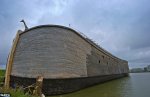
Again you continue to assume that every breed of animal alive today was alive back then, they were not. Thousands of years is long enough for a single type of animal to produce numerous sizes and colour variations, which are then used in your calculations.
Local flood theory is another poo-pooing of the Bible. Evidence for a huge flood covering the earth can be found all over the world, but many archaeologists and scientists will not let on about the finds.
I've heard the tell of the flood evidence. But these floods could have happened seperately and left such evidence.
I don't know. Honestly, it's speculation. But think about it. How can a species evolve different species if evolution doesn't exist to you? Or does it, I don't know. Maybe I'm assuming.
Another argument. If we have 25 million classified species now, and let's say you could fit maybe 500,000 at best in the ark, it seems like a massive evolutionary leap to go from that to 25 million. Also, back then, Noah wouldn't have classified the animals the same as we do, so he'd likely not have brought them all on the ark. Like, for instance, a Bengal tiger would have seemed very similar to a Sumatran tiger. So obviously not all the animals of today were on the ark, yet the exist, and MOST of them would have existed then.
Because a few thousand years isn't really enough for millions of new species to form. Even if we do use classifications that separate animals in more divided distinctions than Noah had done, it would be very difficult to say that those same animals didn't exist in Noah's day. Regardless of whether I call two separate rhinos a white rhino and a black rhino, those animals still would have physically existed. Perhaps not classified the same, but existent nonetheless.
If we take the premise that (logically) perhaps a few hundred thousand unclassified, but existent, species cramped the ark, that's a huge, huge way away from 25 million species. At the rate of evolution, we could maybe dwindle that classification to 24 million or 23, but certainly not all the way down to a few hundred thousand.
HOwever, I don't believe it's unwise to suggest that the flooding of the Earth was a flood of the people of the countries or country in which Noah and his family lived. Since these were the people whom God spoke of. It might also make sense that in Noah's day, the world was not as widely inhabited in terms of humanity's geographical sprawl over the Earth. Perhaps we only inhabited two or three countries at the time.
Noah came a fair distance before Abraham and Moses so it's not unfeasible that the inhabited world was fairly small, geographically.