Biblical contradiction? Geographical location of Mount Sinai...Where?

  • Christian Chat is a moderated online Christian community allowing Christians around the world to fellowship with each other in real time chat via webcam, voice, and text, with the Christian Chat app. You can also start or participate in a Bible-based discussion here in the Christian Chat Forums, where members can also share with each other their own videos, pictures, or favorite Christian music.

    If you are a Christian and need encouragement and fellowship, we're here for you! If you are not a Christian but interested in knowing more about Jesus our Lord, you're also welcome! Want to know what the Bible says, and how you can apply it to your life? Join us!

    To make new Christian friends now around the world, click here to join Christian Chat.

unobtrusive

Senior Member
Jul 23, 2017
916
25
18
Were the “Tables of Stone,” written with God’s own hand, given to Israel in the Sinai Peninsula, or in what is now known as Saudi Arabia? Paul said it was in Arabia, but I have always thought it was in the Sinai Peninsula, which is part of Egypt today, and even back then. What say you?

"
And he gave unto Moses, when he had made an end of communing with him upon mount Sinai, two tables of testimony, tables of stone, written with the finger of God." (Exodus 31:18 KJV)

"For this Agar is mount Sinai in Arabia" (Galatians 4:25a KJV)

If in Arabia, then the crossing of the Red Sea is also in a different location that what is assumed.
 
It is in Arabia not in the Sinai peninsula, the crossing is also in a different place where people believe it was I think.
 
It is in Arabia not in the Sinai peninsula, the crossing is also in a different place where people believe it was I think.

It is unlikely that Paul thought of Arabia in our terms. He was meaning 'in the place where Arabs are', which would be just as true of the Sinai peninsula.
 
Were the “Tables of Stone,” written with God’s own hand, given to Israel in the Sinai Peninsula, or in what is now known as Saudi Arabia? Paul said it was in Arabia, but I have always thought it was in the Sinai Peninsula, which is part of Egypt today, and even back then. What say you?

"
And he gave unto Moses, when he had made an end of communing with him upon mount Sinai, two tables of testimony, tables of stone, written with the finger of God." (Exodus 31:18 KJV)

"For this Agar is mount Sinai in Arabia" (Galatians 4:25a KJV)

If in Arabia, then the crossing of the Red Sea is also in a different location that what is assumed.

By oldhermit

The Numbers 33 text seems to discount any possibility of the route being anywhere other than along the eastern coastline of the Gulf of Suez. The only plausible conclusion is that Mt. Sinai is Jebel Sin Bishar in the west central Sinai peninsula, NOT at Jabel el Laws in Saudi Arabia.


The following arguments are taken from a paper written by Gordon Franz entitled MT. SINAI IS NOT AT JEBEL EL-LAWZ IN SAUDI ARABIA). This paper was presented at the ETS (Evangelical Theological Society) and NEAS ( New England Actuarial Seminars) meeting Thursday, November 15, 2001, 9:50-10:30 a.m. session Broadmoor Hotel Colorado Springs, CO.

Proposition
"I believe that this paper, along with the Bible and Spade article, will conclusively demonstrated that there is no credible historical, geographical, archaeological or Biblical evidence to support the thesis that Mt. Sinai is at Jebel al-Lawz in Saudi Arabia."


I. The Proponents of Jebel al-Lawz as Mt. Sinai
Ron Wyatt first proposed the idea that Mt. Sinai was at Jebel al-Lawz. Whatever one may think of Ron Wyatt's "discoveries," he should be given full credit for this discovery. However, I would like to call your attention to a recent book examining the claims of Ron Wyatt. It is entitled Holy Relics or Revelation, by two SDA researchers, Russell and Colin Standish. (Hartland Publications, Box 1, Rapidan, VA 22733. 1-800-774-3566). This book is a careful, meticulous, in-depth study of Ron Wyatt's claims. These researchers "speak the truth in love" but state that Ron Wyatt has not been truthful in his claims.

II. Problems with the Jebel al-Lawz location view
The biggest problem with the identification of Jebel al-Lawz as Mt. Sinai is that it does not meet the Biblical criteria for the site. There are three questionable assumptions made by the proponents of Jebel al-Lawz.

A. The first questionable assumption that the proponents make is that the Sinai Peninsula was considered part of the "Land of Egypt" (Franz 2000: 103-105). The Bible says that when the Israelites left Succoth they were "out of Egypt," Exodus 13:8-20. The Land of Goshen was the eastern limits of Egypt. Apparently the line of fortresses on the eastern frontier canal was the border between Egypt and Sinai (Hoffmeier 1997: 164-175).
B. The second inaccurate assumption is the claim that Mt. Sinai is in the Land of Midian (Franz 2000:105,106). Two Biblical passages clearly place Mt. Sinai outside the Land of Midian.

In the original paper by Gordon Franz, he present this particular in this way. Two Biblical passages clearly place Mt. Sinai outside the Land of Midian. In Exodus 18, Moses and the Israelites are camped at "the Mountain of God" (Mt. Sinai) when Jethro, Moses' father-in-law, visits them. Verse 27 says, "Then Moses let his father-in-law depart [from Mt. Sinai], and he went his way to his own land [Midian]." Jethro departs from Mt. Sinai to return to the Land of Midian. According to Mandelkern Biblical Concordance, the phrase "his own land" (third person singular possessive) is used 30 times in the Hebrew Scriptures (Ex. 18:27; Num. 21:24,26,34,35; Deut. 2:24,31; 3:2; 4:47; 11:3; 29:1 [29:2 Eng.]; 33:13; 34:11; Josh. 8:1; I Kings 22:36; II Kings 18:33; Isa. 2:7,8; 13:14; 18:2,7; 36:18; 37:7; Jer. 2:15; 27:7; 50:18; Prov. 8:31; Dan. 11:19,28; Neh. 9:10; Mandelkern 1896:153. In the Pentateuch the phrase is use 13 times. Each time it is used of a specific geo-political entity, a kingdom, nation or tribal area. It is used of the Kingdom of the Amorites (Num. 21:24,26; Deut. 2:24,31; 4:47), with the borders clearly delineated as going from the Arnon to the Jabbok (Num. 21:24). The Kingdom of Bashan (Num. 21:34,35; Deut. 3:2; 4:47), which is implied as going from the Jabbok to Mt. Hermon (Deut. 4:48). The nation of Egypt (Deut. 11:3; 29:1 [29:2 Eng.]; 34:11) as well as the tribal territory of Joseph (Deut. 33:13). Joshua gives the delineation of the tribal territory of Ephraim and Manasseh which make up the tribes of Joseph (Deut. 33:17; Josh. 13:29-33; 16:1-10; 17:1-18). If Moses is consistent with his use of the word, and I think he is, the context suggests Jethro returned to the country of Midian, not to a plot of ground that he controlled as the proponents of Jebel al-Lawz contend."


The following represents my own observations based on the account given in Exodus chapters 17-19.

1. In Exodus 19:2, Moses and the Israelites are camped at Rephidim (not the Mt. of God) when Jethro, Moses' father-in-law, visits them. Verse 27 says,
"Then Moses let his father-in-law depart, and he went his way to his own land [Midian]." Jethro departs from Rephidim to return to the Land of Midian.
2. The second passage that places Mt. Sinai outside the land of Midian is Numbers 10:30. It states, "I [Hobab] will not go, but I will depart [from Mt. Sinai] to my own land [Midian] and to my kinsmen." Hobab is returning to Midian where his kinsmen live from Mt. Sinai.


C. The third questionable assumption made by the proponents of Jebel al-Lawz is that Galatians 4:25 says that Mt. Sinai is in Saudi Arabia (Franz 2000: 106,107).


One proponent affirms this conclusion when he writes, "The apostle Paul, under the inspiration of the Holy Spirit, informs us that Mount Sinai is in Saudi Arabia. Not Egypt!" (Cornuke and Halbrook 2000: 17). The Bible does not say Saudi Arabia, it only says Arabia.


One can easily argue that the Apostle Paul used the First Century AD Roman concept of Arabia in this passage. In the first century AD, based on the prior use by Herodotus, Pliny and Strabo, Arabia extended from the Persian Gulf to the Nile Delta, thus including the Sinai Peninsula in Arabia. Paul would be perfectly correct in placing Mt. Sinai in the Sinai Peninsula because the Sinai Peninsula was part of Arabia of his day.

 
It is in Arabia not in the Sinai peninsula, the crossing is also in a different place where people believe it was I think.

That's what I thought too. The crossing might have been somewhere in the southern part of the gulf of Aqaba, the northern gateway from the larger part of the Red Sea.. Possibly the southern part.
gulf_aqaba_map.jpg
 
Last edited:

The following represents my own observations based on the account given in Exodus chapters 17-19.

1. In Exodus 19:2, Moses and the Israelites are camped at Rephidim (not the Mt. of God) when Jethro, Moses' father-in-law, visits them. Verse 27 says,
"Then Moses let his father-in-law depart, and he went his way to his own land [Midian]." Jethro departs from Rephidim to return to the Land of Midian.
2. The second passage that places Mt. Sinai outside the land of Midian is Numbers 10:30. It states, "I [Hobab] will not go, but I will depart [from Mt. Sinai] to my own land [Midian] and to my kinsmen." Hobab is returning to Midian where his kinsmen live from Mt. Sinai.


C. The third questionable assumption made by the proponents of Jebel al-Lawz is that Galatians 4:25 says that Mt. Sinai is in Saudi Arabia (Franz 2000: 106,107).


One proponent affirms this conclusion when he writes, "The apostle Paul, under the inspiration of the Holy Spirit, informs us that Mount Sinai is in Saudi Arabia. Not Egypt!" (Cornuke and Halbrook 2000: 17). The Bible does not say Saudi Arabia, it only says Arabia.


One can easily argue that the Apostle Paul used the First Century AD Roman concept of Arabia in this passage. In the first century AD, based on the prior use by Herodotus, Pliny and Strabo, Arabia extended from the Persian Gulf to the Nile Delta, thus including the Sinai Peninsula in Arabia. Paul would be perfectly correct in placing Mt. Sinai in the Sinai Peninsula because the Sinai Peninsula was part of Arabia of his day.

  1. The Sinai Peninsula is called "The Wilderness of Egypt" The Bible says that there was a long journey through the wilderness BEFORE they reached the Red Sea. (Ezekiel 20:36; Judges 11:16; Exodus 13:18). In 50 AD, Philo of Alexandria understood this and wrote: "a long and desolate journey through the wilderness, destitute of any beaten road, at last arrived at the sea which is called the Red Sea". There is no wilderness west of the bitter lakes or north west of the Gulf of Aqaba, so they must be rejected.
  2. Even Pharaoh knew they were still "in the land of Egypt" at the shores of the Straits of Tiran: "For Pharaoh will say of the sons of Israel, 'They are wandering aimlessly in the land; the wilderness has shut them in." Exodus 14:3
  3. The modern Sinai Peninsula has an unfortunate name. It is called Sinai because in 325 AD, Constantine's mother, Queen Helena saw in a night vision that Mt. Sinai was at Mt. Musa. She built St. Catherine's Monastery and this has been the almost universal choice for Mt. Sinai ever since. Apart of the fact that it is almost impossible for Mt. Musa to be the real Mt. Sinai, we still need to understand that what is called the Sinai Peninsula today, has been Egyptian controlled territory from the time of Abraham in 2000 BC down to the time of Jesus.

I got this from this site. The Sinai Peninsula has always been Egyptian territory.


1967warmap.jpg


Israel crossed the Jordan river from the Eastern side.
 
Last edited:
  1. The Sinai Peninsula is called "The Wilderness of Egypt" The Bible says that there was a long journey through the wilderness BEFORE they reached the Red Sea. (Ezekiel 20:36; Judges 11:16; Exodus 13:18). In 50 AD, Philo of Alexandria understood this and wrote: "a long and desolate journey through the wilderness, destitute of any beaten road, at last arrived at the sea which is called the Red Sea". There is no wilderness west of the bitter lakes or north west of the Gulf of Aqaba, so they must be rejected.
  2. Even Pharaoh knew they were still "in the land of Egypt" at the shores of the Straits of Tiran: "For Pharaoh will say of the sons of Israel, 'They are wandering aimlessly in the land; the wilderness has shut them in." Exodus 14:3
  3. The modern Sinai Peninsula has an unfortunate name. It is called Sinai because in 325 AD, Constantine's mother, Queen Helena saw in a night vision that Mt. Sinai was at Mt. Musa. She built St. Catherine's Monastery and this has been the almost universal choice for Mt. Sinai ever since. Apart of the fact that it is almost impossible for Mt. Musa to be the real Mt. Sinai, we still need to understand that what is called the Sinai Peninsula today, has been Egyptian controlled territory from the time of Abraham in 2000 BC down to the time of Jesus.

I got this from this site. The Sinai Peninsula has always been Egyptian territory.


1967warmap.jpg


Israel crossed the Jordan river from the Eastern side.

A lot of this hinges on where one believes the crossing of the Red Sea to have been. Many locations are still uncertain and some are unknown altogether. By following the exodus rout provided by scripture however, many of these locations can be reasonably estimated There are in fact four or five different wilderness areas that were part of the exodus journey. There was the wilderness of Shur or Etham through which Israel passed before reaching the Red Sea, Exodus 14:1-3, This wilderness apparently occupied both sides of the Red Sea. After departing Elam they entered into the wilderness of Sin. They would also later journey through the wilderness of Paran and the wilderness of Zin.
 
I believe "Red Sea" is also a misnomer - either a translation error or an error when copying the English over and over again. Seems to me I had read somewhere the actual place was the "Reed Sea", or "Sea of Reeds", not the Red Sea.
 
I believe "Red Sea" is also a misnomer - either a translation error or an error when copying the English over and over again. Seems to me I had read somewhere the actual place was the "Reed Sea", or "Sea of Reeds", not the Red Sea.

What do you think the implications are for "Reed Sea" over Red Sea?
 
I don’t think there are any specific implications per se. The text in Hebrew is indeed ‘yam suph’; ‘reed sea’. The confusion seems to have come about with earlier English ‘rede sea’ (being 'reed' sea) being copied and accidentally misread and changed to ‘red sea’.

There are a few schools of thought over where the actual location of this ‘sea’ was. Some suggest it was actually more a swamp since ‘suph’ may actually be an Egyptian loan word into Hebrew; namely ‘thuf’ which refers specifically to an uncut papyrus reed; thus, something like “papyrus marsh”.

Various smaller lakes around the Red Sea area have been postulated as the location.

(from an internet article….)
"More conjecturally, it has also been suggested that suph may be related to the Hebrew suphah ("storm") or soph ("end"), referring to the events of the Reed/Red Sea escape itself:

The crossing of the sea signaled the end of the sojourn in Egypt and it certainly was the end of the Egyptian army that pursued the fleeing Hebrews (Ex 14:23-29; 15:4-5). After this event at Yam Suph, perhaps the verb Soph, meaning "destroy" and "come to an end," originated (cf. Amos 3:15; Jer 8:13; Isa 66:17; Psa 73:19). Another possible development of this root is the word suphah, meaning "storm-wind"...The meanings "end" and "storm-wind" would have constituted nice puns on the event that took place at the Yam Suph.
"

In short, the exact location is simply not known. As some have pointed out, the Red Sea’s width averages about 150 miles - there’s no way that could have been crossed in just a single day/night by a large group of people, though to be fair, the Biblical account focuses more on the water being parted, and then pharaoh's army being subsequently drowned, not how long it took to cross.

So, as I say, the location itself is really not the focal point; the fact that the body of water, wherever it may have been, seems to have been deep enough to have ‘walls of water’ on both sides when it was parted suggests a body of water with some depth. In addition, even if it were a marshy area, heavy chariots could have been bogged down, but certainly not deep enough for people to have drowned (unless they sank up to their necks in mud). Conversely too, a large group of people (the Israelites) would have had just as much, if not more, weight in objects than the Egyptian army and they didn’t seem to have an issue with getting stuck in any mud.

I think discovering the actual location would be more of historical importance than Biblical as it would give better clues as to the actual route used.

 
Yes, yam suph can mean reed or rushes but it's primary use in scripture is red. The word is found 28 times in the OT and of those 28 times it is translated red 24 times. So the question is this, how do we know whether it should be rendered as red, reed? Scripture has a way of defining it's own use of language. In Acts 7:36, Luke records that Stephan, being filled with the Holy Spirit says. “This man led them out, performing wonders and signs in the land of Egypt and in the Red Sea and in the wilderness for forty years." So, did Stephan mean red or reed? In Greek, there is a distinct word for reed which is κάλαμον. This is the word used in Matthew 12:20, "a bruised reed he will not break, and a smoldering wick he will not quench." I can think of two Greek words for red. One is πυρρός meaning red or fire-colored, Rev. 6:4, and the other is ἐρυθρᾷ which simply means red and this is the word used by Stephan in, Acts 7:36. It is also the word used in Hebrews 11:29, "By faith they passed through the Red Sea as though they were passing through dry land." So, these two inspired writers confirm the intended meaning of yam suph as RED and not reed.
 
Last edited:
I don’t think there are any specific implications per se. The text in Hebrew is indeed ‘yam suph’; ‘reed sea’. The confusion seems to have come about with earlier English ‘rede sea’ (being 'reed' sea) being copied and accidentally misread and changed to ‘red sea’.

There are a few schools of thought over where the actual location of this ‘sea’ was. Some suggest it was actually more a swamp since ‘suph’ may actually be an Egyptian loan word into Hebrew; namely ‘thuf’ which refers specifically to an uncut papyrus reed; thus, something like “papyrus marsh”.

Various smaller lakes around the Red Sea area have been postulated as the location.

(from an internet article….)
"More conjecturally, it has also been suggested that suph may be related to the Hebrew suphah ("storm") or soph ("end"), referring to the events of the Reed/Red Sea escape itself:

The crossing of the sea signaled the end of the sojourn in Egypt and it certainly was the end of the Egyptian army that pursued the fleeing Hebrews (Ex 14:23-29; 15:4-5). After this event at Yam Suph, perhaps the verb Soph, meaning "destroy" and "come to an end," originated (cf. Amos 3:15; Jer 8:13; Isa 66:17; Psa 73:19). Another possible development of this root is the word suphah, meaning "storm-wind"...The meanings "end" and "storm-wind" would have constituted nice puns on the event that took place at the Yam Suph.
"

In short, the exact location is simply not known. As some have pointed out, the Red Sea’s width averages about 150 miles - there’s no way that could have been crossed in just a single day/night by a large group of people, though to be fair, the Biblical account focuses more on the water being parted, and then pharaoh's army being subsequently drowned, not how long it took to cross.

So, as I say, the location itself is really not the focal point; the fact that the body of water, wherever it may have been, seems to have been deep enough to have ‘walls of water’ on both sides when it was parted suggests a body of water with some depth. In addition, even if it were a marshy area, heavy chariots could have been bogged down, but certainly not deep enough for people to have drowned (unless they sank up to their necks in mud). Conversely too, a large group of people (the Israelites) would have had just as much, if not more, weight in objects than the Egyptian army and they didn’t seem to have an issue with getting stuck in any mud.

I think discovering the actual location would be more of historical importance than Biblical as it would give better clues as to the actual route used.

You might have a legitimate point here. I looked into it a little.

סוּף çûwph, soof; probably of Egyptian origin; a reed, especially the papyrus:—flag, Red (sea), weed. Compare H5489.
קָנֶה qâneh, kaw-neh'; from H7069; a reed (as erect) The waters stood erect on either side as they crossed on dry land.

"And Moses stretched out his hand over the sea; and the Lord caused the sea to go back by a strong east wind all that night, and made the sea dry land, and the waters were divided.And the children of Israel went into the midst of the sea upon the dry ground: and the waters were a wall unto them on their right hand, and on their left.
(Exodus 14:21-22 KJV)

It seems as if the term "Red Sea" was given to the waters located between the East African coast and the Saudi Arabian peninsula, the Red Sea got its name because of a type of algae called Trichodesmium erythraeum, which is found in the sea. When these blooms of algae die off they appear to turn the blue-green color of the ocean to a reddish-brown.

The Red Sea (also the Erythraean Sea) is a seawater inlet of the Indian Ocean, lying between Africa and Asia. The connection to the ocean is in the south through the Bab el Mandeb strait and the Gulf of Aden. To the north lie the Sinai Peninsula, the Gulf of Aqaba, and the Gulf of Suez (leading to the Suez Canal).
 
I don't have my older (ancient) Egyptian sources handy, but 'reed' in later Egyptian (Coptic) has several forms; two of which are "sô" (long 'o') and sêve (pron. like "say-veh") - either could have been borrowed into Hebrew as 'suph', particular the latter.
 
I don't have my older (ancient) Egyptian sources handy, but 'reed' in later Egyptian (Coptic) has several forms; two of which are "sô" (long 'o') and sêve (pron. like "say-veh") - either could have been borrowed into Hebrew as 'suph', particular the latter.

A while back I was looking more in depth to the scripture where God told the Israelites to go after leaving Etham, the term for wilderness or desert.

"Speak unto the children of Israel, that they turn and encamp before Pihahiroth, between Migdol and the sea, over against Baalzephon: before it shall ye encamp by the sea." (Exodus 14:2 KJV)

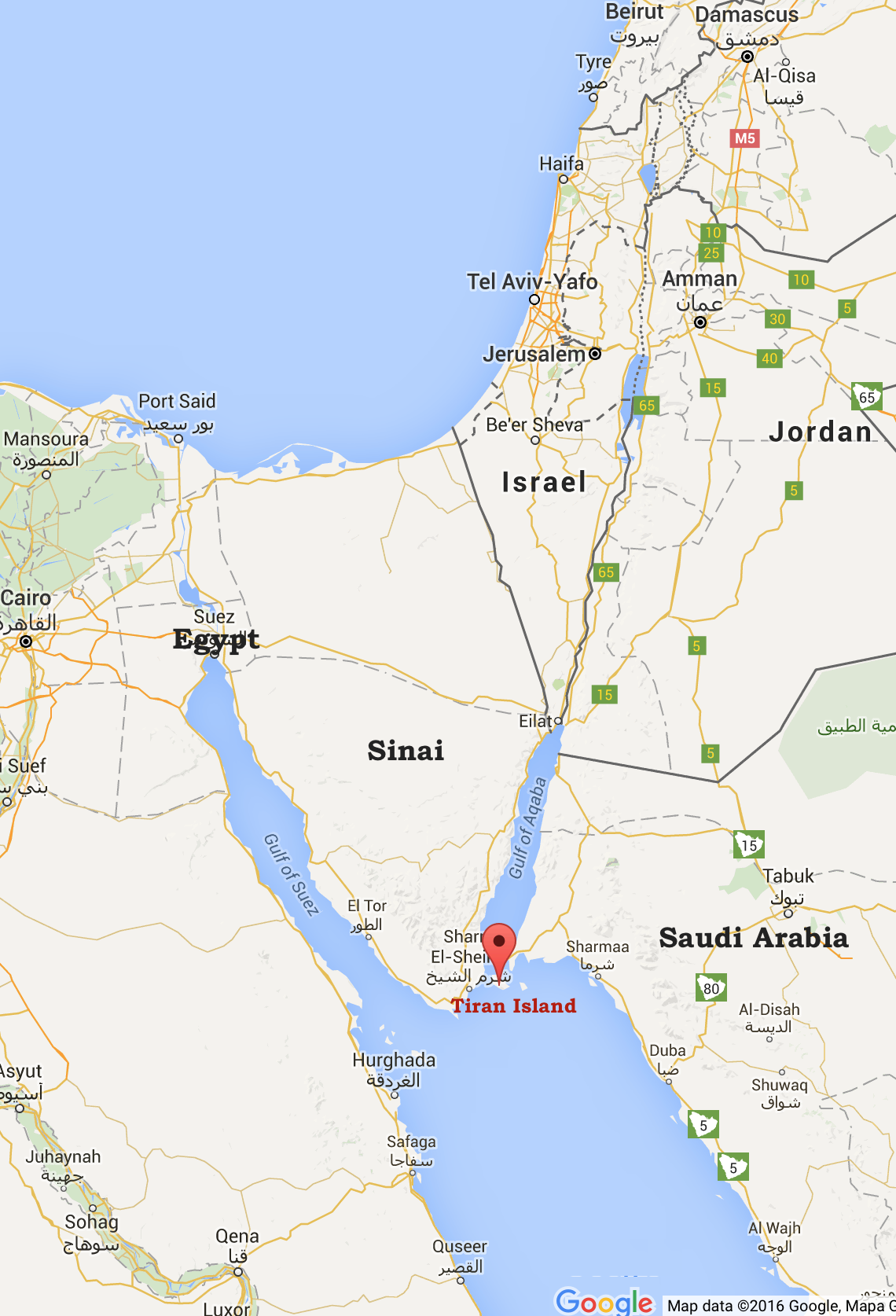
Migdol means "tower," possibly a watch tower in the Sinai peninsula to see trading ships coming in through the golf of Aqaba. That might have been the place where the outpost of Egyptian soldiers saw Israel continuing to travel southward. Then Pharaoh would have thought they were lost.

"For Pharaoh will say of the children of Israel, They are entangled in the land, the wilderness hath shut them in." (Exodus 14:3 KJV)

The "Island of Tiran" might have been what the Bible defines as Baalzephon, the Egyptian god that keeps watch over the sea
.

Tiran-Island-Google-maps.png
 
Last edited:
Here is an interesting video on the subject.

[video=youtube;ICBv1760hTQ]https://www.youtube.com/watch?v=ICBv1760hTQ[/video]


Pihahiroth is the Hebrew rendering of an Egyptian place name - 'place where sedge grows' or a 'place where there is sedge'.
 
Pihahiroth is the Hebrew rendering of an Egyptian place name - 'place where sedge grows' or a 'place where there is sedge'.

That would describe the "reed Sea" as you mentioned previously. Good stuff Kavik. I'm impressed with the information in all that has been posted. Most excellent!
 

I have seen this video, and it is real interesting. It proves things different than what we've (I have ) assumed for years.

It was an eye opener to myself also. Helped me to start questioning things, even things I thought were true for years