You might be interested in taking a look at BibleGateway.com. You can compare a verse across twenty or thirty different English versions, plus minor variants of several.
Thank you I will .

You might be interested in taking a look at BibleGateway.com. You can compare a verse across twenty or thirty different English versions, plus minor variants of several.
in NIV of Matthew 27 they are called 'rebels' -- but it's not like it doesn't say anything about them lol.
ESV, NASB and NKJV say 'robbers' while KJV says 'thieves'

No please don't feel sorry . Now I know what it is . Thank you for the answer back . Wow my head is spining . I had not known how many diffrent types of Bibles there are out there . This is some thing I really need to talk to my pastor about . Thank you for all your help

in NIV of Matthew 27 they are called 'rebels' -- but it's not like it doesn't say anything about them lol.
ESV, NASB and NKJV say 'robbers' while KJV says 'thieves'
I don't think the perfect translation exists, but the ESV and NASB are very good on the more literal extreme, and the NIV is good for conceptual translation.
If I had the perfect Bible, it would be an ESV/NIV parallel bible, with the notes from the Zondervan NIV Biblical Theology Study Bible.
However, I would want the OT quotations in the NT to be indicated some way, like the NASB does through capitalization.
But, I would also want these OT quotations to somehow indicate that when Lord is used, it specifies whether the underlying text indicates Adonai or YHVH, as these are important to proving the deity of Jesus.
But, that bible doesn't exist.
You simply have to compromise somewhere, and I think the ESV is the best compromise.
I would highly suggest that you get a Zondervan NIV Biblical Theology Study Bible, though. The notes on this Bible are the best. They are edited by DA Carson and are fantastic. Even if you only get a hardback version, I would recommend it for any serious understanding of the Bible despite the NIV version.
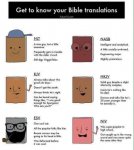

KJV.I have read the king James and the New king James Version plus the New International Version . I find the New Internationan eaiser to understand but at the sametime they leave out a lot of information that you would find in the King James and the New King James . So I find myself cross refersioning the NIV with the King James to get God's word they way it should be , My problem is I am stuck on wich on to read . I so would like your opions .

NIV leaves out a lot... of what, exactly?KJV.
If I am stuck I ask God and usually just read a bit more and scriptures become clearer. Sometimes I go on bIblehub to look up verses in other translations, but my go to bible is the KJV. I agree NIV leaves out a lot.
How would you know? Can you read the original languages?NKJV is ok but KJV is widely available, Ive only read NKJV in new testament not old so cant tell if theres much difference, most of the change has just been thees and thous..to 'you' but I actually dont mind reading the older version as its more specific and I get more meaning out of it. It seems to me KJV sticks closer to the original language than the other versions. Any words I dont know I look up in bible dictionary.


Interesting thread... hard to give specific answer, IMO
Here's a post I made some time back though (along the lines of this topic)...
[quoting]
Here's a verse I believe is inaccurate according to how the esv has it (compared with ylt, just for example):
esv - "and all who dwell on earth will worship it, everyone whose name has not been written before [pro - G4253] the foundation of the world in the book of life of the Lamb who was slain"
ylt - "And bow before it shall all who are dwelling upon the land, whose names have not been written in the scroll of the life of the Lamb slain from [apo - G575] the foundation of the world"
https:/ /biblehub.com/text/revelation/13-8.htm - Revelation 13:8
kjv [another comparison] - "And all that dwell upon the earth shall worship him, whose names are not written in the book of life of the Lamb slain from [apo - G575] the foundation of the world."
Huge difference between "slain from [apo - G575]" and "written before [pro - G4253]" ; )
(I believe "slain from [apo - G575]" is accurate)
For this reason, I tend to avoid the esv.
[end quoting that post]

The earliest manuscripts do not contain these verses..therefore, this is an indication they were added later.
Additionally, Mark's book was meant to lead to the question, who is this man?
It is likely that the person who added these verses meant to harmonize Mark with the other gospels.
Additionally, I don't think the verses about drinking poison and picking up snakes were inspired, neither was Jesus appearing in a different form. The latter is used by Jehovah's Witnesses to deny the bodily resurrection.
Umm, Due to rights that must be requested for any printed or online publication other than personal use, I would try to encourage you to visit the digitized online Vaticanus to see for yourself the weighty evidence I am speaking of. The earliest Greek manuscripts you are referring to are Vaticanus and Sinaiticus. For brevity, the Vaticanus as observed leaves a blank column for Mark 16:9-20, thus providing additional testimony for the existence of this passage.
https://digi.vatlib.it/view/MSS_Vat.gr.1209?ling=en
Numerous shreds of evidence further relate to the longer ending/reading of the text. Examples:
The Syriac Peshitta has it. Whether the ancient version is of the 2nd Ce. Or 5th Century standard of the NT but the version is likely to favor the longer ending of Mark. The observation is that, where did this version translate from? It would certainly to the Greek original and not a 4th ce. Greek Vaticanus or Sinaiticus.
https://www.dukhrana.com/peshitta/index.php
The Old Latin has it. This is actually older than Sin-Vat.
http://www.sacredbible.org/vulgate1861/NT-02_Marcus.htm
http://www.thelatinlibrary.com/bible/mark.shtml#16
The Gothic Bible of the 4th Ce. by Wulfilla has it.
http://www.wulfila.be/gothic/browse/text/?book=4&chapter=16
The overwhelming evidence shows thus that the Sin-Vat had omitted by the unskillful scribe and has the origin of a longer reading of the text.
I consider the KJV my written final authority. It seems to me that standards in use by modern bibles. We have the English Standard Version, the New American Standard Versions, the Holman Standard Christian Bible, etc. which is some kind of confusing to which standard we use.This is the crux of the issue... what do we consider to be the objective standard for the content of Scripture. Most people who began with the KJV consider it to be the standard, but that is usually nothing more than familiarity bias.
Umm, see the evidence first, though these are second-hand pieces of evidence yet it's quite weighty. The assumption is but nothing, I mean.I understand that it's pretty obvious it's an addition due to the different writing styles...additionally, it is used to support whacky stuff.
The inclusion of the word, "Standard" in the name of the translations is irrelevant. I am talking about an objective standard (lower-case 's'), not a marketing gimmick.I consider the KJV my written final authority. It seems to me that standards in use by modern bibles. We have the English Standard Version, the New American Standard Versions, the Holman Standard Christian Bible, etc. which is some kind of confusing to which standard we use.
Umm, see the evidence first, though these are second-hand pieces of evidence yet it's quite weighty. The assumption is but nothing, I mean.
