
This is from a Facebook post where an individual ran the OT, NT, and Apocrypha through a specialized program that tested each for similarities and differences. The results are charted, Has anyone seen this sort of comparison before?
Jeremy Menicucci
This is a PCA plot showing my application of Cosine Delta to the Greek NT, the LXX, and Apocrypha texts. The plot shows that stylistically, the NT is much closer to the OT than to any Apocryphal book surveyed. It also shows that the OT is more stylistically similar to itself than to Apocryphal texts. These Apocryphal texts are all extremely similar to each other and dissimilar to both the NT and the OT combined, suggesting they represent a clearly extra-Biblical stylistic tradition.
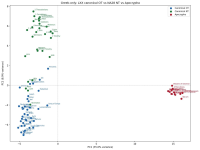
I'm working towards publishing it, and then eventually, my repo should be open source. In order to reproduce this test exactly, you'd need electronic access to the LXX for both the OT and Apocrypha (I used the Vestus Testamentum for books that were available, and Ralhf's/Hanhart as fallback), and the NA28. I have a python script that loads each verse, tokenizes them, and the runs Cosine Delta on their z-scores. There is code that already exists to perform these types of calculations with the R package "stylo" or Python's "scikit-learn".
You can look up Cosine Delta (Evert et al. 2017):
Δ_cos(A, B) = 1 − (𝐳_A ⋅ 𝐳_B) / (‖𝐳_A‖ ‖𝐳_B‖)
Variance here is the standard deviation of all pairwise cosine delta distances within each group.The underlying word frequencies are z-score normalized (mean-centered, divided by standard deviation) before calculating distances.
Jeremy Menicucci
This is a PCA plot showing my application of Cosine Delta to the Greek NT, the LXX, and Apocrypha texts. The plot shows that stylistically, the NT is much closer to the OT than to any Apocryphal book surveyed. It also shows that the OT is more stylistically similar to itself than to Apocryphal texts. These Apocryphal texts are all extremely similar to each other and dissimilar to both the NT and the OT combined, suggesting they represent a clearly extra-Biblical stylistic tradition.
I'm working towards publishing it, and then eventually, my repo should be open source. In order to reproduce this test exactly, you'd need electronic access to the LXX for both the OT and Apocrypha (I used the Vestus Testamentum for books that were available, and Ralhf's/Hanhart as fallback), and the NA28. I have a python script that loads each verse, tokenizes them, and the runs Cosine Delta on their z-scores. There is code that already exists to perform these types of calculations with the R package "stylo" or Python's "scikit-learn".
You can look up Cosine Delta (Evert et al. 2017):
Δ_cos(A, B) = 1 − (𝐳_A ⋅ 𝐳_B) / (‖𝐳_A‖ ‖𝐳_B‖)
Variance here is the standard deviation of all pairwise cosine delta distances within each group.The underlying word frequencies are z-score normalized (mean-centered, divided by standard deviation) before calculating distances.


 >=-
>=-