
Interesting Results from a Facebook Posting

  • Christian Chat is a moderated online Christian community allowing Christians around the world to fellowship with each other in real time chat via webcam, voice, and text, with the Christian Chat app. You can also start or participate in a Bible-based discussion here in the Christian Chat Forums, where members can also share with each other their own videos, pictures, or favorite Christian music.

    If you are a Christian and need encouragement and fellowship, we're here for you! If you are not a Christian but interested in knowing more about Jesus our Lord, you're also welcome! Want to know what the Bible says, and how you can apply it to your life? Join us!

    To make new Christian friends now around the world, click here to join Christian Chat.

Sipsey

Well-known member
Sep 27, 2018
1,784
861
113
This is from a Facebook post where an individual ran the OT, NT, and Apocrypha through a specialized program that tested each for similarities and differences. The results are charted, Has anyone seen this sort of comparison before?

Jeremy Menicucci
This is a PCA plot showing my application of Cosine Delta to the Greek NT, the LXX, and Apocrypha texts. The plot shows that stylistically, the NT is much closer to the OT than to any Apocryphal book surveyed. It also shows that the OT is more stylistically similar to itself than to Apocryphal texts. These Apocryphal texts are all extremely similar to each other and dissimilar to both the NT and the OT combined, suggesting they represent a clearly extra-Biblical stylistic tradition.
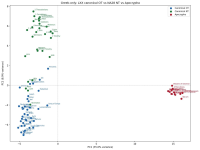
1776212293496.png


I'm working towards publishing it, and then eventually, my repo should be open source. In order to reproduce this test exactly, you'd need electronic access to the LXX for both the OT and Apocrypha (I used the Vestus Testamentum for books that were available, and Ralhf's/Hanhart as fallback), and the NA28. I have a python script that loads each verse, tokenizes them, and the runs Cosine Delta on their z-scores. There is code that already exists to perform these types of calculations with the R package "stylo" or Python's "scikit-learn".

You can look up Cosine Delta (Evert et al. 2017):

Δ_cos(A, B) = 1 − (𝐳_A ⋅ 𝐳_B) / (‖𝐳_A‖ ‖𝐳_B‖)

Variance here is the standard deviation of all pairwise cosine delta distances within each group.The underlying word frequencies are z-score normalized (mean-centered, divided by standard deviation) before calculating distances.
 
  • Like
Reactions: 2ndTimeIsTheCharm
This is from a Facebook post where an individual ran the OT, NT, and Apocrypha through a specialized program that tested each for similarities and differences. The results are charted, Has anyone seen this sort of comparison before?

Jeremy Menicucci
This is a PCA plot showing my application of Cosine Delta to the Greek NT, the LXX, and Apocrypha texts. The plot shows that stylistically, the NT is much closer to the OT than to any Apocryphal book surveyed. It also shows that the OT is more stylistically similar to itself than to Apocryphal texts. These Apocryphal texts are all extremely similar to each other and dissimilar to both the NT and the OT combined, suggesting they represent a clearly extra-Biblical stylistic tradition.

View attachment 287788


I'm working towards publishing it, and then eventually, my repo should be open source. In order to reproduce this test exactly, you'd need electronic access to the LXX for both the OT and Apocrypha (I used the Vestus Testamentum for books that were available, and Ralhf's/Hanhart as fallback), and the NA28. I have a python script that loads each verse, tokenizes them, and the runs Cosine Delta on their z-scores. There is code that already exists to perform these types of calculations with the R package "stylo" or Python's "scikit-learn".

You can look up Cosine Delta (Evert et al. 2017):

Δ_cos(A, B) = 1 − (𝐳_A ⋅ 𝐳_B) / (‖𝐳_A‖ ‖𝐳_B‖)

Variance here is the standard deviation of all pairwise cosine delta distances within each group.The underlying word frequencies are z-score normalized (mean-centered, divided by standard deviation) before calculating distances.
Interesting.
 
  • Like
Reactions: Sipsey
This is from a Facebook post where an individual ran the OT, NT, and Apocrypha through a specialized program that tested each for similarities and differences. The results are charted, Has anyone seen this sort of comparison before?

Jeremy Menicucci
This is a PCA plot showing my application of Cosine Delta to the Greek NT, the LXX, and Apocrypha texts. The plot shows that stylistically, the NT is much closer to the OT than to any Apocryphal book surveyed. It also shows that the OT is more stylistically similar to itself than to Apocryphal texts. These Apocryphal texts are all extremely similar to each other and dissimilar to both the NT and the OT combined, suggesting they represent a clearly extra-Biblical stylistic tradition.

View attachment 287788


I'm working towards publishing it, and then eventually, my repo should be open source. In order to reproduce this test exactly, you'd need electronic access to the LXX for both the OT and Apocrypha (I used the Vestus Testamentum for books that were available, and Ralhf's/Hanhart as fallback), and the NA28. I have a python script that loads each verse, tokenizes them, and the runs Cosine Delta on their z-scores. There is code that already exists to perform these types of calculations with the R package "stylo" or Python's "scikit-learn".

You can look up Cosine Delta (Evert et al. 2017):

Δ_cos(A, B) = 1 − (𝐳_A ⋅ 𝐳_B) / (‖𝐳_A‖ ‖𝐳_B‖)

Variance here is the standard deviation of all pairwise cosine delta distances within each group.The underlying word frequencies are z-score normalized (mean-centered, divided by standard deviation) before calculating distances.


Very beautiful!

Love how similar the OT and NT are stylistically! That is amazing consider how many authors were inspired by God over generations and ~1,500 years that comprise the Bible.

We already knew that the apocrypha was not inspired by God, but it's nice that someone proved it mathematically, at least stylistically wise!


🕊
 
  • Like
Reactions: AnFlaw and Sipsey
Very beautiful!

Love how similar the OT and NT are stylistically! That is amazing consider how many authors were inspired by God over generations and ~1,500 years that comprise the Bible.

We already knew that the apocrypha was not inspired by God, but it's nice that someone proved it mathematically, at least stylistically wise!


🕊
I had never seen anyone attempt this, but it seems a perfectly logical result.
 
To evxplain what all this means, AI search explains it better than I can:

Stylometric analysis is used to assess the authorship of biblical texts by detecting consistent writing patterns such as word frequency, sentence structure, and stylistic choices.

For the Old and New Testaments, scholars apply computational methods like cosine similarity and Burrows’s Delta to compare linguistic features across texts. These tools quantify how similar or different books or letters are in style, helping to identify whether they likely come from the same author.

For example:

Pauline epistles: Cosine similarity has been used to compare the seven undisputed letters of Paul (e.g., Romans, 1 & 2 Corinthians) with disputed ones (e.g., 1 & 2 Timothy, Titus). Results often show the Pastoral Epistles form a distinct cluster, suggesting different authorship.

Old Testament: Algorithms have identified two main stylistic strands in the Pentateuch—“priestly” and “non-priestly”—matching traditional scholarship with over 90% accuracy, supporting multiple authorship theories.

These methods do not prove authenticity but provide objective, statistical evidence about stylistic consistency, complementing historical and textual analysis.

-=<❤️>=-
So it's always amazing to see that consistency considering how many authors over ~1,500 years, God worked through to bring about the Bible!

I used to have to do papers with other people when I was in nursing school. We would all research and write about our own assigned topics which the group leader had to organize into one cohesive, meaningful report, so to see God being the group leader pulling together the Bible means so much to me!


🕊
 
  • Like
Reactions: Sipsey