Revelation 19- A major Key to understanding Revelations

  • Christian Chat is a moderated online Christian community allowing Christians around the world to fellowship with each other in real time chat via webcam, voice, and text, with the Christian Chat app. You can also start or participate in a Bible-based discussion here in the Christian Chat Forums, where members can also share with each other their own videos, pictures, or favorite Christian music.

    If you are a Christian and need encouragement and fellowship, we're here for you! If you are not a Christian but interested in knowing more about Jesus our Lord, you're also welcome! Want to know what the Bible says, and how you can apply it to your life? Join us!

    To make new Christian friends now around the world, click here to join Christian Chat.
I found it interesting that the 1611 translators capitalized Prince in Daniel 9:26 indicating that they believed the Prince was the Messiah. If you believe Josephus it was the Jews who destroyed Jerusalem.
 
I found it interesting that the 1611 translators capitalized Prince in Daniel 9:26 indicating that they believed the Prince was the Messiah. If you believe Josephus it was the Jews who destroyed Jerusalem.
None of mine have prince capitalized.
 
I found it interesting that the 1611 translators capitalized Prince in Daniel 9:26 indicating that they believed the Prince was the Messiah. If you believe Josephus it was the Jews who destroyed Jerusalem.
That would tend to indicate the writers of that bible believed the “prince” was the Messiah…. Correct?

But what do you think it means?

Did you focus on the fact that this “prince” did not destroy the city? It was the “people “ of this prince. Do you think this means God is identifying a prince that is a key figure who comes after the destruction of the city?

Not sure it represents the Messiah as He was not sent to destroy the city…
And if we focus on the “people” angle who did destroy the city in 70 AD then it certainly would not be referring to the Jews- early members of His church.

Perhaps the key to identifying this “prince” is to bring together those verses in Daniel 9 that speak of a “prince” or the “Messiah the Prince,” or “prince,” and determine how they are each used… I believe there are 5 separate times the terms Messiah or Prince or prince is found.

So, who do you believe is this “prince” in 9:26? Thanks
 
You have the wedding, you have the judgment, you have the end of the beast and the false prophet, you have the dragon locked up for a thousand years, you have the first resurrection, and you have the end of all living humanity that was not invited to the wedding. The only ones left on the earth are the dead who were not written in the book of life.

What think you?
Hi T,
The Book of Revelation has four storylines which are the seals (ch. 5-8), the trumpets (ch. 8-11), the mark of the beast (ch. 12-16), and the fall of Babylon (ch. 17-21).
In the fall of Babylon storyline is the judgment (ch. 17), the fall of Babylon proper (ch. 18), the destruction of the beast (ch. 19), the thousand years (ch. 20), and New Jerusalem (ch. 21).
From the destruction of the economic system Babylon in Chapter Eighteen to the destruction of the beast in Chapter Nineteen is 3.5 years. This is the tribulation proper.
The judgment proper is in Chapter Twenty. This is the 3.5 years that begin the thousand years. That is, the thousand years begin at Verse 20:1.
So there are 3.5 years of tribulation in Chapters 18-19, and then 3.5 years of judgment in Chapter 20. The 3.5 years of judgment in Chapter 20 are part of the thousand years in that chapter.
It is during those thousand years that the saints are resurrected. Then, at the end of those thousand years comes the second resurrection, which is a mass resurrection of the damned.
 
  • Like
Reactions: JustThinking
The battle at the second coming is local at the middle east.

Earth's population is not wiped out.
It is a wonderful concept that the world's population will be spared. But the surface of the earth is destroyed after Armageddon. It is for this reason that the saints must be removed in a rapture, as was Noah. Although in the latter case, it appears the saints will be placed in the city of New Jerusalem to descend back to the earth after the destruction has been resolved. Then the earth is repopulated, followed by warfare as shown in Rev. 20:7-9.
 
Hi T,
The Book of Revelation has four storylines which are the seals (ch. 5-8), the trumpets (ch. 8-11), the mark of the beast (ch. 12-16), and the fall of Babylon (ch. 17-21).
In the fall of Babylon storyline is the judgment (ch. 17), the fall of Babylon proper (ch. 18), the destruction of the beast (ch. 19), the thousand years (ch. 20), and New Jerusalem (ch. 21).
From the destruction of the economic system Babylon in Chapter Eighteen to the destruction of the beast in Chapter Nineteen is 3.5 years. This is the tribulation proper.
The judgment proper is in Chapter Twenty. This is the 3.5 years that begin the thousand years. That is, the thousand years begin at Verse 20:1.
So there are 3.5 years of tribulation in Chapters 18-19, and then 3.5 years of judgment in Chapter 20. The 3.5 years of judgment in Chapter 20 are part of the thousand years in that chapter.
It is during those thousand years that the saints are resurrected. Then, at the end of those thousand years comes the second resurrection, which is a mass resurrection of the damned.
Very nice comments! I also find the tribulation to be 3.5 years. But a little differently.

At the end of the “time of the Gentiles” God will remove the blindness from the eyes of His people (Jews). This will be their “Damascus” like experience no different than what Paul went through.

They will recognize the “One they had pierced” and for exactly 3.5 years they will also go out into the world preaching the Word of God AND the Testimony of Jesus (again, just as clear and pure as Paul did).

I think you might agree just how much anger, hatred and violence this will generate throughout the world. This will be the time when bother goes against father, daughter against mother, etc., The power institutions that have built THEIR church / empire preaching a very different gospel will act violently to secure its existence and power in the world.

After 3.5 years then the Messiah will arrive to take His followers away and this begins the 1000 year reign, before He returns to destroy Satan, his army of angels and all those humans that rejected Jesus - He will bring them out of their graves for final judgment and destruction.

Look forward to your thoughts! Thanks.
 
That would tend to indicate the writers of that bible believed the “prince” was the Messiah…. Correct?

But what do you think it means?

Did you focus on the fact that this “prince” did not destroy the city? It was the “people “ of this prince. Do you think this means God is identifying a prince that is a key figure who comes after the destruction of the city?

Not sure it represents the Messiah as He was not sent to destroy the city…
And if we focus on the “people” angle who did destroy the city in 70 AD then it certainly would not be referring to the Jews- early members of His church.

Perhaps the key to identifying this “prince” is to bring together those verses in Daniel 9 that speak of a “prince” or the “Messiah the Prince,” or “prince,” and determine how they are each used… I believe there are 5 separate times the terms Messiah or Prince or prince is found.

So, who do you believe is this “prince” in 9:26? Thanks

In Dan 9:27 it says destruction comes due to the overspreading of abominations. Just who would be the one causing desolation due to abominations? Would that be God? There is the elect and then there is the nation.

Rom11:7What then? Israel hath not obtained that which he seeketh for; but the election hath obtained it, and the rest were blinded They will be blinded until the fulness of the Gentiles comes in. Rom 11:25 For I would not, brethren, that ye should be ignorant of this mystery, lest ye should be wise in your own conceits; that blindness in part is happened to Israel, until the fulness of the Gentiles be come in.

It was Israel that Christ came for, the Jews are the lost sheep of Israel. According to Josephus the Jews in Jerusalem, at the time of the destruction, were a motley bunch, full of thieves and false Christs. Yet, they still were the lost sheep that Jesus came for. According to Josephus, Titus tried to save the city, and asked the Jews to put down their arms and leave, but they would not. It was the jews that started the fire that burnt the Temple.

If you compare this with what Trump is trying to do today there is a comparison. Trump doesn't want to destroy Iran. The Muslim only have to lay down their arms and the fighting would stop.
 
In Dan 9:27 it says destruction comes due to the overspreading of abominations. Just who would be the one causing desolation due to abominations? Would that be God? There is the elect and then there is the nation.

Rom11:7What then? Israel hath not obtained that which he seeketh for; but the election hath obtained it, and the rest were blinded They will be blinded until the fulness of the Gentiles comes in. Rom 11:25 For I would not, brethren, that ye should be ignorant of this mystery, lest ye should be wise in your own conceits; that blindness in part is happened to Israel, until the fulness of the Gentiles be come in.

It was Israel that Christ came for, the Jews are the lost sheep of Israel. According to Josephus the Jews in Jerusalem, at the time of the destruction, were a motley bunch, full of thieves and false Christs. Yet, they still were the lost sheep that Jesus came for. According to Josephus, Titus tried to save the city, and asked the Jews to put down their arms and leave, but they would not. It was the jews that started the fire that burnt the Temple.

If you compare this with what Trump is trying to do today there is a comparison. Trump doesn't want to destroy Iran. The Muslim only have to lay down their arms and the fighting would stop.
I apologize, I am not certain to what you are saying. Are you saying the Jews are the “people” of the prince that destroy the city? And does that mean the “prince” must be the Messiah? Thanks.

Also, I think you MAY be implying that the “abomination” refers to the destruction of the temple / city, etc. ?

And even further, would that mean the “desolation” must also be that the Jews would no longer have a “temple / sanctuary”?

Thanks.
 
I apologize, I am not certain to what you are saying. Are you saying the Jews are the “people” of the prince that destroy the city? And does that mean the “prince” must be the Messiah? Thanks.

Also, I think you MAY be implying that the “abomination” refers to the destruction of the temple / city, etc. ?

And even further, would that mean the “desolation” must also be that the Jews would no longer have a “temple / sanctuary”?

Thanks.
I believe the Jews are the ones spoken of as the people of the Prince.

It says the overspreading of abominations. That would include the whole city.

It has been almost two thousand years, and still there is no Temple. It is just an opinion.
 
I believe the Jews are the ones spoken of as the people of the Prince.

It says the overspreading of abominations. That would include the whole city.

It has been almost two thousand years, and still there is no Temple. It is just an opinion.
Here is a cut / paste from the chapter 9 narrative found within my new commentary on the Book of Daniel. This is a partial narrative for 9:26. I would kindly ask you to consider this interpretation....

PART 1.

And the people of the prince who is to come


This brief yet weighty phrase— “the people of the prince who is to come”—has sparked intense debate and diverging interpretations for centuries. The identity of this mysterious “prince” has become one of the most contested topics in all of eschatology. Much hinges on how one interprets not only who this prince is, but also when he comes and which people belong to him. Broadly speaking, interpreters tend to link this phrase to one of three historical or prophetic contexts, each tied to a specific Temple era:

One view identifies the “people” as the Roman legions who destroyed Jerusalem under the command of General Titus. In this interpretation, Titus is the “prince who is to come,” and the prophecy is seen as fulfilled after the death and resurrection of Jesus in 70 AD.​

Some scholars connect the prophecy to the Syrian ruler Antiochus Epiphanes, who desecrated the second Temple during the intertestamental period. In this view, the “prince” refers to a foreign oppressor or local antagonist who attacked the city and Sanctuary during the tumultuous years after the Babylonian exile. However, this interpretation does not align with the seventy-weeks’ timeline or the appearance of the Messiah and thus creates inconsistencies with the prophecy’s structure.​

The most widely held view in modern dispensationalist circles projects this prophecy into the future, assigning it to a rebuilt third Temple in Jerusalem. Here, the “prince” is often understood to be this mythical antichrist, who will supposedly make a covenant with Israel, break it mid-week, and then desecrate the Temple, initiating a terrible tribulation period. In this model, the “people” are his followers or military forces, expected to carry out destruction during the end times. This third view, though popular, requires a 2,000-year gap between the 69th and 70th weeks—disrupting the prophetic sequence and detaching the passage from the context of Christ's first coming. Moreover, it relies on speculation about a future Temple not mentioned in Daniel 9, and inserts into the text a future figure that Gabriel never names. This is the product of the futurist interpretation authored by the Jesuit priest, Ribera.​

Many interpretations of Daniel 9:26 begin by choosing a Temple and a time period, then assigning an identity to “a prince,” and finally deciding who “his people” must be. But is that the best method? What if there is a more faithful path—one that begins not with external speculation, but with the inspired structure of the chapter itself? Daniel 9 gives us internal clues. Across the chapter there are five occurrences across four reference-types involving “prince” language (and one crucial moment where the title is deliberately withheld). If we follow how Daniel and Gabriel use these terms—and pay attention to the subtle shifts between the restorative and destructive verses—we can approach the identity of “the prince who is to come” with greater textual discipline, rather than beginning with military history or end-time theories.

1) Generic “Princes” — Daniel 9:6 and 9:8

The first two references appear in Daniel’s confession:

“neither have we heeded your servants the prophets, who spoke in your name to our kings and our princes…” (v.6)
“o lord, to us belongs shame of face, to our kings, our princes, and our fathers…” (v.8)

These are generic references to Israel’s leaders who failed to listen to God’s prophets. Importantly, the prophetic title nagiyd is not used here. Daniel is not identifying a foretold figure; he is confessing the guilt of Israel’s historical leadership.

2) “Messiah the Prince” — Daniel 9:25

Then the prophecy turns, and a different kind of “prince” appears:

“until messiah the prince, there shall be seven weeks and sixty-two weeks…” (v.25)

Here “Messiah” is joined to “Prince,” and the Hebrew title nagiyd is used. This is no ordinary ruler. This is a divinely appointed figure—the Anointed One. In the restorative verse, Gabriel speaks with clarity and honor: Jerusalem is named, and the Messiah is presented with a royal title. The city is identified. The Messiah is enthroned in the wording. The prophecy is moving toward restoration and arrival. The structure is deliberate: the first seven weeks highlight rebuilding and restoration; the sixty-two that follow carry Israel forward in expectation until the arrival of the Messiah at the appointed time.

3) “Messiah” (title withheld) — Daniel 9:26

Immediately after the restorative verse comes the first destructive line:

“after the sixty-two weeks, messiah shall be cut off, but not for himself.” (v.26)

Notice what changes. The word “Prince” is not repeated. Gabriel does not say, “Messiah the Prince shall be cut off.” He says simply, “Messiah.” The identity remains the same person as verse 25, but the presentation shifts. The prophecy moves from arrival to sacrifice; from royal emphasis to substitutionary death. The crown-language fades, and the cross-language dominates.

This appears intentional. In verse 25, the Messiah is described in His royal role—as the appointed Prince arriving to fulfill God’s plan. In verse 26, He is portrayed not as the enthroned Prince, but as the sacrificial Lamb—cut off for others, not for Himself. The title of rule is withheld as though the prophecy itself is showing what the gospel will later reveal: the Prince lays down His crown to take up the cross.

At the same time, the place-names shift. In verse 25, Gabriel says “Jerusalem.” In verse 26, the city is no longer named; it becomes simply “the city” and “the sanctuary.” Proper names and honor-titles withdraw. The tone turns judicial. This mirrors the grief-filled transition we see in the Gospels. Jesus cleanses the Temple and calls it “My house” (Matthew 21:12–13). Later, after rejection, He says, “Behold, your house is left to you desolate” (Matthew 23:38). That shift—my house to your house—is not semantic. It is judicial. It marks the withdrawal of recognized ownership and presence because of national rejection. Daniel 9:26 carries a similar weight: the vocabulary tightens, the names fade, and the prophecy speaks in the language of consequence.
 
I believe the Jews are the ones spoken of as the people of the Prince.

It says the overspreading of abominations. That would include the whole city.

It has been almost two thousand years, and still there is no Temple. It is just an opinion.
PART 2.

4) “The People of the Prince Who Is to Come” — Daniel 9:26

Now we reach the controversial phrase:

“the people of the prince who is to come shall destroy the city and the sanctuary…” (v.26)

This is the only other place in Daniel 9 where the Hebrew title nagiyd appears besides verse 25. But now “Messiah” is absent. That combination matters. It signals that this figure is neither the generic “princes” of Daniel’s prayer (v.6, v.8) nor the titled “Messiah the Prince” of verse 25.

He is a distinct nagiyd—a coming ruler connected to the people who bring destruction. And here is the key nuance: God could have used a common, generic word for ruler here, as Daniel did earlier in his prayer. But He does not. He uses the elevated, purpose-weighted term nagiyd again—without granting the identifying title “Messiah.”

The effect is deliberate. It marks this “prince” as more than a mere military administrator, yet also exposes him as something other than the true Anointed One. He is presented as a counterfeit-prince — a figure who will rise clothed in sacred authority, imitating the posture of divine leadership while lacking the divine identity that belongs to Christ alone. By assigning him the elevated title nagiyd without pairing it with “Messiah,” the text subtly signals that this ruler will not merely govern politically, but will assume a role that encroaches upon divine prerogative. He will not deny God outright; he will claim to represent Him. He will not reject sacred authority; he will assert that he embodies it.

In this way, the wording anticipates a ruler who positions himself as the visible head of God’s people on earth — speaking in God’s name, defining doctrine, mediating forgiveness, and exercising authority over conscience as though heaven itself had vested him with Christ’s office. The absence of the title “Messiah” is therefore not accidental. It is protective. God withholds the true Anointed designation while still using the royal term nagiyd to expose the dangerous resemblance. This prince will present himself as Christ’s earthly stand-in — even as he rises in opposition to the true Prince of princes. The text does not call him Messiah because he is not the Anointed One — but it calls him nagiyd because he will claim a place that looks strikingly similar.

Historically, many identify this with Titus and the Roman forces who destroyed Jerusalem and the Temple in 70 AD. As a surface-level fulfillment, the fit is strong: Rome is the destroying “people,” and Titus stands as the associated ruler. Daniel does show that God uses foreign powers as instruments of judgment—Nebuchadnezzar, Cyrus, and others—so the idea of Rome serving this role is not foreign to Daniel’s pattern. But the verse is phrased carefully. It does not say the prince destroys the city; it says his people do. The destruction is attributed first to the people, and the prince is described as “to come.” That wording allows the prince to be tied to the Roman world and its legacy without requiring him to be the field commander in the moment of destruction. It can point to a ruler who emerges from that same people after the devastation—a later authority arising from the aftermath.

This opens the door to a deeper prophetic layer that aligns with Daniel’s visions. Rome’s people destroy the city and the sanctuary, and out of the Roman world—after Jerusalem’s fall and after pagan Rome’s eventual collapse—another power rises. In Daniel’s language elsewhere, this is the trajectory of the little horn: a deceptive, blasphemous force that emerges from the Roman sphere, takes on a religious-political identity, and stands in opposition to the true Prince of princes (Daniel 8:25). In that reading, Daniel’s post-cross arc unfolds in three movements:

Rome’s people destroy the city and the sanctuary (the historical devastation).​
The prince who is to come rises later from among them—the little horn emerging from Rome’s legacy.​
He rules over that legacy—not mainly by military conquest, but by spiritual authority, claiming Christ’s place while opposing Christ’s truth.​

So the language of Daniel 9:25–26 is not incidental. Names and titles appear in restoration; they withdraw in judgment. The Messiah is introduced as Prince; He is cut off as sacrifice. And then another nagiyd appears—untitled, ambiguous, “to come”—linked to the destroying people and pointing forward to the long arc of counterfeit power Daniel had unveiled in chapters 7 and 8.

In this way, the text itself guides the reader. It does not require us to begin with speculation. It invites us to watch what Heaven emphasizes, what Heaven withholds, and how the prophecy’s own structure distinguishes the Messiah from the prince who follows—so we can identify “the prince who is to come,” and understand just who “his people” are, in both the historical and prophetic layers Daniel is presenting.
 
Short answer, Yes I do. Dan 9:24 has a list of six items for which the 70th week was appointed, and they were all accomplished.

Dan 9:24 Seventy weeks are determined upon thy people and upon thy holy city, to finish the transgression, and to make an end of sins, and to make reconciliation for iniquity, and to bring in everlasting righteousness, and to seal up the vision and prophecy, and to anoint the most Holy.

1. To finish the transgression.


Heb 9:15 And for this cause he is the mediator of the new testament, that by means of death, for the redemption of the transgressions that were under the first testament, they which are called might receive the promise of eternal inheritance. (Mat 5:17)

Rom 4:15 Because the law worketh wrath: for where no law is, there is no transgression.

Rom 10:4 For Christ is the end of the law for righteousness to every one that believeth.

Gal 4:5 To redeem them that were under the law, that we might receive the adoption of sons.

2. To make an end of sins.

John 1:29 The next day John seeth Jesus coming unto him, and saith, Behold the Lamb of God, which taketh away the sin of the world.

Heb 9:26 For then must he often have suffered since the foundation of the world: but now once in the end of the world hath he appeared to put away sin by the sacrifice of himself.

3. To make reconciliation for iniquity.

Heb 2:17 Wherefore in all things it behoved him to be made like unto his brethren, that he might be a merciful and faithful high priest in things pertaining to God, to make reconciliation for the sins of the people.

Luk 1:68 Blessed be the Lord God of Israel; for he hath visited and redeemed his people,

Gal 3:13 Christ hath redeemed us from the curse of the law, being made a curse for us: for it is written, Cursed is every one that hangeth on a tree:

1Pe 1:18-19 Forasmuch as ye know that ye were not redeemed with corruptible things, as silver and gold, from your vain conversation received by tradition from your fathers; But with the precious blood of Christ, as of a lamb without blemish and without spot:

Rev 5:9 And they sung a new song, saying, Thou art worthy to take the book, and to open the seals thereof: for thou wast slain, and hast redeemed us to God by thy blood out of every kindred, and tongue, and people, and nation;

4. To bring in everlasting righteousness.

Rom 5:21 That as sin hath reigned unto death, even so might grace reign through righteousness unto eternal life by Jesus Christ our Lord.

Rom 5:18 Therefore as by the offence of one judgment came upon all men to condemnation; even so by the righteousness of one the free gift came upon all men unto justification of life.

Rom 10:4 For Christ is the end of the law for righteousness to every one that believeth.

Psa 119:142 Thy righteousness is an everlasting righteousness, and thy law is the truth.

5. To seal up the vision and prophecy.

Jhn 19:28 After this, Jesus knowing that all things were now accomplished, that the scripture might be fulfilled, saith, I thirst.

Jhn 19:30 When Jesus therefore had received the vinegar, he said, It is finished: and he bowed his head, and gave up the ghost.

6. To anoint the most Holy.

Mar 1:24 Saying, Let us alone; what have we to do with thee, thou Jesus of Nazareth? art thou come to destroy us? I know thee who thou art, the Holy One of God.

Acts 4:27 For of a truth against thy holy child Jesus, whom thou hast anointed, both Herod, and Pontius Pilate, with the Gentiles, and the people of Israel, were gathered together,
AI has another explanation for the prophecies in the book of Daniel.


1 Maccabees is considered critical for understanding the historical context and specific fulfillment of many prophecies
in the Book of Daniel
, particularly chapters 7 through 12. [1, 2]

While Daniel contains the prophecy, 1 Maccabees provides the detailed historical record of how those events unfolded, acting as a crucial bridge between the visionary prophecy and historical reality in the second century BCE. [1, 2]

Why 1 Maccabees is Critical for Daniel
  • Identifies the "Little Horn": Daniel 8 and 11 speak of a "little horn" or a contemptible king who arises from the Greek empire and desecrates the Temple. 1 Maccabees 1 records the rise of Antiochus IV Epiphanes, his persecution of the Jews, and his profanation of the Temple.
  • Explains the "Abomination of Desolation": Daniel predicts the stopping of daily sacrifices and the setting up of the "abomination that makes desolate" (Dan 11:31). 1 Maccabees 1:54-59 records the exact event in 167 BCE when Antiochus built a pagan altar over the altar of burnt offerings in the Temple.
  • Details the "Little Help": Daniel 11:34 mentions the faithful would receive "a little help" during the persecution. Most scholars identify this "little help" as the Maccabean revolt led by Mattathias and Judas Maccabeus, which is documented in 1 Maccabees 2-4.
  • Matches Key Timelines: Daniel 8:14 speaks of the sanctuary being restored after "2,300 evenings and mornings" (often interpreted as 1,150 days). 1 Maccabees records the persecution and subsequent restoration of the Temple by Judas Maccabeus (Hanukkah), fitting within this historical timeframe.
  • Confirms the Historical Context: Many scholars argue that the prophecies in Daniel 7-12 were written or finalized during the Maccabean period because the details of Antiochus’ reign are incredibly precise in the prophecy. [1, 2, 3, 4, 5, 6]

Relationship in Perspective
  • History vs. Prophecy: Daniel provides the prophetic vision of the crisis, while 1 Maccabees provides the historical narrative of the crisis.
  • Mention in 1 Maccabees: The author of 1 Maccabees was familiar with stories of Daniel, as Mattathias on his deathbed encourages his sons to emulate Daniel and his friends (1 Maccabees 2:59-60). [1, 2, 3, 4]
Note: While 1 Maccabees is not included in the traditional Hebrew canon or Protestant Bible, it is part of the Deuterocanonical books (Apocrypha) used in Catholic and Orthodox traditions and is highly regarded by historians for its historical accuracy regarding this period.
 
Some scholars connect the prophecy to the Syrian ruler Antiochus Epiphanes, who desecrated the second Temple during the intertestamental period. In this view, the “prince” refers to a foreign oppressor or local antagonist who attacked the city and Sanctuary during the tumultuous years after the Babylonian exile. However, this interpretation does not align with the seventy-weeks’ timeline or the appearance of the Messiah and thus creates inconsistencies with the prophecy’s structure.

In view of 1 Maccabees, the provided text above presents a balanced, albeit narrow, interpretation that is historically sound regarding the actions of Antiochus IV Epiphanes but ignores the symbolic and messianic framework within which that historical moment is understood. [1]
Here is an appraisal of the text based on the historical narrative of 1 Maccabees:

1. Accurate Historical Alignment (1 Maccabees 1–6)
  • "Antiochus Epiphanes... desecrated the second Temple": This is entirely accurate. 1 Maccabees 1:54 describes Antiochus erecting the "desolating abomination" (a pagan altar or idol) over the altar of burnt offerings in 167 BC.
  • "Foreign oppressor": The text correctly identifies Antiochus as a Seleucid king (foreign) who attacked the sanctuary, stopped the daily sacrifices, and forced Jews to abandon their laws.
  • "Tumultuous years": The Maccabean revolt was indeed a time of severe persecution, as shown in the struggle described by Mattathias and Judas. [1, 2, 3, 4]

2. Appraisal of the Analytical Claim
  • "Interpretation does not align with the seventy-weeks' timeline": This is a subject of intense academic debate. While the 490-year prophecy (70 weeks of years) of Daniel 9:24-27 does not strictly align with the 167-164 BC period in every historical detail, many scholars note that the events of 1 Maccabees (171-164 BC) roughly parallel the final "seven" (last seven years) of that period, particularly the "cutting off" of a leader (Onias III) and the 3.5 years of temple desecration.
  • "Does not align with... the Messiah": In 1 Maccabees, there is no mention of a personal, redemptive Messiah. The focus is on the Hasmonean priestly leadership (Judas, Simon). However, in broader Jewish interpretation, the "Anointed One" (Messiah/Leader) of Daniel 9 is often understood to be a High Priest (like Onias III), not necessarily the end-time Messiah.
  • "Creates inconsistencies with the prophecy's structure": The provided text argues this view creates gaps. While true that Antiochus died in 164 BC, 1 Maccabees portrays the purification of the temple (164 BC) as a new creation, suggesting they believed this to be the end of the predicted desecration.
 
In view of 1 Maccabees, the provided text above presents a balanced, albeit narrow, interpretation that is historically sound regarding the actions of Antiochus IV Epiphanes but ignores the symbolic and messianic framework within which that historical moment is understood. [1]
Here is an appraisal of the text based on the historical narrative of 1 Maccabees:

1. Accurate Historical Alignment (1 Maccabees 1–6)
  • "Antiochus Epiphanes... desecrated the second Temple": This is entirely accurate. 1 Maccabees 1:54 describes Antiochus erecting the "desolating abomination" (a pagan altar or idol) over the altar of burnt offerings in 167 BC.
  • "Foreign oppressor": The text correctly identifies Antiochus as a Seleucid king (foreign) who attacked the sanctuary, stopped the daily sacrifices, and forced Jews to abandon their laws.
  • "Tumultuous years": The Maccabean revolt was indeed a time of severe persecution, as shown in the struggle described by Mattathias and Judas. [1, 2, 3, 4]

2. Appraisal of the Analytical Claim
  • "Interpretation does not align with the seventy-weeks' timeline": This is a subject of intense academic debate. While the 490-year prophecy (70 weeks of years) of Daniel 9:24-27 does not strictly align with the 167-164 BC period in every historical detail, many scholars note that the events of 1 Maccabees (171-164 BC) roughly parallel the final "seven" (last seven years) of that period, particularly the "cutting off" of a leader (Onias III) and the 3.5 years of temple desecration.
  • "Does not align with... the Messiah": In 1 Maccabees, there is no mention of a personal, redemptive Messiah. The focus is on the Hasmonean priestly leadership (Judas, Simon). However, in broader Jewish interpretation, the "Anointed One" (Messiah/Leader) of Daniel 9 is often understood to be a High Priest (like Onias III), not necessarily the end-time Messiah.
  • "Creates inconsistencies with the prophecy's structure": The provided text argues this view creates gaps. While true that Antiochus died in 164 BC, 1 Maccabees portrays the purification of the temple (164 BC) as a new creation, suggesting they believed this to be the end of the predicted desecration.
Thanks for your response. So, what or who do you believe is the "prince" of the people? Do you agree that this individual must come after the cross, and certainly in the 4th kingdom of pagan Rome.... not earlier? Thanks.

By the way, I believe that many folks will lean toward Maccabees and Epiphanes, the Ptolemy's and the Seleucids' because they content, with must certainty, that Daniel 11 is largely speaking to these individuals. Thus, they might feel more comfortable even going back to chapter 9 to identify this "prince" who is to come.

Look forward to your thoughts!
 
AI has another explanation for the prophecies in the book of Daniel.


1 Maccabees is considered critical for understanding the historical context and specific fulfillment of many prophecies
in the Book of Daniel
, particularly chapters 7 through 12. [1, 2]

While Daniel contains the prophecy, 1 Maccabees provides the detailed historical record of how those events unfolded, acting as a crucial bridge between the visionary prophecy and historical reality in the second century BCE. [1, 2]

Why 1 Maccabees is Critical for Daniel
  • Identifies the "Little Horn": Daniel 8 and 11 speak of a "little horn" or a contemptible king who arises from the Greek empire and desecrates the Temple. 1 Maccabees 1 records the rise of Antiochus IV Epiphanes, his persecution of the Jews, and his profanation of the Temple.
  • Explains the "Abomination of Desolation": Daniel predicts the stopping of daily sacrifices and the setting up of the "abomination that makes desolate" (Dan 11:31). 1 Maccabees 1:54-59 records the exact event in 167 BCE when Antiochus built a pagan altar over the altar of burnt offerings in the Temple.
  • Details the "Little Help": Daniel 11:34 mentions the faithful would receive "a little help" during the persecution. Most scholars identify this "little help" as the Maccabean revolt led by Mattathias and Judas Maccabeus, which is documented in 1 Maccabees 2-4.
  • Matches Key Timelines: Daniel 8:14 speaks of the sanctuary being restored after "2,300 evenings and mornings" (often interpreted as 1,150 days). 1 Maccabees records the persecution and subsequent restoration of the Temple by Judas Maccabeus (Hanukkah), fitting within this historical timeframe.
  • Confirms the Historical Context: Many scholars argue that the prophecies in Daniel 7-12 were written or finalized during the Maccabean period because the details of Antiochus’ reign are incredibly precise in the prophecy. [1, 2, 3, 4, 5, 6]

Relationship in Perspective
  • History vs. Prophecy: Daniel provides the prophetic vision of the crisis, while 1 Maccabees provides the historical narrative of the crisis.
  • Mention in 1 Maccabees: The author of 1 Maccabees was familiar with stories of Daniel, as Mattathias on his deathbed encourages his sons to emulate Daniel and his friends (1 Maccabees 2:59-60). [1, 2, 3, 4]
Note: While 1 Maccabees is not included in the traditional Hebrew canon or Protestant Bible, it is part of the Deuterocanonical books (Apocrypha) used in Catholic and Orthodox traditions and is highly regarded by historians for its historical accuracy regarding this period.
This is all very good stuff! And this is also why, if you folks are interested, it is necessary to discuss the many different prophetic issues that have been identified in the earlier posts #'s 194 and 195 which were extracted from posts from @tttallison and @BereanBride. So many of them speak to Daniel 7, 8, 9, and 11.
 
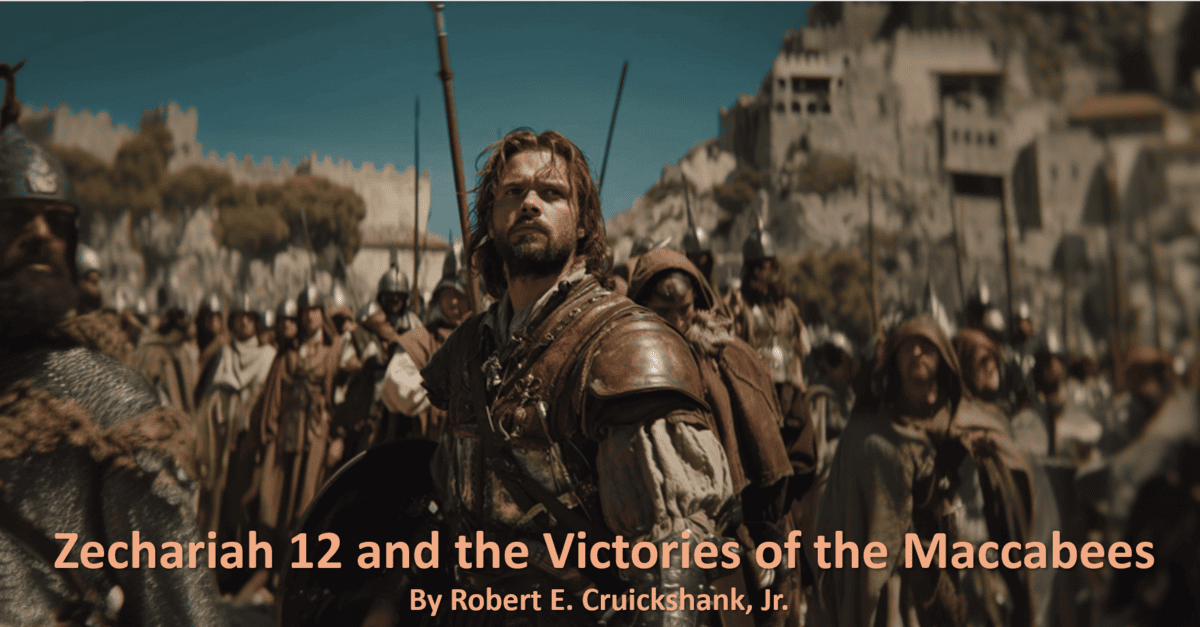
Zechariah 12 is another prophecy that was fulfilled during the Maccabees. Those books should have been included in the protestant canon.

 
Zechariah 12 is another prophecy that was fulfilled during the Maccabees. Those books should have been included in the protestant canon.

I have not read Maccabees. Can you please tell me what prophecy in Zechariah 12 was fulfilled? Thanks.
